
LiuGong ZL50CN ZL50CNL Wheel Loader Operation and Maintenance Manual – PDF Download
Original price was: $39.95.$24.95Current price is: $24.95.
Complete LiuGong ZL50CN / ZL50CNL wheel loader operation and maintenance manual (document 202302005, February 7 2023) covering GCIC 6LT9.3 engine, BS307E gearbox, LiuGong dry axle, hydraulics, brakes, electrical, troubleshooting and full maintenance intervals.
Description
LiuGong ZL50CN / ZL50CNL Wheel Loader – Operation and Maintenance Manual
This is the full operation and maintenance manual for the LiuGong ZL50CN and ZL50CNL wheel loaders, issued under document number 202302005 and dated February 7, 2023. The configuration covered is the GCIC Power China II build with the BS307E gearbox and LiuGong dry axle. Everything a working operator or workshop technician needs to run, service and diagnose these loaders is contained in a single, searchable-by-chapter document that runs from daily checks through to complete system troubleshooting.
File Details
- Manual type: Operation and Maintenance Manual (combined operation manual, maintenance manual and troubleshooting guide)
- Brand: LiuGong (Guangxi LiuGong Machinery Co., Ltd.)
- Models covered: ZL50CN (standard machine), ZL50CN (narrow body machine), ZL50CNL (high dump boom)
- Document number: 202302005
- Publication date: February 7, 2023
- Language: English
- Page count: 234 pages
- File format: PDF
- Configuration: GCIC Power China II / LiuGong dry axle / BS307E gearbox
Chapters Covered
- Important Safety Information
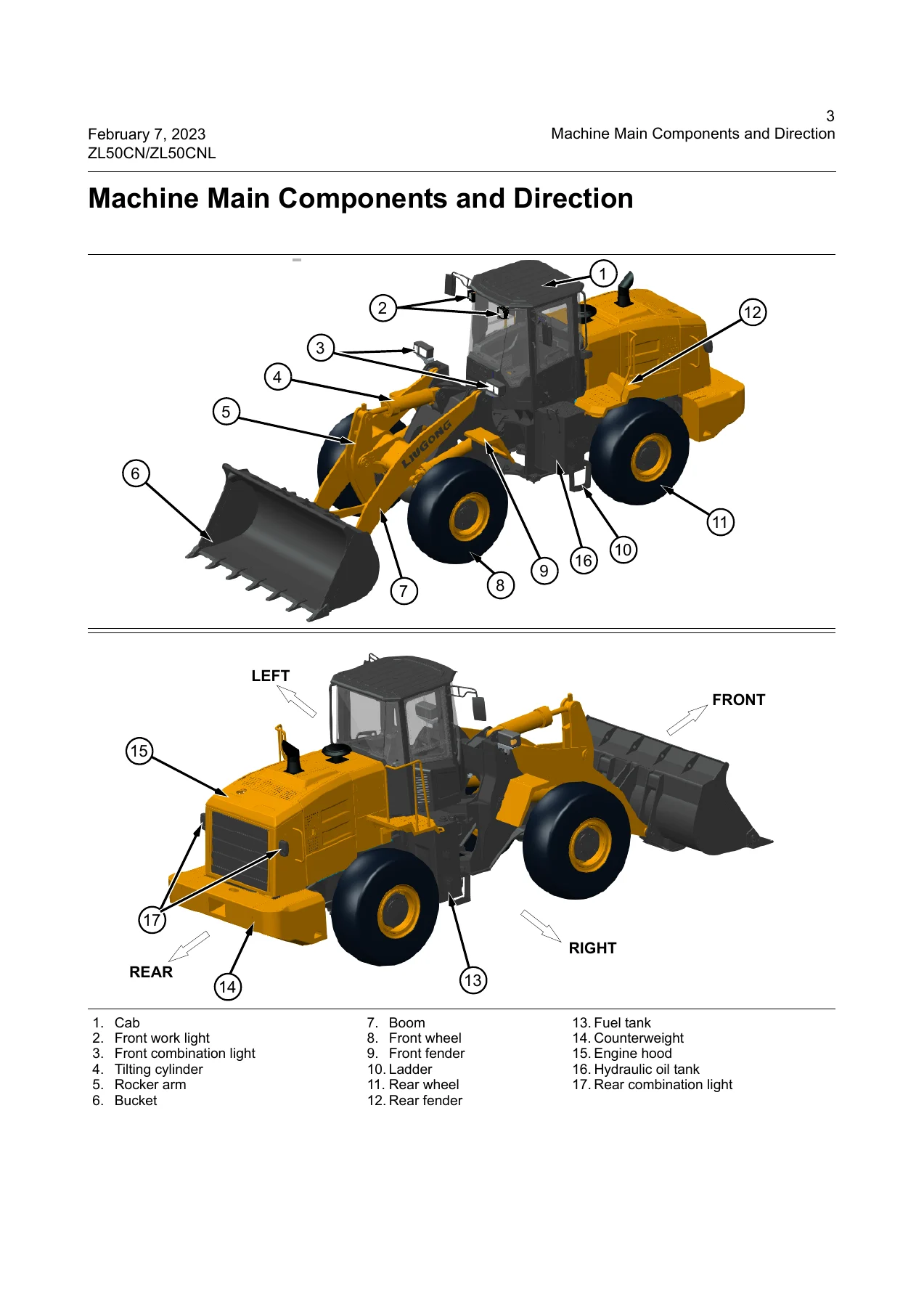
- Machine Main Components and Direction
- PIN Nameplate – Product Identification Number (PIN), Machine Nameplate, Engine Nameplate, Machine and Component Serial Numbers
- Safety Information – Safety Decals and Decal Locations, General Safety Considerations, Accumulators, Compressed Air and Water, Trapped Pressure, High-pressure Fluid, Safe Disposal of Waste Liquids, Burn Prevention, Fire & Explosion Prevention, Ether, Lines/Tubes/Hoses, Fire Extinguishers and First-Aid Kit, Electrical Storm Injury Prevention, Cab Protective Structures, Operator Station, Emergency Hammer, Emergency Exit, Clean Cab Glass, Tire Information, Attachments and Options, Crushing and Cutting Prevention, Steering Frame Lock, Cold Area Cautions
- Noise Information and Vibration Level
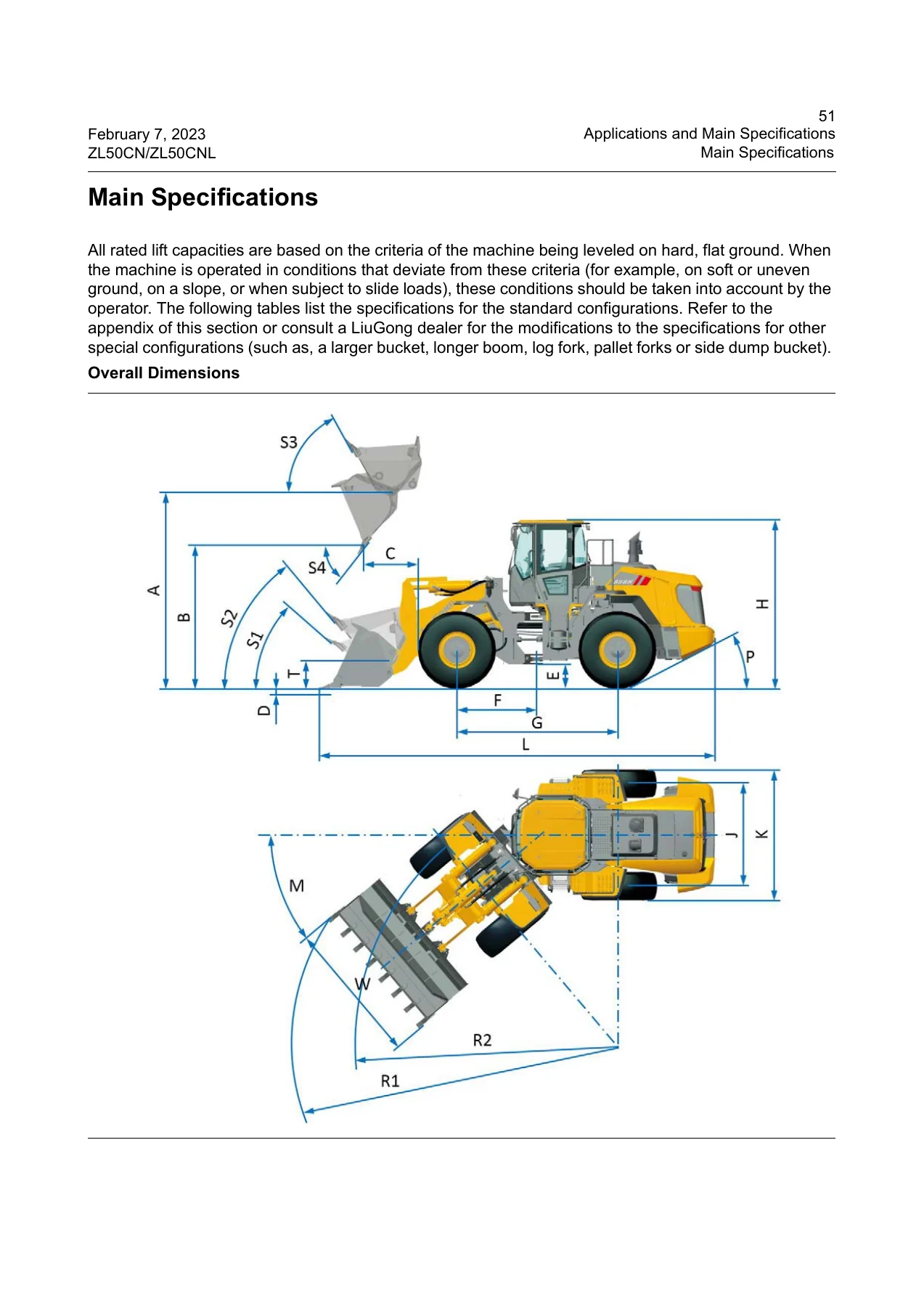
- Applications and Main Specifications – Overall Dimensions, Machine Specifications, Main Components Specifications
- Operation Manual – Before Operation, Daily Inspection, Operator Controls and Instrument Panels, Engine Starting, Operation Techniques, Transportation Information
- Maintenance Manual – Maintenance Guidance, Break-in, Maintenance Interval Schedule, General Torque Specifications, Tire Inflation Information, Fluids and Lubricants, Important Maintenance Procedures
- Troubleshooting – Appendix 1 Powertrain System, Appendix 2 Work Hydraulic System, Appendix 3 Steering Hydraulic System, Appendix 4 Brake System, Appendix 5 Electrical System
- Index
The scope is unusually broad for a single document. The safety section alone runs from decal locations through accumulator handling and high-pressure fluid injury prevention, and it is followed by a full operator training block covering the battery disconnect switch, engine start switch, central instrument panel, front switch panel, steering column switches, A/C panel, work implement control levers (pilot single lever, mechanical double lever and mechanical triple lever variants), pilot cut-off lever, seat adjustment and the sliding windows. From there the manual moves into machine operation: shoveling, combination shoveling, excavating with the bucket, scraping, shoving, V-type and shuttle loading methods, side dump operation, dumping into trucks and hoppers, downhill operation, cold weather operation, parking, storage and transportation.
The maintenance half of the book is where the real workshop value sits. It opens with a break-in schedule for a new machine, then a complete maintenance interval schedule grouped from “as required” through every 10, 50, 100, 250, 500, 1000, 1500 and 2000 hours, with the first 50, first 100, first 250, first 500, first 1500 and first 2500 hour checkpoints listed separately. Detailed procedures follow for coolant level check, coolant add and change, coolant filter replacement, air filter service indicator, air filter element replacement, oil-bath air filter maintenance, fuel add, fuel tank cleaning, fuel strainer cleaning, water and impurity removal, fuel primary and fine filter replacement, engine oil level, engine oil change, engine oil filter replacement, radiator group cleaning, engine belt and tensioner checks, transmission oil level, transmission and torque converter oil change, transmission oil filter replacement, breather cleaning, axle oil level and axle oil change, hydraulic system pressure release, accumulator precharge check, hydraulic oil level, hydraulic oil add and change, hydraulic oil tank strainer cleaning, return oil filter replacement, pilot filter replacement, service brake and parking brake inspection, parking brake clearance adjustment, booster oil level, air reservoir drain valve, clamp air bleeding, manual lubrication system with the complete lubrication diagram, battery check/install/charge/store/recycle, fuse box layouts with fuse ratings, alternator and starter motor maintenance, refrigerant level, compressor belt tension, evaporator, condenser, cab air filters, bucket blade, bucket teeth, bucket positioner and boom lift kickout adjustment.
Each troubleshooting appendix is written as a symptom-cause-correction table, so a fault such as low shift pressure in each gear, high torque converter oil temperature, hard steering, slow left and right turns, poor foot brake force, slow brake air pressure rise, alternator failure, battery not charging or engine failing to start can be traced to a specific component and a specific action rather than guessed at.
What This Manual Lets You Do
Because the ZL50CN and ZL50CNL share this book, owners of either machine — including the narrow body variant and the high dump boom configuration — can carry out scheduled servicing, diagnose faults and complete repairs without a separate publication for each build. The maintenance interval schedule converts directly into a workshop planner: you can build a service checklist around the 10-hour, 50-hour, 250-hour, 500-hour, 1000-hour, 1500-hour and 2000-hour groups exactly as LiuGong specifies them, and the first-hour break-in checkpoints tell you what has to be inspected after the initial 8, 50, 100, 250 and 500 hours of a new or rebuilt machine.
The specification chapter gives you the dimensions, rated load, operating mass, bucket capacity, breakout force, tipping loads, boom lifting time, dump time, travel speeds and traction force for all three machine variants in one table, so you can confirm whether a particular machine is the standard, narrow body or high dump boom build and what its working limits actually are. The main components tables list the engine, transmission, drive axle, tire and hydraulic system details per variant, which removes the guesswork when ordering parts or comparing a machine against its rated configuration.
On the repair side, the torque specification tables (metric and imperial) and the fluid capacity and specification charts let you refill and reassemble to the correct values instead of estimating. The lubrication diagram identifies every grease point on the machine, including the bucket pivot pins, linkage and rocker arm pins, cylinder rod ends, boom pivots, steering cylinder pivots, hinge pins, drive shafts and rear axle swing frames, with the 10-hour and 50-hour intervals marked.
The troubleshooting appendices are the part most owners reach for first. Instead of replacing parts at random, you get a structured path: for a transmission that will not move, check the cut-off valve rod, the gear engagement, the pressure regulating valve spring and the main oil passage in order; for a machine that turns on its own without steering input, check the flow amplifying valve rod, the mounting bolts and the end cap bolts before condemning the steering gear.
Why Correct Procedures and Specifications Matter
Wheel loaders of this size work with high-pressure hydraulic systems, pressurised accumulators, air-over-hydraulic brakes and heavy articulated frames. The manual is explicit about the hazards: trapped pressure in hydraulic circuits, hot coolant under pressure, batteries that produce combustible fumes, tyre explosions from overheated or over-inflated tyres, and the crushing risk at the articulation joint. Working without the correct release sequence for hydraulic pressure or the correct accumulator precharge value is how injuries and damaged components happen. Having the exact procedures, the exact torque values and the exact fluid specifications in front of you is the difference between a repair that holds and a repeat failure.
IMAGES PREVIEW
Instant PDF Delivery
The manual is supplied as a PDF and is available immediately after purchase — no shipping, no waiting for a printed book. It can be opened on a laptop, tablet or phone in the workshop, and individual pages or sections can be printed for use at the machine. Keep a copy on the service laptop and another on the office machine so the maintenance schedule and troubleshooting tables are always within reach.

Reviews
There are no reviews yet.