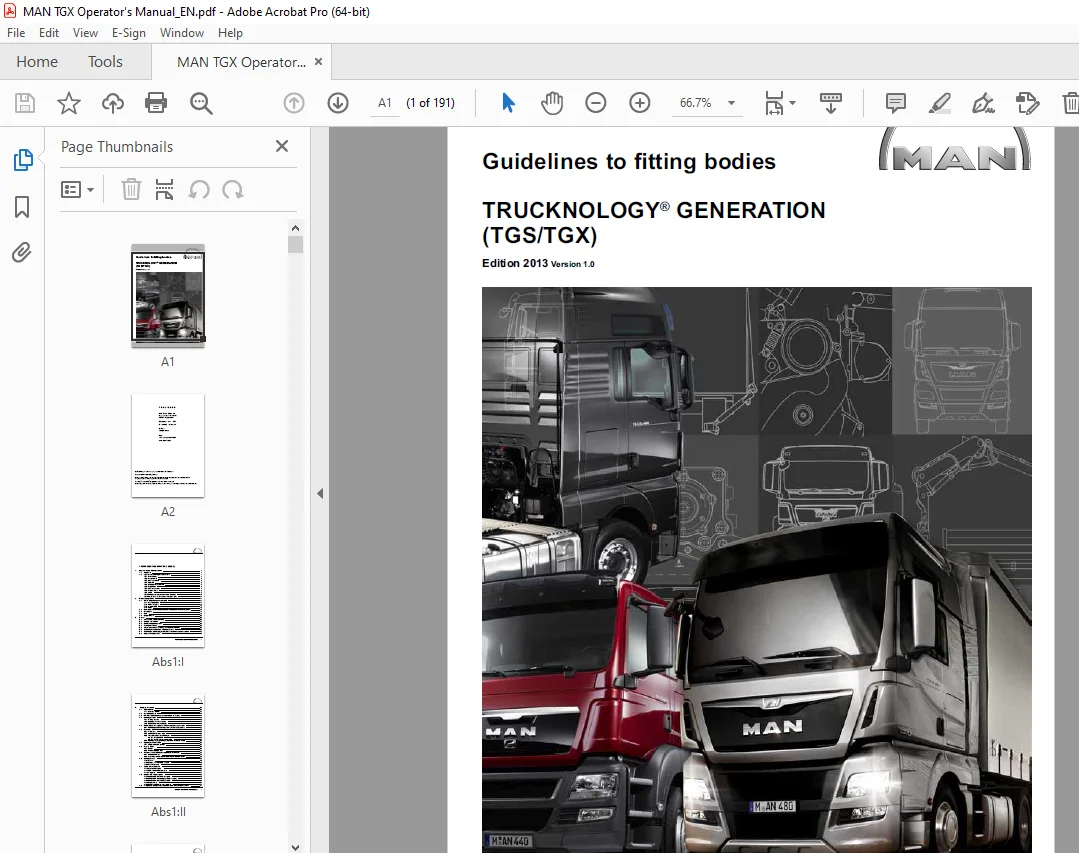
Man Truck TRUCKNOLOGY GENERATION (TGS/TGX) Operator’s Manual PDF
$26.95
Man Truck TRUCKNOLOGY GENERATION (TGS/TGX) Operator’s Manual – PDF DOWNLOAD
Description
Man Truck TRUCKNOLOGY GENERATION (TGS/TGX) Operator’s Manual – PDF DOWNLOAD
FILE DETAILS:
Man Truck TRUCKNOLOGY GENERATION (TGS/TGX) Operator’s Manual – PDF DOWNLOAD
Language : English
Pages : 191
Downloadable : Yes
File Type : PDF
IMAGES PREVIEW OF THE MANUAL:
TABLE OF CONTENTS:
Man Truck TRUCKNOLOGY GENERATION (TGS/TGX) Operator’s Manual – PDF DOWNLOAD
1. Applicability and legal agreements
1.1 Applicability
1.2 Legal agreements and approval procedure
1.2.1 Preconditions
1.2.2 Responsibility
1.2.3 Quality assurance
1.2.4 Approval
1.2.5 Submission of documents
1.2.6 Registration
1.2.7 Liability for defects
1.2.8 Product liability
1.2.9 Safety
1.2.10 Manuals from body and conversion companies
1.2.11 Limitation of liability for accessories/spare parts
2. Product designations
2.1 Vehicle designation and wheel formula
2.1.1 Door designation
2.1.2 Variant descriptor
2.1.3 Wheel formula
2.1.4 Suffi x
2.2 Model number, vehicle identifi cation number, vehicle number, basic vehicle number
2.3 Use of logos
2.4 Cabs
2.5 Engine variants
3. General
3.1 Axle overload, one-sided loading
3.2 Minimum front axle load
3.3 Wheels, rolling circumference
3.4 Permissible overhang
3.5 Theoretical wheelbase, overhang, theoretical axle centreline
3.6 Calculating the axle load and weighing procedure
3.7 Checking and adjustment procedures before and after body has been fitted
3.8 Notes on MAN Hydrodrive®
4. Modifying the chassis
4.1 Frame material
4.1.1 Subframe material
4.2 Corrosion protection
4.3 Drill holes, riveted joints and screw connections on the frame
4.4 Modifying the frame
4.4.1 Welding the frame
4.4.2 Modifying the frame overhang
4.4.3 Modifi cations to the wheelbase
4.5 Retrofi tting additional equipment add-on components or accessories
4.5.1 Retrofi tting additional or larger fuel tanks after factory delivery
4.6 Propshafts
4.6.1 Single joint
4.6.2 Jointed shaft with two joints
4.6.3 Three-dimensional propshaft layout
4.6.3.1 Propshaft train
4.6.3.2 Forces in the propshaft system
4.6.4 Modifying the propshaft layout in the driveline of MAN chassis
4.7 Modifying the wheel formula
4.7.1 Safety-related components
4.8 Coupling devices
4.8.1 Basics
4.8.2 Trailer coupling, D value
4.9 Tractor units and converting the vehicle type – truck / tractor
4.9.1 Articulated vehicles
4.9.2 Converting trucks into tractor units or tractor units into trucks
4.10 Modifying the cab
4.10.1 General
4.10.2 Spoilers, roof extensions, roofwalk
4.10.3 Roof sleeper cabs
4.11 Add-on frame components
4.11.1 Rear underride guard
4.11.2 FUP – front underride protection
4.11.3 Sideguards
4.12 Modifi cations to engine systems
4.12.1 Modifi cations to the air intake system
4.12.2 Modifications to exhaust gas routing for engines
4.12.3 Modifi cations to the AdBlue® system
4.12.4 Engine cooling
4.12.5 Engine encapsulation, noise insulation
4.13 Fitting other manual gearboxes, automatic transmissions and transfer boxes
5. Bodies
5.1 General
5.1.1 Machinery Directive
5.1.2 CE marking
5.1.3 Affi xing the hazardous goods marker board to the front panel
5.2 Corrosion protection
5.3 Subframes
5.3.1 General
5.3.2 Permissible materials, yield points
5.3.3 Subframe design
5.3.4 Attaching subframes and bodies
5.3.5 Screw connections and riveted joints
5.3.6 Flexible connection
5.3.7 Rigid connection
5.4 Bodies
5.4.1 Testing of bodies
5.4.2 Platform and box bodies
5.4.3 Tail-lifts
5.4.4 Interchangeable containers
5.4.5 Self-supporting bodies without subframe
5.4.6 Single-pivot body
5.4.7 Tank and container bodies
5.4.8 Tippers
5.4.9 Set-down, sliding set-down and sliding roll-off tippers
5.4.10 Propping air-sprung vehicles
5.4.11 Loading cranes
5.4.12 Cable winches
5.4.13 Transport mixers
5.4.14 Car transporter
TRUCKNOLOGY® GENERATION (TGS/TGX) IV
6. Electrics, electronics, wiring
6.1 General
6.2 Routing cables, earth cable
6.3 Handling batteries
6.3.1 Handling and maintaining the batteries
6.3.2 Handling and maintaining batteries with PAG technology
6.4 Additional wiring diagrams and wiring harness drawings
6.5 Fuses, additional power consumers
6.6 Lighting installations
6.7 Electromagnetic compatibility
6.8 Radio equipment and aerials
6.9 Interfaces on the vehicle, preparations for the body
6.9.1 Electrical connections for tail-lifts
6.9.2 Engine start-stop system
6.9.3 Tapping into the speed signal
6.9.4 Tapping into the reverse gear signal
6.10 Electronics
6.10.1 Display and instrumentation concept
6.10.2 Diagnostics concept and parameterisation using MAN-cats®
6.10.3 Parameterisation of the vehicle electronics
6.10.4 ESP yaw rate sensor
6.10.5 Emergency Brake Assist
7. Power take-off (See separate booklet)
8. Brakes, lines
8.1 ALB, EBS braking system
8.2 Brake and compressed air lines
8.2.1 Basic principles
8.2.2 Voss 232 system plug connectors
8.2.3 Installing and attaching lines
8.2.4 Compressed air loss
8.3 Connecting additional air consumers
8.4 Retrofi tting continuous brakes not manufactured by MAN
9. Calculations
9.1 Speed
9.2 Effi ciency
9.3 Tractive force
9.4 Gradeability
9.4.1 Distance travelled on uphill or downhill gradients
9.4.2 Angle of uphill or downhill gradient
9.4.3 Calculating the gradeability
9.5 Torque
9.6 Power output
9.7 Rotational speeds for power take-offs at the transfer case
9.8 Driving resistances
9.9 Turning circle
9.10 Axle load calculation
9.10.1 Performing an axle load calculation
9.10.2 Calculation of weight with trailing axle lifted
9.11 Support length for bodies without subframes
9.12 Coupling devices
9.12.1 Trailer coupling
9.12.2 Rigid drawbar trailers / central axle trailers
9.12.3 Fifth-wheel coupling
DESCRIPTION:
Man Truck TRUCKNOLOGY GENERATION (TGS/TGX) Operator’s Manual – PDF DOWNLOAD
Applicability and legal agreements
1.1 Applicability
The statements in this guide are binding. If technically feasible, exceptions will be approved only if a written request has been submitted to MAN, (for address see “Publisher“ above).
1.2 Legal agreements and approval procedure
1.2.1 Preconditions
In addition to this Guide, the company carrying out the work must observe all
• laws and decrees
• accident prevention regulations
• operating instructions
relating to the operation and construction of the vehicle. Standards are technical standards; they are therefore minimum requirements.
- Anyone who does not endeavour to observe these minimum requirements is regarded as operating negligently.
Standards are binding when they form part of regulations. - Information given by MAN in reply to telephone enquiries is not binding unless confi rmed in writing. Enquiries are to be directed to the relevant MAN department. Information refers to conditions of use that are usual within Europe. Dimensions, weights and other basic data that differ from these must be taken into consideration when designing the body, mounting the body and designing the subframe. The company carrying out the work must ensure that the entire vehicle can withstand the conditions of use that it is expected to experience.
S.V 23/02/2025