
Mazda CX-5 KE Technical Guide and Wiring Diagrams SKYACTIV-G 2.0 SKYACTIV-D 2.2
Original price was: $42.95.$26.95Current price is: $26.95.
1910-page Mazda CX-5 KE technical guide covering SKYACTIV-G 2.0 and SKYACTIV-D 2.2 systems, on-board diagnostics, specifications, and wiring schematics for Australian and General R.H.D. vehicles.
Description
Mazda CX-5 KE Technical Guide and Wiring Diagrams SKYACTIV-G 2.0 SKYACTIV-D 2.2
This Mazda CX-5 KE Technical Guide and Wiring Diagrams SKYACTIV-G 2.0 SKYACTIV-D 2.2 file is the 2012 technical guide for the KE-series Mazda CX-5. The opening application note states that the book applies to vehicles beginning with the VIN prefixes printed in General Information:
JM0 KE102100 100001—,
JM0 KE107100 100001—, and
JM6 KE1071*0# 100001—. World manufacturer codes distinguish Australian specs (JM0) from General right-hand-drive specs (JM6). Engine digits in the VIN decode as 2 for the 2.2 L SKYACTIV-D 2.2 Hi diesel and 7 for the 2.0 L SKYACTIV-G 2.0 gasoline engine. The foreword explains that the volume incorporates wiring schematics for the CX-5 and available optional equipment, and that actual vehicle wiring may vary slightly with options or local specifications.
File Details
- Manual type: Technical Guide and Wiring Diagrams
- Brand / model: Mazda CX-5 (KE carline)
- Engines: SKYACTIV-G 2.0 gasoline; SKYACTIV-D 2.2 diesel
- Language: English
- Page count: 1910
- File format: PDF
- Publication marking: ©2012 Ford Motor Company of Southern Africa (FMCSA)
What This Technical Guide Is For
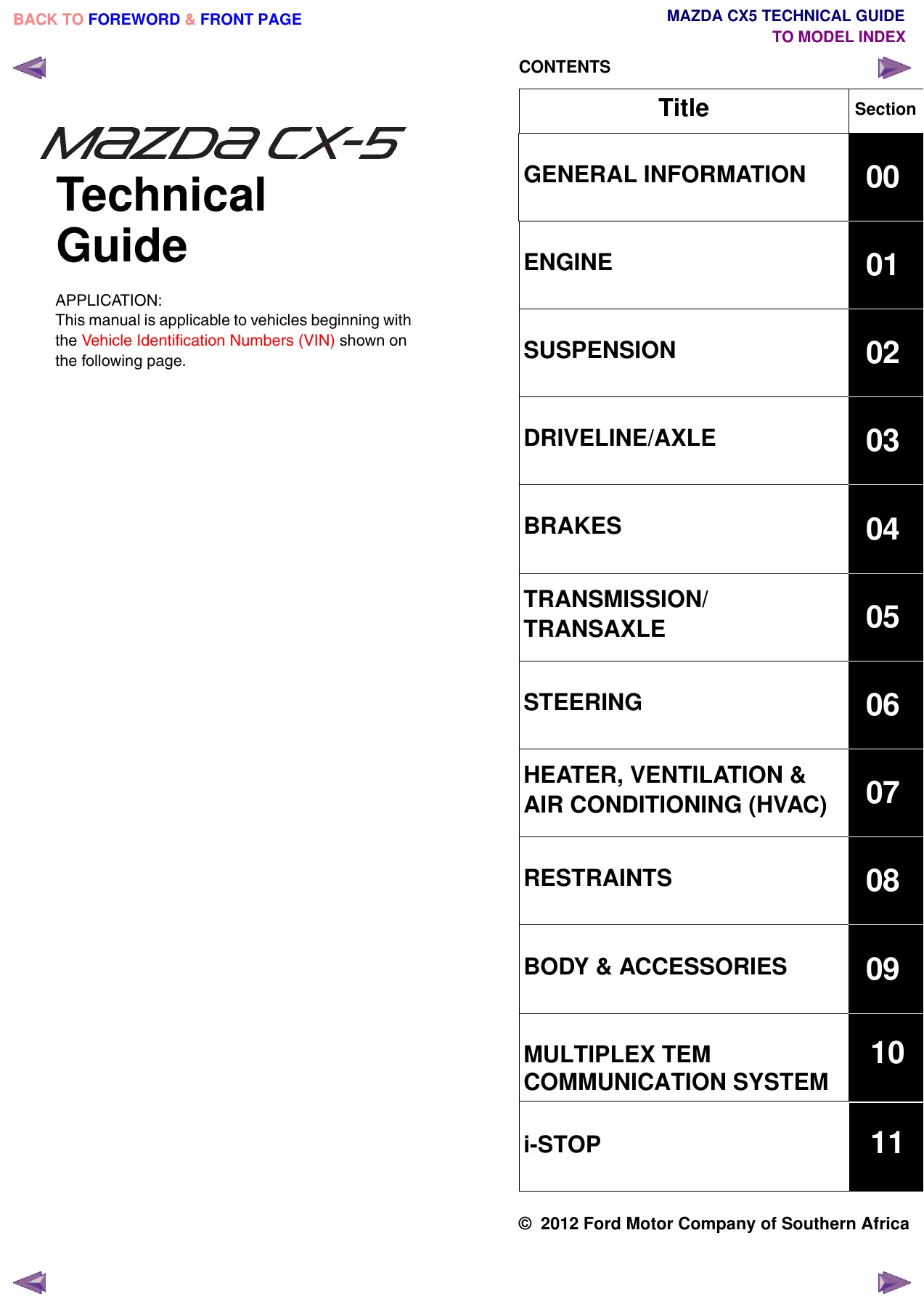
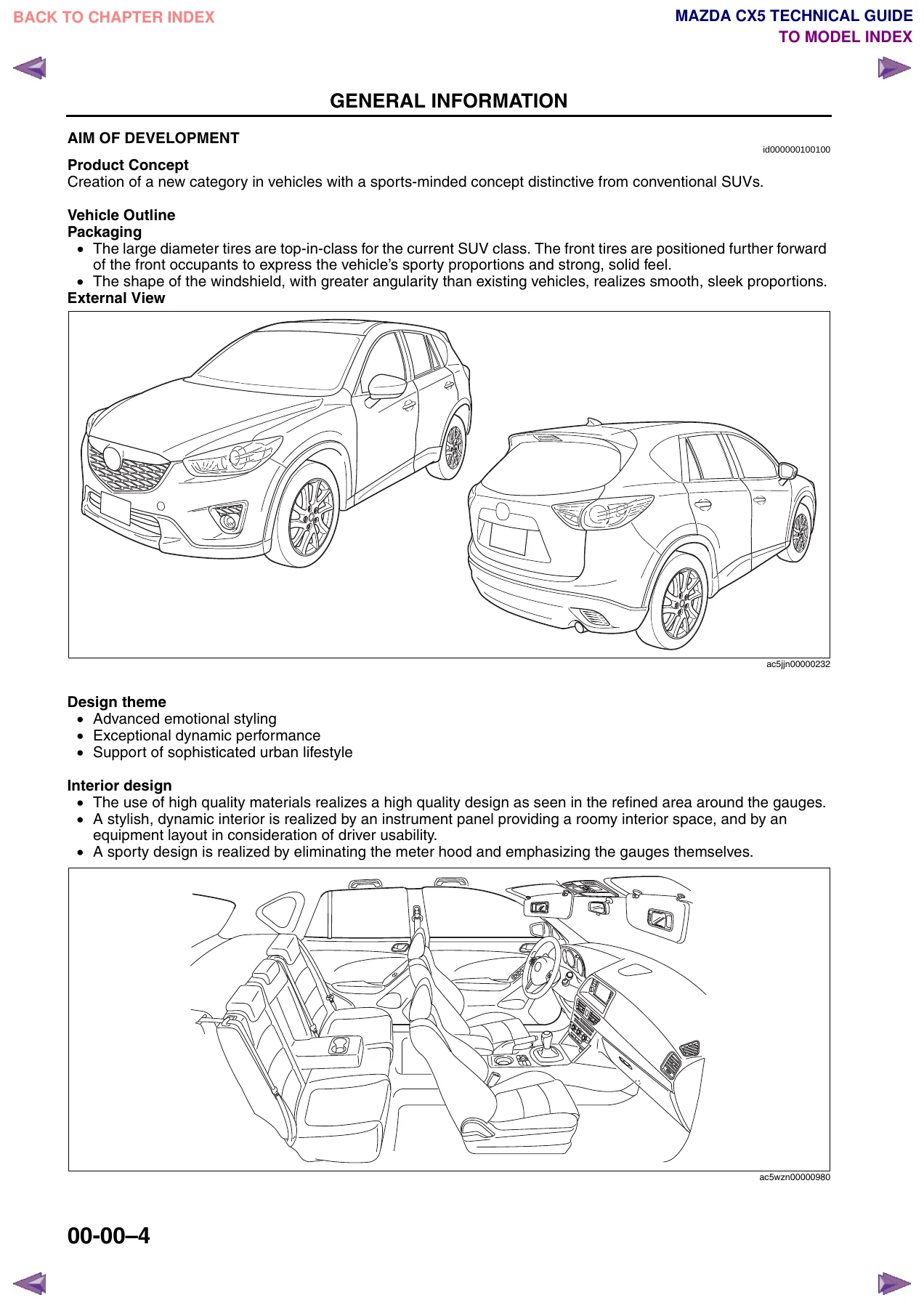
Unlike a thin owner booklet, the Mazda CX-5 KE Technical Guide and Wiring Diagrams SKYACTIV-G 2.0 SKYACTIV-D 2.2 is written for technicians who need construction, operation, control logic, specification tables, on-board diagnostic behavior, and system wiring in one place. Section 00 records VIN structure, development aims, SI-to-conventional unit conversion rules, and the abbreviation list used throughout the book. Later sections walk each major system from outline and structural views through sensors, actuators, fail-safe actions, and M-MDS PID / snapshot data.
Gasoline coverage is built around the SKYACTIV-G 2.0 in-line four: pentroof chamber, DOHC 16-valve timing-chain valvetrain, displacement 1,998 ml, bore × stroke 83.5 × 91.2 mm, compression ratio 14.0:1 on European L.H.D. U.K. specs and 13.0:1 on other listed specs. Diesel coverage is the SKYACTIV-D 2.2: direct-injection four-cylinder, displacement 2,191 ml, bore × stroke 86.0 × 94.3 mm, compression ratio 14.0:1, two-step turbo charging, variable valve lift for cold-start stability, piezo common-rail injectors, glow system, EGR with cooler bypass, and a diesel particulate filter. Both engines carry i-stop idle-stop control where equipped, plus DC-DC converter support for cabin voltage during restart.
IMAGES PREVIEW
Chapters Covered
- 00 General Information — VIN code and VIN ranges; product concept and vehicle outline; units and conversion rules; new standards comparison; abbreviations
- 01-00 Engine outline — special features and specification tables for SKYACTIV-G 2.0 and SKYACTIV-D 2.2
- 01-02 On-board diagnostic [SKYACTIV-G 2.0] — OBD test modes, DTC detection logic, KOEO/KOER, PID/data monitor, active command modes, check engine light
- 01-10A / 01-10B Mechanical — cylinder head and block, crankshaft, pistons, timing chain, HLA/rocker arms, variable valve timing (electric intake / hydraulic exhaust on G 2.0), variable valve lift (D 2.2), engine mounts, OCV
- 01-11A / 01-11B Lubrication — oil filter, cooler, pan, strainer, trochoid pump, jet valves, oil solenoid valve, oil shower pipe
- 01-12A / 01-12B Cooling — radiator, cap, thermostat, water pump, cooling fan component and relays, fan control module (D 2.2)
- 01-13A / 01-13B Intake-air — ducts, resonance chamber, air cleaner, throttle body (G 2.0), vacuum pump, intake manifold, glow system, two-stage turbocharger, charge air cooler
- 01-14A / 01-14B Fuel — returnless and direct injection (G 2.0); common-rail supply pump, suction control valve, piezo injectors, sedimentor and fuel warmer (D 2.2)
- 01-15A / 01-15B Exhaust — 4-2-1 layout and silencers (G 2.0); diesel exhaust path and catalytic converter (D 2.2)
- 01-16A / 01-16B Emission — WU-TWC/TWC, PCV, EVAP purge path (G 2.0); EGR valve/cooler/bypass, DPF, intake shutter valve (D 2.2)
- 01-17A / 01-17B Charging — battery, generator, charging warning light, DC-DC converter
- 01-18 Ignition [SKYACTIV-G 2.0] — direct ignition coils, spark plugs PE01-18-110 / PE02-18-110, firing order 1-3-4-2
- 01-19A / 01-19B Starting — coaxial-reduction starter, starter relay, starter interlock switch (MTX)
- 01-20A / 01-20B Cruise control — set/main indicator logic for both engines
- 01-40 Control system [SKYACTIV-G 2.0] — PCM functions, drive-by-wire, VVT, fuel and spark, purge, fan, i-stop, engine oil pressure switching, sensors
- 02 Suspension — specifications, TPMS, strut front suspension, E-type multi-link rear, 2WD and 4WD layouts
- 03 Driveline / axle — front and rear axle specifications for both engines, 4WD coupling content
- 04 Brakes — conventional hydraulic layout, vacuum pump, ventilated front / solid rear discs, DSC HU/CM, electrical brake assist, SCBS laser sensor content, wheel-speed sensors
- 05 Transmission / transaxle — clutch and 6-speed manual C66M-R / C66MX-R (G 2.0) and D66M-R / D66MX-R (D 2.2); automatic FW6A-EL / FW6AX-EL and GW6A-EL / GW6AX-EL; shift mechanisms; ATX OBD
- 06 Steering — column-assist EPS, torque sensor and motor, steering angle learning, power steering malfunction indicator
- 07 HVAC — full-auto and manual air conditioner control, system wiring, actuators, i-stop related A/C inhibit logic
- 08 Restraints — SAS control module, air bag system wiring, curtain and side air bags, pretensioners
- 09 Body and accessories — glass/windows/mirrors, seats and seat warmers, security and locks, immobilizer and theft-deterrent, sunroof, lighting including HBC and AFS, wiper/washer, entertainment, power systems and fuses, instrumentation, BSM, RVM, LDWS, parking sensors, FSC
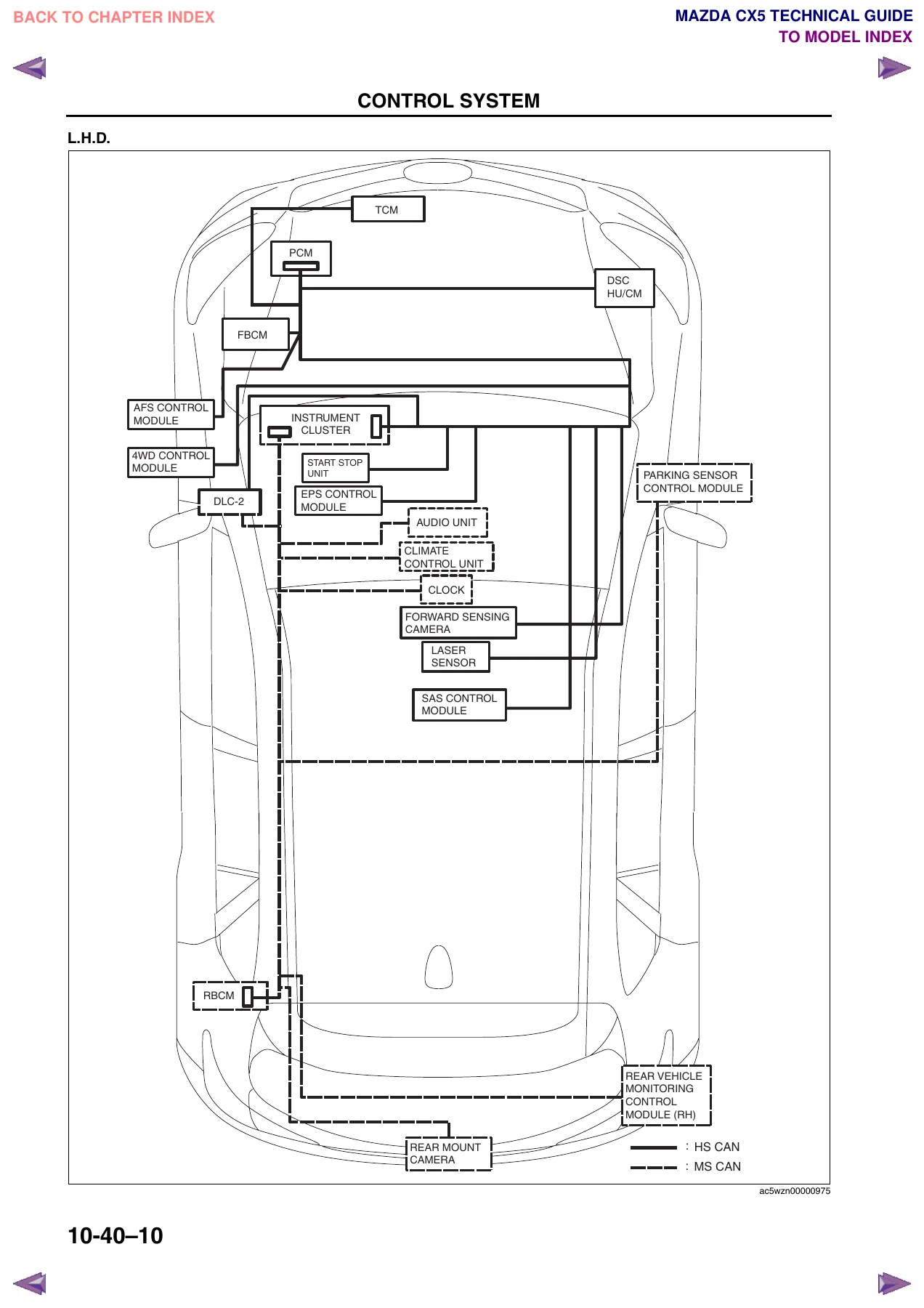
- 10 Multiplex communication system — outline, OBD, HS-CAN / MS-CAN control layout and module communication
- 11 i-STOP — idle-stop related module references and control coordination
Taken together, those divisions give a technician the construction story and the electrical map for the same vehicle. Structural views sit next to system wiring diagrams for cooling fans, starter interlock, DSC, EPS, climate control, air bags, power windows and locks, lighting, washers, audio, and driver-assist modules. The multiplex section then shows how PCM, TCM, DSC HU/CM, EPS, FBCM, RBCM, SAS, climate, audio, AFS, 4WD, parking sensors, and cameras share HS-CAN and MS-CAN paths.
Engines, Driveline, and Chassis Data Inside the Guide
Specification tables in the engine outline are extensive. SKYACTIV-G 2.0 oil capacity is listed as approximately 4.9 L dry without oil cooler and 5.0 L with cooler; oil-and-filter service fill is 4.2 L. Coolant volumes are broken out by market and by ATX versus MTX (for example General R.H.D. ATX 7.4 L, MTX 7.1 L). Fuel tank capacity is 56.0 L on 2WD and 58.0 L on 4WD. Battery is 12 V Q-85 (52 A·h) with a 12-100 generator; starter output is 1.4 kW. Pressure-regulator control pressure is given as approximately 430 kPa.
SKYACTIV-D 2.2 tables list dry oil capacity 6.0 L, oil-and-filter fill 5.1 L, coolant about 8.9–9.2 L depending on European versus other specs, T-110 (64 A·h) battery, 12-150 generator, and a 1.8 kW starter. Fuel type is printed as EN590 or equivalent. Compression pressure is 2,255 kPa at 180 rpm. Cooling-fan motor output is 240 W on the diesel versus 80 W on the gasoline engine.
Chassis pages continue that same density. Front suspension is a strut type on a 6-point rigid-mount crossmember; rear is an E-type multi-link, drawn separately for 2WD and 4WD. Standard tire size printed in the outline is 225/65R17 102V, with a temporary spare 185/80R17 95M. Brake content describes an intrusion-minimizing pedal, small-diameter long-stroke master cylinder, vacuum pump, large ventilated front discs and solid rear discs, plus the integrated DSC HU/CM that receives lateral-G and yaw data from the SAS module over CAN instead of a standalone combined sensor. Steering is column-assist EPS on all models described, with vehicle-speed-responsive assist and no hydraulic pump.
Transaxle coverage names the hardware rather than speaking in generalities: six-speed manuals C66M-R / C66MX-R with the gasoline engine and D66M-R / D66MX-R with the diesel; six-speed automatics FW6A-EL / FW6AX-EL (gasoline) and GW6A-EL / GW6AX-EL (diesel). Gear-ratio tables, clutch specifications, ATF notes, and torque-converter stall ratio (diesel automatic stall torque ratio printed as 1.88) sit in the transmission outline.
Diagnostics, Wiring, and Driver-Support Systems
On-board diagnostic chapters are a large share of the Mazda CX-5 KE Technical Guide and Wiring Diagrams SKYACTIV-G 2.0 SKYACTIV-D 2.2. For the gasoline PCM they include Mode 01–07 style test descriptions, freeze-frame and snapshot item lists, DTC-to-check-engine-light mapping, detection conditions, fail-safe actions, and simulation items used with the Mazda Modular Diagnostic System (M-MDS). Parallel OBD material appears for automatic transaxles, DSC, EPS, restraints, security, lighting, entertainment, and multiplex communication, including U-code communication errors such as a forward-sensing-camera fault.
Wiring is not a separate afterthought. The foreword presents the book as a wiring-diagram volume as well as a technical guide, and system chapters repeatedly include labeled schematics: cooling-fan electrical system, starter interlock, TPMS, DSC, EPS, full-auto and manual A/C, air bag SAS, power windows and mirrors, seat heaters, door locks and advanced keyless entry, immobilizer, theft-deterrent, sunroof, combination lights, auto-leveling and swivel actuators, high-beam control, washers, audio, power distribution, instrument cluster, BSM, parking sensors, and LDWS / FSC. Power-system pages list fuse and relay ratings that differ between SKYACTIV-G 2.0 and SKYACTIV-D 2.2, including an 80 A GLOW fuse on the diesel.
Driver-support hardware documented in General Information and later body sections includes rear vehicle monitoring, blind-spot monitoring, emergency stop signal (ESS), high-beam control, lane departure warning, and smart city brake support with a windshield-mounted laser sensor (printed maximum average power 45 mW, pulse duration 33 ns, wavelength 905 nm). Restraints coverage lists curtain air bags over front and rear side glass, front side air bags, pretensioner and load-limiter belts, an energy-absorbing steering shaft, ISOFIX and top-tether anchors, and the immobilizer that compares the key chip code with the code stored in the vehicle.
How to Use the Guide on a KE CX-5
Start in Section 00 and confirm the VIN engine digit and market prefix before opening an engine-lettered chapter. Gasoline procedures and tables live under the A-suffixed 01-xxA numbers; diesel content uses B suffixes. When a control explanation points to another section—i-stop to 01-40, A/C cut-off to climate control, CAN routing to Section 10—follow the printed cross-reference rather than assuming a single module owns the fault. After a module replacement the text repeatedly describes automatic configuration: the instrument cluster transmits vehicle specification data on CAN so DSC HU/CM, EPS, AFS, and climate control can load the correct variant. That matters on a platform that mixes 2WD/4WD, MTX/ATX, i-stop, and optional cameras.
Read the specification footnotes. Coolant, oil, fuel octane, and refrigerant quantities change by market line (European L.H.D., U.K., General R.H.D., Israel, China, Saudi, Australia). HVAC pages list both HFO-1234yf and HFC-134a charge windows and compressor displacement that differs between SKYACTIV-G 2.0 (135 ml) and SKYACTIV-D 2.2 (160 ml). Treating one printed number as universal will put you off the chart the book itself provides.
Get the Procedures, Specs, and Schematics You Need
The Mazda CX-5 KE Technical Guide and Wiring Diagrams SKYACTIV-G 2.0 SKYACTIV-D 2.2 supports diagnosis and system-level repair work on the KE CX-5: PCM and TCM code interpretation, i-stop permit-condition checks, variable valve timing and lift operation, common-rail and direct-injection fuel paths, two-stage boost and DPF/EGR behavior, DSC and EPS faults, climate and body-control configuration, immobilizer and lighting circuits, and multiplex communication tracing. Using the printed detection conditions, fail-safe tables, capacities, and wiring views keeps sensor substitutions, oil-pressure solenoid work, and module replacements aligned with the control strategy written for this carline.
Download is instant after payment. You receive the PDF for use on any device, with no shipping wait, and you can print the pages you need in the bay. Keep the file with the VIN decoder in Section 00 so the next SKYACTIV-G 2.0 or SKYACTIV-D 2.2 job starts from the correct chapter set.
Reviews
There are no reviews yet.