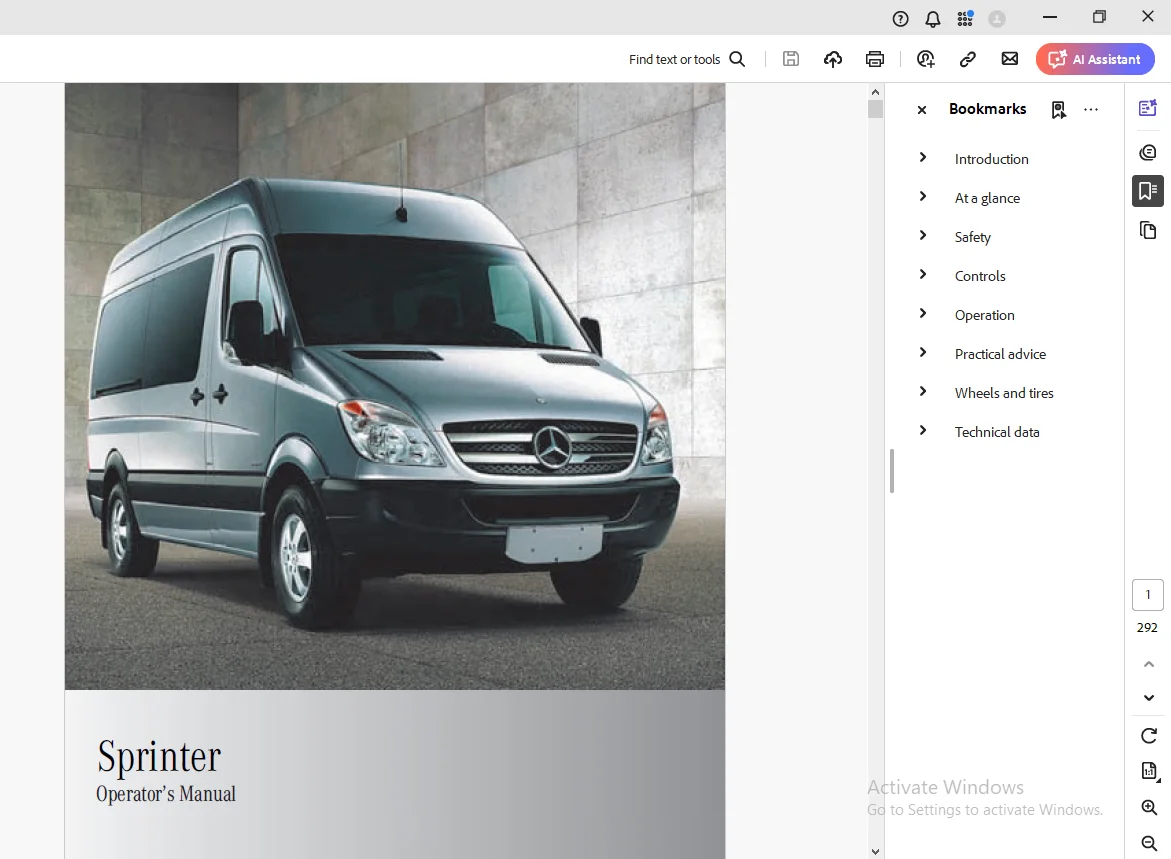
Mercedes-Benz 2010 Sprinter Operators Manual – PDF
$28.95
Mercedes-Benz 2010 Sprinter Operators Manual – PDF DWONLOAD
Description
Mercedes-Benz 2010 Sprinter Operators Manual – PDF DWONLOAD
FILE DETAILS:
Mercedes-Benz 2010 Sprinter Operators Manual – PDF DWONLOAD
Language : English, German
Pages : 292
Downloadable : Yes
File Type : PDF
IMAGES PREVIEW OF THE MANUAL:
TABLE OF CONTENTS:
Mercedes-Benz 2010 Sprinter Operators Manual – PDF DWONLOAD
Introduction 18
Vehicle equipment 18
Environmental protection 18
Environmental concerns and recommendations 18
Operating Safety 18
Safety notes 18
Service and warranty information 19
Registering your vehicle 19
Digital speedometer and total distance recorder 19
Modifying the engine power output 20
Diesel particle filter 20
Vehicle alterations 20
Correct use 21
Problems with your vehicle 22
Reporting safety defects 22
Information regarding electronic recording devices 22
At a glance 24
Cockpit 24
Cockpit 24
Instrument cluster variants 26
Steering wheel with buttons 28
Center console 28
Switch units 29
Center console 29
Roof 29
Driver’s door 30
Additional switch units 30
Safety 34
Vehicle equipment 34
Occupant safety 34
Restraint systems 34
Seat belts 34
SRS (Supplemental Restraint System) 38
Air bags 40
Children in the vehicle 43
Emergency exit 47
Emergency exit window 47
Driving safety systems 49
Important safety notes 49
Overview 49
ABS (Anti-lock Braking System) 49
BAS (Brake Assist System) 50
EBD (Electronic Brake force Distribution) 50
ASR (acceleration skid control) 50
ESP® (Electronic Stability Program) 52
Controls 54
Vehicle equipment 54
Opening and closing 54
Vehicle key 54
Key with remote control 54
Central locking 56
Ignition lock 58
Driver’s door and co-driver’s door 58
Sliding door 58
Rear doors 59
Partition sliding door 61
Opening/closing the windows 62
Anti-theft systems 63
Immobilizer 63
Anti-theft alarm system (ATA) 63
Tow-away alarm 64
Interior motion sensor 64
Seats 65
Driver’s and co-driver’s seat 65
Rear bench seat 68
Folding seat 69
Head restraints 69
Armrests 70
Seat heating 70
Steering wheel 71
Mirrors 71
Rear-view mirror 71
Exterior mirrors 72
Instrument cluster 72
Overview 72
Speedometer 73
Tachometer 73
Fuel gauge 74
Trip odometer 74
Instrument lighting 74
On-board computer without steering wheel buttons 74
Layout and controls 74
Menus 75
On-board computer with steering wheel buttons 76
Layout and controls 76
Menu overview 78
Operation menu 78
Audio menu 79
Message memory menu 80
Settings menu 80
Trip computer menu 87
Telephone menu 88
Power supply 89
Battery isolating switch 89
Lighting 90
General notes 90
Lamp failure indicator 91
Light switch 91
Combination switch 92
Cornering light function (vehicles with Bi-Xenon headlamps) 93
Hazard warning lamps 93
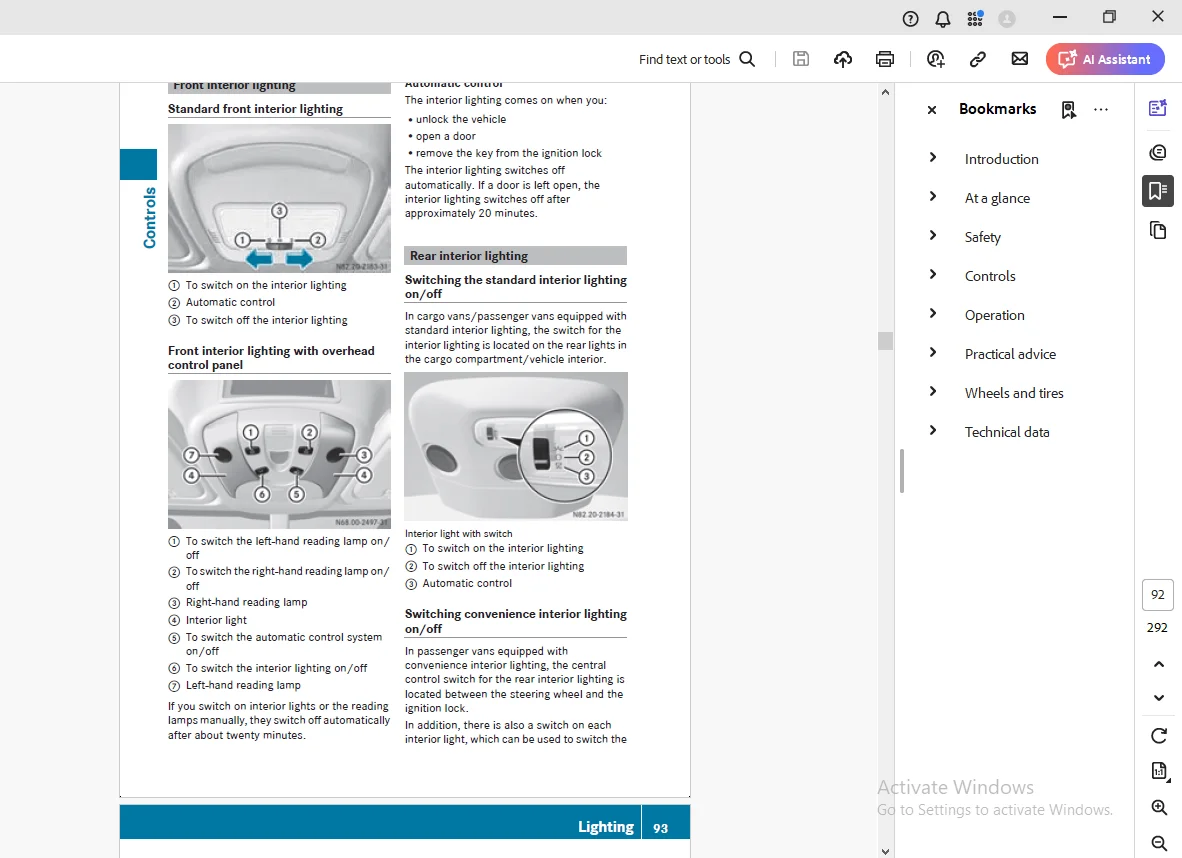
Front interior lighting 94
Rear interior lighting 94
Good visibility 96
Windshield wipers 96
Rear window wiper 96
Windshield washer system 97
Headlamp cleaning system 97
Windshield heater 97
Climate control 99
Overview of climate control systems 99
General notes100
Overview of the functions of the climate control system100
Switching the climate control on/off102
Switching cooling with air dehumidification on/off102
Setting the temperature102
Setting the air vents103
Setting the air distribution104
Setting the airflow104
Defrosting the windows105
Defrosting windows105
Switching air-recirculation mode on/off106
Auxiliary heating106
Driving and parking110
Preparing for a journey110
Before driving off110
Starting the engine111
Driving off112
General driving tips112
Stopping the vehicle and switching off the engine113
Brakes114
Parking brake114
Automatic transmission115
Overview115
Selector lever positions116
Touchshift116
Shift ranges116
Driving tips117
Driving the vehicle118
Exhaust gas aftertreatment118
ADR (working speed governor)119
Driving systems119
Overview119
Cruise control120
PARKTRONIC121
Rear view camera124
Features130
Ashtray130
Cigarette lighter131
Stowage spaces and stowage compartments131
Folding table134
Cup holder134
Socket135
Communications135
Electronic communications equipment135
Telephone136
Operation140
Vehicle equipment140
Driving tips140
Breaking-in140
Driving abroad140
Driving off-road140
Transport by rail142
Fuel consumption142
DEF consumption142
Engine oil consumption143
Speed limiter143
Reverse warning device143
Refueling144
Diesel Exhaust Fluid (DEF)145
Transporting loads with the vehicle146
Loading guidelines146
Load distribution148
Securing loads148
Carrier systems151
Towing a trailer152
Operation in winter155
General notes155
Service products155
Fuel155
Diesel Exhaust Fluid (DEF)157
Engine oils158
Transmission and steering oils160
Brake fluid161
Coolant162
Refrigerant163
Cleaning and care163
General notes163
Cleaning the interior of the vehicle164
Cleaning the exterior of the vehicle164
Power washers166
Automatic car wash166
Cleaning the engine167
Alloy wheels167
After driving off-road or on construction sites167
Maintenance168
General notes168
Active Service System (ASSYST)169
Hood170
Maintenance points under the hood171
Coolant level171
Clutch mechanism and brake system172
Windshield washer system/headlamp cleaning system173
Engine oil level173
Air filter for the rear-compartment air conditioning175
Vehicle assemblies176
Replacing the wiper blades176
Batteries177
Practical advice184
Vehicle equipment184
Where will I find?184
Vehicle tool kit and emergency equipment184
Warning lamp185
Warning triangle185
Wheel chock185
First-aid kit186
Fire extinguisher186
Tire sealant186
Spare wheel187
Troubleshooting189
Indicator and warning lamps in the instrument cluster189
Notes on display messages199
Display messages201
Indicator and warning lamps in switches and buttons213
Warning tones214
Engine214
Automatic transmission216
Driving systems217
Auxiliary heating218
Central locking system219
Headlamps and turn signals221
Windshield wipers221
Fuel and fuel tank222
Engine223
Draining the fuel filter223
Bleeding the fuel system223
Wheels and tires223
General notes223
Preparing the vehicle224
Using tire sealant224
Changing a wheel in the event of a flat tire231
Retightening wheel nuts/wheel bolts235
Electrical system235
Notes on changing bulbs235
Changing bulbs236
Fuses241
Batteries for the remote control247
Notes on changing the batteries247
Key with remote control248
Automatic transmission248
Jump starting, tow-starting and towing away249
Jump-starting249
Tow-starting250
Towing250
Wheels and tires254
Vehicle equipment254
Important safety notes254
Operation255
Notes on driving255
Notes on regularly inspecting wheels and tires255
Tire tread255
Notes on selecting, mounting and replacing tires256
Operation in winter256
Please bear the following in mind256
Driving with summer tires256
M+S tires256
Snow chains257
Tire pressure257
Notes about tire pressure257
Tire pressure too low or too high259
Checking the tire pressure259
Checking the tire pressure manually260
Tire pressure monitor260
Loading the vehicle263
Instruction labels for tires and loads263
Tire and Loading Information placard264
Vehicle identification plate267
Trailer load/noseweight267
Maximum tire load267
Tire labeling268
Overview of tire labeling268
Tire size designation, load-bearing capacity and speed index268
DOT, Tire Identification Number (TIN)270
Tire characteristics270
Definition for tires and loading270
Tire structure and characteristics270
Bar270
DOT (Department of Transportation)271
Average weight of vehicle occupants271
Uniform Tire Quality Grading Standards271
Recommended tire pressure F271
Increased vehicle weight due to optional equipment271
Wheel rim271
GAWR (Gross Axle Weight Rating)271
Speed index271
GVW (Gross Vehicle Weight)271
GVWR (Gross Vehicle Weight Rating)271
Maximum weight of the laden vehicle272
Kilopascal (kPa)272
Unladen weight272
Maximum tire load272
Maximum permissible tire pressure272
Maximum load on one tire272
PSI (Pounds per square inch)272
Aspect ratio272
Tire pressure272
Tire tread272
Tire bead272
Sidewall272
Weight of optional extras272
TIN (Tire Identification Number)273
Load bearing index273
Traction273
Wear indicator273
Distribution of the vehicle occupants273
Maximum permissible payload weight273
Changing wheels273
Flat tire273
Replacing wheels273
Direction of rotation274
Storing wheels275
Cleaning wheels275
Technical data278
Vehicle equipment278
Genuine Sprinter parts278
Vehicle electronics278
Tampering with the engine electronics278
Retrofitting electrical or electronic equipment279
Vehicle identification plates279
Vehicle identification plates279
Tire plates281
Operating data282
General notes282
Tires and wheels282
Lashing points and carrier systems285
Trailer tow hitch286
Capacities289
Internet291
Editorial office291
DESCRIPTION:
Mercedes-Benz 2010 Sprinter Operators Manual – PDF DWONLOAD
INTRODUCTION:
- Environmental note Our declared policy is one of comprehensive environmental protection. Our objective is to use natural resources, which are the basis of our existence on this planet, sparingly and in a manner that takes the requirements of both nature and humanity into account.
- You too can contribute to environmental protection by operating your vehicle in an environmentally responsible manner. Fuel consumption and engine, transmission, brake and tire wear depend on these two factors:
- operating conditions of your vehicle your personal driving style You can influence both factors. Observe the following notes: Operating conditions:
- avoid driving short distances as this increases fuel consumption.
- make sure that the tire pressures are always correct.
- do not carry any unnecessary weight in/on the vehicle.
- keep an eye on the vehicle’s fuel consumption.
- remove roof racks once you no longer need them.
- a regularly serviced vehicle will contribute to environmental protection. You should therefore adhere to the specified service intervals. Ralways have maintenance work carried out at an authorized Sprinter Dealer. Personal driving style:
- do not depress the accelerator pedal when starting the engine.
- do not warm up the engine when the vehicle is stationary.
- adopt an anticipatory style of driving and keep a sufficient distance from other vehicles.
- avoid frequent, sudden acceleration.
- switch off the engine in stationary traffic.
Environmental concerns and recommendations:
- In this manual, whenever you see instructions to discard materials, you should first attempt to reclaim and recycle them.
- To preserve our environment, follow appropriate environmental rules and regulations when disposing of materials.
G.B 05/04/25