
Mitsubishi Fuso Canter 4D3 Diesel Engine Shop Manual 2014 – 4D33 & 4D34T4 Workshop Repair PDF
Original price was: $52.95.$34.95Current price is: $34.95.
Complete 2014 Mitsubishi Fuso Canter 4D3 diesel engine shop manual covering 4D33 and 4D34T4 engines. Engine, lubrication, fuel/engine control, cooling, intake and exhaust service procedures with specifications, torque values, and step-by-step repair instructions. Instant PDF download.
Description
This 2014 Mitsubishi Fuso Canter 4D3 Diesel Engine Shop Manual is the complete engine service volume covering the 4D33 and 4D34T4 four-cylinder diesel engines used in Canter series trucks built for Gulf markets. Published by Mitsubishi Fuso Truck & Bus for the 2014 model year, it contains the adjustment procedures, service standards, torque figures and disassembly/reassembly steps needed to maintain, diagnose and overhaul these engines correctly.
File Details
- Manual type: Diesel Engine Shop Manual
- Brand: Mitsubishi Fuso
- Model: Canter (FE73C, FE84C, FE85C, FG83C, FE85P-Z)
- Engines covered: 4D33, 4D34T4
- Language: English
- Page count: 262
- File format: PDF
- Publication numbers: 00ELT0042 (Engine volume), 00ELT0043 (Chassis Supplement), 00ELT0044 (Electrical)
- Date: October 2013 (2014 model year)
Chapters Covered
- GENERAL 00
- ENGINE 11
- LUBRICATION 12
- FUEL AND ENGINE CONTROL 13
- COOLING 14
- INTAKE AND EXHAUST 15
GENERAL (Group 00)
Covers equipment type codes, power train tables, chassis number and engine number locations, V.I.N. decoding, and name plate details. Includes extensive precautions for maintenance operation: battery handling, sensors, relays and electronic control units, electric circuits, alternators, intermittent faults, arc welding and repainting. Also contains jacking up procedures, diagnosis codes, reading and erasing codes, and the complete table of standard tightening torques for hexagon head bolts, flange bolts, nuts and flare nuts.
ENGINE (Group 11)
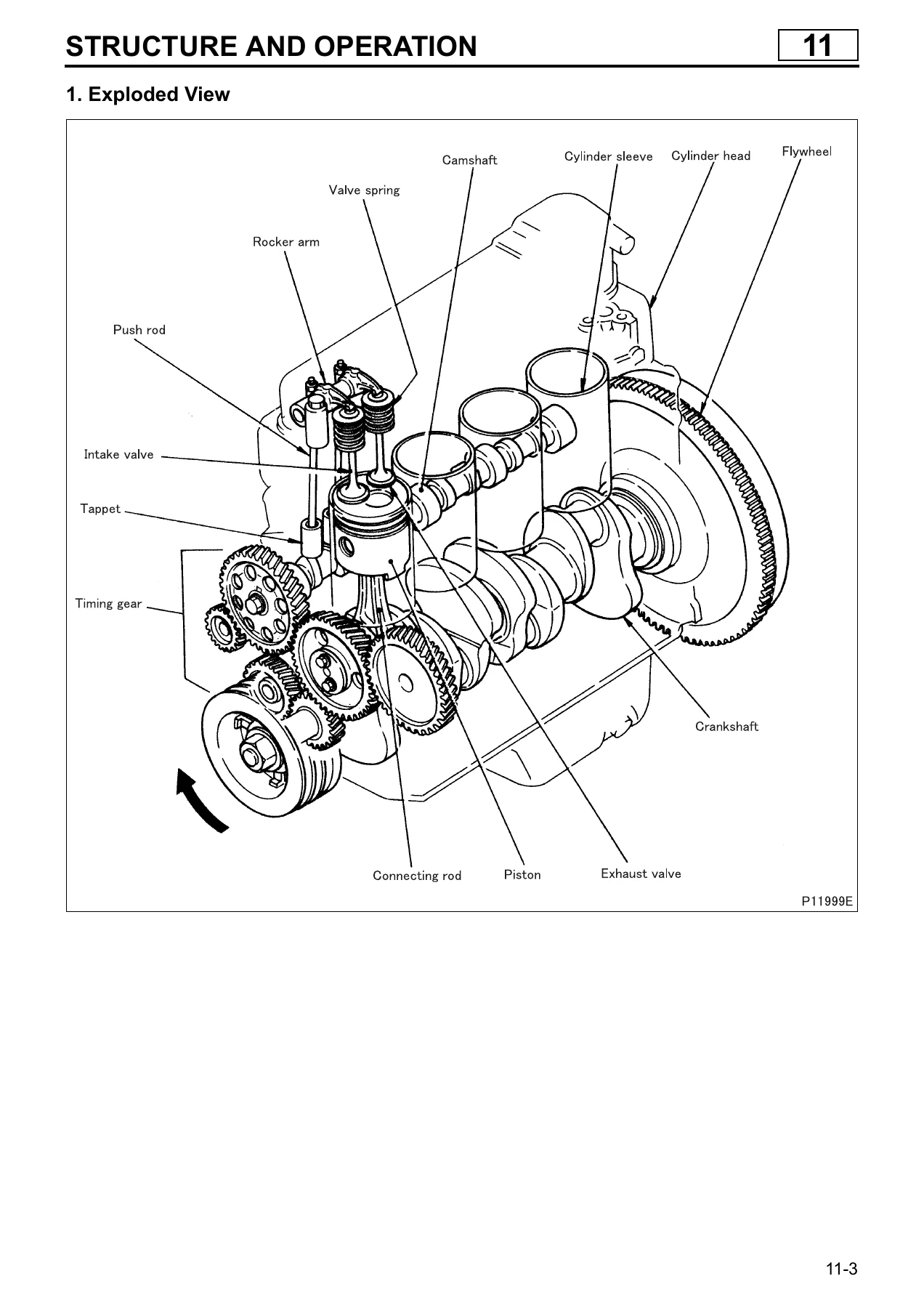
The largest chapter covers the complete 4D33 and 4D34T4 engine assembly. Includes specifications, exploded views, valve mechanism details, cylinder head gasket selection by piston projection, connecting rod differences between 4D33 and 4D34, piston identification, and timing gear alignment marks. Troubleshooting charts help diagnose low power output and abnormal engine noise. On-vehicle inspection and adjustment covers compression pressure measurement (standard 2550 kPa / 26 kgf/cm², limit 1960 kPa / 20 kgf/cm²) and valve clearance adjustment (0.4 mm cold). Engine removal and installation procedures are provided for both tilt cab and fixed cab configurations, with separate tightening torques for front and rear mounting bolts. Individual sections cover cylinder head disassembly and inspection (valve stem diameter, valve guide clearance, valve seat width, sinkage from cylinder head bottom surface, cylinder head distortion), piston and connecting rod servicing (piston ring end gap, side clearance, piston pin clearance, connecting rod bend and twist), cylinder sleeve replacement (including 4D33 correction sleeve and 4D34 standard sleeve), flywheel inspection and ring gear replacement, timing gears (backlash limits, idler gear end play, idler gear bushing replacement), camshaft (end play, cam lift, bend, camshaft gear interference), crankshaft and crankcase (end play, main bearing clearance, crankshaft bend, journal out-of-roundness and taper, grinding dimensions to undersize), and camshaft bushing replacement.
LUBRICATION (Group 12)
Details the forced lubrication system with a gear-type oil pump driven by the crankshaft. Covers the oil cooler and oil filter in both spin-on and replaceable element types, including bypass valve, regulator valve, engine oil pressure switch, and oil bypass alarm. The lubrication circuit for main bearings, connecting rod bearings, timing gears, valve mechanism, vacuum pump, injection pump and turbocharger is explained with flow diagrams. Troubleshooting charts address low oil pressure, excessive oil consumption, overheating and difficult starting. On-vehicle procedures cover oil filter replacement, engine oil replacement (oil pan capacity 8 L, oil filter 1 L), and oil pressure measurement (standard at no-load minimum speed 145 kPa / 1.5 kgf/cm², limit 49 kPa / 0.5 kgf/cm²; at no-load maximum speed 295 to 490 kPa / 3 to 5 kgf/cm², limit 195 kPa / 2 kgf/cm²). Oil pan, oil strainer, check valve, oil jet, and oil pump servicing with clearances and relief valve opening pressure are included.
FUEL AND ENGINE CONTROL (Group 13)
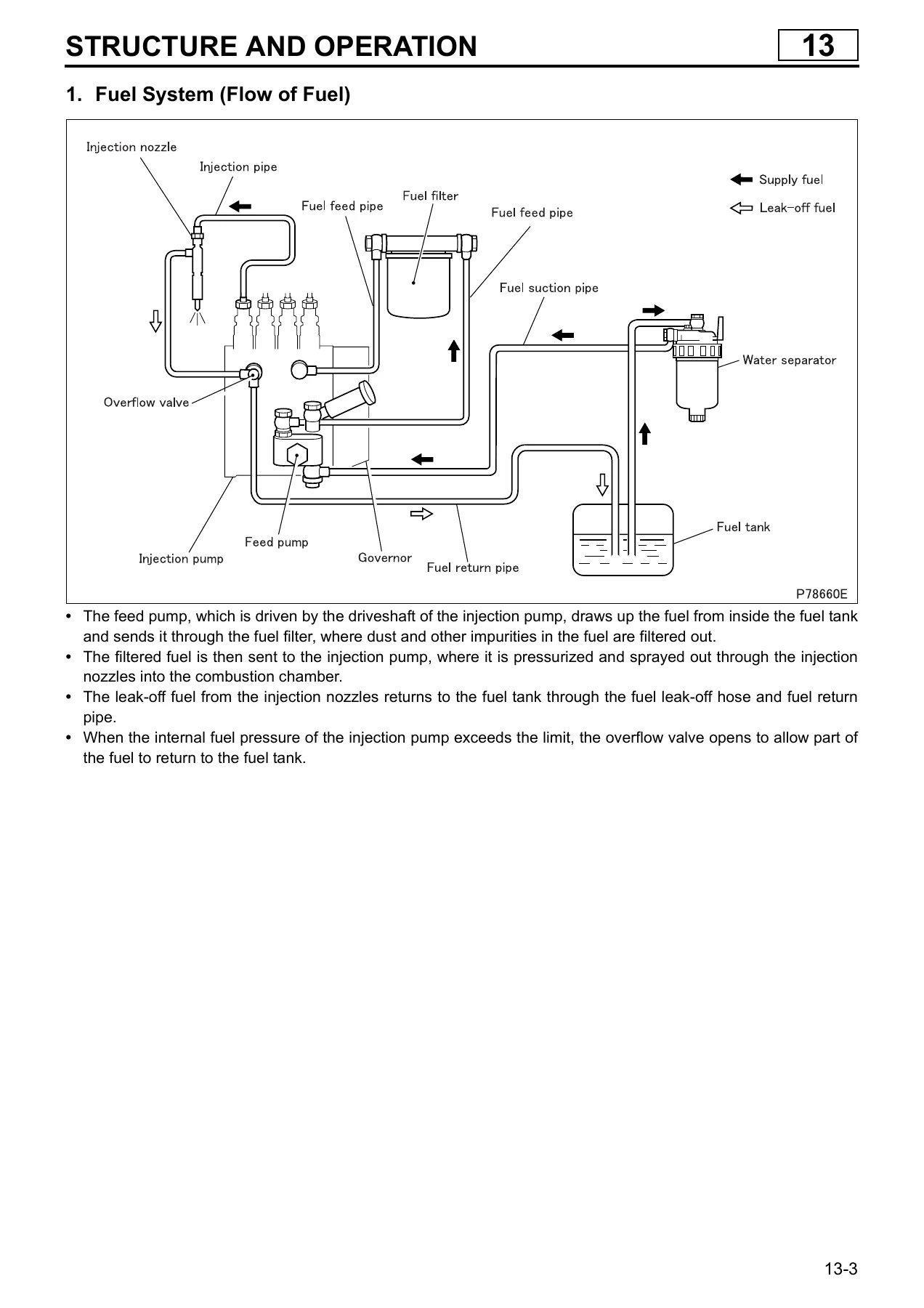
Explains the fuel system from tank through water separator and fuel filter to the Denso injection pump and injection nozzles. Covers the R901 all-speed mechanical governor, mechanical timer (SBO), KS feed pump with priming pump and gauze filter, delivery valve, overflow valve, boost compensator for 4D34, and the two-spring injection nozzle. Engine control components include the idling control knob, fuel-cut motor, accelerator pedal, accelerator link, and engine stop cable. On-vehicle adjustment covers fuel injection timing (4D33: 9° BTDC, 4D34: 7° BTDC, adjusted by tilting the injection pump), no-load minimum speed (650 ± 25 rpm) and no-load maximum speed (4D33: 3750 ± 50 rpm, 4D34: 3175 ± 25 rpm), air-bleeding of the fuel system, gauze filter cleaning, and fuel filter replacement. Major components covered include fuel tank (two-piece and band-mounted types), spare fuel tank with fuel cock, water separator, engine control cables and adjustment, injection pump removal and installation with timing gear alignment, and injection nozzle disassembly, cleaning, inspection and adjustment (1st valve opening pressure, 2nd valve opening pressure, pre-lift, full lift, spray pattern).
COOLING (Group 14)
Covers the forced water circulation system with belt-driven water pump, wax pellet bottom bypass thermostat with jiggle valve, and automatic cooling fan coupling. Includes cooling system flow diagram and component descriptions. Troubleshooting addresses overheating, overcooling, abnormal noise and excessive coolant loss. On-vehicle procedures cover coolant replacement and cleaning (with soft water properties and radiator cleaner procedure), air bleeding, air/gas leakage test, and belt inspection and adjustment. Disconnection and connection of hoses and pipes, radiator removal for FE7 and FE8/FG8 variants, cooling fan and belt service, water pump replacement, and thermostat and pressure cap inspection (valve opening temperature 82 ± 2°C, valve lift 10 mm or more at 95°C, pressure cap valve opening pressure 90 ± 15 kPa) are included.
INTAKE AND EXHAUST (Group 15)
Describes the air cleaner (single or double element, cyclone filter paper type with unloader valve), turbocharger assembly with waste gate mechanism (TD 05), intercooler (air-cooled tube and corrugated fin type), and exhaust brake system. Troubleshooting covers hard starting, dark or whitish exhaust, insufficient output, excessive oil consumption, intake/exhaust noise, and exhaust brake faults. On-vehicle procedures include turbo boost pressure measurement (standard 36 kPa / 270 mmHg at 3700 rpm) with temperature and engine speed correction, and exhaust brake system inspection and adjustment. Individual sections cover air duct and air cleaner for 4D33 and 4D34, turbocharger disassembly and inspection (shaft play limits, cartridge assembly replacement), intercooler air leakage test, intake manifold, exhaust manifold, exhaust pipe and muffler, and exhaust brake unit disassembly and adjustment (butterfly valve clearance, power chamber air-tightness).
Why This Manual Matters for Your Canter
The 4D33 and 4D34T4 engines are robust workhorses, but they demand correct service procedures and accurate specifications to stay reliable. This Mitsubishi Fuso Canter 4D3 shop manual gives you the exact torque values, clearances, wear limits, and adjustment sequences that Mitsubishi Fuso specifies. Whether you are adjusting valve clearances, measuring compression, setting injection timing, replacing a cylinder sleeve, or overhauling the injection pump, having the correct data prevents costly mistakes and ensures the engine performs as intended.
With 262 pages covering six major groups, this manual supports everything from routine maintenance to complete engine overhaul. The step-by-step procedures include disassembly sequences, inspection criteria with standard and limit values, reassembly notes, and special tool references. Torque-turn tightening methods for cylinder head bolts, connecting rod bolts, and main bearing cap bolts are explained with punch-mark counting to prevent reuse beyond safe limits. Piston projection measurement for cylinder head gasket selection, crankshaft grinding dimensions, and injection nozzle adjustment with shim thickness calculations are all documented in detail.
This 4D33 and 4D34T4 diesel engine workshop repair PDF is delivered instantly after payment. There is no shipping, no waiting, and no physical book to lose or damage. The file works on any device — laptop, tablet, or smartphone — and can be printed for use in the workshop. Whether you are a fleet maintenance technician, an independent mechanic, or an owner-operator who services your own Canter, this manual gives you the information you need to do the job right.
IMAGES PREVIEW
Reviews
There are no reviews yet.