
Mitsubishi Fuso Canter Owner’s Handbook 2015 – English French Spanish PDF
Original price was: $55.95.$35.95Current price is: $35.95.
Complete 2015 Mitsubishi Fuso Canter Owner’s Handbook in English, French and Spanish — 810-page PDF covering FEA, FEB, FEC and FG models.
Description
Mitsubishi Fuso Canter Owner’s Handbook 2015 — Complete English, French & Spanish Edition
The 2015 Mitsubishi Fuso Canter Owner’s Handbook, document MH995759, is the complete trilingual operator’s manual for the Fuso Canter truck range. This single 810-page PDF contains three full manuals in one file: the entire English edition, the complete French edition (“Manuel du conducteur”), and the full Spanish edition (“Manual del propietario”), each starting from its own cover page and running through to its own publication page. For anyone running a Canter in a multilingual fleet, exporting to a French- or Spanish-speaking market, or servicing trucks that may be driven by operators who read any of these three languages, this handbook eliminates the need to track down separate language editions.
Where a workshop manual focuses on rebuilding engines and diagnosing faults with a scan tool, this Mitsubishi Fuso Canter owner’s handbook focuses on what happens at the wheel, under the cab, and around the truck during daily operation. It covers every switch on the dashboard, every gauge on the cluster, every warning lamp and what to do when one lights up. It documents the DPF regeneration cycle — both automatic and the parked/manual regeneration procedure with the DPF cleaning switch — including what each PM indicator state means and how long you have before you need to act. It explains the ISS (idling stop and start) system, the PTO engagement procedure, the 4WD and HIGH-LOW transfer case controls on the FG models, and the limited-slip differential. It walks through pre-operational checks, simple service jobs like engine oil and filter changes, fuel filter water draining, coolant replacement, V-belt inspection, brake shoe adjustment, and tire rotation. And it covers emergency procedures: what to do when the engine overheats, when a fuse blows, when the brakes feel sluggish, when the battery is flat, or when the fuel tank runs dry.
File Details
- Manual Type: Owner’s Handbook / Operator’s Manual
- Brand: Mitsubishi Fuso
- Model: Canter
- Document Number: MH995759
- Publication Date: June 2015
- Languages: English, French, Spanish — each complete
- Page Count: 810
- File Format: PDF
Chapters Covered
- 1. Recommendation to drivers
- 2. Warning labels
- 3. Opening and closing
- 4. Seat and steering wheel adjustments
- 5. Switches and controls
- 6. Instruments and warning lamps
- 7. Starting and driving
- 8. Handling special equipment
- 9. Ventilation, Heating and air conditioning
- 10. Interior equipment and accessories
- 11. In cold weather
- 12. Simple inspection and service
- 13. Useful advices for emergencies
- 14. Service data
- 15. Alphabetical index
Recommendation to Drivers and Warning Labels (Chapters 1–2)
The opening chapters establish the truck’s identity — chassis number location (right frame, near the front wheel), engine number position (front side of the cylinder head), and the VIN breakdown that decodes the truck’s country of origin, make, vehicle type, GVW/brake system, model line (FEA01S, FEA51S, FEB71S, FEB71W, FEC91S, FGB71S, FECX1S), wheelbase, cab/chassis type, engine (the 4P10 2.998-litre diesel turbo), and model year. Warning label locations are shown for the driver’s seat area, door pillars, frame and exterior equipment, and the cab exterior/engine bay, with the reference page for each label’s full explanation.
Opening, Closing, Seat and Steering Wheel Adjustments (Chapters 3–4)
Starter key identification (main key, sub key, key number), door locking and unlocking from outside and inside, the power window switches on the driver’s door, and the step-and-grip procedure for entering and exiting the cab safely. The seat and steering wheel chapter covers the correct driving position, seat slide and recline adjustments for both driver and assistant driver seats, the center seatback that folds into a tray, rear seat access on Crew-cab models, the three-point and two-point seat belt systems with ELR (emergency locking retractor), seat belt anchor height adjustment, the SRS air bag system with its operating conditions and limitations, and the seat belt pre-tensioner.
Switches and Controls / Instruments and Warning Lamps (Chapters 5–6)
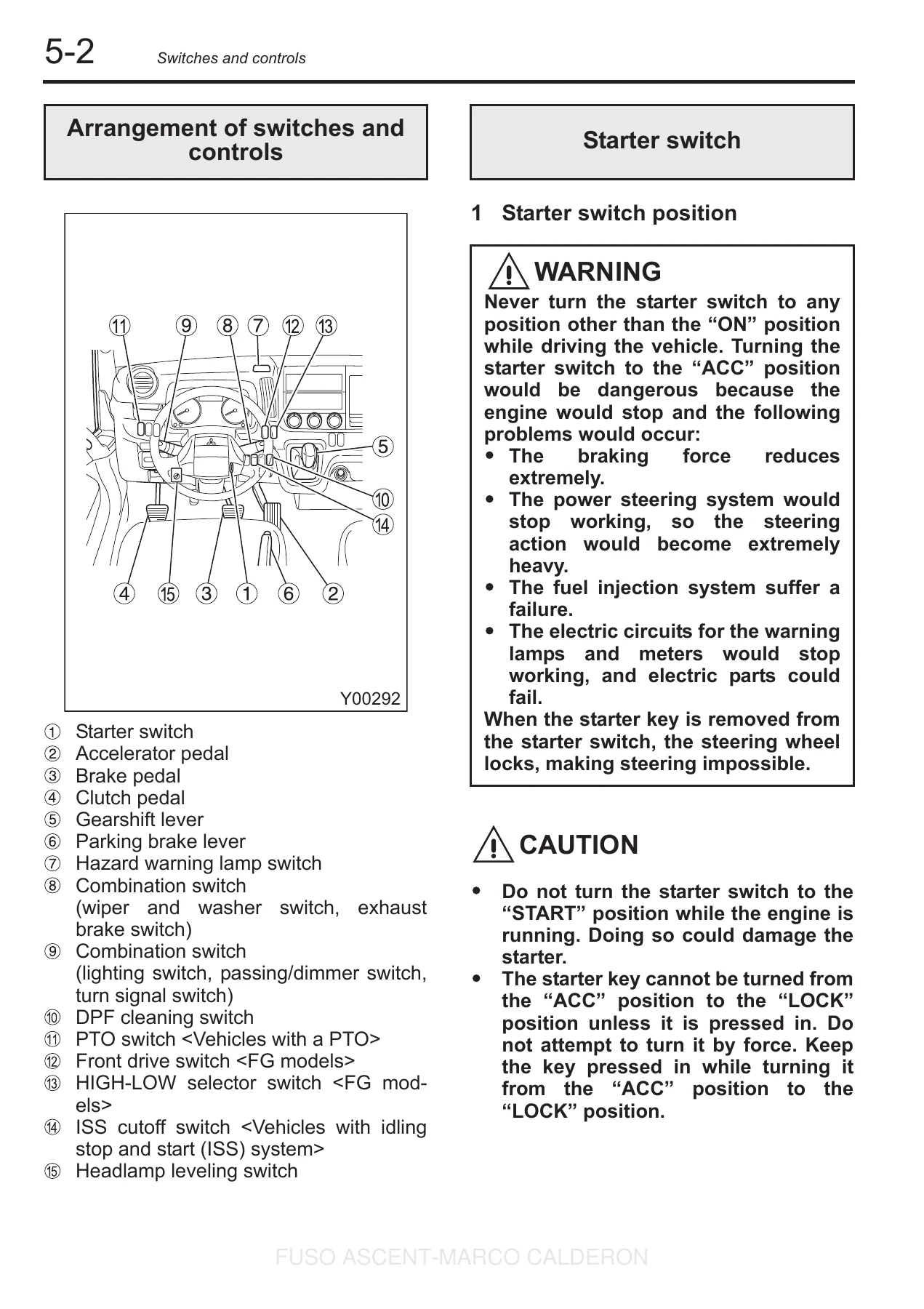
The full dashboard layout: starter switch positions (LOCK, ACC, ON, START), starting procedure with preheat indicator, warming up, stopping the engine, the ISS system with its cutoff switch and automatic stop/start conditions, pedal operation, gearshift lever pattern, parking brake lever stroke and release reminder, combination switch (lighting, passing/dimmer, turn signals, exhaust brake, wiper/washer), hazard warning lamps, headlamp leveling switch, mirror adjustment and retraction, horn, and the full DPF system — PM indicator states, DPF indicator lamp flash patterns, automatic and parked regeneration procedures with the DPF cleaning switch. The instrument chapter covers the speedometer, tachometer, water temperature gauge, fuel gauge, multi-information display with its calendar/clock, DPF monitor, fuel mileage information, maintenance information, illumination intensity settings, and the complete warning/indicator telltale system.
Starting and Driving (Chapter 7)
Precautions when setting the vehicle in motion, driving precautions including what to do if the engine stalls, fuel economy tips, braking technique with engine braking and exhaust brake, uphill and downhill driving, rough road and bad weather driving, parking procedure with chock placement on slopes, and cargo loading rules with weight distribution guidance.
Handling Special Equipment (Chapter 8)
Transmission PTO engagement and disengagement (with engine idling, parking brake applied), the 4WD system on FG models — front drive switch, HIGH-LOW selector switch, free-wheeling hub positions, drive mode combinations, and off-road driving advice — the limited-slip differential and its precautions, and the antilock braking system (ABS) with EBD, including driving tips and brake pedal operation during ABS activation.
Ventilation, Heating and Air Conditioning (Chapter 9)
Air outlet adjustment, heater controls (mode selector dial, fan speed dial, temperature adjustment dial, air selector switch for outside air or recirculation), defogging procedure, and air filter cleaning intervals.
Interior Equipment and Accessories (Chapter 10)
Cigarette lighter, ashtrays, coat hooks, sun visors with ticket holder, interior lamps with ON/door/OFF positions, inside rearview mirror, storage compartments (vertical compartment, door pocket, seatback pocket, center tray, center console box, back panel console box, cup holders, seatback tray, lower pocket, tray, box with lid), and radio antenna operation.
In Cold Weather (Chapter 11)
Coolant concentration for freezing temperatures, engine oil viscosity selection, diesel fuel gelling and refuelling strategy for cold regions, battery electrolyte checks, cold-weather starting (return starter switch to ACC or LOCK and wait 30 seconds), special lubricants for ambient temperatures below -25°C, windshield washer fluid replacement, snow and ice removal from the undercarriage, brake freezing prevention, parking on level ground without the parking brake in extreme cold, and tire chain installation for triple chains with hook and spring band details.
Simple Inspection and Service (Chapter 12)
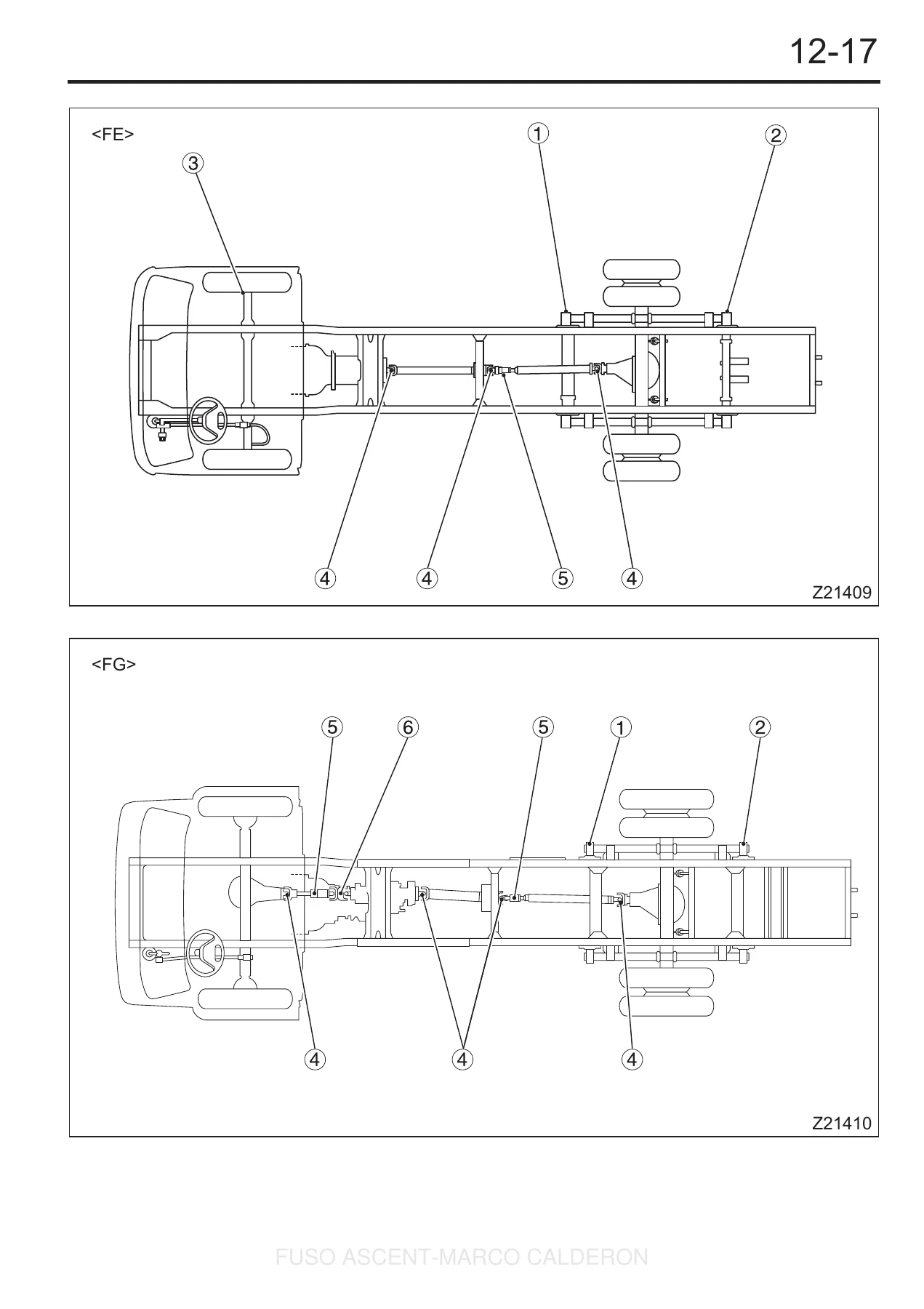
The largest chapter — general servicing precautions, onboard tool list and storage locations, engine access opening on Crew-cab models, cab tilting procedure (except Crew-cab) with the lever A/B/C sequence and cab stay lock, pre-operational checks (coolant level, air cleaner dust indicator, pressure cap, engine oil level, leaks, V-belt tension, parking brake stroke, brake pedal play and stroke, brake fluid level, steering wheel free play, lighting system, gauges, wheels and tires, suspension springs, battery fluid level, steering and brake performance), greasing points (chassis nipples, propeller shaft, door hinges, anchor hooks), engine oil check and replacement, transmission gear oil, transfer gear oil, differential gear oil, brake fluid, power steering fluid, filter elements (oil filter, fuel filter, air cleaner), draining water from the fuel filter, engine coolant check and replacement, V-belt check, steering wheel check, service brake check with brake shoe clearance adjustment, parking brake check, tire check and replacement, tire rotation, spare tire handling, wiper blade replacement, windshield washer fluid, battery check, lamp check, air filter cleaning, vehicle cleaning, and intercooler cleaning.
Useful Advices for Emergencies (Chapter 13)
A troubleshooting chart organized by symptom (engine does not start, engine starts but stalls, engine fails to stop, black smoke, overheating, oil pressure does not build, excessive fuel or oil consumption, lack of power, brakes weak, vehicle pulls to one side, steering difficult, steering wheel vibrates, battery runs down), with causes, remedies and reference pages. Plus detailed procedures for stopping in an emergency, overheating response, fuse replacement (blade-type and high-current), lamp replacement, sluggish braking, engine stall while driving, flat tire, jump starting with booster cables, bleeding the fuel system after running dry, and towing precautions.
Service Data (Chapter 14)
Recommended lubricants and hydraulic fluids with classifications, viscosity grades and atmospheric temperature ranges, fluid quantities for engine oil, coolant, transmission, transfer, differential, power steering and brakes, and a standard values table covering engine idling speed, clutch pedal play, brake pedal play, brake pedal to floor clearance, brake shoe clearance notches, parking brake lever stroke, steering wheel play, tire tread depth and wheel nut tightening torque.
Why This Handbook Belongs in Every Canter Cab
The Canter is a working truck, and the difference between a truck that stays on the road and one that sits in the workshop often comes down to whether the operator knows the correct procedure at the right moment. This Mitsubishi Fuso Canter owner’s handbook is the reference that answers those questions in the language the driver actually reads. The DPF regeneration procedure alone — knowing when to use the DPF cleaning switch, how long the parked regeneration takes, and what the amber indicator lamp flash rates mean — can prevent a derate or a forced workshop visit. The cold-weather chapter covers fuel gelling, battery behaviour, brake freezing and parking without the parking brake, all practical knowledge that matters at 5 a.m. in a cold climate. The emergency chapter turns a potential panic situation into a sequence of documented steps.
For fleet managers and workshops, the trilingual format is a genuine operational advantage. One file serves English-speaking drivers, French-speaking drivers and Spanish-speaking drivers without the risk of a language edition being misplaced or out of date. The service data chapter gives the torque values, fluid capacities and adjustment specifications that come up during routine maintenance — wheel nut torque for FEA0 and non-FEA0 models, brake pedal free play, parking brake lever stroke, steering wheel play, engine idling speed — without needing to cross-reference a separate workshop manual for the basics. The service chapter walks through the engine oil and filter change procedure with the oil level gauge FULL/LOW marks, the fuel filter water drain procedure, the coolant replacement sequence with the air bleed steps, and the brake shoe adjustment procedure with the notches and dust cover details.
This is not a repair manual for rebuilding the 4P10 engine. It is the manual that tells you how to operate the truck correctly, how to spot a problem early, how to handle the routine service jobs yourself, and what to do when something goes wrong on the road. For anyone who owns, operates, manages or services a 2015 Canter, it is the first document to keep in the cab — and the one you will reach for every time a warning lamp comes on, a service interval comes due, or a driver asks how something works.
IMAGES PREVIEW
Delivered as an instant PDF download after payment. No shipping, no waiting for a physical book. The file opens on any device — laptop, tablet, phone — and the pages print cleanly if you prefer a paper copy for the workshop or the cab. Search the PDF on your device, jump straight to the chapter or reference page you need, and keep the full three-language handbook available wherever the truck goes.
Reviews
There are no reviews yet.