
Raymond Model 9800 Swing-Reach Lift Truck Maintenance Manual 1203870A – PDF Download
Original price was: $44.95.$26.95Current price is: $26.95.
Complete Raymond maintenance manual for the Model 9800 Swing-Reach Lift Truck, serial number 980-14-6301195 and up. Publication 1203870A covers scheduled maintenance, motors, drive gear, brakes, wheels, steering, wire guidance, the electrical system with parameters, calibration and fault codes, hydraulics, accumulators, the Mini-Mast turret head fork unit, plus a full set of electrical and hydraulic schematics.
Description
Covering the Raymond Model 9800 Swing-Reach Lift Truck from serial number 980-14-6301195 onward, this maintenance manual, publication 1203870A issued 20 January 2016, is the full technical reference for servicing, troubleshooting and repairing the truck across every major system. The document runs to roughly 626 pages and carries the C-code section numbering Raymond uses to organise its service literature, so a technician can move straight from the table of contents to the exact system in hand: chassis, motors, drive transmission, brakes and wheels, steering, electrical, hydraulics, and the lifting and handling functions.
Unlike a generic forklift guide, this manual is written around one machine. Everything inside it, from torque values and calibration routines to accumulator pressures, connector pin-outs and hose routing, belongs to the 9800 Swing-Reach and nothing else. The supplied document also bundles the matching schematic publication 1203874A, which contains the full 30-sheet electrical schematic and the 7-sheet hydraulic schematic for the same truck.
File Details
- Manual type: Maintenance Manual covering service, repair, calibration, parameters and troubleshooting
- Brand: Raymond (The Raymond Corporation)
- Model: Model 9800 Swing-Reach Lift Truck
- Serial number coverage: 980-14-6301195 and up, plus all subsequent releases until superseded by a new edition or bulletin
- Publication number: 1203870A
- Issued: 20 January 2016
- Language: English
- Format: PDF
- Included schematics publication: 1203874A, Model 9800 electrical schematic (30 sheets) and hydraulic schematic (7 sheets)
Chapters Covered
- How to Use This Manual: warning symbols, abbreviations and acronyms, pictograms, metric and standard conversions
- General Safety: work safety, battery safety, static precautions, safe jacking, welding safety, warning decals
- Scheduled Maintenance: inspection intervals from the initial 250-hour service through 3000 hours, with lubricant types and intervals in days, weeks and months
- Oil and Grease Specifications: chain lubricants, hydraulic oil, gear oil and greases listed with viscosity classes, ambient temperature ranges and part numbers
- Tools: Super Seal contacts, AMP connectors in PT, JPT and MPT sizes, USB/CAN interface, drive gear puller, socket for transmission nuts, hydraulic pressure gauge, operator’s compartment lift remote control, lifting yoke
- Frame Pivot (0320): removal and reassembly of the rear chassis, dismantling the rear chassis, replacing the bearing frame links
- General Tightening Torque (0400): galvanized non-oiled bolts and untreated lubricated bolts
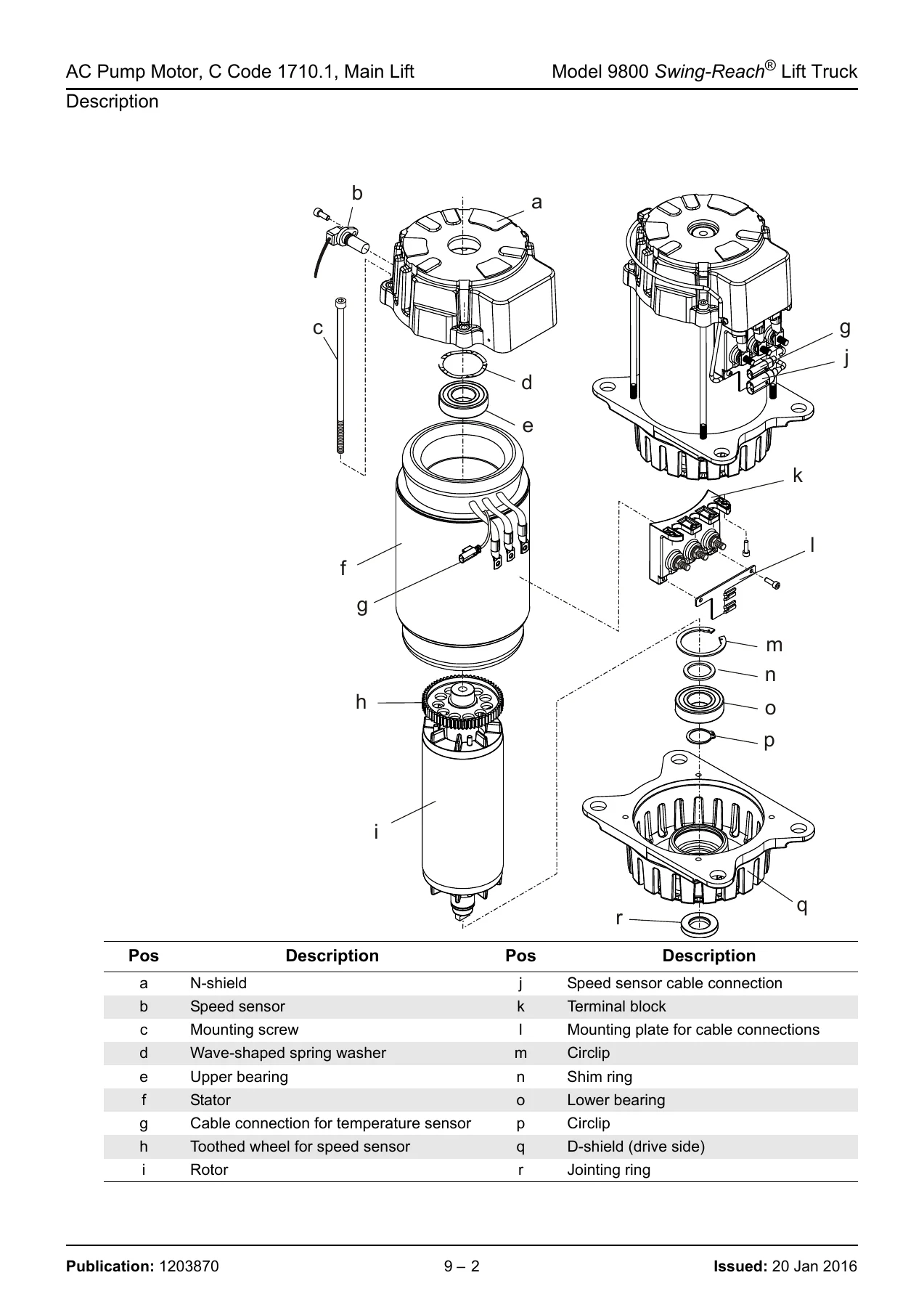
- AC Pump Motor (1710.1), Main Lift: description, replacing the temperature sensor, replacing the speed sensor, replacing bearings
- Electric DC Pump Motor (1710.2): disassembly and assembly, replacing the ball bearing on the D side and N side, carbon brushes and carbon brush rocker, commutator servicing
- AC Drive Motor (1760): description and data, temperature and speed sensor replacement, disassembly, replacing bearings, assembly
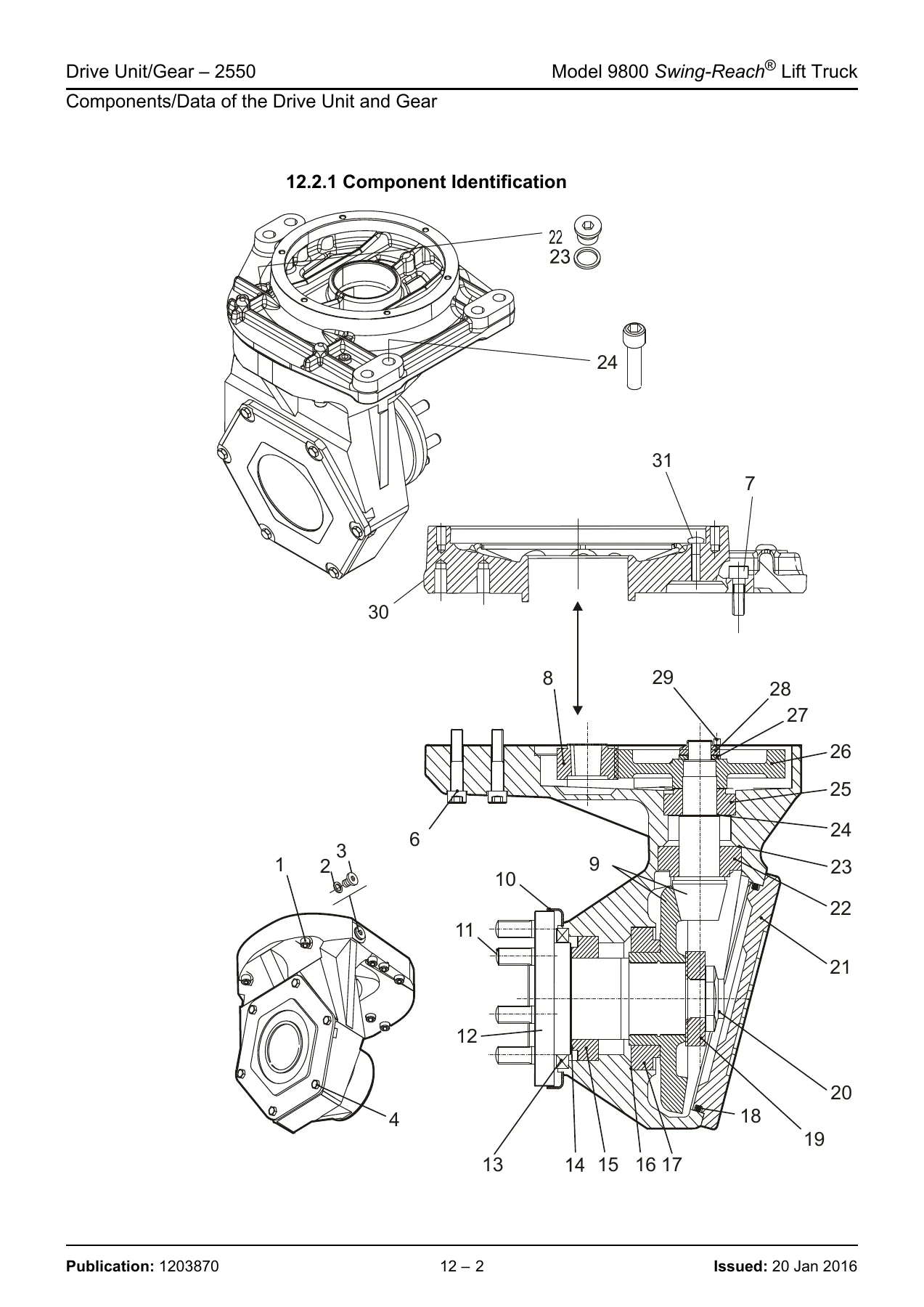
- Drive Unit and Gear (2550): components and technical data, replacing the drive motor and drive gear, oil level check and oil change, leakage repairs, replacing the wheel bolts
- Brake System (3100): function description, electro-mechanical disc brake on the drive motor, multiple-disc brakes in the support arms, air gap and brake force checks
- Wheels (3500): drive wheels, support arm wheels, dismantling and assembling wheel bearings, shimming, available wheel qualities
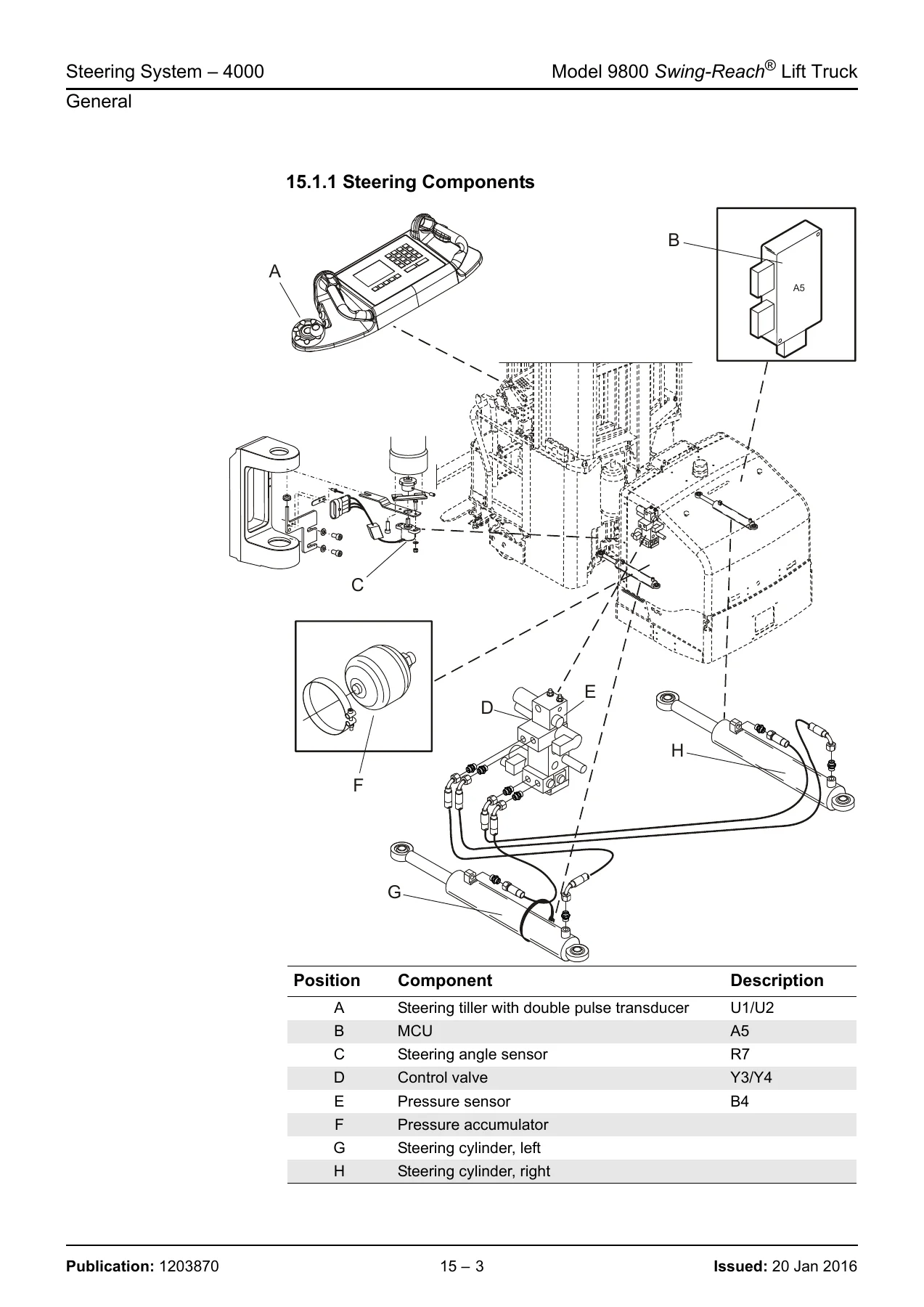
- Steering System (4000): steering components, hydraulic diagram, replacing the steering angle sensor, temperature and voltage compensation, troubleshooting
- Steering Cylinder (4160): checking for internal leaks, removal and installation, repairs to the front steering cylinder mount
- Wire Guidance System (4500): antennas W1 and W2, travel speeds, description of the function, best practice for adjustment, parameters, warning and fault codes
- Electrical System (5000): MCU, FCU and ICP units, ACTL, ACTR and ACH motor controllers, DCHI DC regulator, hand-held terminal 1307, electrical schematic, component location, cabling contacts, functional descriptions for starting, driving, steering and braking
- Parameters (5700): operator parameters, MCU truck parameters, FCU turret head fork unit parameters, ICP parameters and learned calibration values
- Calibration (5700): ICP controls, steering, wire guidance, turret head fork unit functions, weight indication, B cylinder pressure and height indication
- Fault Codes (5700): ICP, MCU, drive system, operator’s compartment lift system, steering system, Mini-Mast and turret head fork unit code groups
- Hydraulic System (6000): cleanliness requirements, symbols, hydraulic schematics, operator’s compartment lifting, Mini-Mast and steering, extra hydraulic functions, operations and repair
- Hydraulic Tank (6110): replacing the hydraulic oil, tank removal and installation of a new tank
- Hydraulic Pump (6140): bleeding the pumps, replacing the main lift pump, replacing the steering and fork hydraulic pump, troubleshooting internal leakage
- Accumulators (6280): charging and measuring pressure in the lifting and steering accumulators
- Main Lift Cylinder (6610): replacing the seal in the B cylinder
- Main Mast and Mast Stoppers (7100): setting the operator’s compartment stoppers and mast stoppers
- Main Lift Chain System (7120): checking the chain setting and chain condition, cleaning, lubrication and chain adjustment
- Mini-Mast and Turret Head Fork Unit (7200): mast assembly and disassembly, inspection and replacement of traversing belts, belt tension checks, friction plate adjustment, fork parallelism
- End-of-Aisle Slowdown and Stopping (8100): EOA slowdown magnet configurations and EOA stop
- Vertical Hold (9390): parameters and programming of programmable lift heights
- Preparation for Transport: tool list, dismantling the truck, laying down the truck
- Appendix A: TruckCom: installation, licence key retrieval, USB/CAN interface drivers, retrieving and downloading software, connecting to the truck, error log, truck report, hour meters, I/O testing
- Index
Taken as a whole, the manual is a single continuous workflow rather than a stack of disconnected chapters. Safety and scheduled maintenance come first so the truck is prepared correctly, then each C-code section deals with one assembly from removal through inspection, repair and refitting, with tightening torques, special tools and adjustment values stated inline at the point where they are needed. The later sections move from mechanical hardware into the electronic side of the truck, where parameters and calibration values stored in the MCU, FCU and ICP are documented alongside the fault codes those modules can raise, and the schematics publication closes the loop by showing how the wiring and hydraulics physically connect.
Diagnostics, Parameters and Fault Codes
A large part of the value here is diagnostic. The fault code section is divided into six groups covering the ICP, the MCU, the drive system, the operator’s compartment lift system, the steering system including wire guidance, and the Mini-Mast and turret head fork unit, and each entry explains what the code means, what the likely causes are and which connectors or components to inspect. Alongside that, the parameters section documents the operator parameters and the truck parameters held in the MCU, FCU and ICP, including the learned calibration values for steering, height and wire guidance, and the calibration section walks through each calibration routine on the truck display. For a wire-guided Swing-Reach working in a narrow aisle, that combination of fault codes, parameters and calibration procedures is what makes the truck diagnosable rather than guessable.
Electrical and Hydraulic Schematics
The bundled schematic publication provides the 30-sheet electrical schematic and the 7-sheet hydraulic schematic for the Model 9800, together with a component legend listing every identifier on the drawings, from the ACTL, ACTR and ACH controllers through the pressure sensors, magneto switches and valve coils. Component location figures and a full cabling contact list give the connector number, function and physical placement on the truck for each plug, which turns circuit tracing into a straightforward exercise instead of a hunt through the harness.
What This Manual Lets You Do
With this Raymond 9800 Swing-Reach maintenance manual on hand, a technician can carry out the full scheduled maintenance programme, remove and refit the rear chassis, rebuild the AC drive motor and AC or DC pump motors, service the drive gear and change its oil, check and adjust the drive motor brake and the support arm disc brakes, replace steering cylinders, set up and adjust the wire guidance system, reload software and parameters through TruckCom, perform every calibration routine on the truck, read and act on fault codes, service the hydraulic pumps, accumulators and tank, adjust the main lift and Mini-Mast chains and traversing belts, and prepare the truck for transport. Doing those jobs with the correct procedures, torque figures and adjustment limits is what keeps a narrow-aisle truck tracking the wire accurately, braking predictably and lifting safely at height, and it is the difference between a repair that holds and one that comes back.
IMAGES PREVIEW
Delivery is instant. The file is a PDF that downloads immediately after payment, with no shipping and nothing to wait for, and it can be read on a workshop PC, a laptop, a tablet or a phone, or printed out page by page for the job at hand.
Reviews
There are no reviews yet.