
Renault Clio 1996-1999 Spare Parts Catalogue PDF Download
Original price was: $34.95.$19.95Current price is: $19.95.
Illustrated Renault Clio spare parts catalogue covering 1996-1999 versions – exploded diagrams, factory part numbers, version codes for Argentina, Brazil, Chile and Especial markets, F8Q 676/696 diesel and petrol engine groups, JB1/JB3 gearboxes and every assembly sold as a replacement part.
Description
Renault Clio 1996-1999 Spare Parts Catalogue – Illustrated Parts Identification
This is the illustrated spare parts catalogue for the Renault Clio built between 1996 and 1999. It is the document a parts counter, workshop or restorer uses to turn a physical component into a usable part number – and to turn a part number back into the correct drawing. Every assembly and loose part sold as a spare is grouped onto plates according to the system or sub-assembly it belongs to, and each plate carries its own five-figure code.
The catalogue is written in four parallel languages throughout – Spanish, French, English and Portuguese – so the same plate, symbol legend and version table can be read by whichever market the vehicle was sold into. That matters here, because the Clio of this era was assembled and sold with very different equipment levels across Argentina, Brazil, Chile and the Especial markets, and this catalogue carries the version codes that separate them.
File Details
- Manual type: Illustrated spare parts catalogue (parts identification and ordering document)
- Brand / Model: Renault Clio
- Coverage years: 1996 – 1999 (vehicle models MOD. 96.03, 96.10, 97.03, 97.07, 97.10 and later)
- Languages: Spanish, French, English, Portuguese (parallel columns on every legend and version table)
- Format: PDF
- Page count: 347 pages
- Plate numbering: Five-figure codes (e.g. 01.100, 10.333, 21.463), two first digits indicating the system code
- Document reference: 1284 (catalogue series) and 357T / 357N (vehicle model prefixes)
Chapters and System Groups Covered
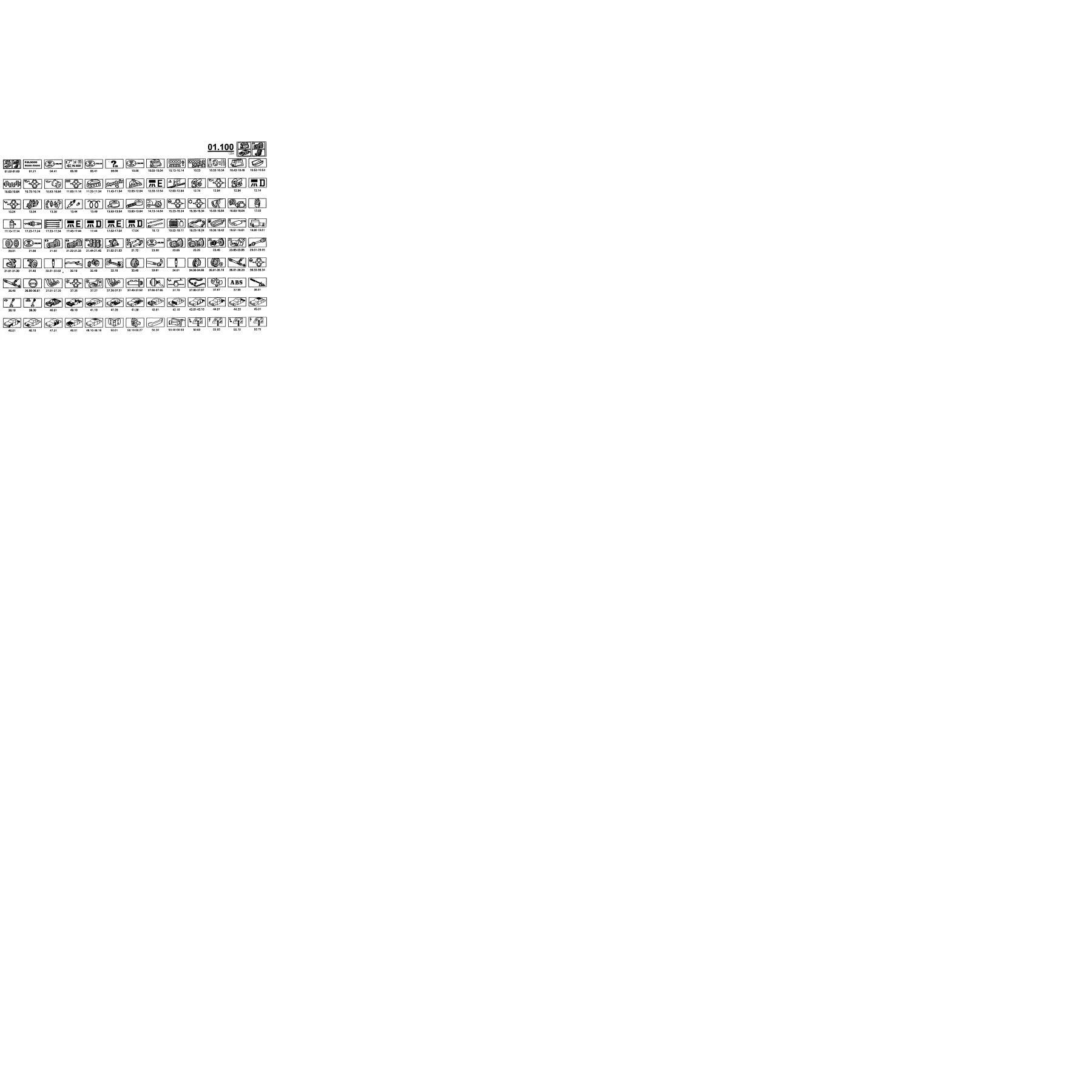
The plates are organised by Renault’s system numbering, and the illustrated index plate (01.100 / 01.101) lets you jump straight from a picture of the component to the plate number that details it.
- 01.100 / 01.101 – Illustrated index of plates
- 01.210 – 01.213 – Version codes (OPC versions) with equipment and market tables
- 001.300 / 01.310 – Serial number ranges and model applicability (MOD. 96.031, MOD. 97.031, MOD. 97.101)
- 03.010 / 03.020 – Introduction and instructions for use
- 03.040 – VIN interpretation (world manufacturer code, vehicle type code, year code, serial number)
- 05.010 – 05.250 – Symbol and coded-expression legends, equipment abbreviations, vehicle type pictograms
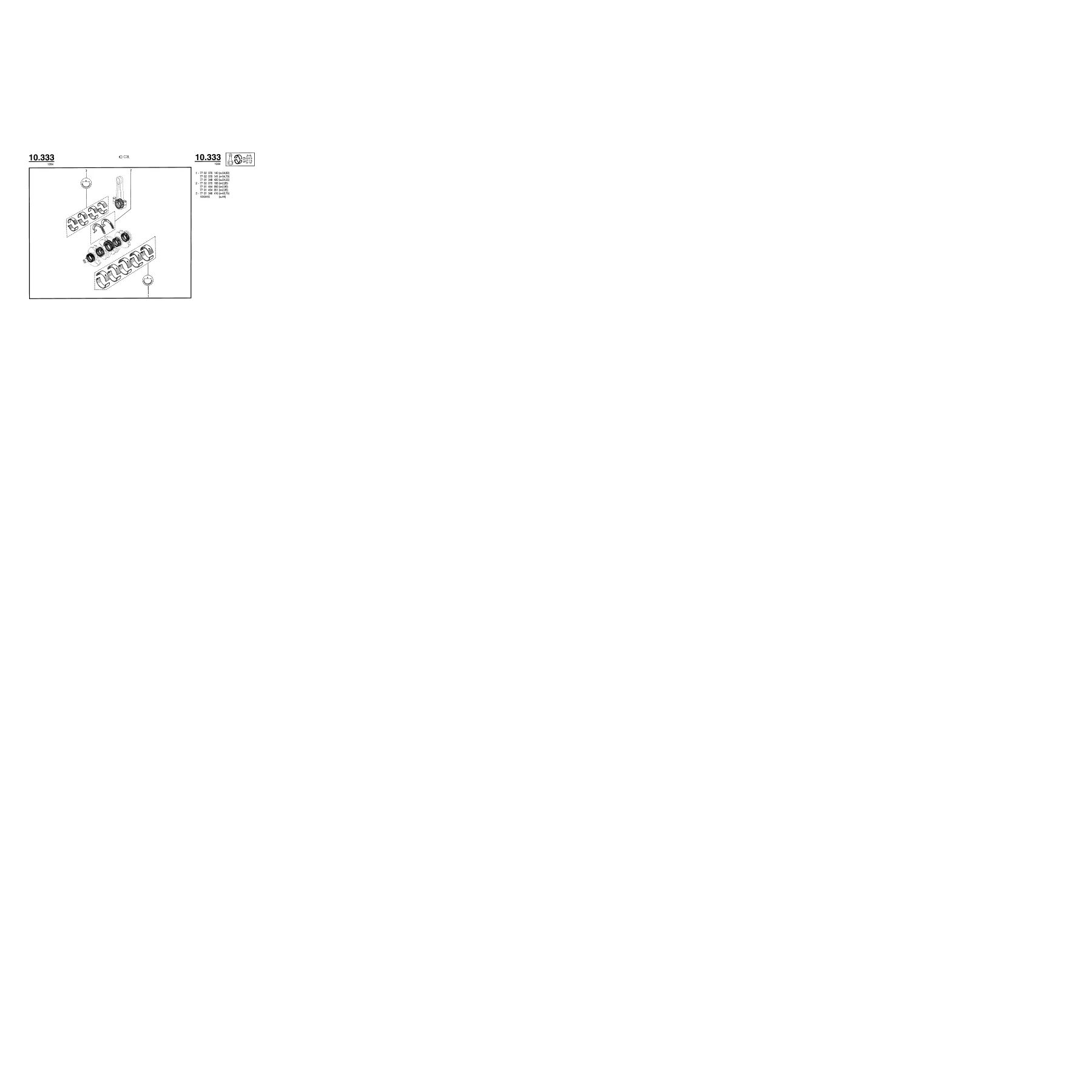
- 10.010 – 10.833 – Engine group: complete engines, cylinder head and gasket sets, crankshaft, connecting rods and bearing shells, cylinder block, liners, sump and oil level dipstick, crankshaft pulley and flywheel, pistons and rings, oil pump, water pump and thermostat housing
- 11.022 – 11.545 – Upper engine: rocker cover and camshaft housing, timing belt and tensioner, camshaft, valves and springs, distributor, alternator mounting
- 12.031 – 12.234 – Petrol fuel system: carburettor, inlet and exhaust manifolds, gaskets, air filter housing
- 13.148 – 13.641 – Diesel fuel system: injection pump, fuel filter and priming, injectors and high-pressure pipes, cold-start and advance device, diesel filter housing
- 15.245 – 16.040 – Alternator, alternator mounting brackets and belts
- 16.020 – 16.040 – Starter motor, drive belts and pulley arrangements
- 17.053 / 17.054 – Ignition distributor, rotor arm, cap and seals
- 19.011 – 19.811 – Cooling and exhaust: radiator and cooling hoses, expansion tank, thermostat, cooling fan, exhaust downpipe, silencer and mounting, front crossmember and engine mountings
- 20.011 – Clutch: pressure plate, driven plate, release bearing and fork
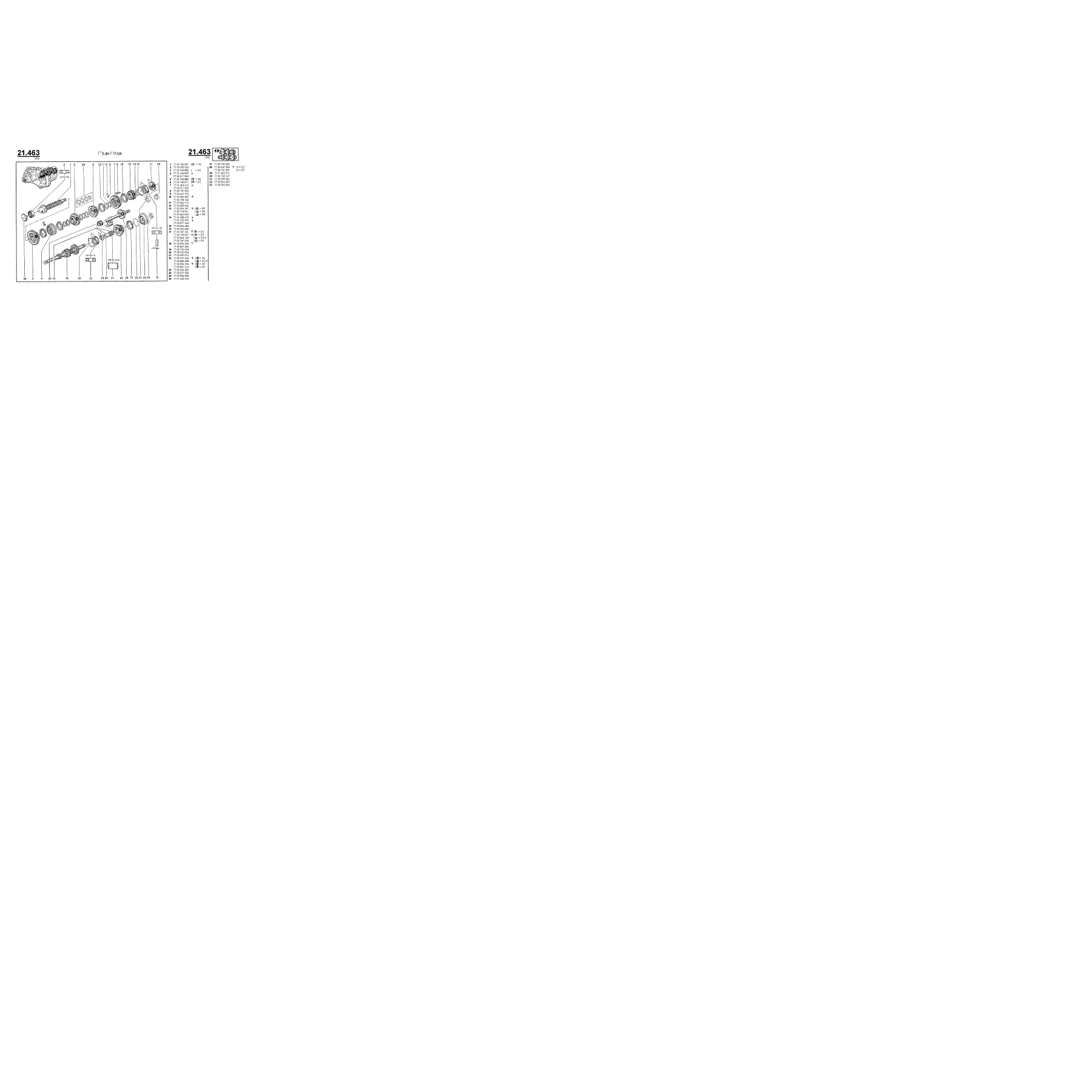
- 21.001 – 21.725 – Gearbox group: complete JB1 and JB3 gearboxes, gearbox housing and covers, gear train and synchromesh assemblies, differential and crown wheel, gear selector and control rods, driveshafts and CV joints
- 31.011 – 32.011 – Front axle: front subframe, track control arms, ball joints, front shock absorber and spring
- 33.011 – Rear axle: rear axle beam, arms and mountings
- 35.011 – Wheels and trims
- 36.011 and steering plates – Steering rack, steering column parts
- Brake plates – Front brake calipers, carriers, discs, brake pads and rear brake shoes with spring kits
- 19.801 / 19.811 – Engine and gearbox mounting, front crossmember assemblies
- Tooling plate – Special service tool references
Read as a whole, the catalogue gives you the full factory parts breakdown of a 1996-1999 Clio: it does not teach you how to repair the car, but it tells you exactly which part belongs to which build, which parts are still sold separately, which components are only sold as a complete assembly under a single number, and which parts are interchangeable between early and late production. That is the information a workshop cannot guess at, and it is the information that stops a wrong part being ordered and a job being done twice.
How the Catalogue Is Organised
Each plate combines a drawing of the parts or assemblies in that system with one or more part numbers keyed to that drawing. Numbers are distinguished from each other by a variant letter or by a coded symbol printed next to the number. Where a change happened during production, a reference box below or beside the illustration gives the starting serial number from which the new part applies, or a dimensional value.
Three lookup routes are described in the introduction:
- From the part in your hand: find the plate in the illustrated index, open that plate, and match the drawing to the component. Where several numbers sit on one drawing, choose the one matching the symbols or the vehicle’s build.
- From a part number already written on an order: use the numeric index at the end of the catalogue to find the plate, then verify against the vehicle’s serial range or variant.
- From a known part number to its drawing: look up the number in the numeric index and consult the plate it points to.
A practical detail that is easy to miss: coded expressions such as “use up stock”, “after exhaustion of stock, supply”, right/left-hand drive, with or without air conditioning, with or without injection cut-off, and the option markers for versions without a load box, are all defined in the legend plates around 05.010 to 05.250. These are not decoration – two nearly identical part numbers are often separated only by one of these symbols, and ignoring them is exactly how the wrong part gets onto a customer’s car.
Version Codes and Market Coverage
The OPC version tables (01.210 to 01.213) list the Clio versions by code with their total equipment and country of sale. The tables cover Argentina, Brazil, Chile and Especial markets, with the equipment strings written in the catalogue’s own abbreviations – LVE/PD, CEP, ABS, TC ABS, P7 ASTOS, and combinations of them – alongside body descriptions such as sin caja de carga (without load box) and the G.M. and RENAULT badged variants.
Typical entries include versions 031, 034, 064, 080, 086, 097 LOSANGE, 100 RL through 156 RL, 157 RL AA ABC ARG, 160 RN through 173 RXE, 200 G.M. through 240 RL, 241 RL AA ABC BRASIL through 310 RN CHILE, and 311 RL AA CHILE through 326 RXE AA DA LVE/PD LVE/PT CEP ABC ABP ABS, ending with version 500 ESPEC. The point of the tables is that a Clio sold in Brazil is not built the same as one sold in Chile or Argentina, and the parts listing changes with it.
The serial-number plates (001.300 / 01.310) give the production date and start-of-range numbers used to separate early from late build, running from the earliest entries in June 1996 through to 99/03/30, with ranges such as 00176, 00242, 00248, 00307, 12462, 14184, 14247, 14464, 14978, 15152, 15160, 15544, 16027, 16313, 16530, 16844, 17042, 19249, 21088 and 21561.
Engines, Gearboxes and Drivetrain Groups in This Catalogue
The engine and transmission plates are where most of the buying interest in this document sits:
- F8Q – 676 and F8Q – 696 diesel engines – complete engines listed as 77 01 469 797 and 77 01 470 522, with the (a) and (b) markers used throughout the catalogue to separate the two builds
- Petrol engine groups with cylinder head gasket sets, piston and ring sets, and full engine overhaul component breakdown
- JB1 and JB3 gearboxes – complete units (JB3 002, JB3 006, JB3 013, JB1 021, JB1 026, JB1 033, JB1 157) plus internal gear trains, synchro hubs and differential assemblies
- Clutch assemblies (20.011) with the release mechanism and bearing
- Driveshafts and CV joint kits with boot, grease and clip references
- Diesel injection equipment by Lucas, with the pump and injector pipe assemblies keyed to individual part numbers and shim thicknesses
- Alternators by Valeo, Lucas and Bosch, and starter motors by Valeo and Bosch, each broken down into rotor, stator, brush gear, solenoid and drive components
Because the catalogue carries the exploded view, the part number and the assembly-level number together, it works as both a rebuilding reference and an ordering document. Where a component is only sold as part of a kit under a single number, the catalogue says so; where a shim, seal or clip is listed separately, you get the number for it.
Who This Renault Clio Parts Catalogue Is For
It suits the independent workshop ordering parts for a customer’s 1996-1999 Clio; the restorer rebuilding a car and needing correct gaskets, bearing shells or synchromesh parts; the parts trader verifying a number against a chassis; and the owner who wants to walk into a counter with the right number instead of a description. It is equally useful when a vehicle has been assembled for a South American market and a generic parts catalogue does not list the right version.
Get the Renault Clio 1996-1999 Spare Parts Catalogue
This Renault Clio 1996-1999 spare parts catalogue gives you the ability to identify a part from a drawing, confirm it against a version code and serial range, and order the correct number for the exact build in front of you – including the market-specific versions that general catalogues miss. Getting the correct procedure and the correct part number the first time is what separates a clean repair from a comeback, and that is exactly what an illustrated factory parts breakdown delivers.
IMAGES PREVIEW
The file is an instant PDF download after payment – no shipping, no waiting on a disc or a printed binder. Open it on a laptop, tablet or phone in the workshop, or print the plate you are working from and take it to the bench. Everything is there in one document, ready the moment you need it.


Reviews
There are no reviews yet.