Royal Enfield Himalayan BS IV EFI Motorcycle Service Manual PDF
Original price was: $95.00.$19.95Current price is: $19.95.
Official Royal Enfield factory service manual for the Himalayan BS IV (Bharat Stage IV) EFI motorcycle. Complete 280-page technical documentation covering the 411cc single-cylinder fuel-injected engine, 5-speed transmission, front/rear disc brakes, suspension systems, Engine Management System (EMS), EVAP system, electrical components, NACS II diagnostics, wiring harness, and comprehensive troubleshooting. Essential workshop manual for Royal Enfield technicians, motorcycle mechanics, and Himalayan owners.
Description
Royal Enfield Himalayan BS IV EFI Motorcycle Service Manual Complete PDF DOWNLOAD
DESCRIPTION
Royal Enfield Himalayan BS IV EFI – Official Factory Service Manual
This is the complete, official Royal Enfield factory service manual for the Himalayan BS IV (Bharat Stage IV emission standards) EFI motorcycle. With 280 comprehensive pages of detailed technical information, this manual provides everything needed for professional maintenance, repair, diagnostics, and troubleshooting of this adventure motorcycle built for both on-road and off-road performance.
FILE DETAILS
- Part Number: 1040333/A
- Equipment: Royal Enfield Himalayan BS IV EFI Model
- Manufacturer: Royal Enfield, A Unit of Eicher Motors Limited
- Document Date: May 2017
- PDF Quality: High-quality professional documentation
- Total Pages: 280 Pages
- File Size: 13.3 MB
- Language: English
MOTORCYCLE SPECIFICATIONS
Engine Specifications:
- Engine Type: Single Cylinder, 4-Stroke, SOHC, Air cooled with oil cooler, Fuel Injection
- Bore: 78 mm
- Stroke: 86 mm
- Displacement: 411 cc
- Compression Ratio: 9.5:1
- Maximum Power: 24.5 bhp (18.02 kW) @ 6500 rpm
- Maximum Torque: 32 Nm @ 4250±250 rpm
- Idle Speed: 1250±50 rpm
- Starting System: Electric Start
- Air Filter: Paper element
- Lubrication: Forced lubrication, wet sump
- Engine Oil Capacity:
- Initial fill: 2.3 liters
- Subsequent refills: 2.0 liters
- Engine Oil Grade: SAE 15W-50 API SL Grade JASO MA 2
- Cooling System: Air cooled with oil cooler
Ignition System:
- Electronic ECU / Variable ignition system
- Spark Plug: Bosch UR5CC
- Spark Plug Gap: 0.7 to 0.8 mm
Transmission:
- Clutch: Wet multi-plate
- Primary Drive: Gear
- Primary Ratio: 2.312:1
- Gearbox: 5-Speed constant mesh
- Gear Ratios:
- 1st Gear: 2.916:1
- 2nd Gear: 1.833:1
- 3rd Gear: 1.428:1
- 4th Gear: 1.173:1
- 5th Gear: 1.000:1
- Secondary Drive: 5/8″ chain & sprocket
- Secondary Ratio: 2.533:1
- Drive Chain: 110 links
Chassis:
- Frame: Half duplex split cradle
- Front Suspension:
- Telescopic, hydraulic damping
- Front wheel travel: 200 mm
- Rear Suspension:
- Swing arm with linkage type hydraulic damping mono shock
- Rear wheel travel: 180 mm
- Front Brake: 300mm diameter disc
- Rear Brake: 240mm diameter disc
- Front Tire: 90/90-21
- Rear Tire: 120/90-17
- Tire Pressures:
- Front (Solo): 25 PSI / 1.75 kg/cm²
- Rear (Solo): 32 PSI / 2.25 kg/cm²
- Front (With Pillion): 27 PSI / 1.89 kg/cm²
- Rear (With Pillion): 34 PSI / 2.39 kg/cm²
COMPREHENSIVE MANUAL COVERAGE
SECTION 1: TECHNICAL SPECIFICATIONS
- Complete vehicle and vehicle systems specifications
- Engine performance data
- Transmission ratios
- Chassis dimensions
- Tire specifications and pressures
- Electrical system specifications
- Fuel system specifications
- Brake system specifications
SECTION 2: PERIODICAL MAINTENANCE
- Maintenance Schedule Overview:
- Free service intervals (500 km, 5,000 km, 10,000 km, 15,000 km, 20,000 km)
- Paid service intervals (25,000 km through 50,000 km and beyond)
- Time-based intervals (months)
- Whichever comes earlier protocol
- Maintenance Items:
- Engine Oil: Level check at every 1,000 km, replacement schedule
- Oil Filter Element: Regular replacement intervals
- Engine Oil Strainer: Cleaning schedule (crankcase LH)
- Valve Tappet Settings: Inlet/exhaust tappet inspection and adjustment
- Inlet Manifold Rubber Hose: Inspection and replacement schedule
- Oil Cooler Pipes: Inlet and outlet pipe inspection/replacement
- Spark Plug: Inspection and replacement intervals
- HT Leads: Crack inspection
- Fuel System Components:
- Fuel hose inspection and replacement
- Fuel hose clips and injector O-rings
- Fuel pump cleaning and replacement
- Air Filter Element: Cleaning/replacement (more frequent for dusty/off-road conditions)
- Control Cables:
- Accelerator cable inspection and replacement
- Clutch cable inspection and replacement
- Clutch free play adjustment (every 1,000 km or as required)
- Throttle Body: Cleaning spray procedures (carb cleaner/fuel line cleaner every 6,000 km)
- PAV (Pulse Air Valve): Pipes and hose clip inspection
- Clutch System:
- Clutch plates inspection
- No slippage verification
- Free play adjustment
- Cam Chain Components: Chain, chain pads, auto chain tensioner
- Valve Seating: Compression test procedures
- Steering Head Bearings: Inspection (especially after off-road riding)
- Front Fork Oil: Replacement intervals
- Fuel Pipe: Regular inspection and replacement
- Battery Terminals: Cleaning and petroleum jelly application
- Earth Wire Eyelet: Tightness verification
- Legend:
- A = Adjust
- C = Clean
- I = Inspect
- L = Lubricate
- R = Replace
SECTION 3: SPECIAL TOOLS USAGE LIST
- Complete listing of specialized tools required for service
- Tool applications and procedures
- Part numbers for special tools
- Alternative tool options where applicable
SECTION 4: ENGINE DISMANTLING FROM FRAME & REASSEMBLY
- Step-by-step engine removal procedures
- Frame mounting points and bolt locations
- Disconnection of all systems:
- Electrical connections
- Fuel lines
- Exhaust system
- Control cables
- Cooling system pipes
- Engine lifting procedures and safety precautions
- Reassembly sequence and torque specifications
- Post-installation checks
SECTION 5: RIDER & PILLION SEAT
- Seat removal and installation procedures
- Locking mechanism service
- Mounting point inspection
- Seat base and cushion replacement
SECTION 6: CONTROL CABLES
- Throttle cable routing and adjustment
- Clutch cable routing and adjustment
- Free play specifications
- Cable lubrication procedures
- Cable replacement procedures
- Cable end fitting installation
SECTION 7: AIR FILTER
- Air filter housing access
- Element removal and cleaning procedures
- Inspection criteria for replacement
- Proper installation sequence
- Sealing verification
- Dusty environment maintenance notes
SECTION 8: PULSE AIR VALVE (PAV)
- PAV system operation principles
- Component location
- Removal and installation procedures
- Hose and clip inspection
- System testing procedures
SECTION 9: FUEL TANK
- Fuel tank removal procedures
- Fuel line disconnection
- Cap and petcock service
- Tank cleaning procedures
- Rust and contamination inspection
- Mounting and securing procedures
- Fuel system bleeding
SECTION 10: EXHAUST PIPE & SILENCER
- Exhaust system removal sequence
- Header pipe service
- Silencer disassembly
- Gasket replacement
- Mounting bracket inspection
- Torque specifications
- Leak testing procedures
SECTION 11: FRONT SUSPENSION
- 11.1 Front Mudguard:
- Removal and installation procedures
- Mounting bracket inspection
- Stay adjustment
- 11.2 Front Wheel:
- Wheel removal procedures
- Axle service
- Bearing inspection and replacement
- Wheel balancing
- Spoke tension (if applicable)
- Installation and torque specifications
- 11.3 Front Fork:
- Fork removal from triple clamps
- Disassembly procedures
- Oil seal replacement
- Damper rod service
- Spring inspection
- Oil capacity specifications
- Reassembly sequence
- Fork oil level measurement
- 11.4 Handle Bar:
- Handlebar removal
- Control switch removal
- Grip replacement
- Bar end weight service
- Alignment procedures
- Torque specifications
- 11.5 Steering Stem:
- Bearing adjustment procedures
- Bearing replacement
- Race removal and installation
- Preload adjustment
- Play inspection
- Grease specifications
SECTION 12: REAR SUSPENSION
- 12.1 Rear Wheel:
- Wheel removal procedures
- Drive coupling service
- Bearing inspection and replacement
- Installation and alignment
- 12.2 Rear Sprocket / Drive Chain Adjustment:
- Chain slack specification
- Adjustment procedures
- Sprocket wear inspection
- Chain lubrication
- Replacement criteria
- 12.3 Rear Mudguard:
- Mudguard removal
- Bracket service
- Number plate light access
- 12.4 Mono Shockabsorber:
- Shock removal procedures
- Spring preload adjustment
- Damper inspection
- Seal inspection
- Mounting bush service
- Installation procedures
- 12.5 Drag & Drop Links:
- Linkage removal
- Bearing inspection
- Bushing replacement
- Grease application
- Reassembly sequence
- 12.6 Swing Arm:
- Swing arm removal
- Pivot bearing service
- Alignment verification
- Chain slider replacement
- Installation and torque specs
SECTION 13: HYDRAULIC DISC BRAKES – FRONT & REAR
- Brake System Overview:
- Front 300mm disc specifications
- Rear 240mm disc specifications
- Hydraulic system principles
- Front Brake Service:
- Caliper removal and disassembly
- Piston service
- Seal replacement
- Pad replacement and wear limits
- Disc inspection (runout, thickness)
- Master cylinder service
- Lever free play adjustment
- Rear Brake Service:
- Caliper service procedures
- Pad replacement
- Disc inspection
- Master cylinder service
- Pedal height adjustment
- Brake System Maintenance:
- Fluid replacement procedures
- System bleeding
- Air removal techniques
- Leak testing
- Hose inspection and replacement
SECTION 14: EVAP (EVAPORATIVE EMISSION CONTROL SYSTEM)
- EVAP system components
- Canister location and function
- Purge valve operation
- Vapor line routing
- System testing procedures
- Fault diagnosis
- Component replacement
SECTION 15: ENGINE MANAGEMENT SYSTEM (EMS)
- EMS Components:
- ECU (Electronic Control Unit) location
- Throttle body assembly
- Fuel injector specifications
- Throttle Position Sensor (TPS)
- Manifold Absolute Pressure (MAP) sensor
- Engine Temperature Sensor
- Oxygen (O2) sensor
- Crankshaft Position Sensor
- Camshaft Position Sensor
- Fuel Injection System:
- Throttle body service and cleaning
- Injector testing and replacement
- Fuel pressure specifications
- Fuel pump testing
- Pressure regulator service
- Sensor Testing and Calibration:
- TPS adjustment procedures
- MAP sensor testing
- Temperature sensor verification
- O2 sensor replacement intervals
- Position sensor testing
- ECU Diagnostics:
- Fault code reading
- ECU reset procedures
- Software version identification
- Parameter verification
SECTION 16: ELECTRICAL COMPONENTS
- Battery specifications and testing
- Charging system:
- Alternator/stator output testing
- Regulator/rectifier testing
- Charging voltage specifications
- Starting system:
- Starter motor testing
- Starter relay service
- Starting circuit diagnosis
- Lighting system:
- Headlight adjustment
- Bulb specifications
- Switch testing
- Instrumentation:
- Speedometer/odometer
- Tachometer
- Warning lights
- Fuel gauge sender unit
- Horn and switches
- Turn signal system
SECTION 17: ELECTRICALS
- Complete electrical system overview
- Wiring color codes
- Connector identification
- Fuse locations and ratings
- Relay locations
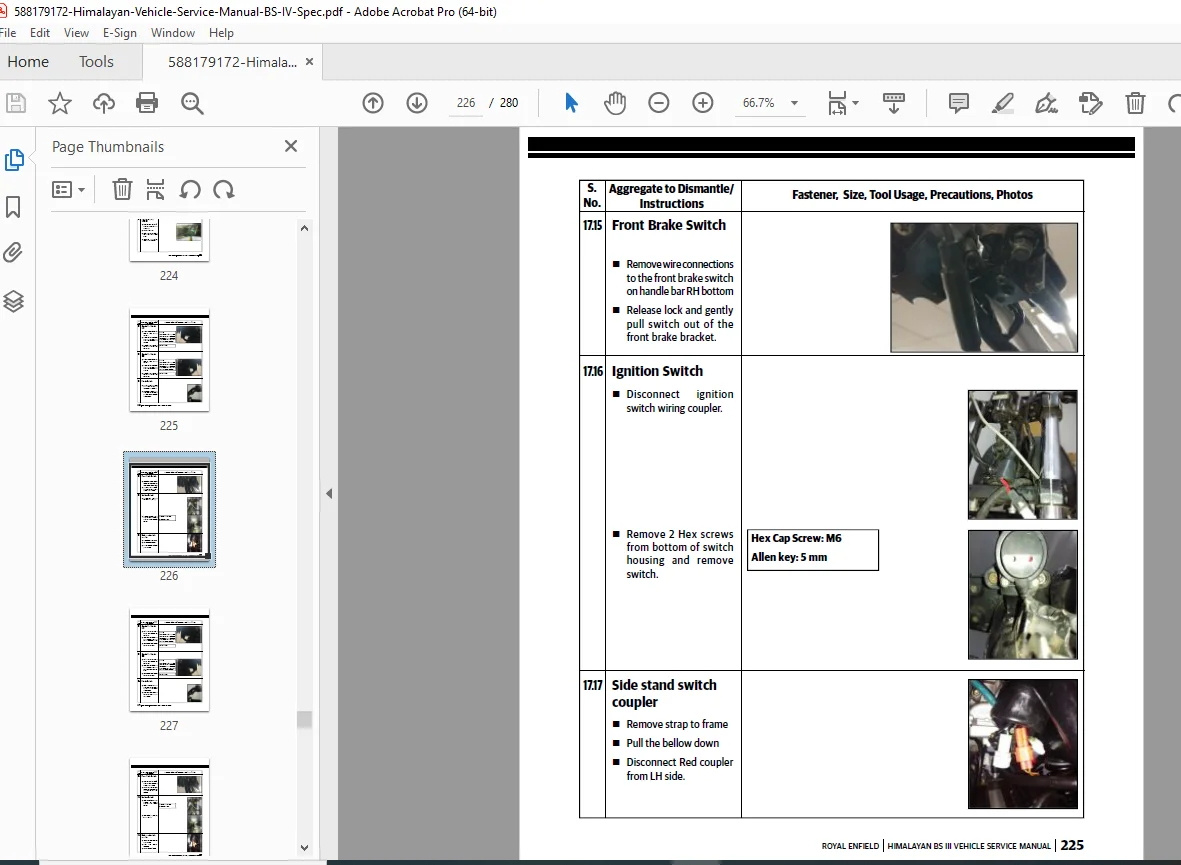
- Switch testing procedures
- Continuity testing
- Voltage drop testing
- Ground point locations
- Electrical troubleshooting flowcharts
SECTION 18: NACS II DIAGNOSIS
- NACS II System Overview:
- Non-Active Code Scan diagnostic system
- Diagnostic connector location
- Connection procedures
- Diagnostic Procedures:
- Entering diagnostic mode
- Reading fault codes
- Code interpretation
- Code clearing procedures
- Live data monitoring
- Fault Code Reference:
- Complete fault code listing
- Code descriptions
- Probable causes
- Corrective actions
- Sensor-specific codes
- Actuator-specific codes
- System-specific codes
- Diagnostic Equipment:
- Required diagnostic tools
- Scanner connection
- Software requirements
SECTION 19: WIRING HARNESS
- Complete wiring diagram
- Color-coded wire identification
- Connector pinouts
- Harness routing diagrams
- Junction box locations
- Ground distribution
- Power distribution
- Individual circuit diagrams:
- Ignition circuit
- Charging circuit
- Starting circuit
- Lighting circuit
- Fuel injection circuit
- Instrumentation circuit
- Safety circuits
SECTION 20: TROUBLESHOOTING
- 20.1 Vehicle Troubleshooting:
- Starting Problems:
- Engine won’t crank
- Engine cranks but won’t start
- Hard starting when cold
- Hard starting when hot
- Running Problems:
- Poor idle quality
- Engine stalling
- Poor acceleration
- Lack of power
- Excessive fuel consumption
- Engine overheating
- Engine Mechanical:
- Unusual engine noise
- Excessive vibration
- Oil consumption
- Oil leaks
- Compression loss
- Transmission Issues:
- Clutch slipping
- Hard gear shifting
- Gear jumping out
- Chain noise
- Electrical Problems:
- Battery not charging
- Lights dim or flickering
- Horn not working
- Turn signals not functioning
- Brake Problems:
- Insufficient braking
- Brake drag
- Spongy brake lever/pedal
- Brake noise
- Handling Issues:
- Steering wobble
- Poor handling
- Suspension bottoming
- Front fork oil leaks
- Starting Problems:
- 20.2 EMS Troubleshooting:
- Fuel injection system faults
- Sensor-related issues
- Throttle body problems
- ECU communication errors
- Emission control system faults
- Diagnostic code interpretation
- Systematic fault isolation
- Component testing procedures
KEY FEATURES OF THIS MANUAL
“FIRST TIME RIGHT” Philosophy:
- Royal Enfield’s commitment to technician skill development
- Scientific repair techniques
- Accurate repair procedures
- Customer satisfaction focus
- Continuous improvement updates
Comprehensive Coverage:
- Complete dismantling and reassembly procedures
- Systematic inspection guidelines
- Detailed diagnosis procedures
- Step-by-step repair instructions
- Torque specifications throughout
BS IV Emission Standards:
- Bharat Stage IV (equivalent to Euro 4) compliance
- EVAP system for fuel vapor control
- Advanced fuel injection system
- Emission control diagnostics
Adventure Motorcycle Specific:
- Off-road usage considerations
- Dusty environment maintenance
- Severe condition service schedules
- Rugged terrain component wear
MAINTENANCE HIGHLIGHTS
Key Service Intervals:
- 500 km / 1.5 months: First free service
- 5,000 km / 6 months: Second free service
- 10,000 km / 12 months: Third free service
- Ongoing: Every 5,000 km or 6 months
Critical Maintenance:
- Valve tappet adjustment at every service
- Chain and sprocket inspection (especially after off-road use)
- Brake system inspection
- Suspension component lubrication
- Electrical connection checks
IDEAL FOR:
- Royal Enfield authorized service centers
- Independent motorcycle mechanics
- Royal Enfield Himalayan owners (DIY enthusiasts)
- Motorcycle technical training institutions
- Adventure motorcycle specialists
- Touring riders performing field maintenance
- Fleet maintenance departments
- Export market service centers
- Military/government fleet technicians
- Motorcycle customization shops
WHY THIS MANUAL IS ESSENTIAL:
The Royal Enfield Himalayan BS IV is a modern fuel-injected adventure motorcycle designed for both on-road and challenging off-road conditions. This comprehensive 280-page service manual provides:
✓ Complete EFI System Coverage – Fuel injection troubleshooting and diagnostics
✓ BS IV Emission Compliance – EVAP and emission control systems
✓ NACS II Diagnostics – Fault code reading and interpretation
✓ Adventure-Ready Maintenance – Off-road and severe condition schedules
✓ 411cc Engine Service – Complete single-cylinder SOHC procedures
✓ Comprehensive Wiring Diagrams – Full electrical system coverage
✓ Suspension Service – 200mm front / 180mm rear travel systems
✓ Brake System – Dual disc hydraulic brake service
IMPORTANT SERVICE NOTICE:
This service manual follows Royal Enfield’s “FIRST TIME RIGHT” philosophy and is intended for use by trained motorcycle technicians. Servicing the Himalayan BS IV requires:
- Understanding of fuel injection and engine management systems
- Knowledge of emission control systems (EVAP, O2 sensors)
- Diagnostic equipment for NACS II system
- Proper torque wrenches and measurement tools
- Understanding of motorcycle chassis dynamics
- Safety awareness when working with fuel systems
Note from Royal Enfield: “While this manual is updated with latest Information and Specifications at the time of going to print, due to continuous improvements being done to improve performance, some of the data, illustrations etc., in this manual may be different from some of the parts fitted in the motorcycle.”
For queries, clarifications, suggestions, or feedback:
Keep your Royal Enfield Himalayan BS IV running perfectly! This official factory service manual provides the same comprehensive information used by Royal Enfield-trained technicians worldwide. With instant PDF download, qualified mechanics and DIY enthusiasts can access this 280-page technical resource immediately. Whether performing routine maintenance, diagnosing fuel injection issues, servicing suspension systems, or troubleshooting electrical problems, this manual is your complete technical reference for adventure-ready reliability.