
Safran Arriel 2E Helicopter Engine Troubleshooting Manual – X292R23002 2024 Update
Original price was: $34.95.$19.95Current price is: $19.95.
Complete troubleshooting manual for the Safran Arriel 2E turboshaft helicopter engine. Document X 292 R2 300 2, updated through Dec. 30/2024. Covers failure codes, HELIONIX indications, fault isolation trees, EDR code mapping, and corrective procedures for every reported engine anomaly.
Description
Safran Arriel 2E Troubleshooting Manual — X 292 R2 300 2
This is the Safran Arriel 2E turboshaft engine troubleshooting manual (Maintenance Manual, Chapter 71-00-06), document number X 292 R2 300 2, original issue December 17, 2012, brought current with Update No. 25 dated December 30, 2024. It is the fault-isolation companion to the Arriel 2E maintenance manual — the document a technician opens when the engine or the airframe avionics reports something that should not be there.
The manual is organised around the way failures actually present themselves: first a list of what the pilot may observe in flight, then a list of what the maintainer finds on the ground, then the failure-code tables, and finally a dedicated troubleshooting task for every entry. Each task gives the possible causes, the reference documents, and a box-by-box decision tree that walks you from symptom to root cause to the correct removal, replacement, or adjustment.
File Details
- Manual type: Maintenance Manual — Troubleshooting (Chapter 71-00-06)
- Brand: Safran Helicopter Engines (Turbomeca)
- Engine model: Arriel 2E turboshaft
- Language: English
- Page count: Approximately 766 pages (including the List of Effective Pages, Table of Contents, failure lists, failure-code tables, and troubleshooting tasks)
- File format: PDF
- Document number: X 292 R2 300 2
- Original issue: December 17, 2012
- Current revision: Update No. 25 — December 30, 2024
Chapters and Sections Covered
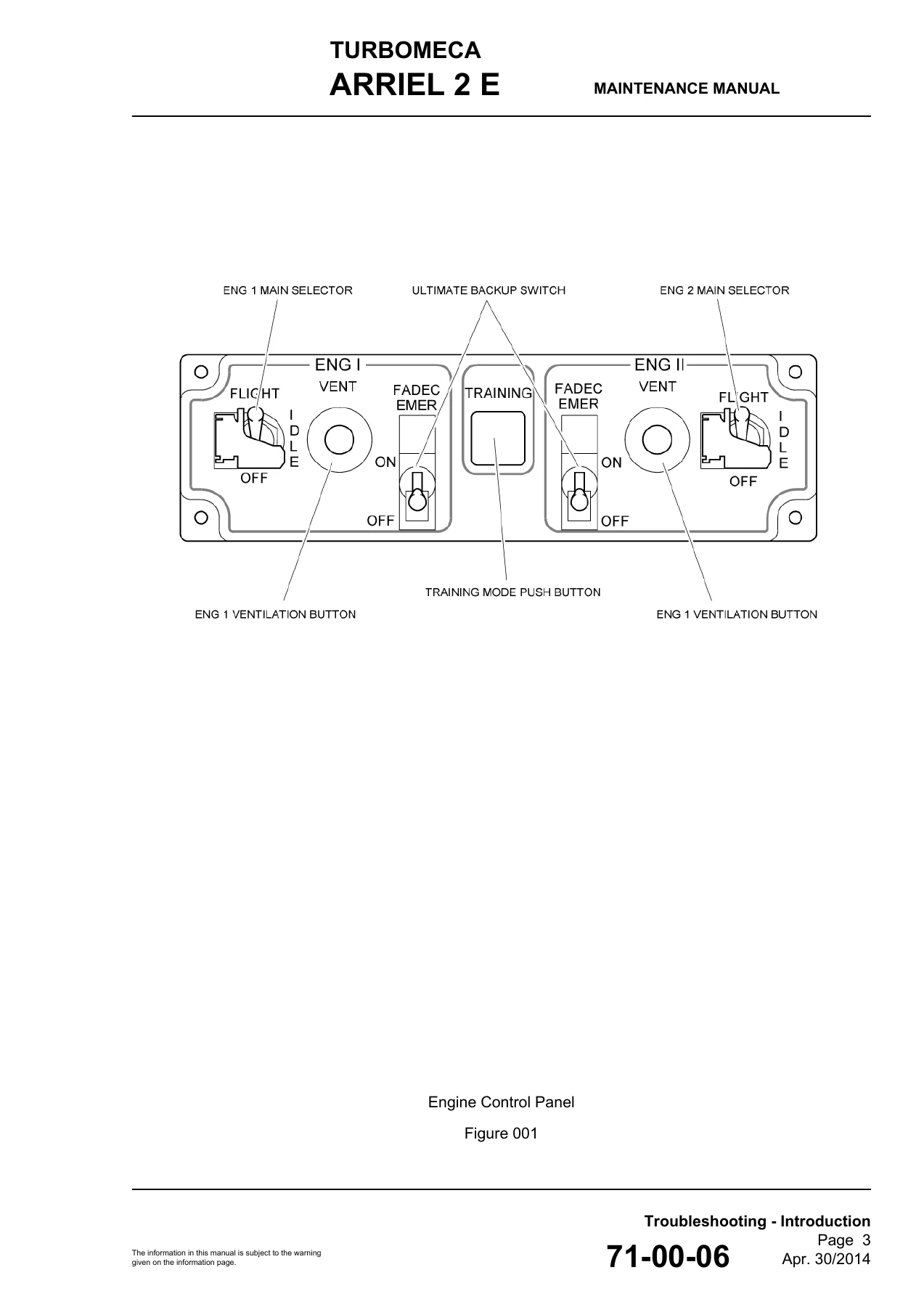
- 71-00-06 — Troubleshooting — Introduction (manual layout, troubleshooting advice, engine control in the cockpit, engine indication in the cockpit)
- Warning Unit indications — ENG 1 FAIL, ENG 2 FAIL
- HELIONIX avionics overview — operational mode and maintenance mode
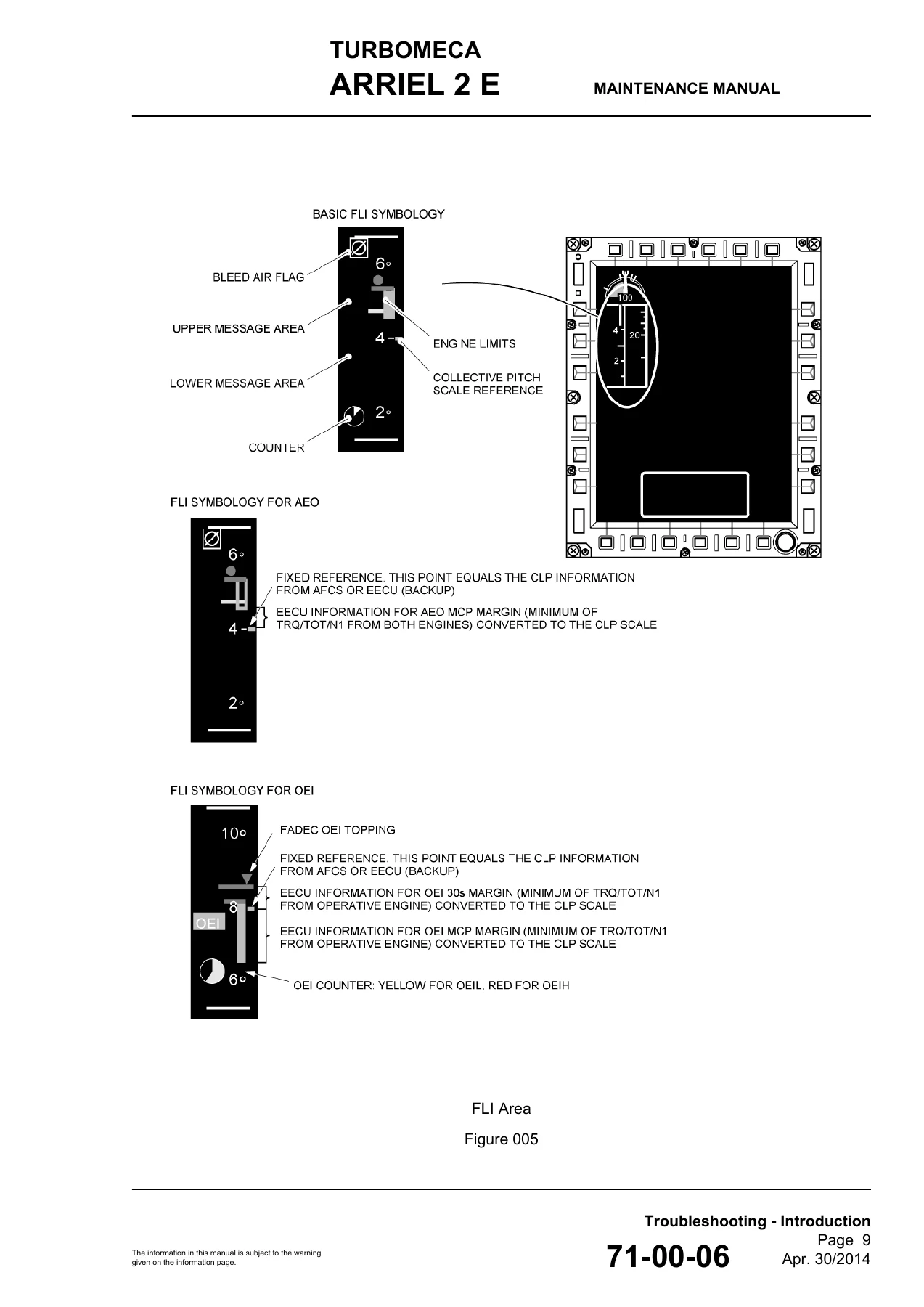
- Flight and Navigation Display (FND) — First Limit Indication area, Master List, N2/Rotor speed
- Vehicle Management Display (VMD) — engine parameters, EECU status, bleed air/valve status, free turbine speed
- Flight Report pages — TOT/N1/N2/TRQ exceedance reports, chip detection, engine service needed
- System Status Page — CLP, T1, P0, N2, N2 datum, fuel temperature
- EPC (Engine Power Check) page
- Maintenance Mode — Level 1 and Level 2 failure displays
- List of failures observed during engine operation — at power up, at starting, engine running, at shutdown
- List of failures observed during maintenance — smoke at exhaust, fuel filter by-pass, fuel dilution, ignition device lines, particles on magnetic plug, abnormal oil consumption, abnormal oil pressure, EPC margin, oil leaks, purge valve test
- List of HELIONIX failure codes — current failures, EDR failure-code equivalence table
- Troubleshooting tasks — oil leakage of the transmission shaft
- Troubleshooting tasks — engine parameter out of limit: T4.5 overtemperature during start, torque limitations, N1 limitations, N2 limitations
- Troubleshooting tasks — aborted start: gas generator not driven, no ignition, slow start or stagnation, flame out during start, first start aborted, flames at the exhaust pipe
- Troubleshooting tasks — helicopter rotor movement after usual time during engine start, surge
- Troubleshooting tasks — metal particle indication
- Troubleshooting tasks — fuel filter pre-clogging or clogging indication, low fuel pressure indication
- Troubleshooting tasks — unusual oil pressure instability, low oil pressure indication, oil over temperature, T4.5 over temperature during flight, torque parameter instability, fuel over temperature, max oil pressure exceeded, oil flow interruption, LP fuel pump pressure
- Troubleshooting tasks — N2 overspeed detection, oil filter pre-clogging, OEI N1/T4.5 rating used during previous flight, OEI N1/T4.5 exceeded
- Troubleshooting tasks — unusual noises during rundown phase, rundown time out of limit, power turbine blocked
- Troubleshooting tasks — smoke at the exhaust, fuel filter by-pass indication, fuel dilution rate in oil not compliant, incorrect operation of one of the ignition device lines, particles on magnetic plug or oil filter, abnormal oil consumption, abnormal oil pressure, engine power check incorrect margin, oil leak at bleed valve or air intake, chip detection system failure, oil leakage of the power drive of the starter, incorrect purge test of the injection wheel purge valve
- Troubleshooting tasks — watchdog failure, invalid training request, off/idle/flight selector failure, T1 inconsistency between engine 1 and engine 2, collective pitch position failure, TOT (T4) failure, T0 inconsistency between engine and helicopter, P3 failure, raw torque failure, TOT (T4) conformation failure, torque conformation failure, EECU internal failure, P3 drift, engine P0 failure
- Troubleshooting tasks — inconsistency between P0 and P3, fuel valve resolver failure, stepper motor failure, bleed valve position inconsistency, EECU cross-talk failure, NR datum failure, EECU/aircraft configuration inconsistency, N2 failure channel B, EECU interchannel failure, N2 failure channel A, N2 inconsistency between channels A and B, N1 failure channel A, N1 failure channel B, N1A/N1B inconsistency
- Troubleshooting tasks — ARINC failure, alternator A failure, alternator B failure, 28 volt failure, P0 inconsistency between engine and helicopter
- Troubleshooting tasks — stop electro-valve failure, helicopter or other engine P0 failure, TOT (T4) 1 / TOT (T4) 2 inconsistency, increased NR inhibition request inconsistency, NR datum inconsistency between engine 1 and engine 2, NR N2 inconsistency, OEI selector failure, training request inconsistency, fast flame out, engine T1 failure, helicopter or other engine XPC failure, P0 inconsistency between engine 1 and engine 2, helicopter or other engine T1 failure, torque drift, N2 torque failure
- Troubleshooting tasks — oil pressure (filter input) failure, oil pressure inconsistency, oil pressure (filter output) failure, oil temperature failure, fuel pressure (filter inlet) failure, fuel pressure inconsistency, fuel pressure (filter output) failure, fuel temperature failure
- Troubleshooting tasks — EDR not available, EDR data invalid, invalid helicopter NR, NR datum inconsistency between channel A and channel B, invalid installation losses, invalid power off-take, invalid helicopter data, slow P3 drift, invalid helicopter ID, invalid ultimate back-up request, ultimate back-up request inconsistency, engine 1 XPC / engine 2 XPC inconsistency, engine XPC / helicopter XPC inconsistency, engine 1 engine 2 inconsistency
- Troubleshooting tasks — FADEC 1 (or 2) signal fail on master list, overspeed continuous built-in test failure, overspeed inhibition by the CSS, overspeed PBIT failure CAM activation, overspeed PBIT failure cross inhibition, overspeed protection failure, failure indication on master list, EECU-EDR conformation inconsistency, ARINC 429 not received by aircraft, validity collective pitch, engine chip sensor failed, power split sensor fail, N1C speed sensor failure, engine oil temperature failure, engine oil pressure failure, N2 failure, N1 failure, T1 failure, EECU P0 failure, N1C speed sensor failure (FRHI code)
IMAGES PREVIEW
What This Manual Gives You
The Arriel 2E is a FADEC-controlled turboshaft, and most of what goes wrong shows up first as an avionics message, a maintenance flag, or a flight-report entry rather than as something you can see on the engine. This manual bridges that gap. It tells you what each HELIONIX indication and each EDR failure code actually means, then hands you a structured troubleshooting tree so you are not swapping parts on a hunch.
The failure-code tables are the backbone. Every code that the EECU can raise — N1, N2, T4, torque, P3, P0, T1, oil pressure, oil temperature, fuel pressure, fuel temperature, alternator, ARINC, stepper motor, resolver, bleed valve, stop electro-valve, EDR, overspeed, chip detection — has an entry with the HELIONIX wording, the failure code number, and a pointer to the task that fixes it. The EDR-to-HELIONIX code equivalence table lets you cross-reference when the aircraft only exposes the EDR tool rather than the maintenance page.
For starting problems the manual separates the failure modes properly: gas generator not driven, no ignition, slow start or stagnation, flame out, first start aborted, flames at the exhaust pipe. Each has its own tree and its own list of likely causes, so a hot start is not treated the same as a hung start. For running problems it covers the exceedance cases — T4.5, torque, N1, N2, oil pressure, oil temperature, fuel pressure, fuel temperature — and the sensor/conformation failures that can make a good engine look bad.
Who This Manual Is For
This troubleshooting manual is written for Arriel 2E engine maintenance personnel — the people who read the maintenance flags, pull the EDR data, and decide what to remove, replace, or adjust. It assumes access to the airframe maintenance manual, the engine maintenance manual, and the test equipment called out in the tasks, and it references those documents by task number throughout.
If you are maintaining, inspecting, or returning an Arriel 2E to service after a reported failure, this is the document that turns the fault indication into a repair action.
Get the Safran Arriel 2E Troubleshooting Manual
With the Safran Arriel 2E Troubleshooting Manual X292R23002 on hand you can diagnose and correct the full range of Arriel 2E engine faults: identify the exact failure code, follow the correct isolation tree, confirm the root cause, and carry out the specified repair rather than guessing. Correct fault isolation matters — a misdiagnosed Arriel 2E fault can lead to unnecessary module removal, repeat maintenance flags, or a return to the shop for a problem that was never where it was thought to be.
The manual is delivered as an instant PDF download after payment. No shipping, no waiting, no physical media. Read it on a laptop, tablet, or phone in the hangar, print the specific task pages you need for the job, and keep the full document on file for the next aircraft.
Reviews
There are no reviews yet.