
Sandvik DD321 Drill Rig Operator’s Manual – BG00200922 PDF
Original price was: $34.95.$19.95Current price is: $19.95.
Complete 296-page factory operator’s manual for the Sandvik DD321 underground drill rig. Covers safety, tramming, boom and drilling controls, daily maintenance and operator troubleshooting. Instant PDF download.
Description
The Sandvik DD321 is a twin-boom underground drill rig built for drifting, tunnelling, face drilling, cross-cut drilling and bolt hole drilling in underground mines. This Sandvik DD321 Drill Rig Operator’s Manual is the factory operating guide for the machine, issued under document number BG00200922 (edition en-US F.001.1, dated 2015-07-01). Across 296 pages it takes the operator through every stage of running the rig safely and productively — daily walk-around inspection, diesel engine start-up, tramming, boom positioning, percussion drilling, shut-down, and the operator-level maintenance tasks that keep the machine working shift after shift.
File Details
- Manual type: Operator’s Manual
- Brand: Sandvik
- Product: DD321 drill rig
- Document number: BG00200922
- Edition / revision: en-US F.001.1
- Publication date: 2015-07-01
- Language: English
- Page count: 296
- File format: PDF
- Manufacturer: Sandvik Mining and Construction Oy, Tampere, Finland
What the DD321 Operator’s Manual Covers
The manual follows Sandvik’s own chapter structure, from the introduction through to operator troubleshooting. Inside you will find:
- 1. Introduction — purpose of the instructions, product identification (type plate, serial number, manual identification), copyright, definitions
- 2. Safety and environmental instructions — signal words, mandatory and prohibited action symbols, hazard symbols, labels on the product, user obligations, PPE, product limitations, hazard zones, guards and protective devices, emergency stop, emergency exit, isolation and energy dissipation, fire risk control measures (including ANSUL and FS1000 fire suppression), emission hazards, emergency procedures, environmental and disposal instructions
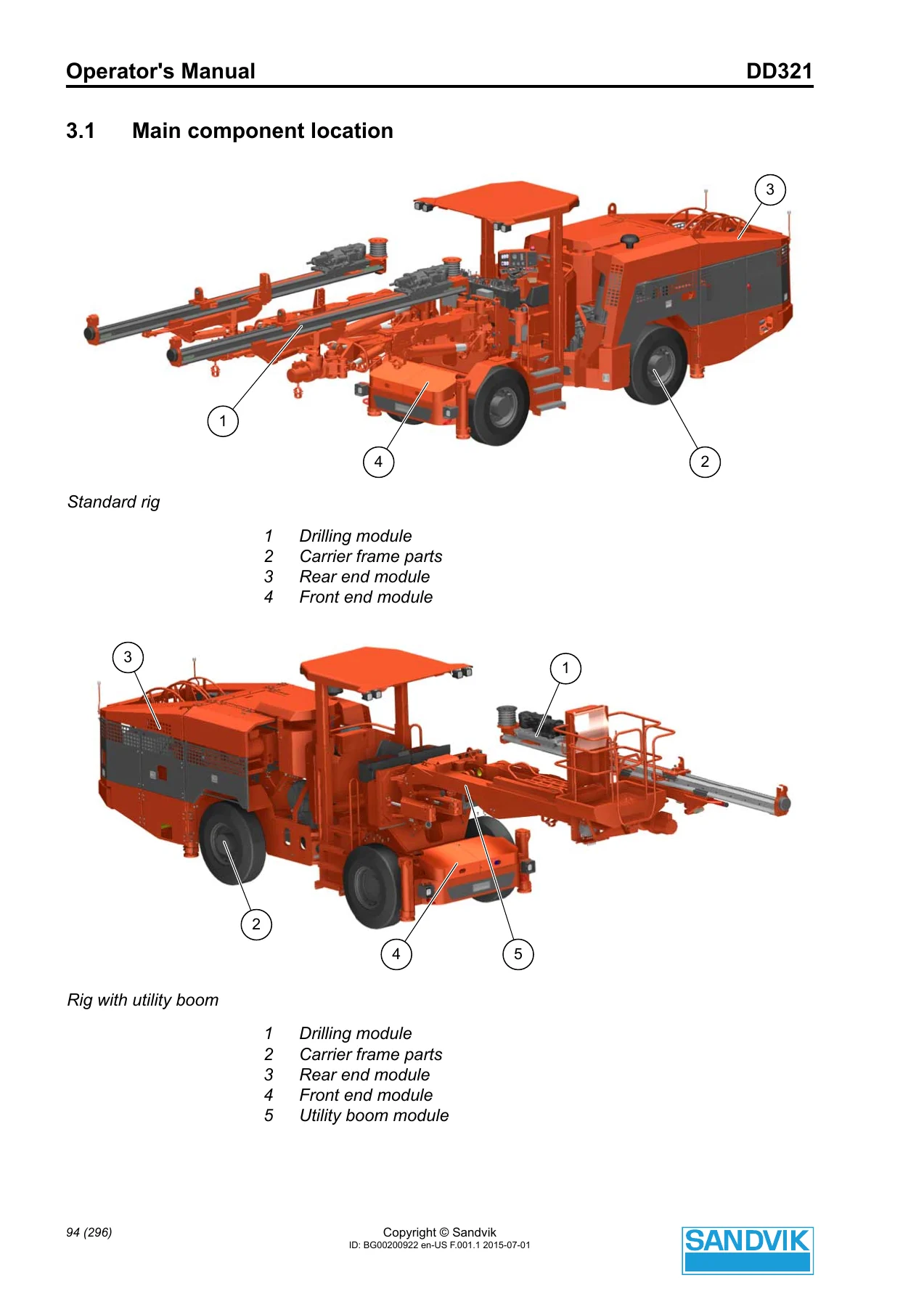
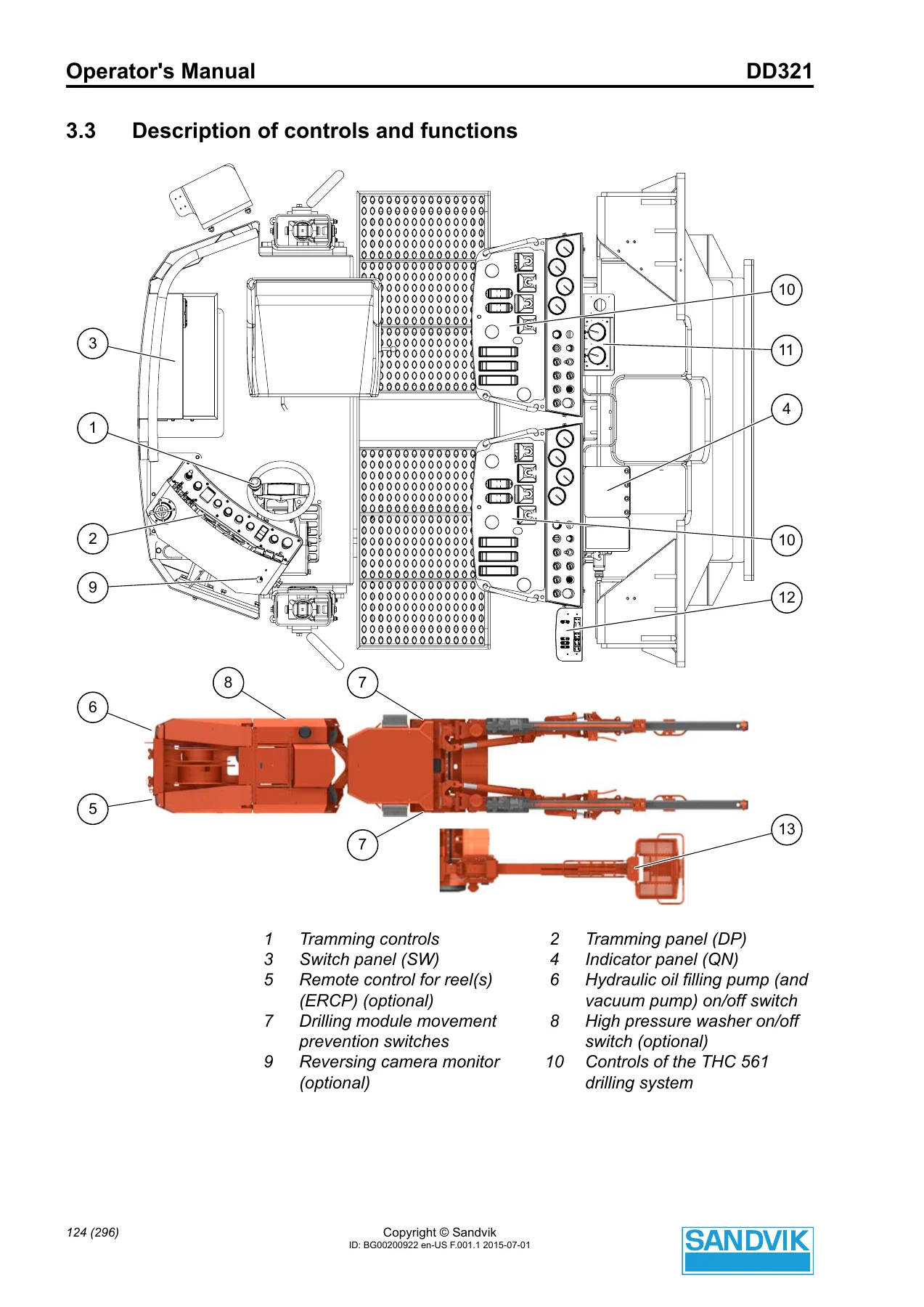
- 3. Machine description — main component location, drilling module, carrier frame parts, rear end module, front end module, utility boom module, machine orientation, controls and functions (tramming panel, switch panel, indicator panel, drilling system panel, utility boom control panels), main fuses and circuit breakers
- 4. Operating instructions — starting and stopping the diesel engine, tramming controls, speed range and driving direction, steering, braking, parking, positioning at the drilling site, boom controls, utility boom controls, drilling controls, percussion drilling principles, collaring, reaming, anti-jamming automatics, threading, flushing, drilling parameters, operation prevention functions
- 5. Operator’s maintenance instructions — daily checks, hydraulic rock drills (RD520/RD525, RD314, HLX5), booms (SB20/SB20NV/SB40/SB40NV), SUB utility boom, feeds (TF/TFX, CF), carrier, diesel engine MB, cable and water hose reel, drilling hydraulics, water circuit, air circuit, compressors (CTN and CT), SLU, electric system, grease reservoir
- 6. Additional instructions — towing, transport, lifting, reassembly after transportation, storage, washing
- 7. Troubleshooting — operator troubleshooting instructions
Taken as a whole, the manual is not simply a list of steps. It explains why each step matters — how percussion, feed, rotation and flushing interact, what maximum inclination angles apply during tramming versus drilling, which parameters cause drill steel wear, which faults the rig will throw and what they mean. That structure is what makes it usable as a training document, a shift-level reference and a first-line fault-finding aid.
Safety and Environmental Instructions
The safety chapter is the longest in the book and is written around the actual hazards of an underground drilling jumbo rather than generic warnings. It reproduces the DANGER, WARNING and NOTICE signal words used on the machine, shows every mandatory and prohibited action symbol, and maps the location of the safety, information and symbol labels on the articulation area, drilling module, front frame, rear frame and operator station. Hazard symbols cover mechanical, electrical, thermal, noise, radiation, material/substance and ergonomic risks, each with the specific hazard and the consequence of contact spelled out.
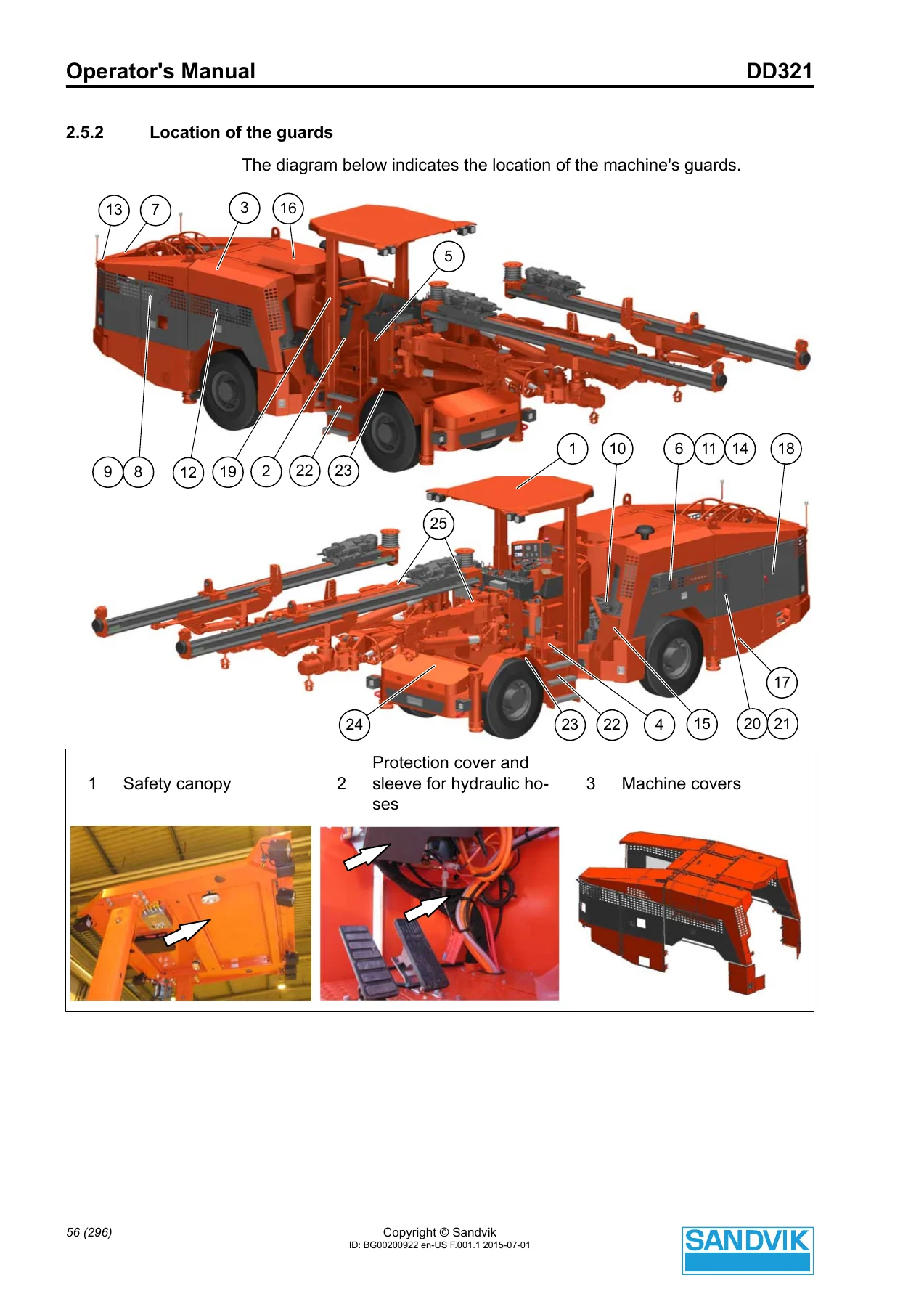
Practical sections deal with product limitations (intended use, prohibited use, centre of gravity, maximum inclination angles, operator visibility), hazard zones during tramming and drilling, the location of every guard and protective device on the rig — FOPS canopy, seat belt, carrier frame joint locking bar, articulation wire-rope, basket safety gate, safety wire on the feed — and the correct procedure for isolating and dissipating stored hydraulic, air, fuel and electrical energy before maintenance.
Operating the DD321
The operating chapter walks through the full working shift. Starting the diesel engine — including cold-starting below -20 °C — is followed by the checks to make once the engine is running, with the normal reading for every gauge (engine oil pressure, engine temperature, transmission pressures, voltmeter, front and rear brake pressures). The tramming section then covers the pre-tramming inspection, brake testing, tramming position, selecting speed range and driving direction, steering, braking, parking and positioning at the drilling site, along with the correct order for extending and lowering the front jack beam and jacks.
Boom control chapters explain how the four control levers drive lift, swing, zoom, head rotation, feed tilt, feed swing and feed transfer, with their combined functions with the bolting cylinder. The drilling section is a short course in percussion drilling: the relationship between percussion, feed, rotation and flushing, drill steel selection (shank, coupling sleeve, extension rods, MF rods, guide tubes, drill bits), collaring, reaming, the anti-jamming automatics, threading on and off, flushing control, and the factory test drilling parameters for a 9-button, Ø 45 mm bit with HLX5 rock drill and TF feed. A table of symptoms and faults helps diagnose incorrect percussion pressure, rotation speed, feed force and flushing pressure from the way the rig behaves and sounds.
Operator Maintenance and Daily Checks
The operator maintenance chapter contains the daily checklist the manual expects the operator to complete. It is organised by assembly and covers the horn, working and driving lights, gauges, emergency stop devices, rock drills (RD520/RD525, RD314, HLX5), booms, SUB utility boom, feeds, carrier (tyres, transmission oil level, hydraulic oil level), diesel engine MB (coarse filter, fuel level, water separator, engine oil, coolant), cable and water hose reel, drilling hydraulics, water circuit, air circuit, compressors CTN and CT, SLU, electric system, and the grease reservoir. Where a check needs a specific figure — tyre pressure and tightening torque, tightening sequences for utility boom mounting bolts, brake pressures — the value is given, so the operator is not left guessing.
Troubleshooting for the Operator
The closing chapter lists the faults an operator can realistically encounter and the checks to make before calling a technician: diesel engine will not start, power pack will not start, soft starter or main contactor issues on different voltage systems, power pack stops, and automatic drilling stopping after 30 seconds. Each fault is paired with the sequence of checks — battery isolation switch, parking brake, main power, fuses and circuit breakers, drive selector position, emergency stop devices, water pump and compressor switches, shank lubrication fault indicator.
Additional Instructions — Towing, Transport, Lifting, Storage
The final operating chapters cover the tasks that sit outside the normal shift: towing (preparing the rig, towing points, towing with and without brakes, releasing the parking brakes, restoring them afterwards), transport, lifting, reassembling the rig after transport (drilling booms, utility boom, reassembly check-up), storage conditions and washing. The towing and brake-release procedures in particular include torque and adjustment figures that are not published anywhere else in the operator documentation.
Why the Sandvik DD321 Drill Rig Operator’s Manual Matters
Whether you are running a DD321 on site, taking delivery of a used rig, or training a new operator, this Sandvik DD321 operator’s manual is the reference that keeps the machine inside its limits. It tells you the maximum inclination angles that are safe to tram at, the brake pressures that have to be present before you release the parking brake, the feed and percussion settings that give good penetration without destroying drill steel, and which warning lights mean stop and which mean carry on. Working from the correct factory procedures is the difference between a machine that reaches its full service life and one that spends its days in the workshop.
Because the manual is a single, complete document for one machine, it also works as a training aid — every procedure is written for an operator, not a specialist, and each one is grounded in the actual layout of the DD321. It is a document you can hand to a new operator on their first shift and expect them to use.
IMAGES PREVIEW
Delivered as an instant PDF download. No shipping, no waiting. The file opens on any device — desktop, tablet or phone — and every page is printable, so you can keep a working copy in the cab and a clean copy in the office. Buy once, download immediately and start using the DD321 the way Sandvik intended it to be used.
Reviews
There are no reviews yet.