

SANY Hydraulic Excavator Service Training Manual PDF Download
Original price was: $29.95.$18.95Current price is: $18.95.
SANY hydraulic excavator service training manual with 372 pages on model coding, electronics, hydraulics, engines, troubleshooting and the Zexel fuel system.
Description
SANY Hydraulic Excavator Service Training Manual
This SANY hydraulic excavator service training manual is a 372-page training presentation prepared for overseas dealers and attributed in the document to Andy Liu. It is not limited to a single excavator model: the training explains SANY excavator structure and model coding, electronic controls, hydraulic operation, engine systems and the Zexel fuel system, using multiple machine families and configurations as examples. The result is a broad educational reference for technicians learning how the machine systems interact and how service information, monitor functions and diagnosis are approached.
What the Training File Contains
- Brand: SANY
- Document: Sany Hex Service Training For Overseas Dealers
- Manual type: Training / Educational
- Language: English
- Pages: 372
- Format: PDF
- Presenter/author shown: Andy Liu
Five Main Training Chapters
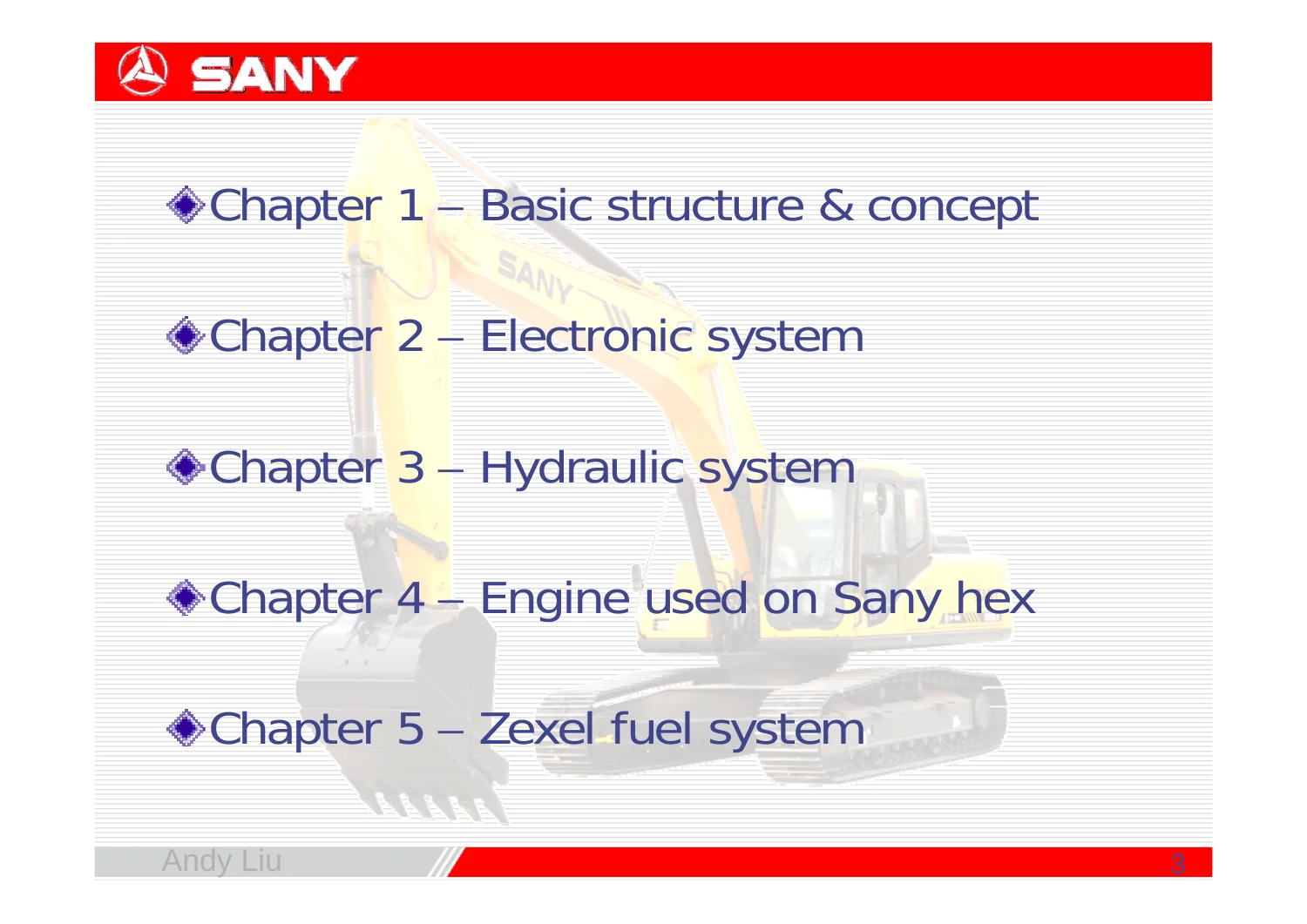
- Chapter 1 – Basic structure & concept
- Chapter 2 – Electronic system
- Chapter 3 – Hydraulic system
- Chapter 4 – Engine used on Sany hex
- Chapter 5 – Zexel fuel system
Model Coding and Machine Configurations
Early slides explain how a SANY excavator product/model code is built. The example SY235C8I2K is broken into brand, excavator weight class, design/update information, engine/emission designation and hydraulic-system designation. Engine-code slides define I2 as Isuzu Tier II, I3 as Isuzu Tier III, M2 as Mitsubishi Tier II, M3 as Mitsubishi Tier III and C3 as Cummins Tier III. The K suffix in the example is identified with a Kawasaki hydraulic system. A model table then gives explicit configurations including SY135C8I2K, SY135C8I3K, SY205C8C3K, SY205C8M2K, SY215C8C3K, SY215C8M2K, SY215C8I3K, SY235C8C3K, SY235C8I2K and SY240C8I3K.
Later controller and calibration training names additional SANY excavator examples: SY135C8, SY235C8, SY230C8, SY420C, SY460C, SY425C, SY465C, SY700C, SY850C, SY230R, SY310R, SY420R, SY460R, SY335C8, SY365C8, and compact models SY55C, SY65C, SY75C and SY95C. These references appear in the context of monitor/controller combinations and engine-speed calibration, so the PDF is best treated as multi-model SANY service training rather than a model-specific workshop manual.
Electronic Controls, Monitor Functions and Diagnosis
The electronic-system section identifies four key functions: engine speed control, main hydraulic-pump power control, electric energy-saving control and auxiliary electrical functions. It shows monitor information, machine-configuration inquiry, engine and hydraulic-system identification, trouble-information inquiry and code-based troubleshooting. The training explains that failure codes can be displayed in sequence and used to identify likely failed parts. It also shows examples such as code 41 for engine speed too slow under a key-on/engine-off condition and abnormal trouble 34 represented through an indicator blink pattern. Rather than presenting codes as isolated numbers, the material emphasizes a troubleshooting process, circuit checks, relay substitution tests, connector and wiring logic and experience-based fault isolation.
Hydraulic System Training
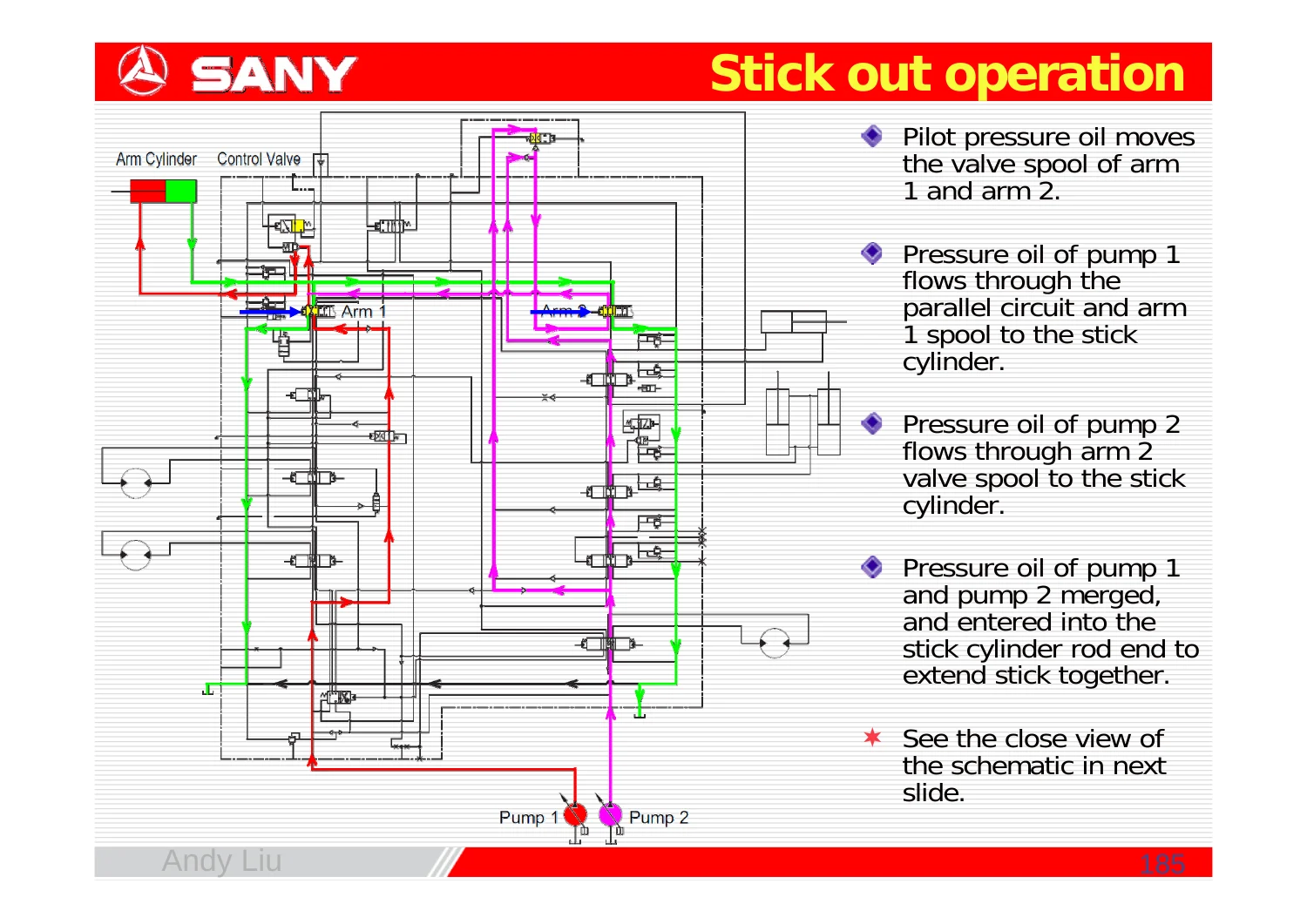
The hydraulic chapter describes NFC and PFC arrangements, pressure-sensor feedback, proportional control and pump displacement control. It states that the system uses two pumps and two circuits with constant horsepower control and four working modes. The material follows pump control, pilot circuits, main valve logic, boom, arm, bucket, swing and travel functions, high/low travel switching, travel damping, hydraulic filters and hydraulic schematics. A SY205C/SY215C hydraulic schematic identifies components such as arm regeneration and holding valves, bucket confluence check valve, boom holding valve, main spill valve, straight tracking valve and swing-priority elements. Pilot-circuit slides map boom up/down, stick in/out, left/right swing, bucket in/out and left/right travel signals.
Engine and Fuel-System Learning Material
The engine chapter breaks the diesel engine into basic components, fuel, inlet/exhaust, lubrication, electrical and cooling systems. It names cylinder block, cylinder head, crankshaft, connecting rod, piston, turbocharger, injection pump, injector, governor/actuator, ECM and sensors, along with oil pump, oil cooler, alternator, starter and radiator. Practical operating references include a warm-up period of 10 minutes below 1000 rpm and after-start engine-oil pressure of 290~590 kPa. The training also gives H mode at 2200 rpm, L mode at 1950 rpm, S/B mode control at 2150 rpm and automatic idle at 1400 rpm in the electronic-control discussion.
The final Zexel section follows fuel transfer and priming, the injection pump, plunger/rack operation, injector behavior, governor functions and workbench checks. Slides explain bleeding after filter service, fuel contamination concerns and injector test concepts. It is training material aimed at understanding the system and service logic rather than a replacement for a model-specific parts catalog or a single-machine service specification book.
Calibration, Inspection and Practical Service Context
The course also spends time on calibration and service workflow rather than only component theory. It identifies several controller approaches for engine-speed calibration, including SANY SEHC through the monitor, KCM with a setter and EC-7 with a calibration/short-plug method. The monitor examples distinguish configurations used on larger C8/R machines and compact SY55C/SY65C/SY75C/SY95C machines. The general throttle-calibration sequence moves through numbered throttle positions and confirms completion at the monitor, while related slides discuss working-mode selection and automatic idle behavior.
Practical inspection slides reinforce the system training. They call for checks of fluid levels, filters, leakage, wiring and machine condition, and they describe after-start observations such as battery charging, engine sound, smoke color, coolant condition and oil pressure. Before shutdown after extended work, the training instructs the operator to unload the excavator, return joysticks to neutral, reduce engine speed gradually, allow a low-idle cool-down period, release accumulator pressure and secure the machine. These points help place the electronic, hydraulic and engine diagrams in the context of how a technician actually observes and evaluates the excavator before disassembly.
Training Reference Values and Topics
- Model-code example: SY235C8I2K
- I2 engine code: Isuzu Tier II engine
- I3 engine code: Isuzu Tier III engine
- M2 engine code: Mitsubishi Tier II engine
- M3 engine code: Mitsubishi Tier III engine
- C3 engine code: Cummins Tier III engine
- K suffix in model-code example: Kawasaki hydraulic system
- Hydraulic system architecture: Two pumps, two circuits
- Hydraulic control: Constant horsepower control
- Working modes: Four working modes
- NFC: Neutral Flow Control system (C8 before)
- H mode engine speed: 2200 rpm
- L mode engine speed: 1950 rpm
- S mode / B mode control: 2150 rpm
- Automatic idle control: 1400 rpm
- Engine warm-up guidance: 10 minutes below 1000 rpm
- After-start engine oil pressure: 290~590 kPa
- Trouble-code examples shown: 41 and 34
Build a Better Diagnostic Picture Before You Repair
For a technician working across several SANY excavator generations, this training PDF can be used to decode machine configurations, understand controller/monitor behavior, follow hydraulic signal flow, review engine fundamentals and approach trouble codes with the system logic shown in the slides. That context can make later model-specific service work more disciplined because the technician knows what signals, pressures, controllers and hydraulic functions are supposed to be doing before replacing parts. Delivery is by instant PDF download immediately after payment, with no shipping or waiting; the file can be opened on phone, tablet, laptop or workshop PC and printed for training-room or bench reference.
Reviews
There are no reviews yet.