
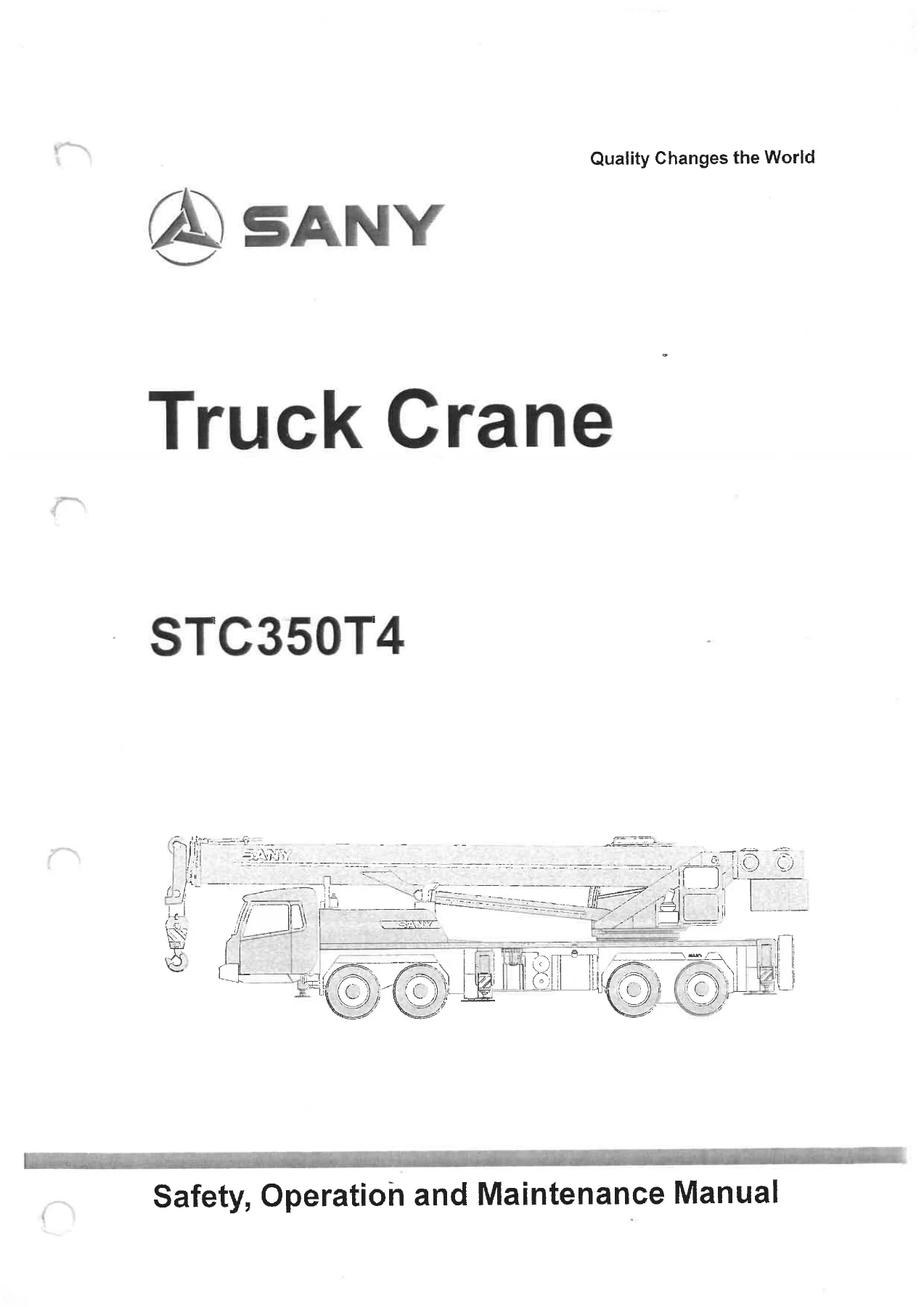
SANY STC350T4 Truck Crane Safety, Operation & Maintenance Manual – Full PDF Workshop Guide
Original price was: $74.95.$49.95Current price is: $49.95.
Complete SANY STC350T4 Truck Crane Safety, Operation and Maintenance Manual (July 2021). Covers engine, axles, transmission, brakes, outriggers, boom, hoist, swing, hydraulics, LMI system, troubleshooting and specifications. Instant PDF download.
Description
This is the complete SANY STC350T4 Truck Crane Safety, Operation and Maintenance Manual — the July 2021 SOM publication covering the carrier, superstructure, and every system the operator and maintenance technician needs to run this machine safely and correctly. From pre-start checks and outrigger setup through lifting operations, routine maintenance intervals, hydraulic diagnostics, and full specifications, this is the reference document that ships with the STC350T4 and stays with the machine for its working life.
File Details
- Manual type: Safety, Operation and Maintenance Manual (SOM)
- Brand: SANY
- Model: STC350T4
- Language: English
- Page count: 466 pages (file position)
- Publication date: July 2021
- File format: PDF
Chapters Covered
- 1. Introduction
- 2. Safety
- 3. System Functions
- 4. Operation
- 5. Maintenance
- 6. Troubleshooting
- 7. Specifications
Introduction and Documentation Package
The opening chapter explains how the manual is organized, what the complete documentation package includes — the SOM manual, Load Charts, brake/hydraulic/electrical schematics, and the Parts Book — and where to find the machine’s key data plates. Serial number locations are documented for the product identification plate (left side of the operator’s cab), the engine identification plate, the swing motor data plate, and both the main and auxiliary hoist motor data plates. A correction request form is provided for reporting manual errors, and full SANY contact information is listed for technical support and parts ordering.
Safety — General and Product-Specific
This is the chapter every operator should read before touching the machine. It starts with general safety principles, hazard alert definitions, and the responsibilities of the supervisor, owner, operator, and signal person. Hand signals are documented with illustrated diagrams — hoist up, hoist down, use main hoist, use whip line, raise boom, lower boom, swing, stop, emergency stop, travel, dog everything, extend/retract boom, and the combined boom/load movements. Job site safety covers permissible ground pressure by soil type, slopes and ditches (minimum safety clearances A and B, load entry angle, slope angle), crush and pinch-point precautions, and wind speed limits with a full Beaufort scale table. Electrical hazard clearances are listed by cable voltage, with separate procedures for high-voltage areas and transmitter/communication towers. Fire safety covers fuel/oil/hydraulic/electrical fires, extinguisher and first aid kit requirements, dust hazards, and environmental precautions.
Product-specific safety covers authorized versus unauthorized use, driving precautions, and crane stability and structural integrity — including the critical rule that the crane carrier must be level before any lifting or swinging occurs, and that all four outrigger beams must be equally extended to the fully extended position before operation. Operational aids, personal protective equipment, personnel handling, and lockout/tagout procedures are also fully documented. Maintenance safety covers cold-weather maintenance, preparing for maintenance, correct tools, rotating parts, jacking, high-pressure fluid lines, accumulators, refueling, adding fluids, and battery safety.
System Functions — Carrier and Superstructure
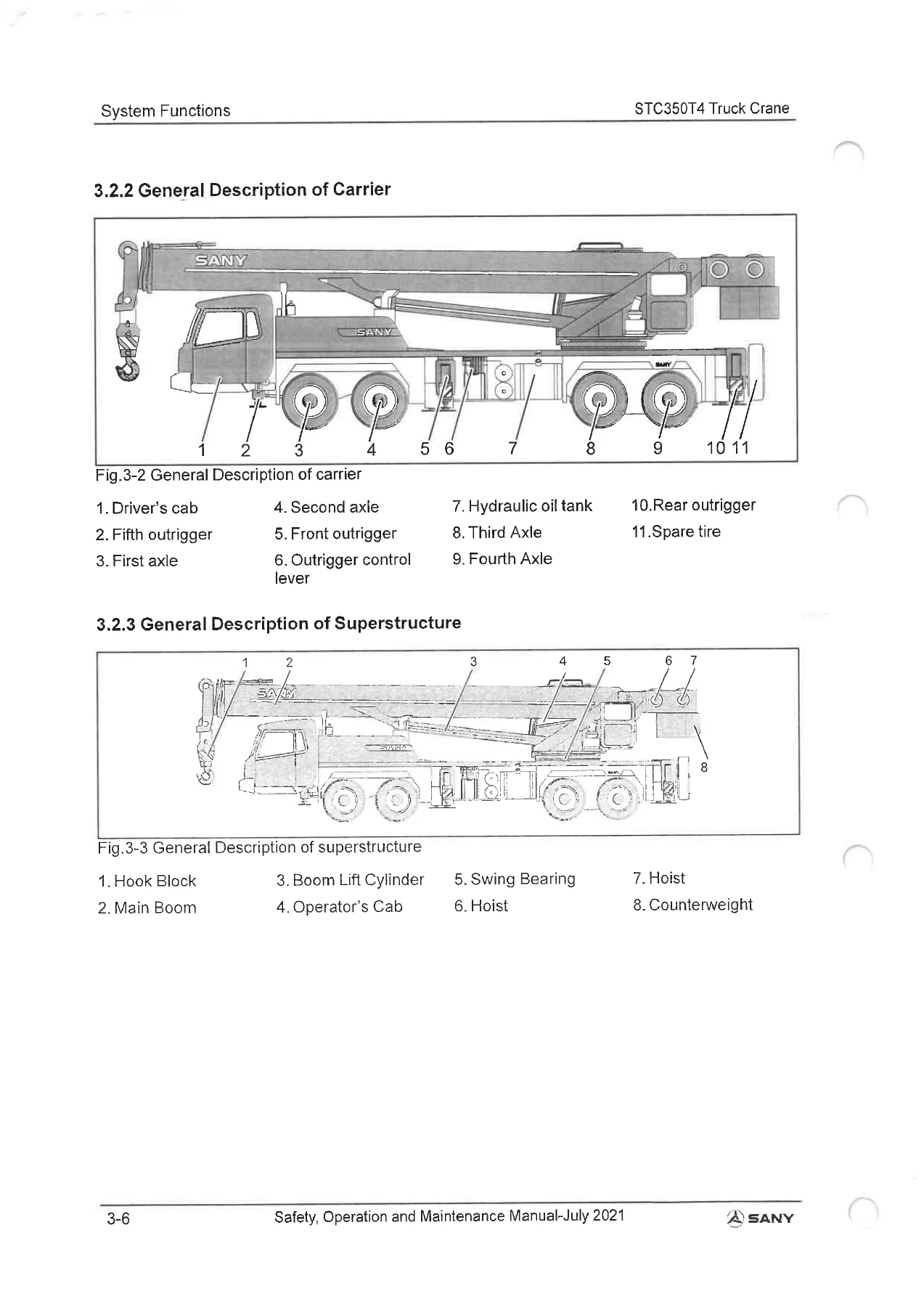
The System Functions chapter is the identification and operating reference for every control in the machine. Directional positions (front, rear, left, right) are defined against an overhead diagram. The carrier section walks through the driver’s cab layout, front instrument panel, A/C and heater control panel, the multi-function gauge (tachometer, fuel gauge, engine coolant thermometer), and the full warning/indicator lamp panel — charge indicator, engine oil pressure, engine coolant temperature, brake air pressure, travel reverse, power, preheat, rear fog lamps, high-beam, unlocked door, coolant level, parking brake, engine stop, PTO, transverse and longitudinal differential locks, fuel level, and exhaust brake. Speedometer, status display screens, control button panel switches, parking brake lever, ignition switch, cigar lighter, combination switches, and A/C heater panel switches are each described with function and icon. Driver’s seat adjustments (backrest angle, rigidity, fore/aft position, cushion height) are covered with illustrated instructions.
The superstructure section covers the operator’s cab layout, LMI instrument panel, side instrument panel switches (working lamp, windshield wiper, skylight wiper, washer, hydraulic radiator, instrument lamp, marker lamp, swingaway boom extension down), and the air conditioning control panel. The LMI system receives its own detailed walkthrough: main screen layout (max rated weight, actual weight, parts of line, boom selection, alert and warning indicators, load capacity percentage, anemometer, boom length, tip height, boom angle, load radius), password screen, boom selection (main boom with main hook block, main boom with auxiliary hook block, swingaway boom extension at 0°, 15°, 30°), parts of line selection, information screen, calibration screen, I/O screen, mute, and override. Operator aids are described in detail: third wrap protector, winch drum monitor mirror, anti-two block switch, turntable locking device, and spare tire location.
Operation — From Pre-Start to Shutdown
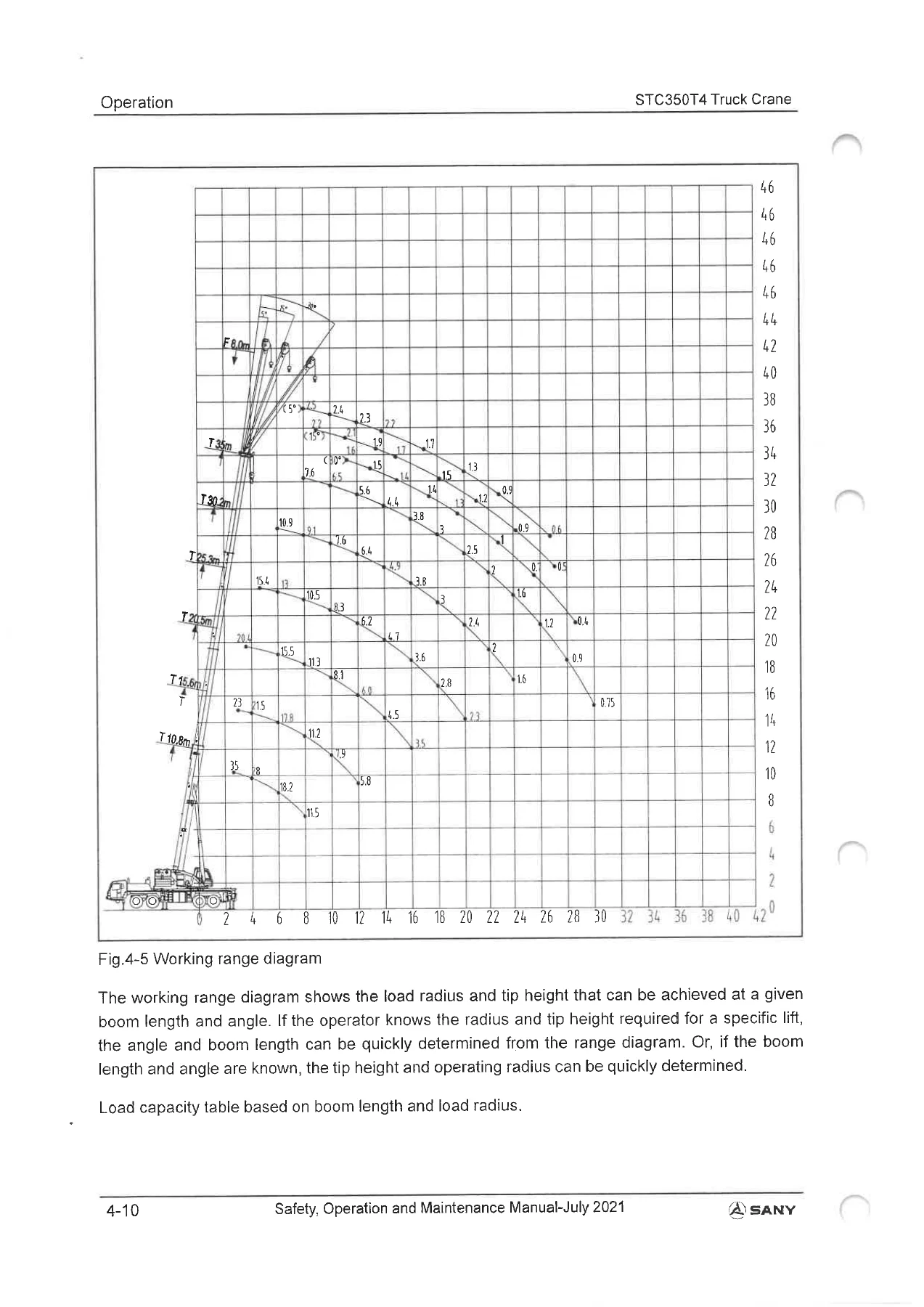
The Operation chapter is the largest procedural section in the manual. It opens with basic lifting terminology — load radius, tip height, boom length, boom angle, rated load, actual load, swingaway boom extension length and offset angle — and then explains how to use the load chart: the principle of lift weights, the principle of radius, and full load chart understanding with a worked example. The working range diagram and load capacity table are shown and explained.
Pre-start checks cover manuals, maintenance records, exterior inspection (batteries, fuel supply, tires, seat and mirror adjustment, turntable locking device, cab and deck), and interior checks (seat belt function, electrical system, brakes, operation control levers, fire extinguisher). Engine procedures cover cold-weather operation, start procedure from both the driver’s cab and the operator’s cab, idling, shutdown, and emergency shutdown. PTO activation and deactivation are documented step by step with prerequisites and procedures.
Outrigger operation is covered in depth: cribbing support, outrigger placement (minimum distance from slopes, safe distance from scallops, maximum gradient, cavity avoidance), and complete procedures for extending and retracting both the outrigger beams and the jacks using the left and right control panels plus the master control lever. Hoist operation covers main and auxiliary hoist raise/lower with control lever positions. Boom operation covers raise/lower (max boom angle 78°), extend/retract with boom cylinder selector, and slewing with the turntable locking device procedure. Crane preparation includes preload check, disconnect and attach main hook block, wire rope installation onto a hoist, and reeling procedure (parts of line selection, reeling procedure with rope socket, clamp, wedge and anti-two block weight). Swingaway boom extension operation covers erection, rigging, stowing, and offset angle adjustment from lesser to higher and higher to lesser.
Travel operation covers general precautions, preparing to travel, moving the machine (travel start, travel steer, service brake, travel on slopes), end-of-driving operations, storage (short-term and long-term), and transport (loading, unloading, towing, lifting). The transmission range shift is documented with a 9-gear speed ratio table, and cold-weather operation, keeping cabs clean, mounting/dismounting, and in-cab safety are covered.
Maintenance — Carrier and Superstructure
Maintenance information begins with general guidance, checks before and after maintenance, hours and mileage reading, genuine SANY replacement parts, approved lubricants, welding/drilling/cutting/grinding guidance, tool and parts inventory, covers and locks, hydraulic fluid inspection, inspection and maintenance in adverse environments (mud, rain/snow, salt air, dusty, rocky, cold), and environmental protection. The maintenance overview provides intervals for both carrier and superstructure, followed by a full lubricants and fluids section — fuel, engine oil viscosity/temperature data, lubricating grease, gear oil (swing/main and auxiliary hoist drive), gear oil (axle), and hydraulic oil with ambient temperature data.
Carrier maintenance procedures are exhaustive: carrier overall condition, engine (fuel, oil, coolant, air cleaner, belts), axles (center drive and final drive gear oil check/drain/change, lubrication), wheels and tires (inspection, tire switch position, toe-in measurement and adjustment), steering system (function check, hydraulic oil check/drain/change, lubrication), clutch (pedal check, fluid check/drain/change), transmission (gear oil check/drain/change, lubrication), drive shaft (inspection, lubrication), brake system (moisture drain, air pressure alarm, service brake, exhaust brake, lining thickness, slack adjustment, lubrication, air dryer replacement), carrier electrical system (component function check, battery check), air conditioning (refrigerant check, hoses and connections, refrigerant compressor), and other work (windshield washing fluid, windshield washer, outrigger beam lubrication, suspension lubrication).
Superstructure maintenance covers wire rope (inspection, boom extend/retract wire ropes, replacement, adjustment, lubrication), hook blocks (main hook block check, headache ball check, lubrication), main boom and boom extension (check, section alignment, lubrication), swing mechanism (gear oil check/drain/change, mounting bolts, swing gear and drive pinion, lubrication), hoist (mounting bolts, gear oil check/drain/change, lubrication), hydraulic system (oil check/drain/change, air removal, reservoir breather replacement, hydraulic filter replacement), superstructure electrical system, air conditioner (refrigerant, cooling fan, hoses and connections, refrigerant compressor), and other work (windshield washing fluid, windshield washer). A tightening torques section closes the chapter with general torque values, hardware, hoses, and fittings.
Troubleshooting — Emergency and Repair Procedures
The troubleshooting chapter covers emergency operation during crane operation, towing the truck crane, jump-starting the engine, wheel change (remove damaged wheel, mounting the wheel), oil and fluid issues (hydraulic noise, oil and fluid leaks), motor repair (hoist motor removal/installation/test/internal leak check, swing motor removal/installation/test), wiper and washer repair (windshield wiper, windshield washer, skylight wiper — removal, inspection, installation, check), and third wrap protector (check, removal, installation, adjustment).
Specifications — Dimensions and Technical Parameters
The final chapter provides outline and dimensions of the truck crane and technical parameters in both driving status and operating status.
Why This STC350T4 Manual Belongs in Every Cab and Workshop
The STC350T4 is a substantial machine, and this manual reflects that. It covers the carrier — engine, axles, transmission, brakes, steering, electrical, air conditioning — and the superstructure — boom, swing, hoist, hydraulics, LMI system, outriggers, and swingaway boom extension. Torque values, fluid capacities, wear limits, adjustment procedures, and safety clearances are stated throughout, with diagrams and tables supporting the text. This is the reference a technician needs when a hoist motor requires replacement, when the LMI is showing a fault, when the swing gear needs lubrication, when the boom extend/retract wire ropes need adjustment, or when the hydraulic system is due for an oil change.
Every procedure is laid out sequentially with the tooling, safety considerations, and specifications specific to the STC350T4. Whether you are performing a routine service interval or diagnosing a hydraulic fault in the field, the correct procedure and the correct value are here. The safety chapter alone — hand signals, ground pressure tables, slope clearances, wind speed limits, electrical hazard clearances, lockout/tagout — is worth having on hand before any lift.
IMAGES PREVIEW
Instant PDF download after purchase — no shipping, no waiting. The file works on any device: laptop on the service truck, tablet in the shop, or desktop in the office. Print the pages you need for the job, or keep the full manual open on your screen for reference. This is the same document that keeps an STC350T4 running correctly and safely, and it is available right now.



Reviews
There are no reviews yet.