
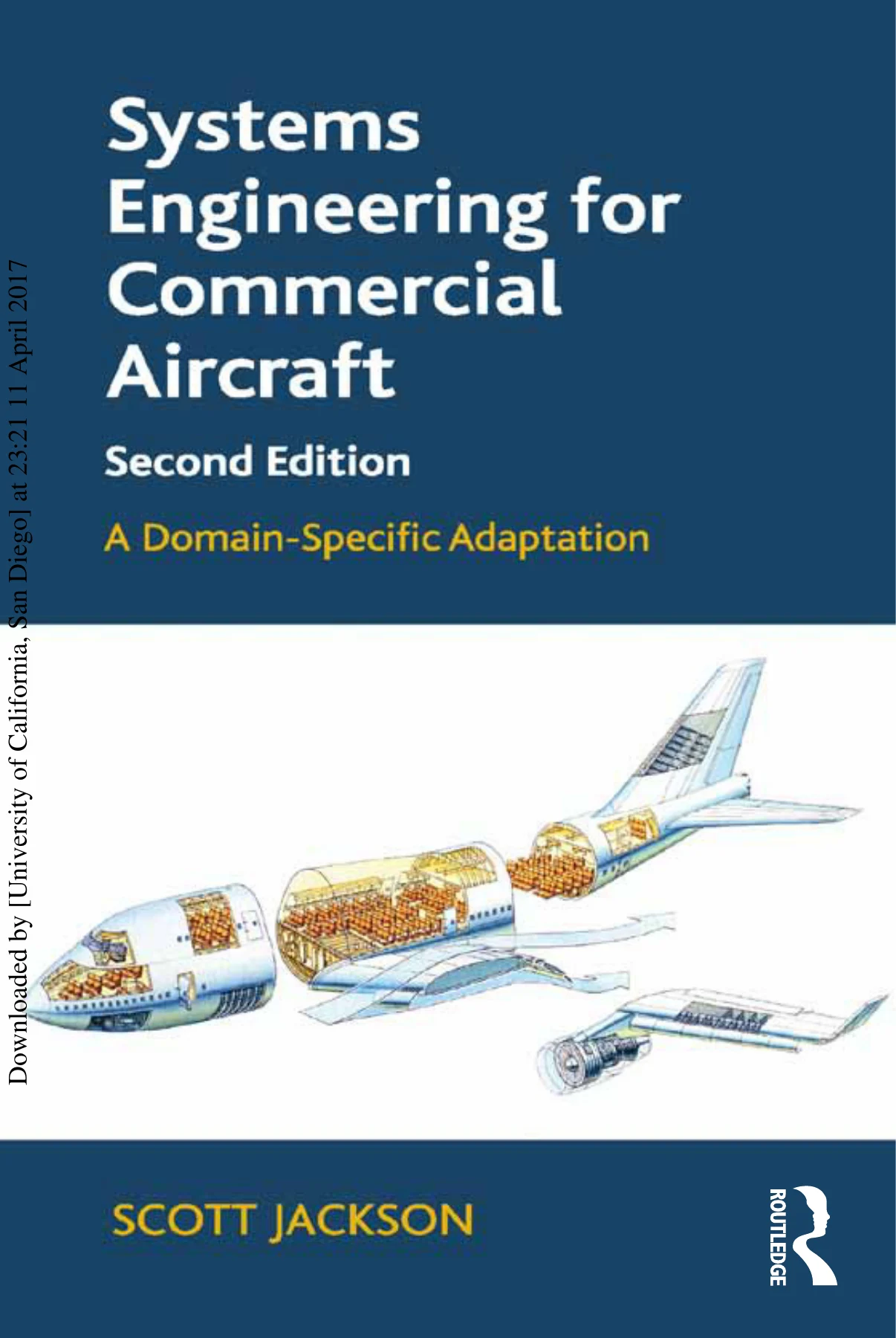
Systems Engineering for Commercial Aircraft Second Edition PDF – A Domain-Specific Adaptation Guide
Original price was: $34.95.$21.95Current price is: $21.95.
Scott Jackson’s second edition of Systems Engineering for Commercial Aircraft, revised from the 1997 original and expanded with new chapters on risk management and aircraft resilience. A 315-page PDF reference that adapts the systems engineering process specifically to commercial aircraft development, from requirements and interfaces through synthesis, certification and verification.
Description
File Details
- Document type: Technical reference book supplied as a PDF
- Full title: Systems Engineering for Commercial Aircraft, Second Edition: A Domain-Specific Adaptation
- Author: Scott Jackson, University of Southern California and Burnham Systems Consulting
- Publisher: Ashgate Publishing; published 2016 by Routledge, an imprint of the Taylor and Francis Group
- Edition: Second Edition, revised from the 1997 first edition
- ISBN: 978-1-4724-3921-5 (hardback); 978-1-3156-1172-3 (ePub)
- Language: English
- Length: 315 pages
- File format: PDF
What the Second Edition Adds
Systems engineering as a discipline has grown considerably since this book first appeared, and the second edition tracks that growth. It is subtitled A Domain-Specific Adaptation because the central argument is that the commercial aircraft domain cannot simply inherit a generic SE process — the market pressures, the certification regime and the technology base all demand a tailored version. Two entirely new chapters extend the original scope: one on risk management, and one on the resilience of the aircraft system, a subject that goes beyond safety into anticipation, withstanding and recovery from disruption.
The revision also folds in material that did not exist in 1997, including the FAA Systems Engineering Manual, SAE ARP 4754A, the Systems Engineering Body of Knowledge distinction between product, enterprise and service SE, and the increased use of outsourcing as a large-scale system integration problem.
Chapters Covered
- 1 Introduction — definition of a system, definition of systems engineering, historical background, roadmap for applying SE to commercial aircraft, summary of themes
- 2 Commercial Aircraft — the commercial aircraft industry, levels of SE application (new, derivative and change-based aircraft), aircraft architecture and the ATA index correlation, advanced technologies on aircraft, manufacturing processes, trends in commercial aviation
- 3 Functional Analysis — SE life-cycle functions, aircraft system-level functions, aircraft-level functions, functional aspects of safety, the cluster model, the swim lane model
- 4 Requirements and Needs — requirements definition and types, requirements development, requirements sources, allocation to system elements, derived requirements, the principle of top-down allocation, requirements trade-offs, certification categories, requirement validation, avoiding requirement creep
- 5 Constraints and Specialty Requirements — regulatory requirements, mass properties, dimensions, reliability, human factors, environments, maintainability, design standards, emitted noise, emitted electromagnetic interference, cost, transportability, flexibility and expansion, producibility
- 6 Interfaces — functional, physical, external, internal and operational interfaces, interface management, the interface control drawing, development fixtures, the N2 diagram, interface requirements and verification
- 7 Synthesis — aircraft architecture, initial concept, trade-off studies, quality function deployment, safety features, introduction of new technologies, preliminary design
- 8 Top-Level Synthesis — the aircraft system, top-level aircraft sizing, other top-level requirements, system architecture, top-level constraints, economic constraints, top-level trade-offs
- 9 Subsystem Synthesis — environmental, avionics, electrical, interiors, mechanical, propulsion, auxiliary and airframe segments, allocation to software, subsystem constraints
- 10 Certification, Safety, and Software — certification, safety, software development and certification, the Commercial Aviation Safety Team, fatality rate history
- 11 Verification and Validation — the verification matrix, traditional SE verification, verification of regulatory and customer requirements, verification sequence, system validation, qualification
- 12 Systems Engineering Management and Control — management responsibilities, the Chief Systems Engineer, integrated product development, design reviews, documentation, automated requirements tools, technical performance measurement, software and supplier management, configuration management, integration planning
- 13 Adapting Systems Engineering to the Commercial Aircraft Domain — adapting the process, adapting the SE process to the existing organization
- 14 Large-Scale System Integration — the system of systems view, outsourcing, complexity and how it increases risks, managing the risks of a large-scale system, other LSS principles to apply to commercial aircraft
- 15 Risk Management — overview, types of consequences, root causes of risks, risk mitigation steps, issues, independent review, the risk management process, risk management tools, opportunities, challenges for risk management
- 16 Resilience of the Aircraft System — the history and definition of resilience, whether resilience is measurable, design rules and example solutions, other rules, a final word on interdependency
- Final Comments and Appendices — the systems mindset, the risk mindset, the resilience mindset; the mathematics of reliability allocation; an example commercial specification outline; systems engineering automated tools; bibliography; glossary; index
Read end to end, this Systems Engineering for Commercial Aircraft Second Edition PDF walks a technical team from the earliest market analysis through to qualification. It opens by establishing what a system actually is in the SE sense and why the aircraft itself is only one of five elements of the aircraft system. From there it builds a functional architecture that stays valid across aircraft types, converts those functions into performance requirements and constraints, and then follows the requirements down the hierarchy through allocation and derivation. Later chapters turn to the practical machinery of getting an aircraft built: interface control, trade-off studies, quality function deployment, top-level sizing, subsystem synthesis, certification alignment, verification methods and the management controls that keep it all coherent.
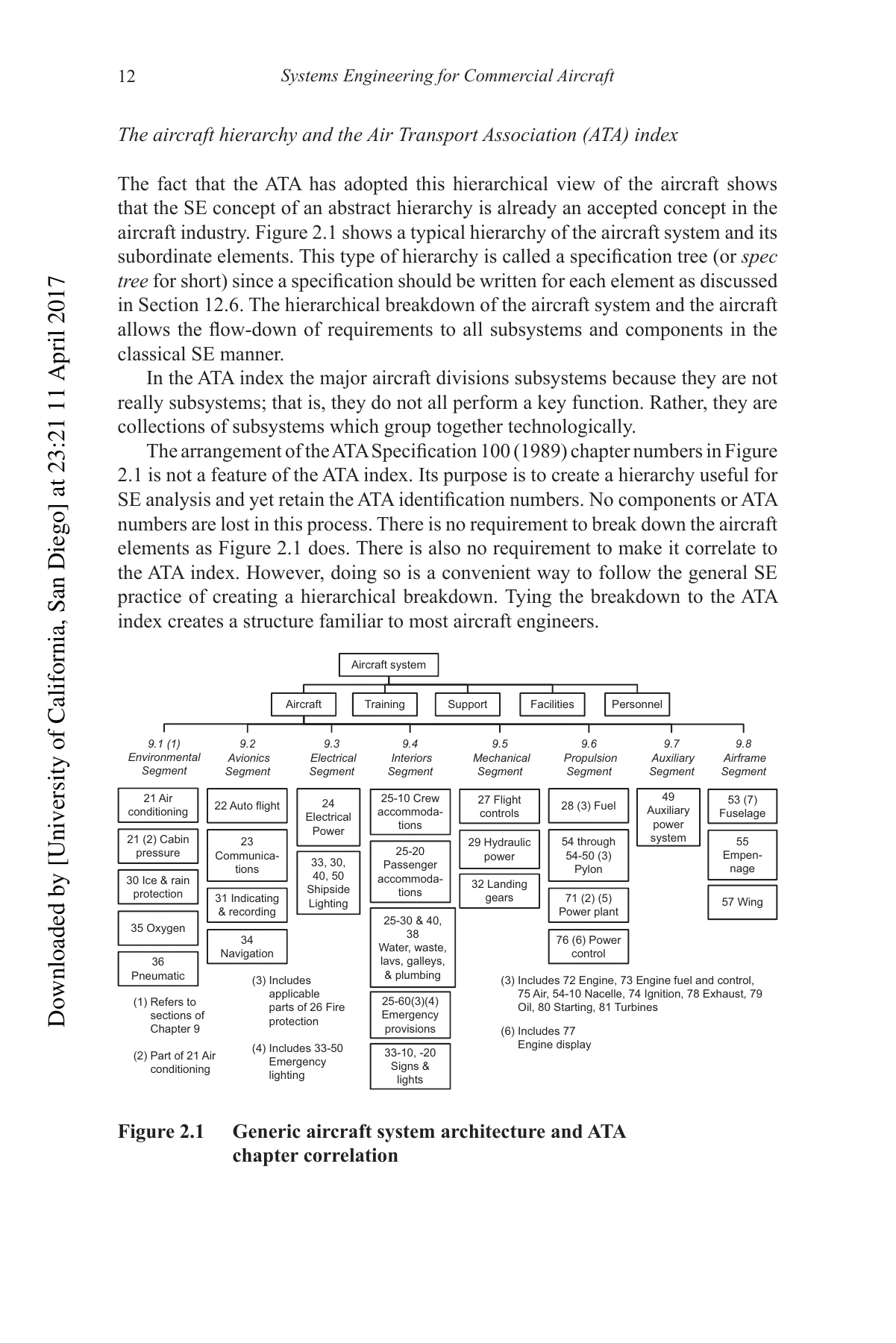
A recurring argument in this guide is that the aircraft hierarchy shown in the Air Transport Association index is already an abstract systems engineering hierarchy, which means much of the SE discipline is quietly present in commercial practice already. The book builds on that rather than replacing it, which is why it repeatedly warns against abolishing processes that already exist.
Who This Reference Is Written For
The book addresses engineers, systems engineers, program managers and technical managers working on new, derivative or change-based commercial aircraft programs. It assumes the reader either already understands the fundamentals of the SE process or is prepared to follow the sources it cites. It is written as a how-and-why guide rather than a step-by-step manual, and it explicitly does not attempt to replace the FAA Systems Engineering Manual, SAE ARP 4754A or RTCA DO-178B — it shows how those documents fit into a systems engineering context.
Because it concentrates on the commercial domain rather than military aircraft, the emphasis throughout falls on economic requirements, airline customer needs, direct operating cost, certification and the supply chain. Aircraft types discussed range from large jet transports through regional jets, freighters, commuter and general aviation aircraft, with advanced subsonic and supersonic transport concepts covered in the technology chapter.
Put This Reference to Work
What you get from this Systems Engineering for Commercial Aircraft Second Edition guide is a working framework rather than a theory text. It supports the front end of an aircraft program — capturing customer needs, building a functional architecture, allocating and deriving requirements, judging which requirements can be dropped without excessive risk, and structuring an organization so that the technical and managerial sides of SE operate together instead of in parallel. It supports the middle of a program through interface definition, trade-off methodology, sizing logic, subsystem synthesis across every major aircraft segment, and certification compatibility. And it supports the back end through verification matrices, validation, qualification, configuration management and integration planning.
The reason that matters is that commercial aircraft development punishes guessed procedures. A weight allocation, a dispatch reliability target, a hazard probability, an interface tolerance or a derived requirement value all propagate through the whole aircraft. Getting the process right at the requirements stage is far cheaper than correcting it after preliminary design review, and this book is unusually direct about where the common failures occur — requirement creep, neglected interfaces, unexamined buyer furnished equipment, over-optimistic schedules and unmanaged supplier variability.
IMAGES PREVIEW
Delivery is instant. The 315-page Systems Engineering for Commercial Aircraft A Domain-Specific Adaptation PDF is available for immediate download after payment, with no shipping and no waiting. Read it on a laptop, tablet or phone, print the chapters you need for a design review, and keep the searchable document as a working reference across the full development life cycle.
Reviews
There are no reviews yet.