
Taiyo Electric Brushless AC Generator FEAW / FEW Instruction Manual – Built-in PMG Edition
Original price was: $29.95.$17.95Current price is: $17.95.
Complete Taiyo Electric instruction manual for the FEAW and FEW brushless AC generators with built-in PMG excitation – covering installation, operation, parallel running, maintenance, troubleshooting, disassembly and the DST-162 AVR supplement.
Description
Taiyo Electric Brushless AC Generator FEAW / FEW Instruction Manual
This is the full instruction manual issued by Taiyo Electric Co., Ltd. for the FEAW and FEW brushless A.C. generators fitted with a built-in PMG. It is the document that ships with the machine and it is written for the people who actually run and service it – the marine engineer or electric lead engineer responsible for the set, and the maintenance crew working alongside them. Everything from safe crane handling at the dock through to bearing clearance limits, insulation resistance judgement and rotor extraction is contained in one file.
The manual deals with two lubrication variants of the same generator family. The FEAW model uses the self oil ring lubrication method, while the FEW model uses forced lubrication. Which one you have changes the bearing care regime, the oil specification, the pressure values you must hold, and the disassembly sequence, and the manual separates the two throughout rather than blending them.
File Details
- Manual type: Manufacturer instruction / operation and maintenance manual
- Brand: Taiyo Electric Co., Ltd.
- Models covered: FEAW, FEW (Built-in PMG)
- Document series reference: IB-1362-1 (AVR supplement section)
- Language: English (with reproduced bilingual Japanese/English safety labels)
- Page count: Approximately 105 pages
- File format: PDF
Chapters Covered
- Introduction
- Safety – Cautions on Safety in Transportation; Installation and before Operation; Operation, Inspection and Maintenance; Disposal; Safety Labels
- Outline of Product – Purpose of Use; Features of This Machine; Outline of Exciting System
- Qualification of Operator
- Identification
- Unloading, Unpacking and Storage
- Installation – Name of Parts; Description of Parts (Stator Frame, Stator Core, Stator Coil, Rotor Core, Rotor Coil, Shaft, Bearing, Fan, AC Exciter, Rotating Rectifier, PMG, Air Cooler, Connection Diagram); Installation Procedures
- Operation – Inspection before Operation; Operation Procedures; During Operation; Parallel Running; Stop Operation
- Maintenance and Inspection – Periodical Inspection; Method of Maintenance and Inspection (Temperature Rise, Bearing and Lubrication, Bearing Clearance Limit, Vibration, Cleaning and Drying of Coil, Insulation Resistance, Operation Suspension, Terminal Box and AVR, Rotating Rectifier, Air Cooler, Periodical Parts Replacement)
- Troubleshooting – No Voltage Build-up, Voltage Decrease, Voltage Increase, Voltage Instability, Bearing Trouble, Air Cooler Trouble
- Disassembly and Assembly – Precautions, FEAW and FEW Procedures, Rotating Rectifier Replacement
- Check List
- Parts List
- Specifications
- Automatic Voltage Regulator Instruction Manual, Type DST-162
What the document gives a technician is the complete working envelope of the machine. The opening chapters establish what the generator is and who is qualified to touch it. The installation chapter walks through alignment against the flywheel, magnetic centre setting with the gauge, air gap checking, spigot engagement and coupling bolt tightening, together with a full fastening torque table from M5 up to M36 plus the PT3/8 drain plug. The operation chapter covers the pre-start checks on terminals, insulation and bearing oil, then monitoring during running, and a detailed treatment of parallel running – synchronising with lamps or synchroscope, load sharing between a follow-up and a forerunning generator, and the correct procedure for releasing one set from the bus.
The maintenance chapter is the heaviest part of the book and is organised into inspection intervals: daily during operation, weekly during stop, monthly, six-monthly, yearly, and overhaul. Each inspection item is given an inspection method, a judgement criterion and an improvement measure. Alongside the schedules you get the technical background – allowable temperature rise for class B, F and H insulation measured by thermometer or by resistance, the bearing clearance formula and when to exchange the bearing, vibration amplitude and velocity limits at rated load, coil cleaning by cloth, compressed air, suction or kerosene No. 2, and a full drying procedure with the insulation resistance saturation curve explained.
Bearing care is treated in depth because it is the most common cause of generator downtime. The manual lists the causes of bearing burning for both lubrication types, the oil level window around the red round mark on the oil gauge with its upper and lower limits, the ISO VG-46 recommendation for the FEAW self oil ring type, the SAE No.30 and VG-68 turbine oil recommendations for the FEW forced lubrication type, and the six-month oil exchange interval. The instructions for handling an overheated bearing are explicit – keep rotating, feed oil between bearing and shaft, reduce speed gradually, and never stop abruptly or the shaft will seize.
Exciter, PMG and the DST-162 AVR
Because the machine is brushless with a built-in PMG, the manual explains the excitation chain properly: the revolving-armature AC exciter output is rectified by the rotating rectifier and fed to the generator field, while the PMG output is converted by the AVR to excite the exciter field, with the AVR holding generator terminal voltage constant. The rotating rectifier gets its own inspection routine – disconnect the module wiring, measure forward and reverse resistance with a tester, forward below 10 ohms and reverse above 100 kilohms, and exchange anything conducting both ways.
At the back of the file is the separate instruction manual for the automatic voltage regulator, type DST-162. It documents the sensing input, power input from the PMG, generator current input through the CT, the parallel operation link circuit, external variable resistor and analog signal voltage adjustment, the CN3 external voltage adjusting switch, PID stability constants with their defaults, V/Hz under-frequency characteristic with its starting frequency range for 50 Hz and 60 Hz machines, droop setting from 0 to 10 percent, over-excitation protection behaviour, the full setting menu from No.00 through No.09, and an AVR-specific troubleshooting section covering failure to build voltage, high output voltage, low output voltage, voltage fluctuation and current imbalance during parallel operation.
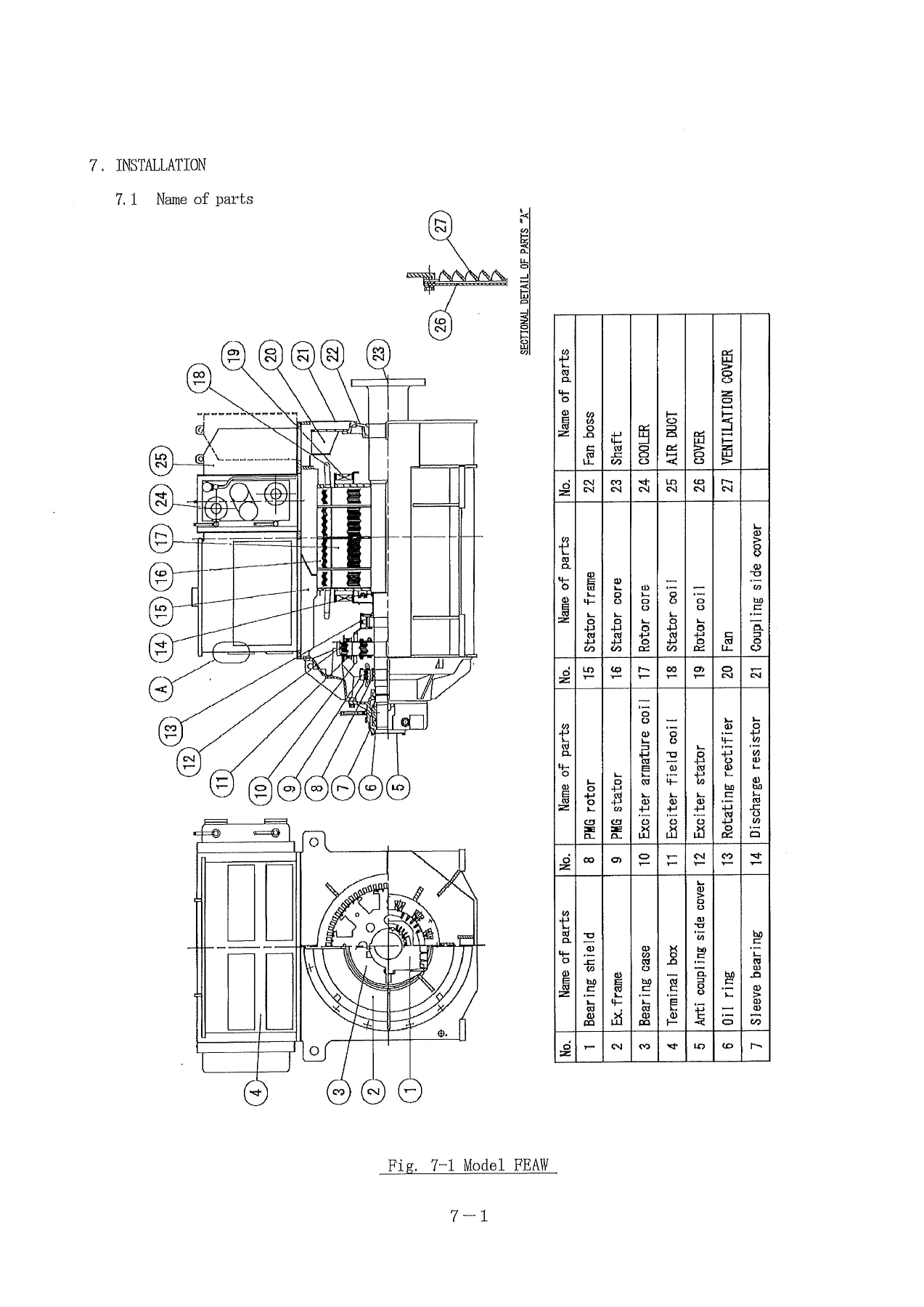
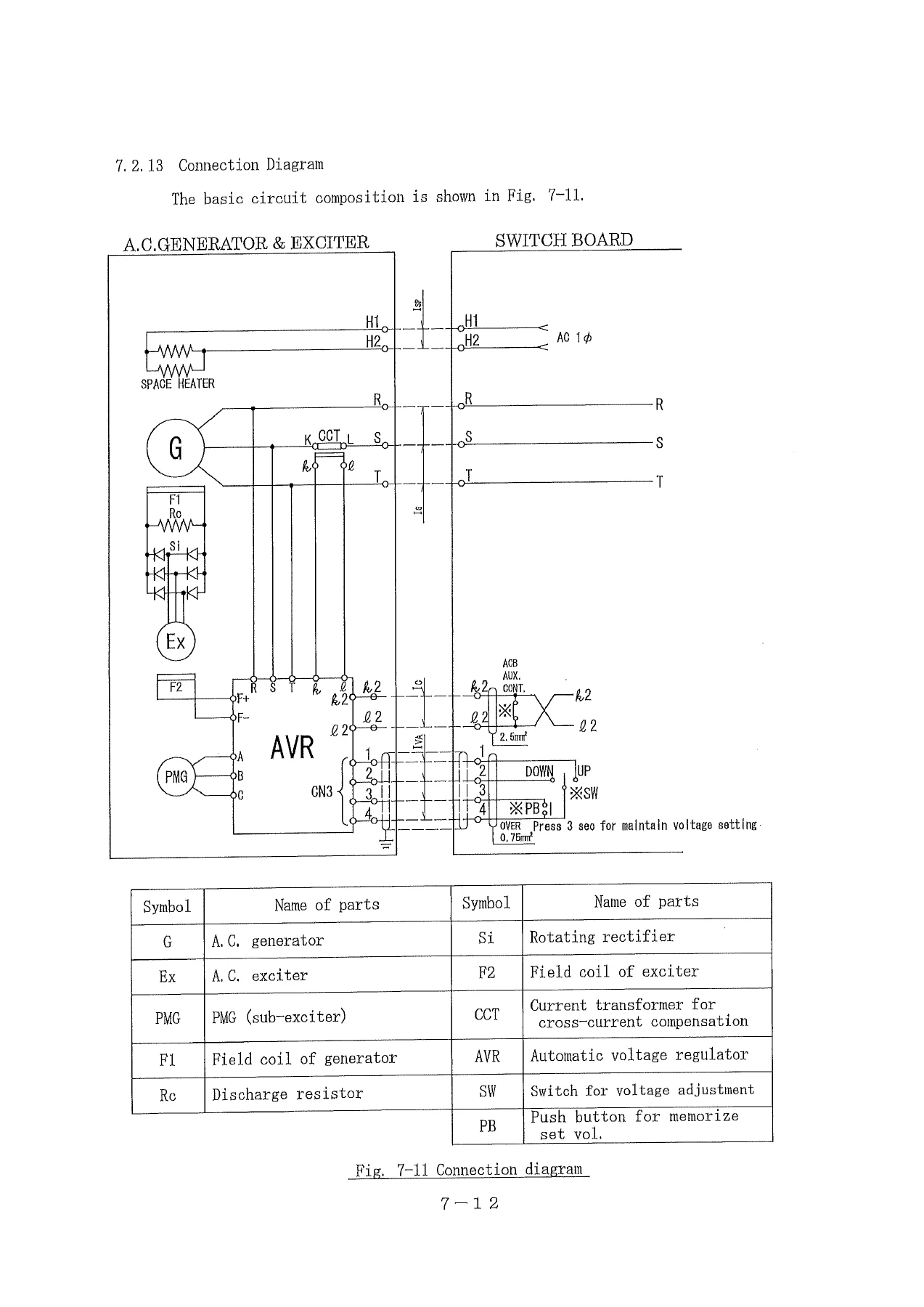
Two large fold-out style diagrams are reproduced in the file and are among the most useful pages for anyone working on the set: the labelled cross-section drawings of the FEAW and FEW generators with numbered parts lists covering the bearing shield, Ex. frame, bearing case, terminal box, oil ring, sleeve bearing, PMG stator and rotor, exciter armature and field coils, rotating rectifier, discharge resistor, fan, cooler, air duct and ventilation covers; and the basic connection diagram showing the generator, exciter, PMG, AVR, CT for cross-current compensation and the switchboard interface.
The air cooler chapter covers the double-tubing construction, why leakage from a cracked inner tube shows up at the water leak sensor rather than inside the generator, how to locate a damaged inner tube with soap film and compressed air, how to blank it off with blind plugs, and how to clean the inner and outer tubes without damaging them. The corrosion preventing rods and their periodic replacement are also described.
Rounding out the file are the check list for normal running inspections with columns for voltage, current, power, power factor, frequency, temperatures, vibration, noise, smell and bearing oil condition, the parts list with main component names and quantities, and the specification table giving output range, insulation class, rated voltage and frequency, power factor, phase wire type, number of poles, rotational direction and the applicable standards.
Why This Manual Matters
A brushless generator is unforgiving of guesswork. Fill the sleeve bearing to the wrong level, run the FEW model below its specified oil supply pressure, stop an overheated bearing abruptly, megger the AVR terminals, or drop the rotor without a pressboard between rotor and stator and you are looking at a seized shaft, a destroyed semiconductor module, or a burnt winding. The manual gives you the numbers that prevent those outcomes – the red round mark and its 5 mm tolerance, the pressure range in the outline drawing, the 1 megohm minimum insulation resistance, the 500 V megger requirement, the formula for bearing clearance, the fastening torques, and the step-by-step rotor extraction sequence with the auxiliary pipe or auxiliary shaft and the two-crane method.
It also tells you which jobs require two workers or more, which parts must be covered with a vinyl or cloth cover while the machine is open, and where the permanent magnets in the PMG rotor can catch a finger because of their attraction force.
Get the Taiyo FEAW / FEW Instruction Manual Today
This Taiyo Electric brushless AC generator FEAW / FEW instruction manual covers the full service life of the machine – commissioning, daily running, parallel operation, scheduled inspection, fault diagnosis, bearing work, air cooler servicing, and complete disassembly and reassembly of both the self oil ring and forced lubrication variants. Whether you are aligning a replacement set to a diesel engine flywheel, chasing a voltage that will not build, replacing a rotating rectifier module, or setting up the DST-162 AVR after a board swap, the correct procedure and the correct value are in here.
IMAGES PREVIEW
Delivery is instant. The PDF is available for download immediately after payment, there is no shipping and nothing to wait for, and the file opens on any phone, tablet, laptop or desktop. Print the pages you need for the engine room and keep the rest on the machine – the manual itself tells you to keep it near the generator for reference and to pass it on when the machine changes hands.
Reviews
There are no reviews yet.