

Takeuchi TB295W Wheeled Excavator Operator Manual – 305-Page PDF Download (2016 Edition)
Original price was: $49.95.$32.95Current price is: $32.95.
Complete 305-page Takeuchi TB295W wheeled excavator operator manual in PDF – safety, controls, operation, transport, full periodic maintenance schedule, fault code lists and capacity charts for 2-Piece boom and Mono-boom machines with the ISUZU 4JJ1X engine.
Description
The Takeuchi TB295W is a wheeled hydraulic excavator built to travel on roads and dig on site, and the Takeuchi TB295W Operator Manual is the complete 305-page document that covers operating, inspecting, maintaining and troubleshooting it. It applies to the TB295W in both 2-Piece boom and Mono-boom configurations, fitted with a rear blade or outriggers, powered by the ISUZU 4JJ1X diesel engine. Every chapter that shipped with the machine is present here: the safety decal walk-around, the controls and multi-information display, operating technique, transport and hoisting, the full periodic maintenance schedule, the fault code lists and the lifting capacity charts.
File Details
- Manual type: Operator’s Manual (operation, inspection and maintenance)
- Brand: Takeuchi
- Model: TB295W hydraulic excavator
- Language: English
- Page count: 305 pages
- File format: PDF
- Publication number: No.43757
- Publication dates: First published July 2013; ninth published January 2016
Chapters Covered
- Introduction
- Machine description
- Safety
- Controls
- Operation
- Transport
- Maintenance
- Troubleshooting
- Specifications
- Options
Machine Description, Designated Operations and Break-In
This chapter states plainly what the machine is for – excavation, ditch digging, side ditches, levelling and loading – and lists the features that shape how it behaves on site: the auto-idle system that cuts fuel consumption, the engine emergency stop system, electronic control of the auxiliary hydraulic circuit, flow-rate control on the auxiliary 1st and 2nd lines, the 5-inch colour LCD instrument cluster, the ROPS-certified cab with front sash assist and hydromount, and the wider engine hood and right side cover that make servicing easier. It also sets out the 100-hour break-in period for a new machine – warm the engine and hydraulic oil, work at roughly 80% of maximum load, and avoid abrupt starts, acceleration, direction changes and stops.
Safety
The largest single block of the manual, and the reason it belongs on the machine rather than in an office. General precautions cover protective equipment, fire extinguishers and first aid, signal and flag persons, exhaust fumes, asbestos dust, crush and cut hazards and the prohibition on unauthorised modifications. It then walks through stage-by-stage precautions for preparing, starting, operating, stopping, transporting and maintaining the TB295W – including working around high-voltage cables, travelling on slopes, loading and unloading, hoisting, refuelling, hot and pressurised components, hydraulic internal pressure, battery handling, tyre maintenance, jump starting with booster cables and the precautions for servicing the air conditioner. A full safety sign (decal) section shows where each label sits on the machine.
Controls
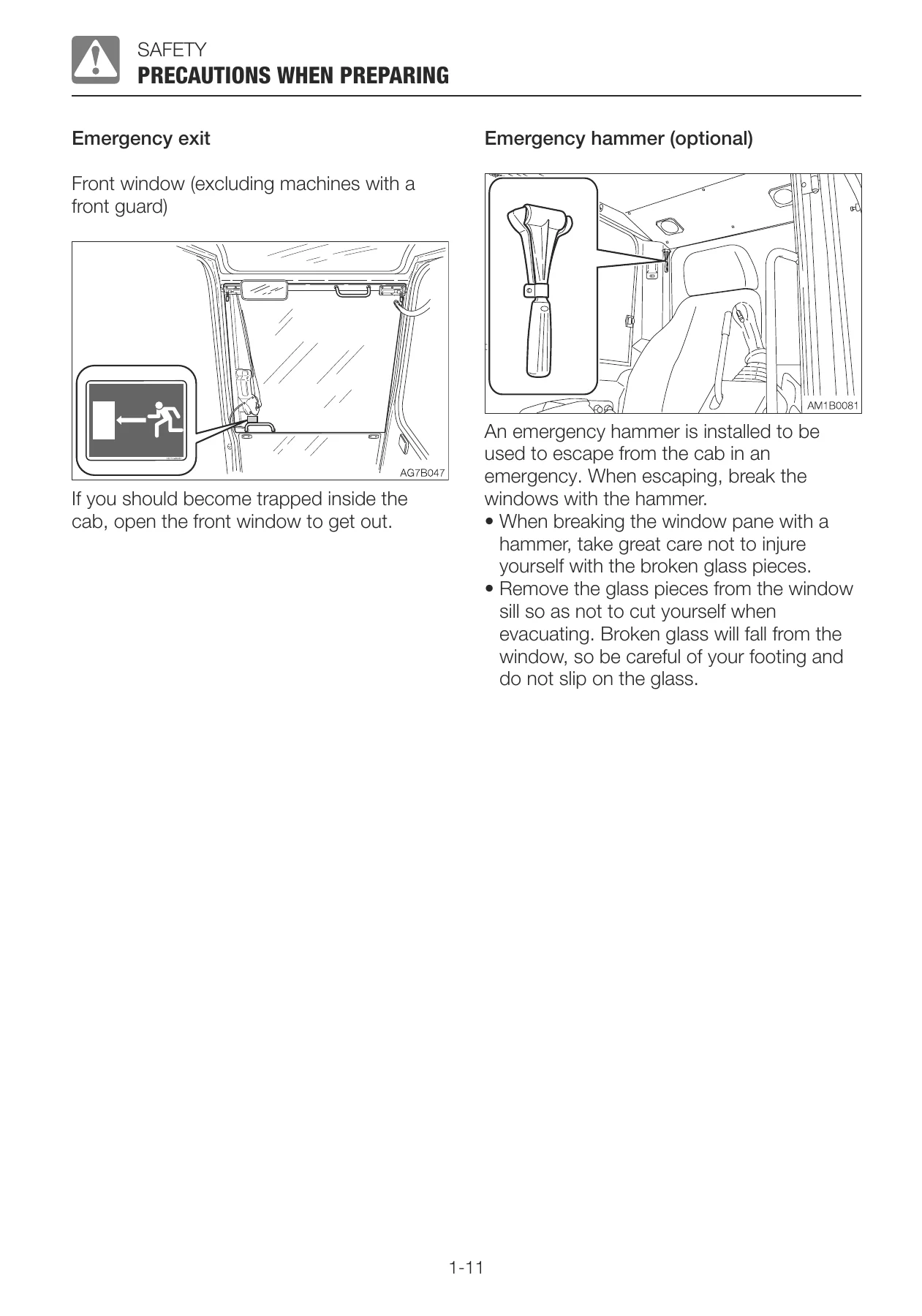
Everything the operator touches is documented with its location and function: the starter key and the covers it locks, the right side cover, tool box, fuel filler port, engine hood and fuse box cover; the cab door, emergency exit, front window, lower front window, side window and emergency hammer; the standard seat and the air suspension seat with its lumber support, backrest, absorber, fore/aft isolator, weight and height adjustment, seat pan angle, seat depth and heater. The multi-information display chapter works through the main menu screen, every warning lamp and indicator, the screen control keys and the full navigation tree – trip meter setting, auxiliary line flow rate display, auxiliary 1st and 2nd/4th flow rate settings, date and time, data display, error code display and LCD settings. Then come the control console switches and buttons, the starter switch, engine shutdown switch, throttle controller, horn and deceleration buttons, travel select, auxiliary switches, outrigger switches, ram lock, DPD manual regeneration/inhibit select, light, swing/second boom select, automatic deceleration, power mode, detent mode, lift overload warning, beacon and diff-lock. The levers and pedals section covers the safety lock lever, slew/swing lock pin, steering wheel adjustment, turn signal lever, brake pedal and its lock, travel pedal, boom swing/second boom pedal, operating levers, blade lever and blade/outrigger lever.
Operation
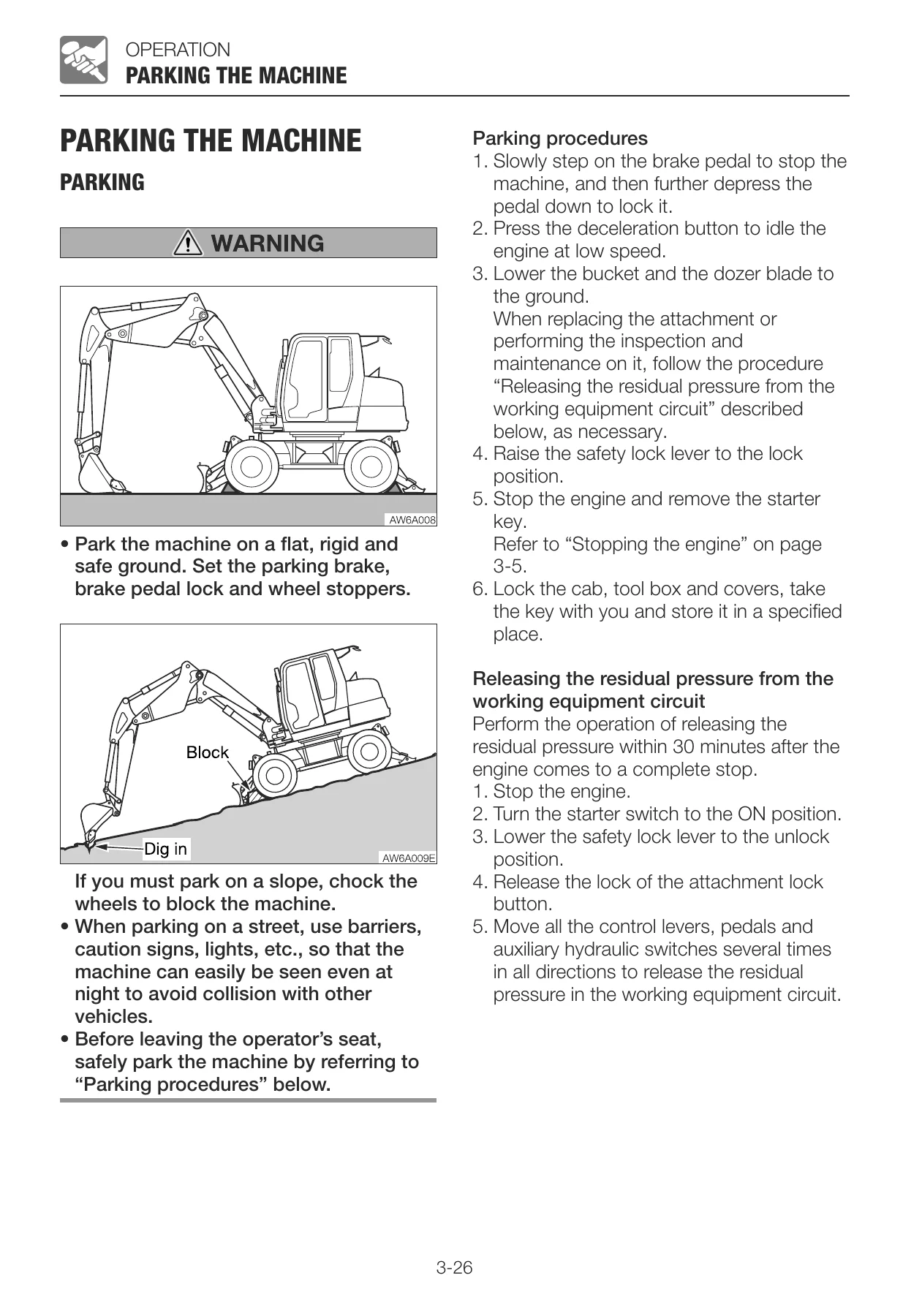
Getting on and off the machine, the walk-around inspection and the daily inspection open the chapter, followed by starting and stopping the engine – including cold-climate starting with the glow lamp and the deceleration mode that is active at every start. It then covers warming up the machine and the hydraulic oil, the inspection after warm-up, preparing the machine for travel, moving forward and in reverse, turning, stopping travel, and operating each function: boom, bucket, arm, slewing, boom swing, second boom, dozer blade and outriggers. The ISO and G lever patterns are both illustrated. Operating procedures set out what is prohibited, precautions for travel on slopes, how to get the machine out of mud when one side or both sides are stuck, and practical technique for excavating, digging ditches, loading and levelling. The chapter closes with parking, inspection and checks after stopping the engine, handling in cold climates and handling tires.
Transport
Loading and unloading with ramps (slope must not exceed 15 degrees), hoisting the machine with wire ropes in the specified posture, and securing the machine for transport. The transporting posture and road travel posture are illustrated for both 2-Piece boom and Mono-boom machines, along with the precautions to observe while the machine is on the truck – route selection, no abrupt starts or stops, no high speed through sharp curves.
Maintenance
This is the chapter that pays for the manual. It opens with general cautions, then the fuel and lubricant table with oil grades and replacement intervals keyed to ambient temperature, the regularly-replace hydraulic oil schedule for machines running a hydraulic breaker, the list of consumables with part numbers, the tool list and the tightening torque table for ISO strength category 10.9 nuts and bolts. The safety-critical parts list gives the replacement periods that cannot be judged by eye: fuel hoses and fuel filler cap packing every 2 years, cooling system rubber hoses, heater and air conditioner hoses, the long list of hydraulic hoses across the main body, working equipment, swing cylinder, brake line, blade, outrigger, ram lock, pilot valve and auxiliary piping, and the seat belt every 3 years. The maintenance list then maps every interval – walk-around, daily (every 10 hours), after the initial 50 hours, every 50, after the initial 100, every 250, 500, 800, 1000, 1500, 4000 and 4500 hours, when required, and every 2 years – to the exact page for each job. Individual procedures give step-by-step instructions with tools, capacities and torque values for coolant, engine oil and filter, water separator and fuel filters, fuel level, hydraulic tank level, working equipment lubrication, tyre inflation and wheel nut torque, the slew bearing, battery fluid, transmission, differential and hub gear oils, V-belt and compressor belt tension, air cleaner and radiator/oil cooler cleaning, air conditioner filters, condenser and refrigerant level, service brake, negative brake, fuel filter and feed pump filter, supply pump strainer, engine cooling system, air cleaner element, air breather filter, bucket teeth and side cutters, bucket replacement, bucket-to-arm gap adjustment, windshield washer fluid and lever and pedal lubrication. Extended storage procedures and the return-to-service routine complete the chapter.
Troubleshooting
It begins honestly, with the symptoms that are not malfunctions – momentary slowdown as the arm passes vertical, slew motor noise at the start and end of slewing, travel motor noise on sudden stops, control valve noise at the stroke end, DPD regeneration smoke and noise. From there it covers engine overheating, a dead battery and jump starting with booster cables, blown fuses and the fusible link, restarting after running out of fuel with the air bleeding procedure, what each flashing warning lamp means and what to do about it, the vehicle and engine error code lists with their DTC, SPN and FMI references, other symptoms in a cause-and-remedy table, lowering the boom to the ground when the engine has stopped (with and without an accumulator), towing with the permissible force and speed limits, and what to do if the cab is damaged.
Specifications and Options
Basic specifications, machine dimensions for rear blade and outrigger machines, operating ranges and the rated lift capacity charts for both boom types. The options chapter covers attachment installation and operation cautions, the attachment combination table with bucket capacities and cutting widths for the long arm, lever pattern selection and how to switch it, hydraulic breaker operating cautions and the accelerated hydraulic oil and filter replacement intervals that come with breaker work, biodegradable oil and the flushing procedure, cab options, the operating lever switch kit, travel alarm and the 4-speed travel switch.
Warning Lamps, Fault Codes and the Multi-Information Display
One of the most useful things in this TB295W operator manual PDF is the way it ties the instrument cluster to the diagnosis. The manual explains the ECM error warning lamp and vehicle/engine emergency lamp, battery charge, engine oil pressure, water separator, coolant temperature, air cleaner, fuel filter, fuel level, third auxiliary hydraulic, travel line filter and brake oil pressure warning lamps, plus the deceleration, travel pedal, auto-cruise, blade/outrigger, glow, DPD regeneration, ram lock, travel speed and diff-lock, travelling/digging mode, travel gear and parking brake, power mode, lift overload, upperstructure position, swing/second boom, auxiliary select, attachment lock and turn signal indicators. The error code chapter then lists vehicle codes (CAN communication errors, power supply voltage errors, sensor voltage errors, accelerator and foot accelerator sensor errors, AUX slide switch errors, FWM output current errors and more) and engine codes with their SPN and FMI values and DTC references, so a flashing lamp can be traced to a specific circuit or component instead of guesswork.
Safety-Critical Parts and Why the Schedule Matters
Hoses, seat belts and fuel lines deteriorate in ways that cannot be seen. The manual states this directly and gives fixed replacement periods regardless of how the part looks, plus the instruction to replace immediately if wear is found. For a machine that spends its life at hydraulic pressure and road speed, that schedule is the difference between planned maintenance and a burst hose. The daily, monthly and annual hose inspection table in this TB295W manual tells you exactly what to check and when – leakage at connections, cracks and wear, twisted or deteriorated hoses, and hoses contacting other parts of the machine.
Who This Takeuchi TB295W Manual Is For
Machine owners who want the service intervals and fluid capacities on hand. Operators who need to understand the display, the DPD regeneration procedure, the ram lock switch, the travel modes and the brake pedal lock before the first shift. Fleet and rental workshops that service the TB295W alongside other Takeuchi machines and need the torque values, gear oil capacities and bleed procedures. Buyers inspecting a used machine who want to see the real maintenance list and the safety-critical replacement schedule. Anyone running a hydraulic breaker, quick-hitch third auxiliary line or outrigger-equipped machine, because the operating and maintenance cautions for those attachments are covered in their own chapters.
Get the Complete TB295W Manual Instantly
This is the full 305-page Takeuchi TB295W operator manual, not a summary or a scanned fragment. With it you can run the daily and 10-hour checks correctly, set the correct torque on a wheel nut or a fuel filter case, follow the air bleeding sequence after a fuel system repair, work out why a warning lamp is flashing, plan the 250, 500, 1000 and 4000-hour services, and operate the machine within the limits the manufacturer set. Correct fluid grades, correct tightening torques and correct procedures are what keep a wheeled excavator productive and safe, and all three are printed here. The PDF is delivered instantly after payment – no shipping, no waiting on a printed book. Read it on a laptop, tablet or phone in the cab or the workshop, search it on screen, or print just the pages for the job you are doing today and keep them next to the machine.
IMAGES PREVIEW
Reviews
There are no reviews yet.