
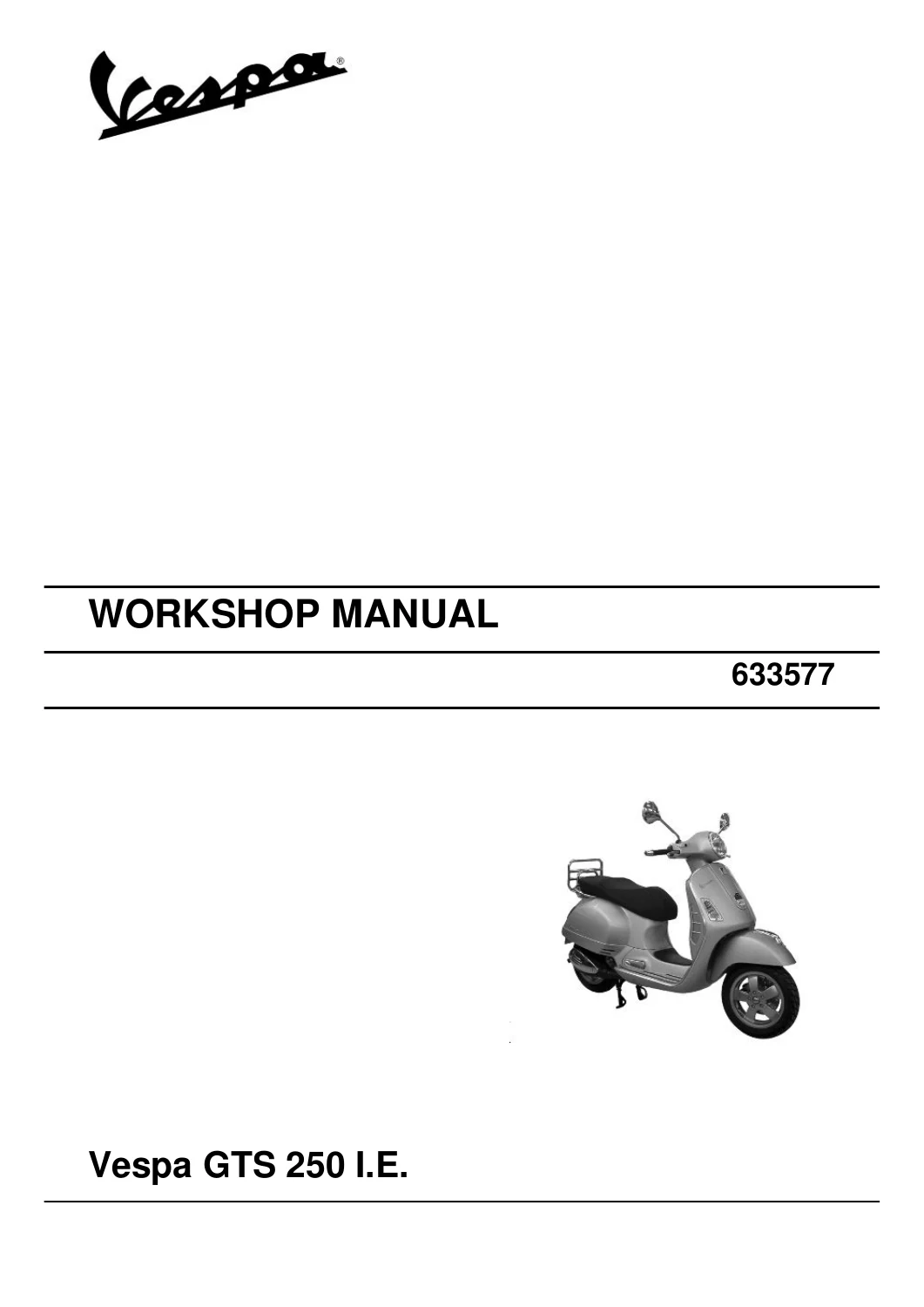
Vespa GTS 250 I.E. Workshop Manual 633577 (2007) Complete Service Repair PDF
Original price was: $32.95.$18.95Current price is: $18.95.
Piaggio workshop manual 633577 for the Vespa GTS 250 I.E.: characteristics, tooling, scheduled maintenance, troubleshooting, wiring, engine removal, injection diagnostics, brakes, cooling, chassis, pre-delivery and labor times.
Description
Vespa GTS 250 I.E. Workshop Manual 633577 (2007) Complete Service Repair PDF
This Vespa GTS 250 I.E. Workshop Manual 633577 (2007) Complete Service Repair PDF is the Piaggio & C. S.p.A. workshop text prepared for Piaggio-Gilera dealer mechanics. Copyright on the title pages is 2007. Publication number 633577 appears on the cover with the model line Vespa GTS 250 I.E. The book assumes a working knowledge of metric fasteners and scooter repair practice, then supplies the model-specific clearances, torques, tool codes, wiring splits by chassis number, and injection checks that a general handbook cannot give.
File Details
- Manual type: Workshop manual
- Brand / model: Vespa GTS 250 I.E.
- Document number: 633577
- Copyright date: 2007
- Language: English (selected wiring notes also printed in Italian)
- Page count: 317
- File format: PDF
Who the book is written for
The opening pages state that the workshop manual was drawn up by Piaggio & C. S.p.A. for Piaggio-Gilera dealer workshops. Notes, cautions and warnings are defined at the front, together with personal-safety, environmental and vehicle-intactness reminders. Fuel, battery acid, hydrogen and brake-dust handling rules sit next to the instruction to use original Piaggio spare parts, metric tools only, new gaskets and sealing rings on rebuild, and confirmed earth and battery connections before any electrical work.
Vehicle identification and published data
Vehicle identification lists chassis prefix ZAPM45100000 ÷ 1001 and engine prefix M451M ÷ 1001, with photographs of the stamp locations. Loadless weight is given as 151 ± 5 kg. Overall figures printed in the characteristics tables are width to the hand grips 755 mm, length 1930 mm, wheelbase 1370 mm and saddle height 800 mm.
The engine is described as a single-cylinder, four-stroke, four-valve liquid-cooled unit with a chain-driven single overhead camshaft on the left-hand side and three-arm rocking levers with threaded set screws. Bore 72 mm, stroke 60 mm, cubic capacity 249.29, compression ratio 10.5 ÷ 11.5, idle 1650 ± 50 rpm. Valve clearance is intake 0.10 mm and discharge 0.15 mm. Maximum speed is listed as 120 km/h. Fuel is supplied by electronic injection with an electric fuel pump. Lubrication is a chain-driven lobe pump inside the crankcase with mesh and paper filters. Starting is an electric starter motor with freewheel. The air filter is a sponge impregnated with a 50% petrol / 50% oil mixture.
Transmission is an automatic expandable pulley variator with torque server, V-belt, automatic clutch, gear reduction unit and a forced-air-cooled transmission housing. Capacities printed in the same chapter: engine oil approx. 1300 cc (Selenia HI Scooter 4 Tech / AGIP CITY HI TEC 4T SAE 5W-40), fuel tank ~9.2 l including a ~2 l reserve, rear hub 250 cc (TUTELA MATRIX / AGIP ROTRA 80W-90), cooling system approx. 2.100 ÷ 2.150 l PARAFLU 11FE diluted. Electrical entries list electronic inductive ignition with variable three-dimensional mapping, spark plug CHAMPION RG 4 PHP, battery 12V-12Ah, and fuses 30A, 15A, 10A, 7.5A and 3A. Front and rear brakes are both Ø 220 mm discs; the front calliper uses Ø 25 mm twin plungers, the rear two Ø 30 mm counteracting plungers. Tyres are 120/70-12 front and 130/70-12 rear tubeless on 3.00×12 light-alloy rims, with cold pressures 1.8 bar front, 2 bar rear, and 2.2 bar with a passenger.
Chapters Covered
- Characteristics (CHAR) — safety and maintenance rules; vehicle identification; dimensions and mass; engine, transmission, capacity and electrical data; frame and suspensions; brakes; wheels and tyres; tightening torques by group; cylinder-piston coupling categories; crankshaft axial clearance; slot packing / base-gasket shimming; recommended products
- Tooling (TOOL) — Piaggio store-coded special tools with descriptions and photographs (steering, bearings, engine support, punches, diagnosis tester, pulley and flywheel wrenches, injection interface wiring, software disc 020638Y)
- Maintenance (MAIN) — interval chart from 1,000 km through 80,000 km and every two years; spark-advance check with diagnostic tester and stroboscopic light; spark plug; hub oil; air filter; engine oil, cartridge filter and oil-pressure warning light; ignition-timing marks; coolant level; brake-fluid level and top-up; headlight aiming
- Troubleshooting (TROUBL) — excessive oil consumption and exhaust smoke; poor lubrication pressure; clutch grab or slip; inefficient or overheating brakes; heavy steering and excessive steering play; noisy suspension and shock-absorber oil leak
- Electrical system (ELE SYS) — complete wiring diagrams split by chassis range ZAPM4510000001007–1578 and from ZAPM4510000001579 onward; component keys; fuse maps; ignition, charging and starting circuits; instruments; devices and horn; immobilizer and injection ECU connections
- Engine from vehicle (ENG VE) — exhaust and lambda-probe removal; engine drop from the frame (coolant, fuel, throttle body, starter, flywheel connectors, rear shocks, rear-brake pipe, swinging-arm pin); refit notes and torque call-outs
- Engine (ENG) — automatic transmission cover, air duct, driven and driving pulleys, clutch, belt and hub work, plus the remaining thermal-group, timing, flywheel, crankcase and lubrication overhaul sequences that occupy this section
- Injection (INJEC) — MIU integrated injection-ignition description; component layout (throttle body/MIU, pump, injector, lambda, HV coil, rpm sensor, load relay); precautions; interface-wiring pin checks; fuel-pressure tests; injector resistance; coil primary resistance; lambda-heater checks; idle stepper and TPS reset rules; diagnostic tester use
- Suspensions (SUSP) — front single-arm cantilever service and rear swinging-arm / dual-shock work
- Braking system (BRAK SYS) — front floating calliper and rear two-piston calliper hydraulic service
- Cooling system (COOL SYS) — circuit service, thermostat and water-pump related operations
- Chassis (CHAS) — body and frame fittings
- Pre-delivery (PRE DE) — dealer pre-delivery checks and safety-lock sequence referenced from the torque tables
- Time (TIME) — labor-time codes and durations, including sticker/plate replacement on the closing pages
Taken together, the Vespa GTS 250 I.E. workshop text is a full dealer repair path rather than an owner’s booklet. A technician can identify the scooter from the prefix plates, pull the correct torque and clearance from the CHAR tables, select the numbered special tool, follow the km chart, drop the engine, overhaul the variator and thermal group, then prove the MIU system with the 020460Y tester and the published fuse and resistance figures.
Scheduled service printed in the book
Every two years the chart calls for coolant and brake-fluid changes. After 1,000 km the list covers safety locks, throttle adjustment, engine-oil change, electrical and battery check, coolant and brake-fluid levels, pad wear, tyre pressure, road test, hub-oil change and steering. Intermediate stops at 5,000 / 25,000 / 35,000 / 55,000 / 65,000 km are oil level and pads only. At 10,000 / 50,000 / 70,000 km the air filter is cleaned, the belt compartment inspected and the variator sliding blocks / rollers renewed. Driving-belt replacement is listed at 15,000 / 45,000 / 75,000 km and again in the 30,000 km and 60,000 km packages. Spark-plug replacement and valve-clearance checks appear at 20,000 / 40,000 / 80,000 km and in the 60,000 km package. Spark-plug electrode gap is 0.7–0.8 mm; the plug is specified as CHAMPION RG4 PHP and torque 12 ÷ 14 Nm, with a caution that non-conforming ignition units or plugs can damage the engine.
Engine oil and the cartridge filter change together at 1,000 km and every 10,000 km, drained hot from the flywheel-side gauze pre-filter. MAX on the dipstick corresponds to about 1300 cc; MIN to MAX is approximately 200 cc. Hub oil capacity is approximately 250 cc, drain plug 15 ÷ 17 Nm. Coolant is a 50% ethylene-glycol mix checked every 10,000 km on a cold engine between MIN and MAX in the right-hand expansion tank. Brake fluid is DOT 4 (AGIP BRAKE 4), renewed every 20,000 km or every two years under normal climate.
Engine rebuild figures and injection diagnostics
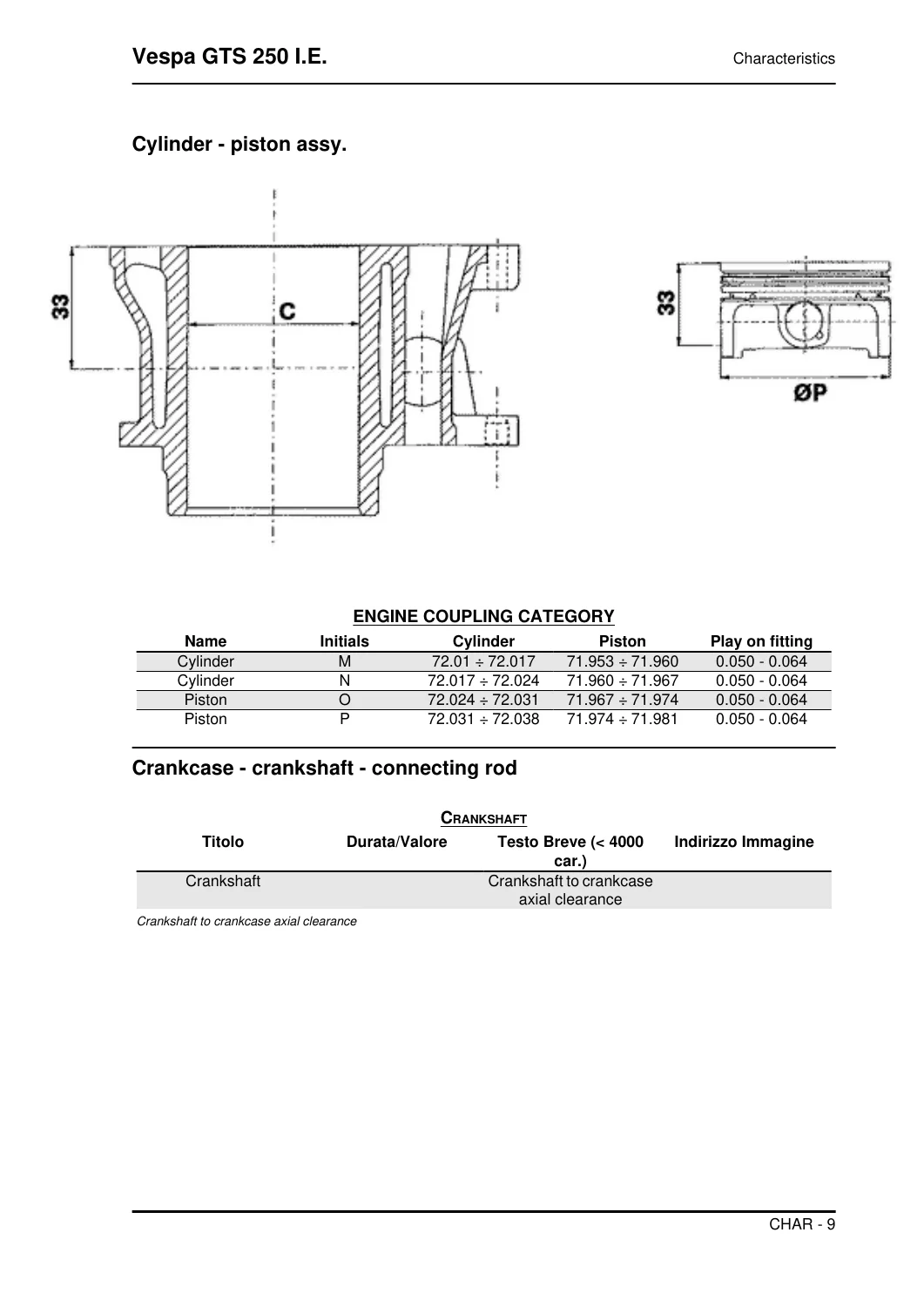
Cylinder–piston pairing is graded M, N, O and P with fitting play 0.050–0.064 mm across the 72.01–72.038 mm bore bands. Crankshaft-to-crankcase axial clearance is built from half-shaft, connecting-rod and spacer dimensions to a 0.20–0.50 mm stack. Base-gasket shimming uses piston-crown drop measurement A without a gasket: 3.70–3.60 mm takes 0.4 ± 0.05 mm, 3.60–3.40 mm takes 0.6 ± 0.05 mm, 3.40–3.30 mm takes 0.8 ± 0.05 mm, targeting compression 10.5 ÷ 11.5 : 1. Head nuts use the printed sequence 7±1 + 10±1 + 270°. Drive-pulley nut is 75 ÷ 83 Nm, clutch nut on the driven pulley 45 ÷ 50 Nm, flywheel nut 94–102 Nm, rear wheel shaft 104 ÷ 126 Nm.
The injection chapter explains the MIU system: indirect manifold injection timed by a crankshaft tone wheel so ignition occurs only on the compression stroke. Checks include injection-load 10A fuse No. 3 and live-control-unit 7.5A fuse No. 2, load-relay coil 40–80 Ohm between pins 86 and 85, injector 14.5 ± 5% Ohm, HV-coil primary 0.5 ± 8% Ohm, and fuel-pressure work with tool 020480Y. TPS reset is required on first fit or after control-unit replacement, and must not be performed on a used throttle body. Idle mixture is not a screwdriver job — the system finishes idle control through the stepper and ignition variation.
IMAGES PREVIEW
Electrical splits, tools and labor times
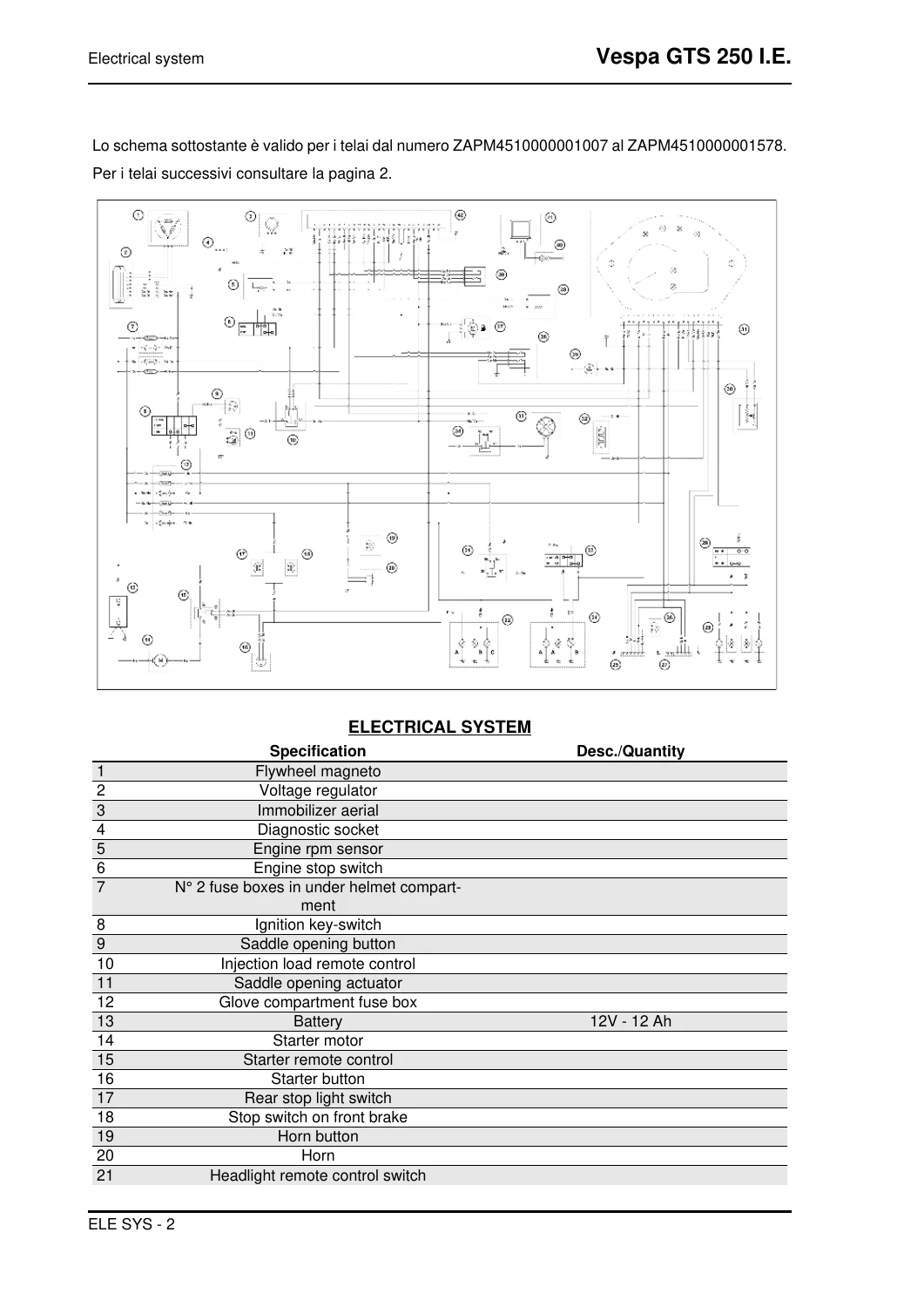
Wiring is not a single drawing. One schema is valid for frames ZAPM4510000001007 to ZAPM4510000001578; a second applies from ZAPM4510000001579 onward. The key lists flywheel magneto, voltage regulator, immobilizer aerial, diagnostic socket, rpm sensor, injection load remote control, 12V-12Ah battery, fuel pump, injector, lambda sensor, HV coil and the electronic injection control unit, plus lighting, horn, fan and instrument circuits. Colour abbreviations are printed on the same pages.
The tooling chapter photographs the dealer kit: 005095Y engine support, 020460Y scooter diagnosis tester, 020481Y control-unit interface wiring, 020626Y driving-pulley lock wrench, 020627Y flywheel lock wrench, 020423Y driven-pulley lock wrench, 020444Y clutch tool, 020638Y 250 I.E. engine ABS software and the 020469Y reprogramming kit, among many punches, adaptors and extractors. The TIME section at the back assigns duration codes to workshop operations so a dealer can estimate a job before the stand is booked.
Get the Vespa GTS 250 I.E. Workshop Manual 633577 (2007) Complete Service Repair PDF
With this file a mechanic can run the printed service chart, set valve clearance and spark-plug gap, change engine, hub and brake fluids to the listed products, diagnose oil smoke or weak brakes from the cause/operation tables, drop the engine, rebuild the variator and clutch to the CHAR torques, and step through MIU fuel-pump, injector, coil and lambda tests without guessing fuse numbers or relay pin-outs. Using the values and sequences actually printed in publication 633577 keeps compression, belt tracking, hydraulic circuits and injection timing inside the limits Piaggio published for this scooter.
Delivery is an instant PDF download after payment — no shipping, readable on any device and printable for the bench. Keep the Vespa GTS 250 I.E. Workshop Manual 633577 (2007) Complete Service Repair PDF with the scooter so the next oil service, belt change or injection fault is handled from the same document the dealer workshop was written to use.
Reviews
There are no reviews yet.