
Zoomlion ZMC85 Truck Crane Operator’s Manual (Hong Kong) April 2013
Original price was: $46.95.$28.95Current price is: $28.95.
English operator’s manual for the Zoomlion ZMC85 truck crane Hong Kong specification, covering chassis driving, superstructure lifts, load charts, outriggers, jib setup, and cab controls from the April 2013 Edition 1 book.
Description
File Details
- Manual type: Operator’s manual
- Brand / model: Zoomlion ZMC85 truck crane (chassis ZLJ5480JQZ)
- Market edition: For Hong Kong
- Language: English
- Page count: 190
- File format: PDF
- Publication: April 2013, Edition 1
- Engine shown on name plate: WP10.375
What this Hong Kong edition covers
The Zoomlion ZMC85 Truck Crane Operator’s Manual (Hong Kong) April 2013 is the English operator book issued for the ZMC85 / ZLJ5480JQZ truck crane sold into Hong Kong. It is written for the driver and the crane operator, not as a workshop overhaul guide. Keep it in the cab. The foreword states that the book must be read by everyone who operates or maintains the machine, that the Chinese original remains the reference for factual accuracy, and that Zoomlion assumes no liability for operation outside these instructions.
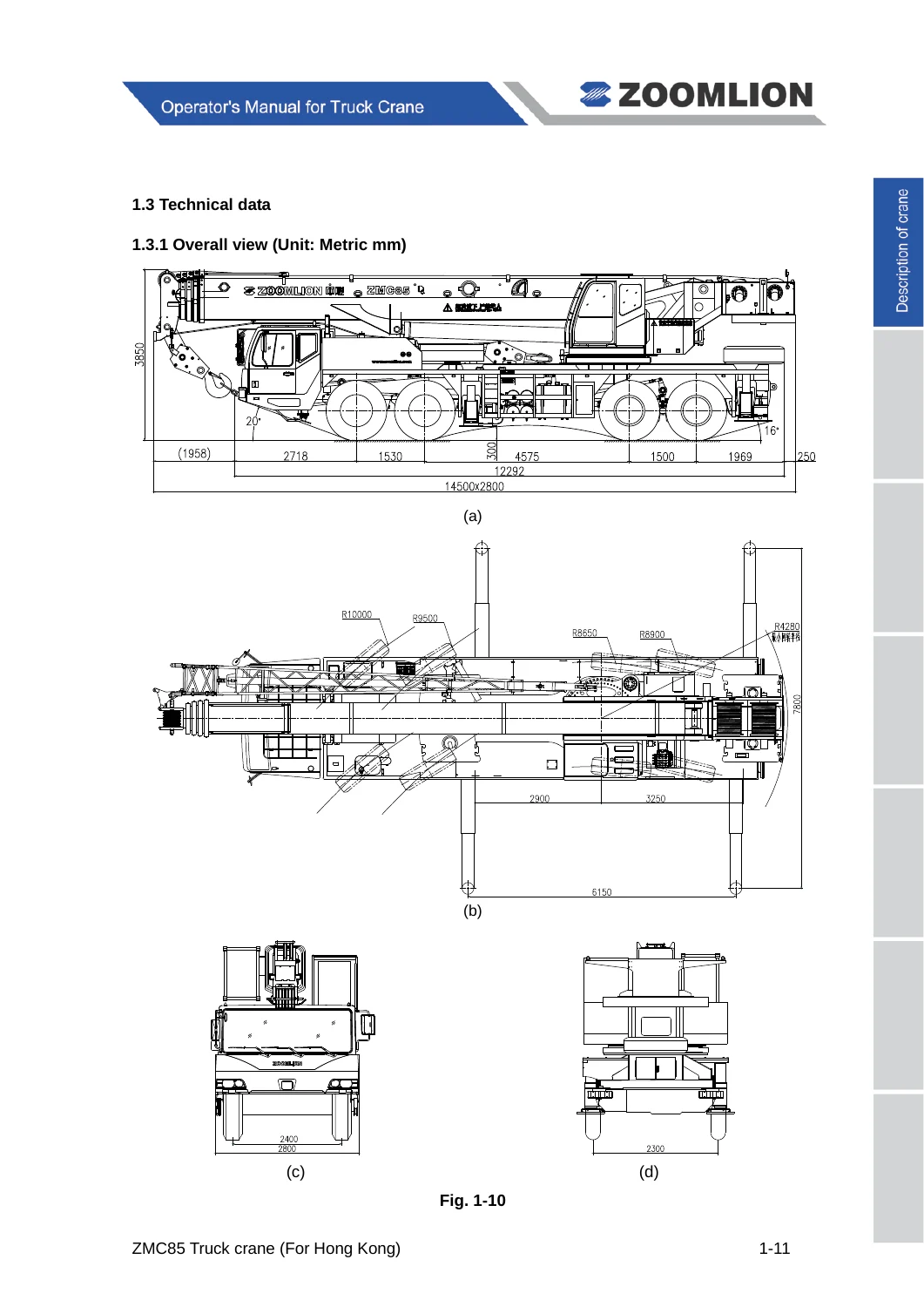
Name plates in Chapter 1 identify the crane as ZMC85 with maximum lifting capacity 85000 kg, engine model WP10.375, engine rated power 276 kW, maximum design total mass 39800 kg, complete vehicle kerb mass 39670 kg, and overall dimensions 14500 × 2800 × 3850 mm. The chassis name plate repeats the same engine and VIN family. The VIN format stamped on the plates and on the right longitudinal beam is L5E6H5D3××A×××××. Engine code is printed near the gear chamber on the right side of the WP10.375; the engine plate sits on the left side of the block.
Chapters Covered
- Foreword and Safety Instruction (Danger, Warning, Caution, Careful, Note, Important, prohibition symbol)
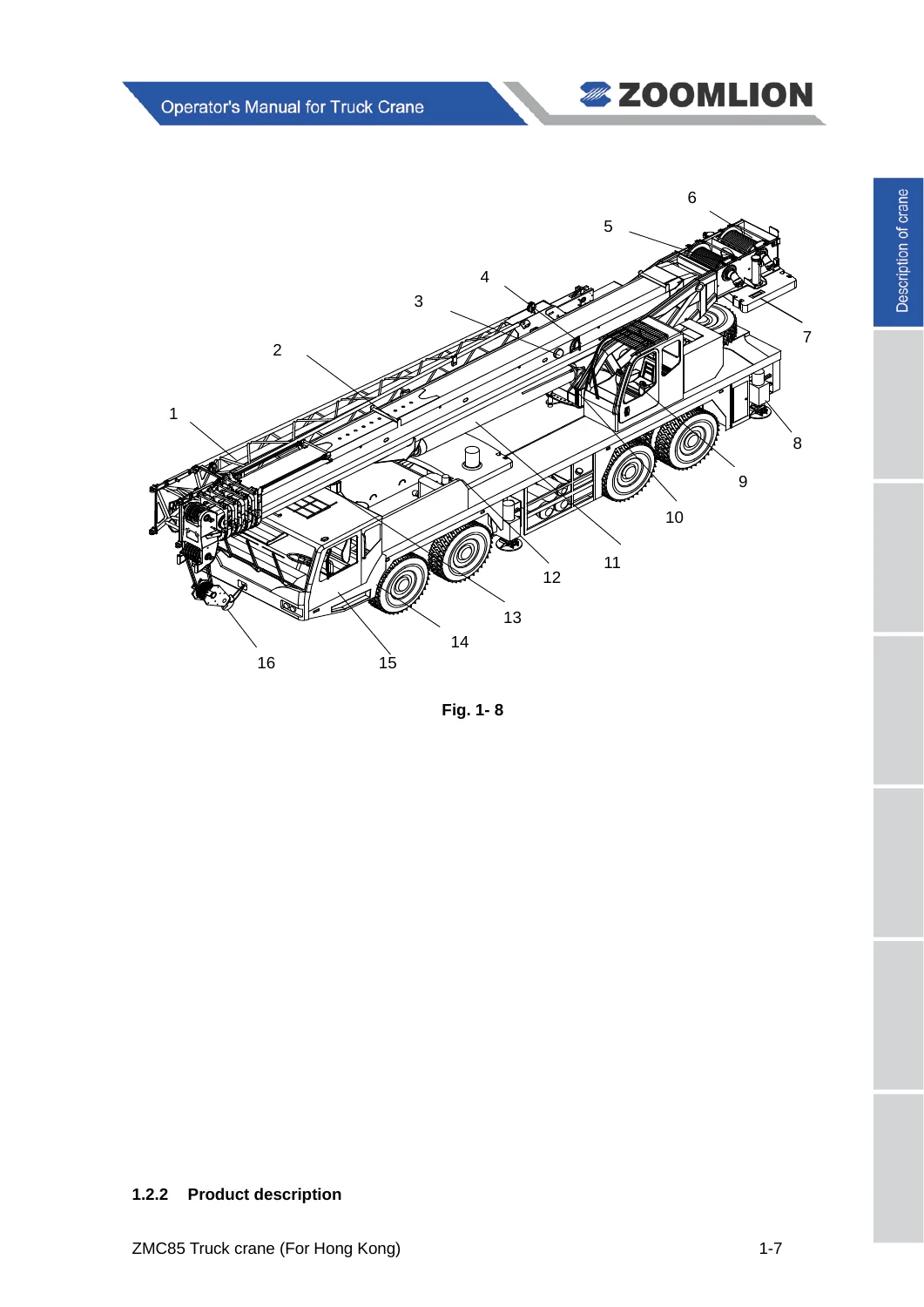
- Chapter 1 Description of crane — Model and name plate; crane components and product description (chassis and complete vehicle); boom lengths; technical data; load capacity tables; lifting height chart; working areas
- Chapter 2 Safety — Safety instructions and signs; planning crane operation; break-in instructions; general safety technical guidelines (operator/rigger/signalman, site selection, supporting, working conditions, points for safe operation); hand signals
- Chapter 3 Operation – crane chassis — Driver’s cab (steering wheel, instrument panel, pedals, center console, lighting, doors, seats, attachments); checks before starting; driving (engine start/stop, transmission and clutch, steering, brakes, PTO, towing); driving, off-road, parking and breakdown notes
- Chapter 4 Operation – crane superstructure — Operator’s cab, switch panels, control boxes, seat and accelerator; computer system; starting the crane; safety devices (level gauge, angle indicator, hoisting and lowering limit switches, hydraulic safety devices, emergency off); crane operation (preparations, outriggers, derricking, telescoping, lifting/lowering, slewing, simultaneous movements, rope reeving)
- Chapter 5 Equipment — Safety guidelines for attachments; jib general notes, assembly, angle settings, dismantling, auxiliary hoist rope reeving, hoisting limit switch connection; rooster sheave assembly and dismantling
- Chapter 6 Additional equipment — Driver’s cab air conditioning; GPS terminal (display, emergency unlocking, control-light states); operator’s cab air conditioning and heater
- Chapter 7 Transportation and storage — Transport points; long-term storage and restart checks
Taken together, the Zoomlion ZMC85 Truck Crane Operator’s Manual (Hong Kong) April 2013 gives the crew the identification data, rated charts, cab layout, driving rules, lift-sequence controls, attachment setup, and storage steps needed to work this 85 t class machine without guessing at the next control or the next chart.
Ratings, boom and load charts
Work performance figures in Table 1-1 include maximum rated lifting capacity 85000 kg, maximum load moment of the basic boom 2646 kN·m, and 1376 kN·m on the fully extended main boom. Lifting heights listed (without boom or jib deflection) are 12.8 m on the basic boom, 46.4 m on the fully extended main boom, and 62.5 m with jib. Main hoist rope speed is 140 m/min on the 4th drum layer; auxiliary hoist is 120 m/min on the 2nd layer. Boom derricks up in 55 s and telescopes out in 110 s. Slewing range is 0–1.7 r/min.
The five-section main boom runs 12–46 m. Optional jibs are 9.5 m and 16 m at 0°, 15° or 30° offset. Combined lengths given in the boom chapter are 55.5 m (46 m + 9.5 m) and 62 m (46 m + 16 m). Standard reevings in Table 1-3 drop from 12 parts on the 12 m boom to 3 parts on 46 m and 1 part on jib combinations. Maximum permissible load on a single wire rope is 6000 kg. Main and auxiliary ropes are both specified as 4V*48S+5FC-20.0-1870 left-hand ordinary lay, 220 m and 130 m long.
Rated capacity tables occupy a large share of Chapter 1. Separate charts cover outriggers fully or intermediately extended, telescopic cylinder I fully out, mid, or in, and counterweight combinations of 3 t fixed only, 3 t fixed plus 4 t movable, or 3 t fixed plus 6 t movable. Jib tables list capacities against boom angle for 46+9.5 m and 46+16 m. A lifting height chart plots radius versus height for those boom and jib setups. Working-area drawing Fig. 1-11 splits over-front from over-sides-and-rear. Notes require the fifth outrigger, wheels clear of the ground, sliding beams pinned to the charted span, and deduction of hook and tackle weight (main hook 560 kg, auxiliary hook 140 kg; jib itself 2000 kg when left on the head). Starred capacities call for the 70 t hook. Maximum support strength per outrigger inside the published charts is 75 t. Inclination of the crane must stay within 0.6°.
Driving the chassis and running the crane
Chapter 3 walks through the low-mounted full-width driver’s cab: adjustable steering wheel, instrument cluster with axle-pressure bars, air horn, engine and dual service-brake pedals, center console, lighting, doors and air-cushioned seat with sleeper berth. Pre-start checks, engine start and stop, the 10-speed 10JSD160 mechanical transmission (10 forward, 2 reverse), clutch use only above 0.4 MPa air pressure, steering limits, dual-circuit air service brake plus spring parking brake and engine exhaust brake, PTO engagement and towing cautions are all written as operating steps. Driving mass is 39800 kg; maximum road speed 75 km/h; gradeability 37%; minimum turning diameter ≤ 21 m; fuel tank 300 L.
Chapter 4 shifts to the operator’s cab: monitor and load moment limiter, pressure gauges, switch panels, pilot joysticks, adjustable seat, computer system and start-up checks. Safety devices include the level gauge, boom angle indicator, hoisting and lowering limit switches, hydraulic circuit pressure limits (for example main/auxiliary winch spool-up 30 MPa, derricking up 27 MPa, telescoping out 13 MPa / in 16 MPa, slewing 12 MPa, control 3 MPa) and the emergency-off switch that kills engine and electrical crane control. Outrigger, derrick, telescope, hoist, slew and simultaneous-movement procedures are joystick-based, with notes on restricted vision over side and rear and the rule that derricking down is not sped up with the engine pedal. Rope reeving must match the chart for the boom length in use.
Jib, rooster sheave, cab options and storage
Chapter 5 covers lattice/box jib assembly, the three offset angles, dismantling, reeving the auxiliary hoist rope through the jib and connecting the hoisting-limit cables so the switch stays live. The rooster sheave is limited to 6000 kg. Chapter 6 documents driver’s-cab air conditioning, the GPS terminal display and emergency-unlock procedure plus yellow/red/green status lamps, and the operator-cab A/C and heater panel. Chapter 7 lists transport cautions and a storage checklist: retract cylinder rods (except vertical jacks), hold tires off the ground, grease exposed parts and wire rope with ZG-3 graphite calcium grease, disconnect the battery for long idle periods, and run all mechanisms at idle for at least an hour every three months.
Use this manual on the job
With the Zoomlion ZMC85 Truck Crane Operator’s Manual (Hong Kong) April 2013 in hand, a licensed operator can identify the machine from the name plates, pick the correct capacity table for outrigger span, boom length, cylinder I position and counterweight, set the fifth outrigger and level the carrier, drive the 8×4 chassis, engage PTO, run derrick/telescope/hoist/slew from the pilot joysticks, fit the 9.5 m or 16 m jib, and park or store the crane as specified. Using the printed charts and pressure limits instead of memory keeps the lift inside the published envelope and keeps limit switches and emergency-off in the loop. After payment the file is delivered instantly as a PDF you can open on any device and print for the cab — no shipping wait.
IMAGES PREVIEW
Reviews
There are no reviews yet.