

1999-2002 Kawasaki Prairie 300 / Prairie 300 4×4 Service Manual PDF
Original price was: $39.95.$24.95Current price is: $24.95.
341-page Kawasaki Prairie 300 and Prairie 300 4×4 service manual covering 1999-2002 KVF300-A1 through A4 and KVF300-B1 through B4 models, with maintenance, repair, specifications, troubleshooting, exploded views and wiring diagrams.
Description
1999-2002 Kawasaki Prairie 300 / Prairie 300 4×4 Service Manual PDF
This 1999-2002 Kawasaki Prairie 300 / Prairie 300 4×4 Service Manual PDF covers the Prairie 300 all-terrain vehicle family identified in the manual as KVF300-A and KVF300-B models. The model application section spans 1999 through 2002, including A1 through A4 and B1 through B4 variants, while the specifications distinguish the four-wheel-drive KVF300-A configuration from the two-wheel-drive KVF300-B configuration. Across 341 pages, the manual brings together scheduled maintenance, inspection standards, adjustment procedures, disassembly and assembly instructions, troubleshooting information, torque data, service limits, system diagrams, and electrical wiring diagrams.
File Details
- Manual type: All Terrain Vehicle Service Manual
- Brand: Kawasaki
- Models: Prairie 300 4×4 / Prairie 300; KVF300-A1, A2, A3, A4 and KVF300-B1, B2, B3, B4
- Model application: 1999-2002
- Language: English
- Page count: 341 pages
- File format: PDF
- Part No.: 99924-1239-04
Workshop Coverage for the Prairie 300 and Prairie 300 4×4
The manual is arranged by vehicle system so a technician can move from identification and service data into the exact component being inspected or repaired. The foreword explains that each major system is given its own chapter, with procedures ranging from adjustment through disassembly and inspection. Exploded views are used throughout many chapters to show component relationships and assembly information, while dedicated specification pages provide standards and service limits for measurements that determine whether a part remains usable.
For routine service, the General Information chapter includes a periodic maintenance chart covering engine and chassis items such as converter drive-belt wear and deflection, air-cleaner service, throttle play, valve clearance, fuel-system cleanliness, engine oil, oil filter, spark plug, brakes, battery, steering, final gear-case oil and general lubrication. The same section also provides general specifications, torque and locking-agent information, special tools, and cable, wire and hose routing illustrations.
The engine coverage goes well beyond basic tune-up work. The 290 mL, 4-stroke, SOHC, single-cylinder, air-cooled engine is supported by procedures for compression measurement, cylinder-head removal and installation, valve-clearance inspection and adjustment, valve-guide and valve-seat work, camshaft and rocker-arm inspection, cam-chain service, piston and cylinder inspection, piston-ring measurements, exhaust-system service, oil-pressure testing, oil-pump work, and complete engine removal and installation. The crankshaft and transmission chapter adds crankcase separation and assembly, crankshaft and balancer-shaft work, connecting-rod checks, transmission removal and assembly, shift-fork inspection, bearing service, and oil-seal inspection.
Chapters Covered
- General Information – before servicing, model identification, general specifications, periodic maintenance, torque-converter technical information, reverse power control, torque and locking agent, special tools, cable/wire/hose routing
- Fuel System – throttle and choke controls, Keihin CVK32 carburetor, fuel-level inspection and adjustment, carburetor removal/disassembly/cleaning, air cleaner, fuel tank, fuel tap/filter and fuel-level gauge
- Engine Top End – compression testing, cylinder head, compression releasing lever, valves/guides/seats/springs, camshaft and rocker arms, cam chain and tensioner, cylinder/piston, exhaust system
- Converter System – torque converter, drive belt, drive-belt deflection, drive pulley, driven pulley, inspection limits and high-altitude setting information
- Recoil Starter – removal, disassembly, assembly, cleaning and inspection
- Engine Lubrication System – oil-flow chart, engine oil and filter, oil screen, oil-pressure measurement, pressure-relief valve, oil pump and oil cooler
- Engine Removal/Installation – engine removal sequence, mounting hardware and installation checks
- Crankshaft / Transmission – crankcase, crankshaft/balancer shaft, connecting rod, transmission shafts, shift mechanism, bearings and oil seals
- Wheels / Tires – wheel alignment and toe-in, wheel removal/installation, rims, tires, front and rear hubs
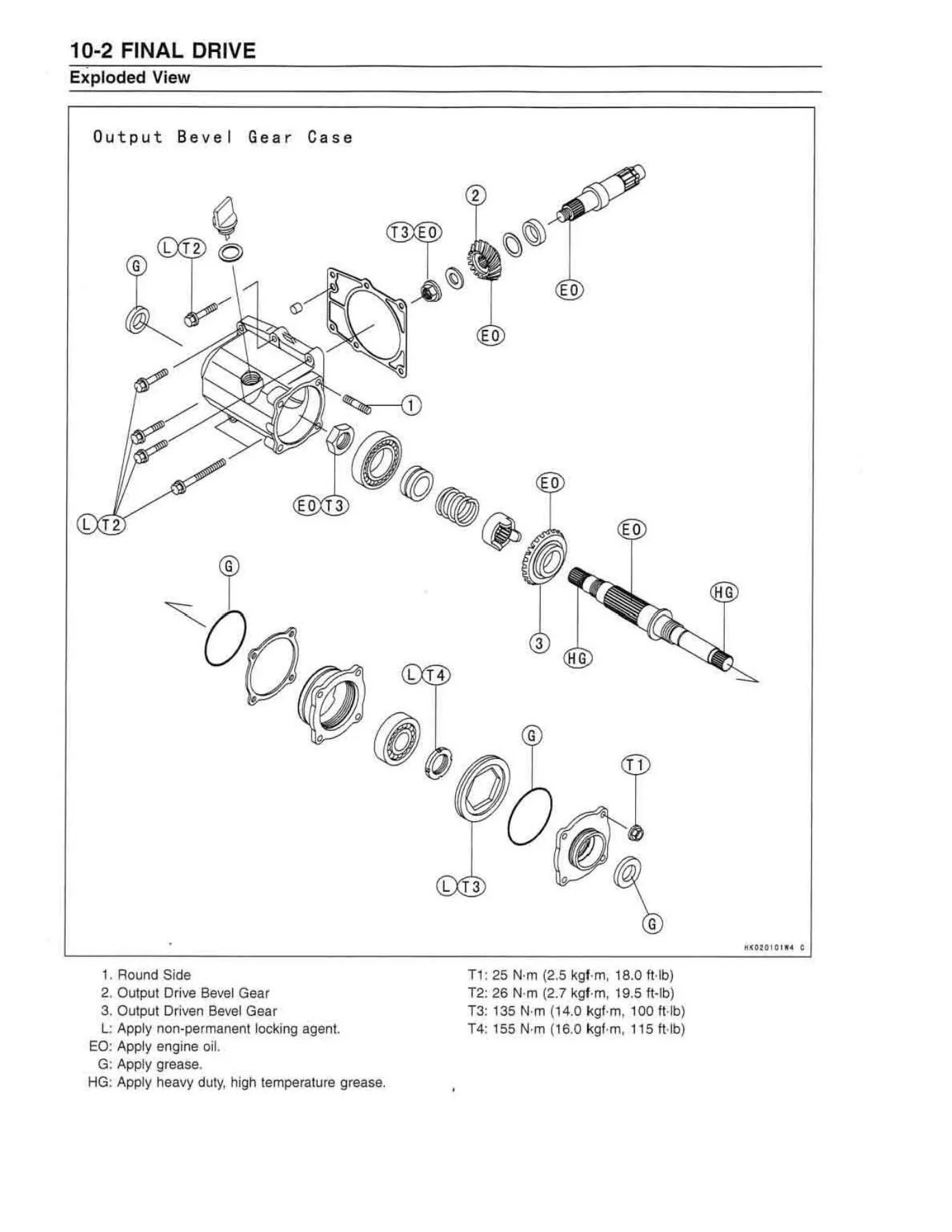
- Final Drive – output bevel gear case, front and rear propeller shafts, front axle, front final gear case and differential, rear axle, rear final gear case, bevel-gear adjustment, bearings and seals
- Brakes – brake fluid, hydraulic master cylinder and calipers, brake pads and discs, brake hoses, rear brake lever/pedal/cables, drum and panel, shoes and wear inspection
- Suspension – front and rear shock absorbers, spring work, suspension arms, swingarm, bearings and lubrication
- Steering – steering stem, steering knuckle, tie-rods, steering inspection and lubrication, bearings, handlebar removal and installation
- Frame – seat, front and rear fenders, covers, guards, steps, headlight holder and related body/frame components
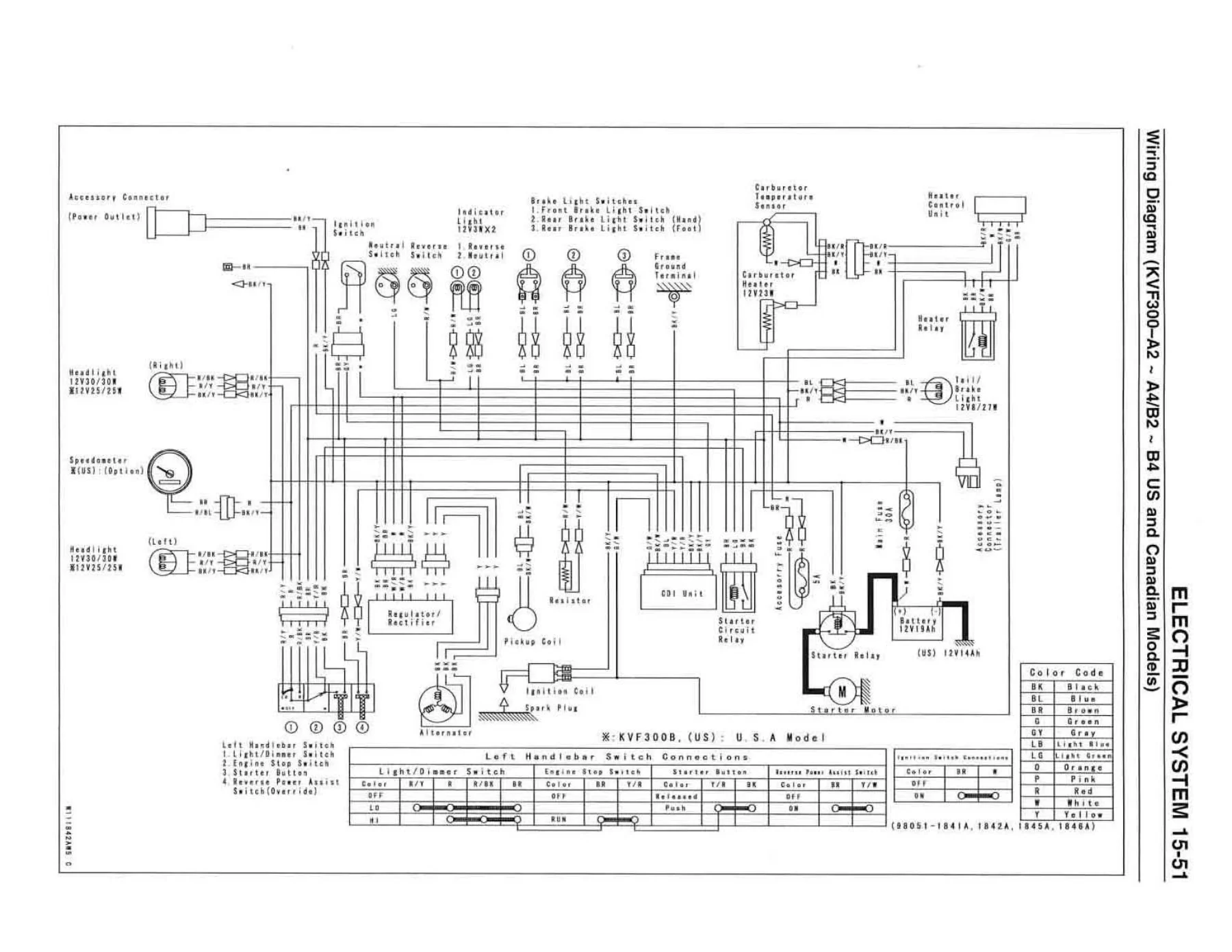
- Electrical System – wiring inspection, battery, charging system, ignition system, troubleshooting, electric starter, starter clutch and chain, lighting, carburetor heater, switches, fuses and model/market wiring diagrams
- Appendix – riding-condition considerations, carburetor and spark-plug guidance, troubleshooting guide, general lubrication, bolt and nut tightening, unit conversion table and model application
Taken together, these chapters make the 1999-2002 Kawasaki Prairie 300 / Prairie 300 4×4 Service Manual PDF useful for both systematic maintenance and component-level repair. The document links many procedures to related specifications and inspection standards, helping the user check a system rather than simply remove and replace parts.
Specifications, Measurements and Diagnostic Reference
The manual contains detailed measurement data throughout its system chapters. Examples include engine compression ranges, valve clearances, valve-guide and valve-seat dimensions, cam height, cam-chain length, cylinder and piston measurements, piston-ring clearances, drive-belt width and deflection, oil pressure, crankshaft and connecting-rod limits, wheel alignment, brake specifications and numerous tightening torques. These values are paired with inspection instructions so measurements can be compared against the stated standard or service limit before deciding whether adjustment or replacement is required.
The converter section is especially practical for performance-related diagnosis. It explains drive and driven pulley operation, specifies drive-belt deflection, shows inspection limits for pulley components, and includes high-altitude settings for ramp weights, springs, spacers and carburetor main jets. The Final Drive chapter provides separate procedures for the output bevel gear case, front and rear drive components, differential and final gear cases, including gear adjustment and bearing or seal work. This is particularly important because the Prairie 300 4×4 and Prairie 300 configurations do not use identical final-drive layouts.
Electrical work is supported by component tests and wiring references rather than only a general schematic. The chapter covers the battery and charging system, alternator and regulator/rectifier checks, ignition components, CDI-related testing, starter motor and relays, starter clutch, lighting, heater system, switches and fuses. Separate wiring diagrams are provided for model and market groupings, including A1/B1 and A2-A4/B2-B4 applications.
Illustrated Service Procedures
Photographs, line drawings, exploded views and routing diagrams are used throughout the manual to clarify component position and assembly order. The early pages show model identification and cable, wire and hose routing. Engine chapters illustrate valve train, piston, cam-chain and lubrication-system details; converter pages show pulley and belt assemblies; final-drive pages map gears, shafts and axle components; and the electrical section supplies full-page wiring diagrams. These illustrations are especially useful when a repair requires confirming orientation, routing, fastener location or the relationship between several parts before reassembly.
The manual also identifies special tools where a procedure calls for them, including pullers, drivers, gauges, holders, wrenches and valve-service tools. Torque tables cover major fasteners across the fuel system, engine, converter, lubrication system, transmission, wheels, final drive, brakes, suspension, steering, frame and electrical system. Following those stated values and sequences is essential when reassembling components that rely on correct clamping load or alignment.
Repair and Maintain Your Kawasaki Prairie 300 with the Right Reference
The 1999-2002 Kawasaki Prairie 300 / Prairie 300 4×4 Service Manual PDF gives you one detailed reference for maintenance, adjustment, diagnosis, engine work, converter service, transmission repairs, final-drive work, brakes, suspension, steering and electrical troubleshooting on the covered KVF300 models. Using the procedures, standards, service limits, tightening torques and diagrams printed in the manual helps you work to the specified measurements instead of relying on guesswork. After purchase, the manual is delivered instantly as a PDF with no shipping required; it can be viewed on your compatible phone, tablet or computer and printed when you want a workshop copy of the pages you need.
IMAGES PREVIEW



Reviews
There are no reviews yet.