
2004 Honda CBR1000RR Service Manual – CBR1000RR-4 Repair & Workshop PDF
Original price was: $32.95.$18.95Current price is: $18.95.
The 2004 Honda CBR1000RR service manual for the CBR1000RR-4, covering all 23 sections from general information and torque values through PGM-FI diagnostics, engine, chassis, brakes and the full wiring diagram.
Description
2004 Honda CBR1000RR Service Manual – CBR1000RR-4
This is the 2004 Honda CBR1000RR service manual, written around the CBR1000RR-4 and laid out in 23 numbered sections that run from general information and technical features through every mechanical, fuel, electrical and chassis system on the motorcycle. Honda’s own introduction states plainly what the book is for: it describes the service procedures for the CBR1000RR-4 and directs the technician to follow the Maintenance Schedule in Section 4 so the machine stays in peak operating condition and within the emission standards set by the U.S. Environmental Protection Agency, California Air Resources Board and Transport Canada.
That structure matters. Sections 1 and 4 apply to the whole motorcycle, Section 3 illustrates the removal and installation of the components you have to move out of the way before you can reach the job, and Sections 5 through 20 break the machine down by location. Most of those sections open with an assembly or system illustration, service information and a troubleshooting page before the detailed procedure begins, so you are looking at the system as a whole before you start undoing fasteners.
File Details
- Manual type: Motorcycle service manual
- Brand and model: Honda CBR1000RR (CBR1000RR-4), 2004
- Language: English
- Page count: 586
- File format: PDF
- Structure: 23 numbered sections plus an index
- Units: Metric fasteners and torque values throughout
- Scope: Sections 1 and 4 apply to the whole motorcycle
Chapters Covered
- 1. General Information – service rules, model identification, general specifications, lubrication, fuel system, cooling system, cylinder head/valves, clutch/starter clutch, transmission, crankcase/crankshaft/balancer/piston/cylinder, front and rear wheel/suspension, hydraulic brake, battery/charging, ignition, electric starter and lights/meters/switches specifications, standard torque values, engine and frame torque values, lubrication and seal points, cable and harness routing, emission control systems
- 2. Technical Features – HESD (Honda Electronic Steering Damper), radial-mounted front brake caliper, EGCV (Exhaust Gas Control Valve)
- 3. Frame/Body Panels/Exhaust System – body panel locations, middle cowl, under cowl, upper cowl, windscreen, top shelter, front fender, rear fender A and B, seat rail, exhaust pipe and muffler
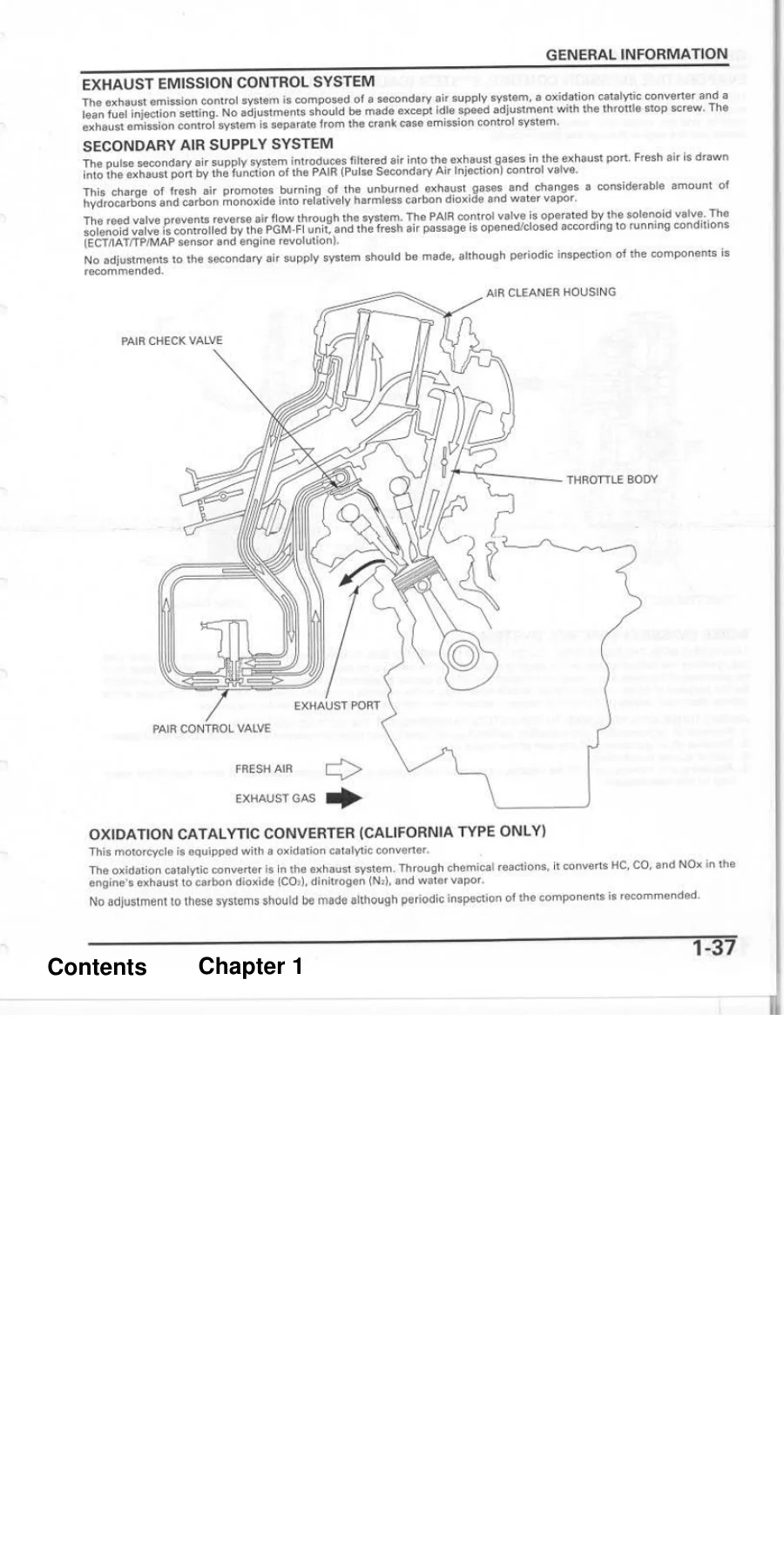
- 4. Maintenance – maintenance schedule, fuel line, throttle operation, air cleaner, spark plug, valve clearance, engine oil and oil filter, radiator coolant, cooling system, secondary air supply system, evaporative emission control system, exhaust gas control valve cable, drive chain, brake fluid, brake pad wear, brake system, brake light switch, headlight aim, clutch system, side stand, front and rear suspension, nuts/bolts/fasteners, wheels and tires, steering head bearings
- 5. Lubrication System – oil pressure inspection, oil strainer and pressure relief valve, oil pump, oil cooler
- 6. Fuel System (Programmed Fuel Injection) – component location, system diagram, PGM-FI self-diagnosis information, MIL code index, MIL troubleshooting, fuel line inspection, fuel pump unit, fuel cut-off relay, fuel tank, air cleaner housing, secondary injector, throttle body, primary injector, idle air control valve and synchronization, MAP/IAT/ECT/CMP sensors, bank angle sensor, engine stop relay, ECM, PAIR control solenoid valve, EVAP purge control solenoid valve, intake air duct, EGCV and EGCV servomotor
- 7. Cooling System
- 8. Engine Removal/Installation
- 9. Cylinder Head/Valves
- 10. Clutch/Starter Clutch
- 11. Alternator
- 12. Transmission/Gearshift Linkage
- 13. Crankcase/Crankshaft/Balancer/Piston/Cylinder
- 14. Front Wheel/Suspension/Steering
- 15. Rear Wheel/Suspension
- 16. Hydraulic Brake
- 17. Battery/Charging System
- 18. Ignition System
- 19. Electric Starter
- 20. Lights/Meters/Switches
- 21. Wiring Diagram
- 22. Troubleshooting
- 23. Index
What that adds up to for a technician is a single reference that carries the whole job: the specification tables that tell you whether a part is still serviceable, the assembly illustrations that show you how it goes back together, and the procedure pages that sit between them. The 2004 Honda CBR1000RR service manual does not assume you already know the machine either. Its own guidance is to read Technical Features in Section 2 if the motorcycle is unfamiliar, and to go straight to Section 22 Troubleshooting if the source of the trouble is not known.
Technical Features Specific to the CBR1000RR-4
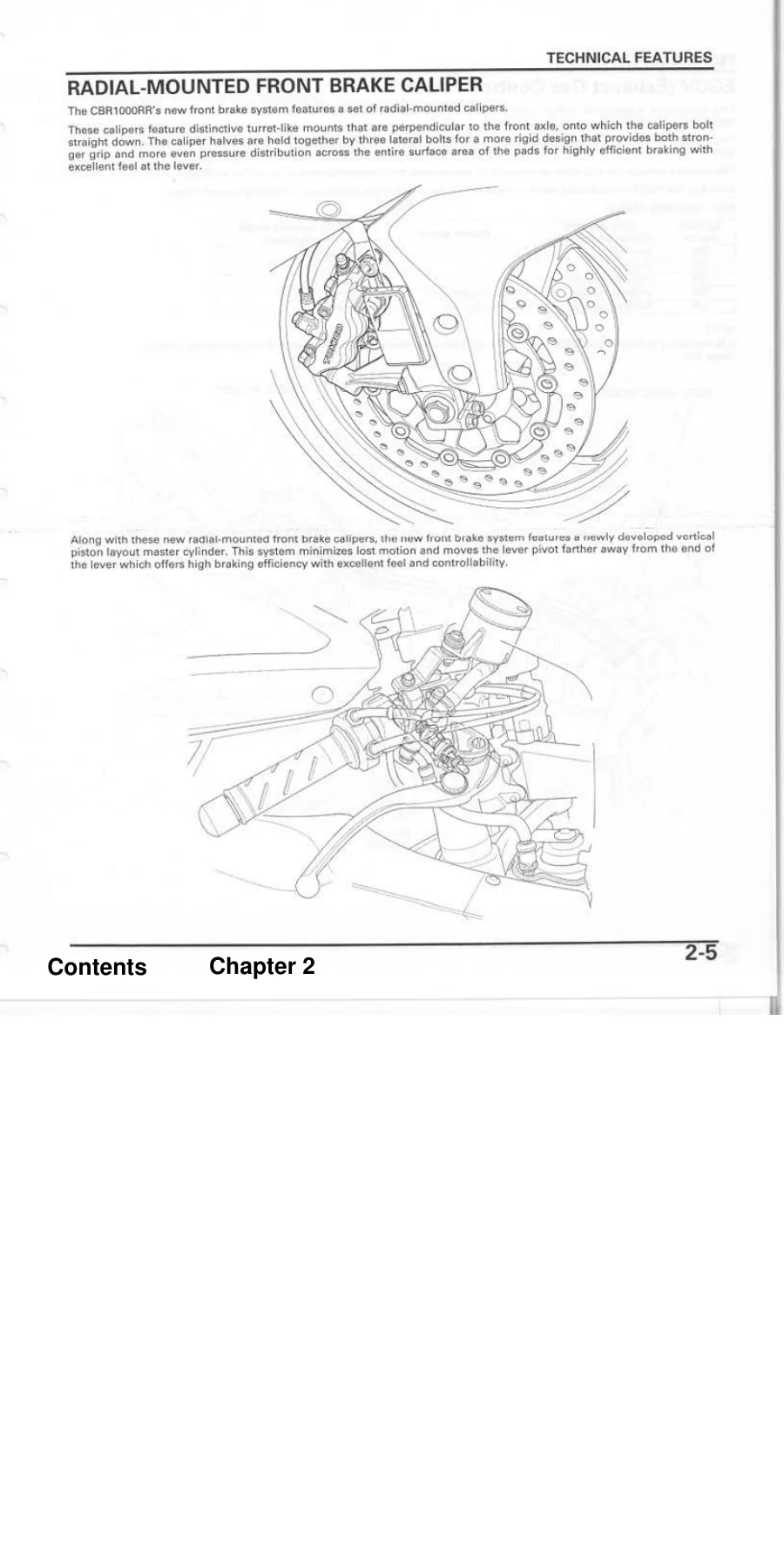
Section 2 is where this CBR1000RR-4 repair manual separates itself from a generic sportbike book. The HESD system is documented as a hydraulic rotary damper with a linear solenoid, a VS (vehicle speed) sensor and ECM control, with damping characteristics mapped against vehicle speed and acceleration, plus a self-diagnostic and fail-safe system linked to the PGM-FI system that reports trouble through the MIL and the HESD indicator. The section also covers the radial-mounted front brake calipers, whose halves are held together by three lateral bolts and which bolt straight down onto turret-like mounts perpendicular to the front axle, and the EGCV, a variable exhaust control valve in the muffler driven by a servomotor under the fuel tank with opening angles tabulated against gear position and engine speed.
PGM-FI Diagnostics and MIL Codes
The fuel injection chapter is built around the PGM-FI self-diagnosis system. The manual explains how to read the malfunction indicator lamp, how to short the Data Link Connector with the SCS service connector, how to erase stored self-diagnosis memory, and how to work through the MIL code index. Individual code routines walk the technician through voltage and resistance checks at the ECM test harness terminals – MAP sensor output and input voltage, ECT sensor resistance, TP sensor output, IAT sensor, VS sensor pulse, injector circuit resistance, CMP and CKP peak voltage, EGCV potentiometer and servomotor circuits. It is the difference between replacing parts and finding the fault.
Torque Values, Clearances and Service Limits
Section 1 gathers the numbers into one place: standard torque values by fastener size, then engine and frame torque values broken out by assembly – maintenance, lubrication, fuel, cooling, engine removal, cylinder head and valves, clutch and starter clutch, alternator, transmission, frame and bodywork. The specification tables carry both the standard and the service limit side by side, so valve clearance, cam lobe height, valve guide clearance, clutch disc thickness, piston-to-cylinder clearance, brake disc thickness and runout, and fork spring free length can all be judged against Honda’s limits rather than against guesswork. Lubrication and seal points are listed separately, with the molybdenum disulfide oil, multi-purpose grease, locking agent, sealant and DOT 4 fluid callouts identified page by page.
Maintenance Schedule and Routine Service
The maintenance chapter is written as a schedule with an odometer grid, marking each item as inspect and clean, adjust, lubricate, replace or clean, and flagging which items are best handled by an authorized Honda dealer. Beyond the schedule itself, the chapter has step-by-step procedures for the routine work: lifting and supporting the fuel tank, measuring throttle grip free play at 2-4 mm, replacing the air cleaner elements, pulling the spark plugs, checking and shimming valve clearance, changing engine oil and the oil filter cartridge, topping the coolant reserve tank, adjusting drive chain slack to 25-35 mm, checking brake pad wear at the wear limit groove and setting brake pedal height.
Buy the 2004 CBR1000RR Service Manual
With this 2004 Honda CBR1000RR service manual on the bench you can carry out the work the CBR1000RR-4 actually asks for: a valve clearance check and shim change, camshaft removal, clutch and starter clutch service, engine removal and reinstallation, crankcase and transmission work, fork and shock absorber servicing, brake caliper and master cylinder overhaul, charging and ignition system diagnosis, and the full PGM-FI fault-finding routine from MIL code to root cause. The torque figures, service limits and clearances are the ones Honda printed, which is the whole point – a fastener tightened to the wrong value or a part run past its wear limit costs far more than the manual does.
IMAGES PREVIEW
Delivery is instant. The file is a PDF that downloads immediately after payment, with no shipping and nothing to wait for. It opens on any phone, tablet, laptop or desktop, and every page can be printed for the garage if you prefer paper in your hand while you work.

Reviews
There are no reviews yet.