
Airbus A318 A319 A320 A321 CFM56 Mechanical and Avionics Technical Training Manual
Original price was: $39.95.$23.95Current price is: $23.95.
Complete Airbus A318/A319/A320/A321 CFM56 technical training manual covering mechanical and avionics systems at Level 1. 388 pages of system presentations, cockpit layouts, structural zoning, ground handling procedures, and avionics fundamentals for the Single Aisle family.
Description
Airbus A318 A319 A320 A321 CFM56 Technical Training Manual — Mechanical & Avionics Level 1
This Airbus A318 A319 A320 A321 CFM56 Mechanical and Avionics Technical Training Manual is a comprehensive training resource covering the Single Aisle family aircraft. It spans 388 pages of detailed system presentations, cockpit familiarization, structural breakdown and zoning, ground handling procedures, aircraft documentation, and avionics fundamentals. The manual is organized into two major training blocks: T1+T2 Mechanical and T1+T2 Avionics, both at Level 1.
Whether you are a maintenance technician, aviation student, flight crew member, or aviation enthusiast, this Airbus A320 technical training manual provides a structured walkthrough of the aircraft’s major systems, from the airframe and powerplant interfaces to the electronic instrument system, electrical power generation and distribution, navigation sensors, auto flight, communications, and lighting.
File Details
- Manual Type: Technical Training Manual (Level 1)
- Brand: Airbus
- Models Covered: A318, A319, A320, A321 (including NEO variants)
- Engine Applications: CFM56-5A, CFM56-5B, IAE V2500 series, PW1127G-JM, CFM LEAP-1A
- Language: English
- Page Count: 388 pages
- File Format: PDF
- Document Reference: TP REV 6
Chapters Covered
The manual is structured into two major training sections. The first covers general aircraft systems and mechanical content, while the second covers avionics systems. The following list represents the top-level modules and their primary sub-sections as they appear in the training manual.
- Family Ties Presentation — The Airbus Prodigy, A320 NEO overview
- SA Family Presentation
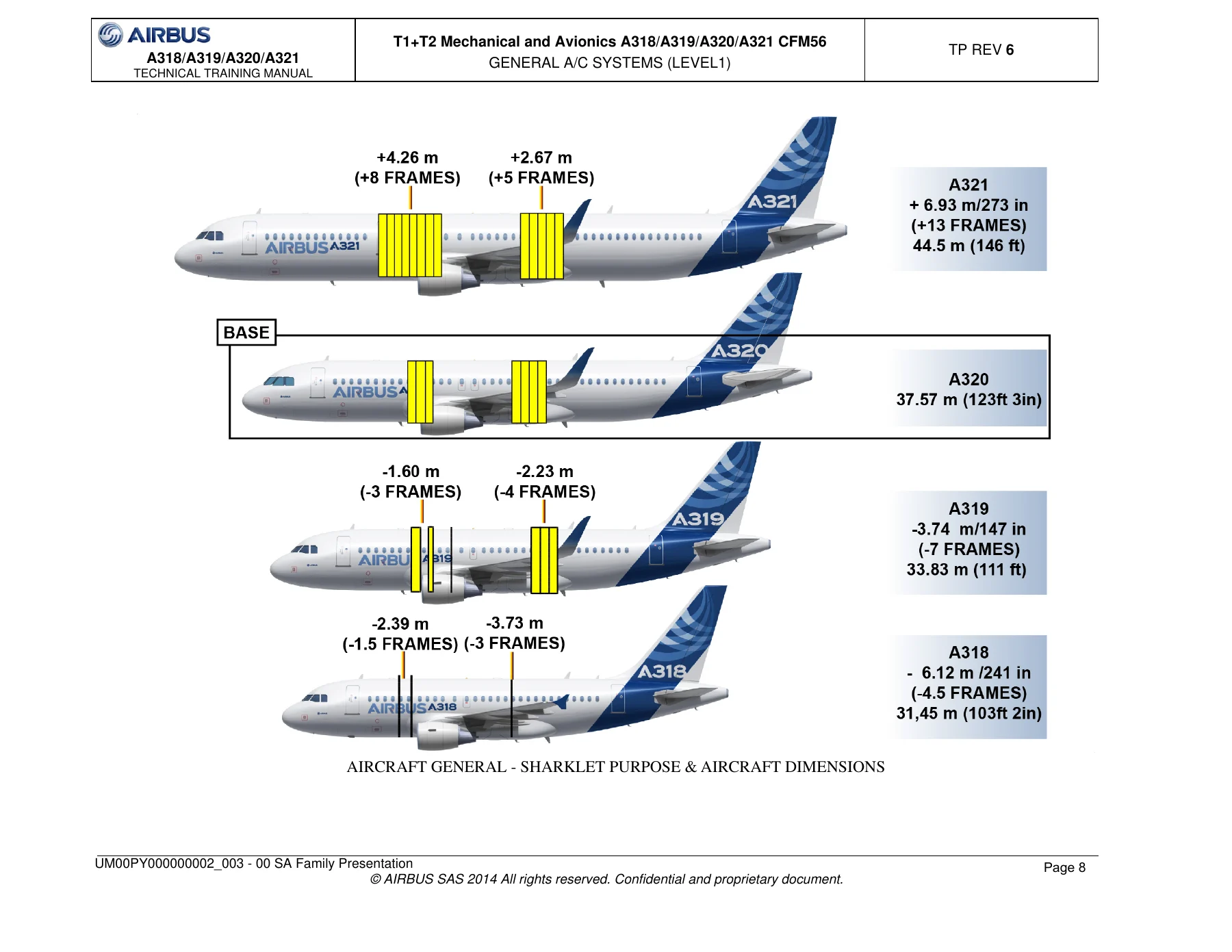
- Aircraft general and dimensions
- Family range and maximum weights
- Operating limits
- The cabin — seat layouts and pitches
- Door heights
- Composite structures
- Structural breakdown and zoning — fuselage, vertical stabilizer, horizontal stabilizer, wing
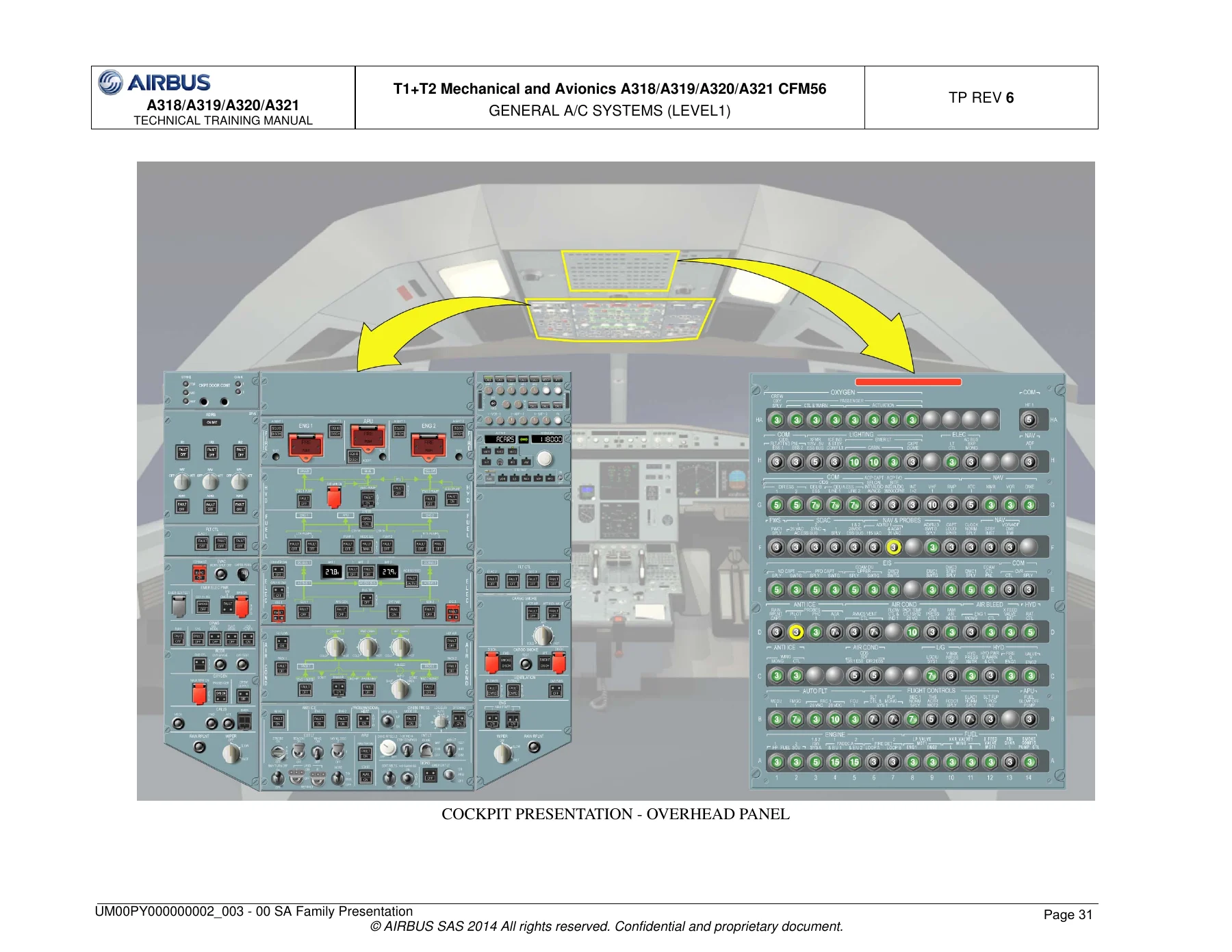
- Cockpit presentation — overhead panel, glareshield, main instrument panel, center pedestal, side consoles
- Cockpit philosophy — pushbutton logic and color philosophy
- Ground support equipment and tools
- Jacking, towing, safety items
- Placards and markings
- Ground Handling
- Servicing points and A/C servicing arrangement
- Turning radii
- Parking and mooring
- Earthing and bonding points
- Environmental precautions
- Aircraft Documentation Introduction
- Functional Item Number (FIN) — unique identification, electro-mechanical/electrical parts, connectors, mechanical parts
- FIN specificities — A320 family, A330/A340
- FIN identification — system identification, fictitious circuits
- FIN usage — search functions, AirN@V technical documentation
- Time Limits and Maintenance Checks
- Scheduled maintenance tasks and checks in MPD
- Unscheduled maintenance in AMM Section 05-50-00
- Scheduled repetitive requirements through MPD
- Indicating/Recording System Presentation
- Electronic Instrument System (EIS)
- ECAM — system architecture, control and indicating
- EFIS — control and indicating
- Clock
- Centralized Fault Display System (CFDS)
- AIRMAN option
- Digital flight data recording
- Aircraft Integrated Data System (AIDS)
- On-board maintenance facilities
- Maintenance/test facilities and safety precautions
- Electrical Power System Presentation
- General — IDG, CSD, TR, batteries, essential buses
- Abnormal, emergency and battery-only configurations
- Control and indicating — main panel, ECAM page, emergency panel
- Component layout
- Maintenance/test facilities and safety precautions
- ADIRS and Standby Instruments Presentation
- General system overview
- Air Data/Inertial Reference System — air data inputs, air data section, inertial reference section
- ADIRS control and indicating
- PFD and ND indicating
- Standby instruments (optional)
- Integrated Standby Instrument System (ISIS)
- Maintenance/test facilities and safety precautions
- Dependent Position Determining Systems and Landing Aids Presentation
- Landing aids — ILS and marker system
- Landing aids control and indicating
- Radio navigation system — normal tuning, backup tuning, control and indicating, ND modes
- MMR (GPS part) system — control and indicating
- T/TISS (or T3CAS) — TCAS principle, ATC function, control and indicating, TCAS indicating
- On-board airport navigation system — function, interface, controls
- Maintenance/test facilities
- Independent Position Determining Systems Presentation
- T/TISS — TAWS function — system architecture, GPWS panel, control and indicating
- Radio altimeter — control and indicating
- WXR/PWS — panel, multiscan, autotilt mode
- Maintenance/test facilities and safety precautions
- Auto Flight System Presentation
- General — FM, FG, flight augmentation, FIDS
- Flight management/flight guidance — autopilot/flight director, autothrust
- Flight augmentation — rudder trim, yaw damper, rudder travel limitation, flight envelope protection
- Control and indicating — MCDUs, FCU, EFIS displays, PFD, side sticks, throttle levers, flight control panels
- Maintenance/test facilities and safety precautions
- Communications System Presentation
- General — radio communication, on-board communication
- Radio communication system — VDR, HFDR, SATCOM
- Radio communications control and indicating — RMP, ACP
- On-board communications — flight interphone, AMU, calls panel
- Cabin Intercommunication Data System (CIDS) — system overview, passenger entertainment and signs, evacuation command system, aircraft data management
- CIDS control and indicating — purser station, cabin crew station, area call panel
- Passenger entertainment system (optional)
- Cockpit door surveillance system
- Solid State Cockpit Voice Recorder (SSCVR)
- Maintenance/test facilities and safety precautions
- Air Traffic Info Management System Presentation
- ATIMS — architecture, data link communication
- FlySmart with Airbus (FSA) — architecture, flight operations application
- Airline Network Architecture (ALNA) — CINS, OMTS
- Maintenance/test facilities
- Lights System Presentation
- General — cockpit, cabin, emergency, cargo/service, exterior
- Cockpit lights system — control, cockpit lights
- Cabin lights — through CIDS, cabin lights and signs
- Emergency lights — control and indicating, component layout
- Cargo and service compartment lights
- Exterior lights — controls, component layout
- Maintenance/test facilities and safety precautions
This Airbus A318 A319 A320 A321 CFM56 technical training manual gives a technician or aviation student a structured, systems-level understanding of the Single Aisle family. It does not replace the Aircraft Maintenance Manual (AMM) or the Illustrated Parts Catalogue (IPC), but it provides the conceptual foundation needed to interpret those documents correctly. The mechanical portion covers airframe structure, zoning, cabin layout, ground handling, jacking, towing, mooring, and the cockpit layout including the overhead panel, glareshield, main instrument panel, center pedestal, and side consoles. The avionics portion covers the electronic instrument system (ECAM and EFIS), electrical power generation and distribution (IDG, APU generator, emergency generator, batteries, TRs, static inverter), air data and inertial reference, dependent and independent navigation systems (ILS, GPS, DME, ADF, VOR, T3CAS, TAWS, weather radar), auto flight (FMGC, FAC, autopilot, flight director, autothrust), communications (VHF, HF, SATCOM, CIDS, CVR), air traffic information management, and the aircraft lighting system.
Each system is presented with a general description, control and indicating information, component layout, maintenance/test facilities, and relevant safety precautions. The manual also includes structural breakdown and zoning data for the fuselage, vertical stabilizer, horizontal stabilizer, and wing, with station numbers that are essential for locating components and understanding repair boundaries.
Why This Manual Matters
Working on an Airbus A320 family aircraft without a proper systems overview is a recipe for mistakes. Torque values, system logic, bus priorities, and structural station references all matter. This Airbus A320 training manual PDF helps you understand why a system behaves the way it does, what the normal configuration looks like, and how abnormal and emergency configurations differ. For avionics troubleshooting, the manual explains how the ECAM, CFDS, BITE, and AIRMAN systems interact, so you can trace a fault from a cockpit effect to the relevant computer and then to the correct AMM task.
For mechanical and structural work, the zoning and station number information — covering fuselage, vertical stabilizer, horizontal stabilizer, and wing — gives you the reference framework used across Airbus documentation. The ground handling section covers servicing points, turning radii, parking, mooring, jacking, towing, and earthing/bonding, all of which are critical for safe ground operations.
What You Can Do With This Manual
- Understand the layout and function of the Airbus A318/A319/A320/A321 cockpit, including the overhead panel, glareshield, main instrument panel, center pedestal, and side consoles.
- Study the Electronic Instrument System (EIS) including ECAM and EFIS, and understand how the DMCs, FWCs, and SDACs work together.
- Learn the electrical power system architecture, including normal, abnormal, emergency, and battery-only configurations.
- Review the Air Data/Inertial Reference System (ADIRS) and standby instruments, including the Integrated Standby Instrument System (ISIS).
- Understand dependent position determining systems (ILS, GPS, DME, ADF, VOR, T3CAS) and independent systems (TAWS, radio altimeter, weather radar).
- Study the auto flight system, including flight management, flight guidance, autopilot, flight director, autothrust, and flight augmentation.
- Review communications systems including VHF, HF, SATCOM, CIDS, flight interphone, and cockpit voice recording.
- Understand the aircraft lighting system, including cockpit, cabin, emergency, cargo, and exterior lights.
- Reference structural breakdown and zoning data for the fuselage, vertical stabilizer, horizontal stabilizer, and wing.
- Review ground handling procedures including servicing points, turning radii, parking, mooring, jacking, towing, and earthing/bonding.
- Understand the Functional Item Number (FIN) system used across Airbus documentation for identifying systems, circuits, and equipment.
IMAGES PREVIEW
This Airbus A318 A319 A320 A321 CFM56 Mechanical and Avionics Technical Training Manual is delivered as an instant PDF download. There is no shipping, no waiting, and no physical media to lose. You can open it on any device — laptop, tablet, or smartphone — and print the pages you need for the hangar or the classroom. Whether you are preparing for type training, refreshing your systems knowledge, or supporting maintenance planning, this manual gives you the Airbus-specific reference material in a single, organized document.
Reviews
There are no reviews yet.