
Caterpillar C18 Marine Engine Disassembly & Assembly Manual (2012) – UENR0179-01 PDF Download
Original price was: $39.95.$23.95Current price is: $23.95.
Complete Caterpillar C18 Marine Engine Disassembly and Assembly Manual, document UENR0179-01 (2012). Covers teardown and rebuild of the fuel system, turbocharger, cylinder head, camshaft, pistons, crankshaft, cooling system, front gear group and more for TNA1, GTB1, DTP1, T2R1 and GEX1 serial prefixes. Instant PDF download.
Description
Caterpillar C18 Marine Engine Disassembly & Assembly Manual – UENR0179-01
This Caterpillar C18 Marine Engine Disassembly and Assembly Manual is the complete teardown and rebuild reference for the Cat C18 marine powerplant, published under document number UENR0179-01 in 2012. Every component group is handled as its own self-contained job – Remove and Install, Disassemble, and Assemble – with the required tooling, torque figures and step-by-step sequences printed at the point where you need them. Instead of hunting through a general service book, you open the section for the part in your hand and work straight through it.
File Details
- Manual type: Disassembly and Assembly Manual
- Brand: Caterpillar
- Model: C18 Marine Engine
- Document number: UENR0179-01
- Publication date: 2012
- Language: English
- Page count: 112 pages
- File format: PDF
Chapters Covered
The manual is organised by component, and each entry carries the full removal, installation, disassembly or assembly procedure where applicable.
- Fuel system – Fuel Priming Pump, Fuel Filter Base, Fuel Transfer Pump, Fuel Cooler, Electronic Unit Injector, Electronic Unit Injector Sleeve
- Air and exhaust – Air Cleaner, Turbocharger (Remove/Install, Disassemble, Assemble), Exhaust Manifold, Aftercooler (Sea Air – Treated Water)
- Cylinder head and valvetrain – Inlet and Exhaust Valve Springs, Valves, Valve Guides, Valve Seat Inserts, Valve Mechanism Cover, Valve Mechanism Cover Base, Rocker Arm and Shaft, Rocker Arm Disassemble/Assemble, Cylinder Head, Camshaft, Camshaft Gear, Camshaft Bearings
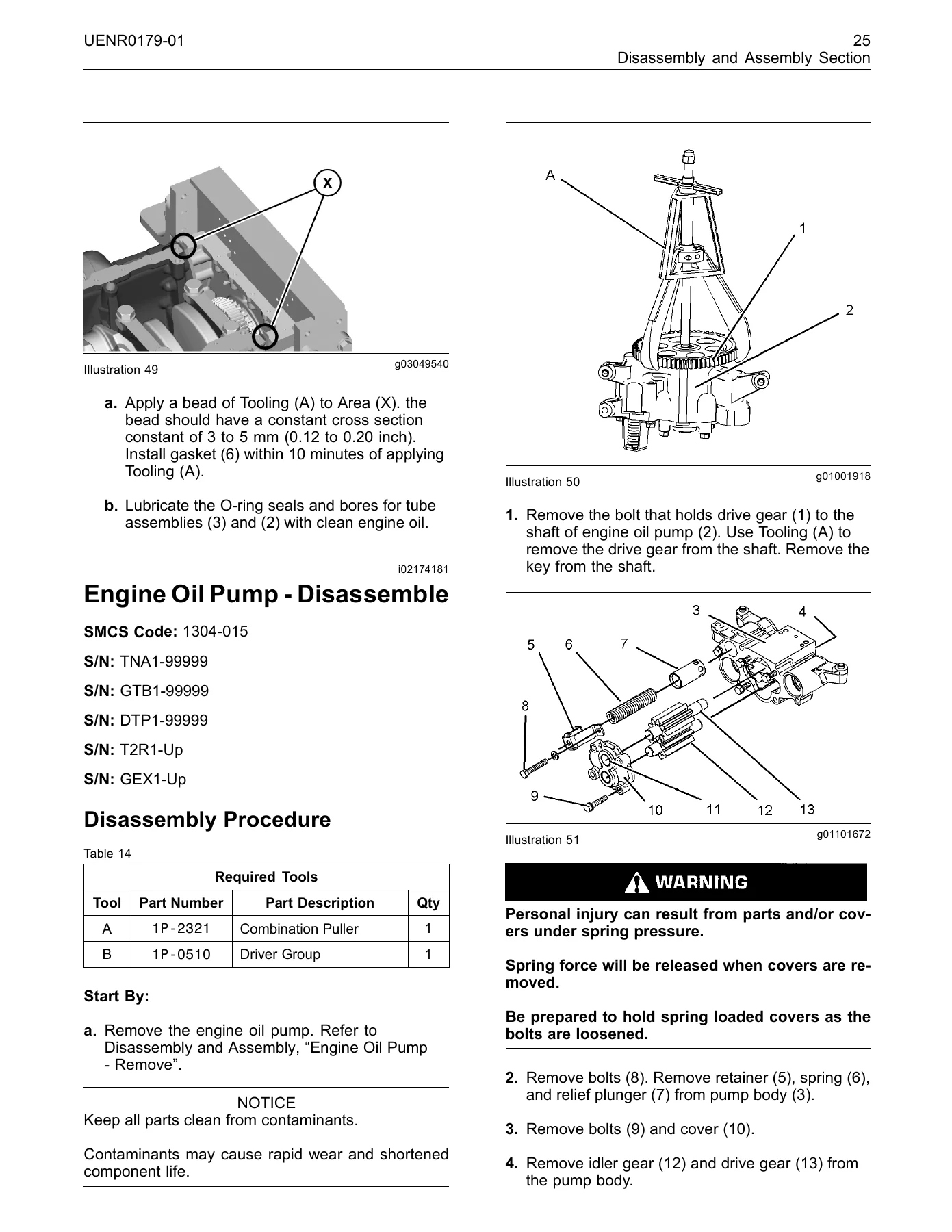
- Lubrication – Engine Oil Filter Base, Engine Oil Cooler, Marine Transmission Oil Cooler Core, Engine Oil Pump (Remove/Install, Disassemble, Assemble), Engine Oil Pan, Piston Cooling Jets, Bearing Clearance Check
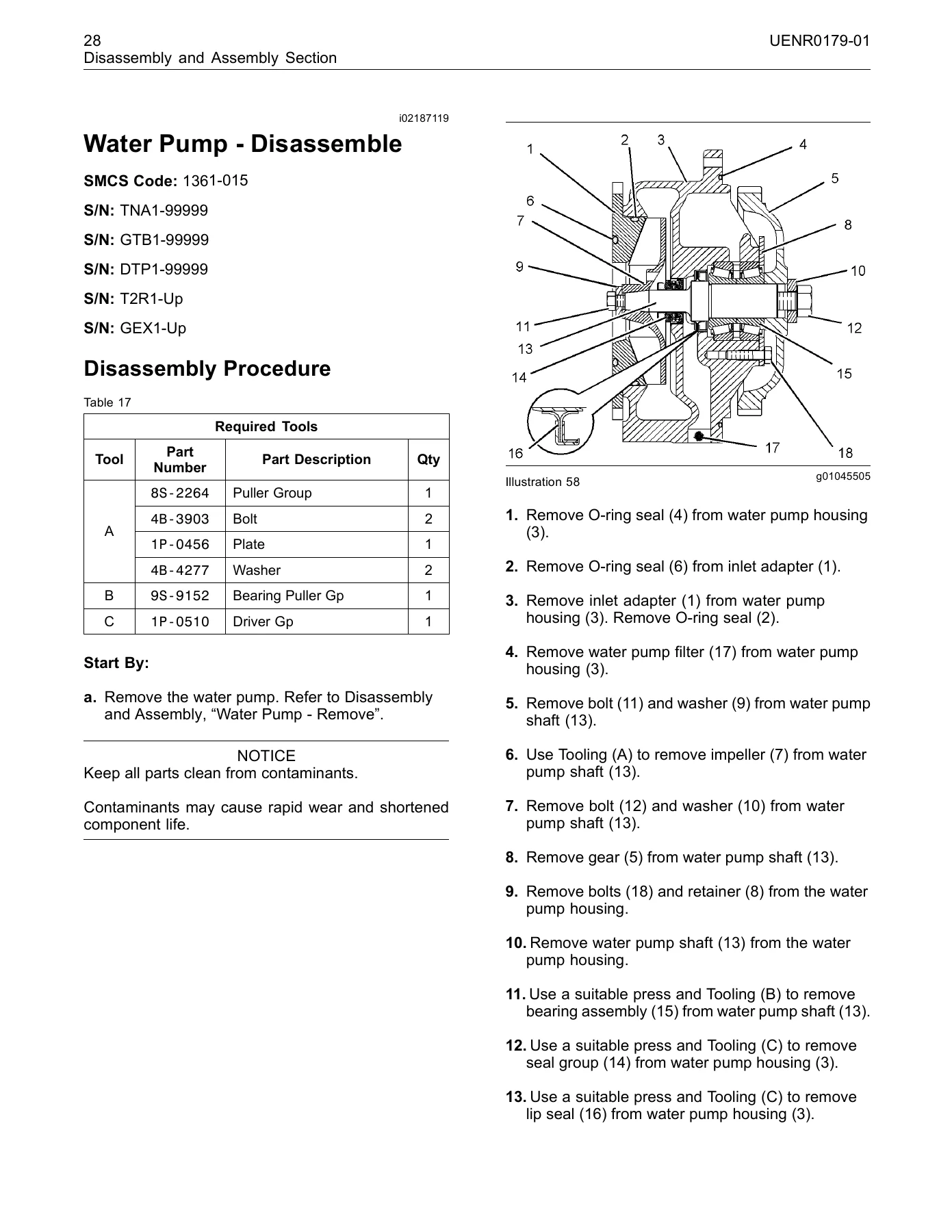
- Cooling – Water Pump (Remove/Install, Disassemble, Assemble), Water Temperature Regulator (SCAC and Jacket Water), Auxiliary Water Pump (Fresh Water and Sea Water), Heat Exchanger, Expansion Tank (Jacket Water and SCAC)
- Bottom end – Cylinder Liner, Pistons and Connecting Rods, Connecting Rod Bearings, Crankshaft Main Bearings, Crankshaft, Crankshaft Front Seal, Crankshaft Rear Seal, Flywheel, Flywheel Housing, Engine Support (Front)
- Front end and gear train – Front Cover, Gear Group (Front), Housing (Front), Vibration Damper and Pulley
- Crankcase ventilation – Fumes Disposal Filter
- Sensors and electronics – Atmospheric Pressure Sensor, Camshaft Position Sensor, Crankshaft Position Sensor, Coolant Level Sensor, Coolant Temperature Sensor, Engine Oil Pressure Sensor, Engine Oil Temperature Sensor, Fuel Pressure Sensor, Fuel Temperature Sensor, Turbocharger Outlet Pressure Sensor, Inlet Air Temperature Sensor, Electronic Control Module
- Electrical and starting – Alternator, Electric Starting Motor, Air Starting Motor
What the C18 Disassembly and Assembly Manual Gives You
This is a procedure manual, not a theory book. It assumes you already have the engine out or opened up and need to know the correct order of operations before a bolt turns. That focus is what makes it useful: a cylinder head is not simply “unbolt and lift” – it has a documented start-by list that has to be worked backwards first, and a specific bolt sequence with staged torque values that has to be followed on the way back on. The same applies to the crankshaft main bearing caps, the connecting rod bolts and the camshaft gear.
Because each section lists its own prerequisites, you can see at a glance what must come off before the part you are targeting. Removing the crankshaft, for example, requires the front housing, flywheel housing and piston cooling jets to be out of the way first. Pulling the cylinder head means the aftercooler, exhaust manifold, fumes disposal group, expansion tanks, camshaft gear, valve mechanism cover base, rocker arms and electronic unit injectors are already off the engine. That dependency chain is written into the manual rather than left to memory.
Torque Values and Tooling
Fastener torques are stated inline with each procedure, in both metric N·m and imperial lb ft or lb in, so there is no conversion work and no ambiguity. Representative examples from the manual include fuel priming pump bolts at 25 ± 6 N·m (18 ± 4 lb ft), fuel transfer pump bolts at 47 ± 9 N·m (34.7 ± 6.6 lb ft), electronic unit injector clamp bolts at 55 ± 10 N·m (41 ± 7 lb ft), injector harness nuts at 2.5 ± 0.25 N·m (22 ± 2 lb in), flywheel bolts at 100 ± 5 N·m (74 ± 4 lb ft) plus an additional 90° ± 5°, and cylinder head bolts staged up to 450 ± 15 N·m (330 ± 11 lb ft). Main bearing cap bolts run to 258 ± 14 N·m (190 ± 10 lb ft) followed by a further 120° ± 5°.
Required tooling is listed per job in tabular form, including Cat part numbers for pullers, drivers, seal installers, bearing puller groups, valve spring compressors, vacuum gun kits and the plastic gauge set used for bearing clearance checks. Where a torque-to-yield or angle-turn step is required, the manual flags it and tells you to place an index mark on the bolt if a degree wheel is not being used. Lubricants and sealants are called out too – rubber lubricant, Loctite 271, Loctite 587, Loctite 540, Loctite C5-A copper antiseize, Krytox LS23 or GPL 205, and retaining compound for injector sleeves.
Serial Number Coverage
The procedures apply to the following engine and generator set prefixes as printed in the manual:
- TNA1-Up (Engine)
- GTB1-Up (Engine)
- DTP1-Up (Generator Set)
- T2R1-Up (Engine)
- GEX1-Up (Engine)
Not every procedure shares identical serial applicability – individual sections state their own prefix coverage, and a few entries carry a bounded range rather than “-Up”. Always confirm the prefix stated at the head of the section you are working from before starting the job.
Working on the C18 Marine Engine
A marine C18 is rarely sitting on a stand in a clean shop. It is usually down in a hull, behind a bulkhead, with the heat exchanger, expansion tank and sea water pump crowded around it. That environment makes procedure order and correct lifting weights more important, not less. The manual gives approximate component weights so you can plan rigging before you commit: turbocharger approximately 28 kg (62 lb), flywheel approximately 44 kg (97 lb), front engine support approximately 25 kg (55 lb), aftercooler approximately 50 kg (110 lb), cylinder head approximately 235 kg (518 lb), camshaft approximately 39 kg (86 lb), flywheel housing approximately 105 kg (230 lb), crankshaft approximately 177 kg (390 lb), and the complete engine approximately 1700 kg (3748 lb).
IMAGES PREVIEW
Cooling system specifics are split properly between the two circuits on this engine – separate entries exist for the Sea Air – Treated Water aftercooler, the Sea Water heat exchanger, the fresh water and sea water auxiliary pumps, and both the Jacket Water and SCAC expansion tanks and water temperature regulators. That distinction matters because the two circuits do not share parts or procedures.
Safety content is carried through the document rather than dumped in one place. Fuel system work opens with a fire warning and instructions to relieve pressure at the relief valve, turn the fuel supply off and disconnect the battery before breaking any connection. Spring-loaded assemblies – valve springs, oil pump relief valves and the cooler bypass plunger – carry explicit warnings about released spring force and the protective equipment required. Cylinder head installation carries a warning about accidental machine starting and the do-not-operate tag procedure.
Who This C18 Marine Engine Disassembly & Assembly Manual Suits
Marine engineers maintaining a vessel’s own C18, independent diesel mechanics taking on a rebuild, workshops handling generator set installations using the DTP1 prefix, and apprentices who need the documented order of operations rather than a rough guess. It is equally useful as a reference when you are quoting a job and need to know how deep the teardown goes, or when you are partway through a rebuild and want to confirm a torque figure before the cap goes back on.
The manual deals with the engine itself in detail – fuel, air, exhaust, valvetrain, lubrication, cooling, bottom end, gear train and the electronic sensors and control module that feed the engine’s management system. It is a disassembly and assembly document, so it tells you how to take components off and put them back correctly rather than how to diagnose a fault from a code.
Get the C18 Disassembly & Assembly Manual UENR0179-01
With this Caterpillar C18 Marine Engine Disassembly and Assembly Manual on hand you can strip and rebuild the engine properly – pull the electronic unit injectors and reseal their sleeves, replace a failed turbocharger cartridge, lift and refit a cylinder head with the correct staged bolt sequence, renew the front and rear crankshaft seals together as a matched set, set camshaft and gear train timing, measure bearing clearance and end play, and reassemble the flywheel housing and front cover with the correct sealants applied in the right places. Getting these procedures and torque values right is what separates a rebuild that lasts from one that comes back – a mis-sequenced cylinder head, an under-torqued connecting rod bolt or a front seal installed without its matching wear sleeve will all cost far more than the manual did.
The file is a digital PDF delivered immediately after checkout. There is nothing to ship and nothing to wait for – download it, save it to your phone, tablet or workshop laptop and print the pages you need for the job in front of you. Keep it on the vessel, keep it in the toolbox, or print a section and take it into the engine room.
Reviews
There are no reviews yet.