
Central Electricity Authority PTCC Manual 2010 – Power & Telecommunication Co-ordination Technical Manual
Original price was: $34.95.$21.95Current price is: $21.95.
The 2010 edition of the PTCC Manual from India’s Central Electricity Authority — the definitive technical reference for power and telecommunication line co-ordination, covering induced voltage calculations, mutual coupling, earth potential rise, crossing codes of practice, and clearance procedures for lines up to 400 kV.
Description
PTCC Manual 2010 – The Complete Technical Reference for Power and Telecommunication Co-ordination
The Central Electricity Authority PTCC Manual 2010 is the authoritative technical document governing the safe co-existence of power transmission lines and telecommunication networks across India. Published by the Central Electricity Authority under the Ministry of Power, this 2010 edition represents the most comprehensive revision of the Power and Telecommunication Co-ordination Committee (PTCC) manual since the original 1995 release.
This manual is indispensable for power utility engineers, telecom field officers, railway signal and telecom engineers, defence communication personnel, and electrical inspectors who are responsible for ensuring that high-voltage power lines do not injuriously affect telegraphic, telephone, or electric signaling circuits through induction or direct contact.
File Details
- Manual Type: Technical Co-ordination Manual / Code of Practice
- Issuing Authority: Central Electricity Authority (CEA), Ministry of Power, Government of India
- Committee: Power and Telecommunication Co-ordination Committee (PTCC)
- Edition: 2010 Edition (Revised from 1995 Edition)
- Language: English
- File Format: PDF
- Page Count: Approximately 325 pages
Chapters Covered
This comprehensive manual is organised into eleven technical chapters, each addressing a critical aspect of power-telecom co-ordination:
- Chapter I – Brief Description of the Set-Up and Activities of the PTCC: Historical background from 1949, formation, functions, membership, meetings, plenary and technical sessions, codes of practice, protective devices, route approval procedures, low frequency induction limits, coordination measures, induced voltage calculations, VHF/PLCC licensing, cost apportionment, State Level PTCC, coordination with Railways, and guidelines for laying power cables above 33 kV in proximity to telecom cables.
- Chapter II – Various Committees Connected with Power & Telecommunication Co-ordination: High Level Committee, Central Standing Committee, Central PTCC composition and functions, State Level PTCC composition and functions, Protection/Re-engineering Supervisory Sub-committee.
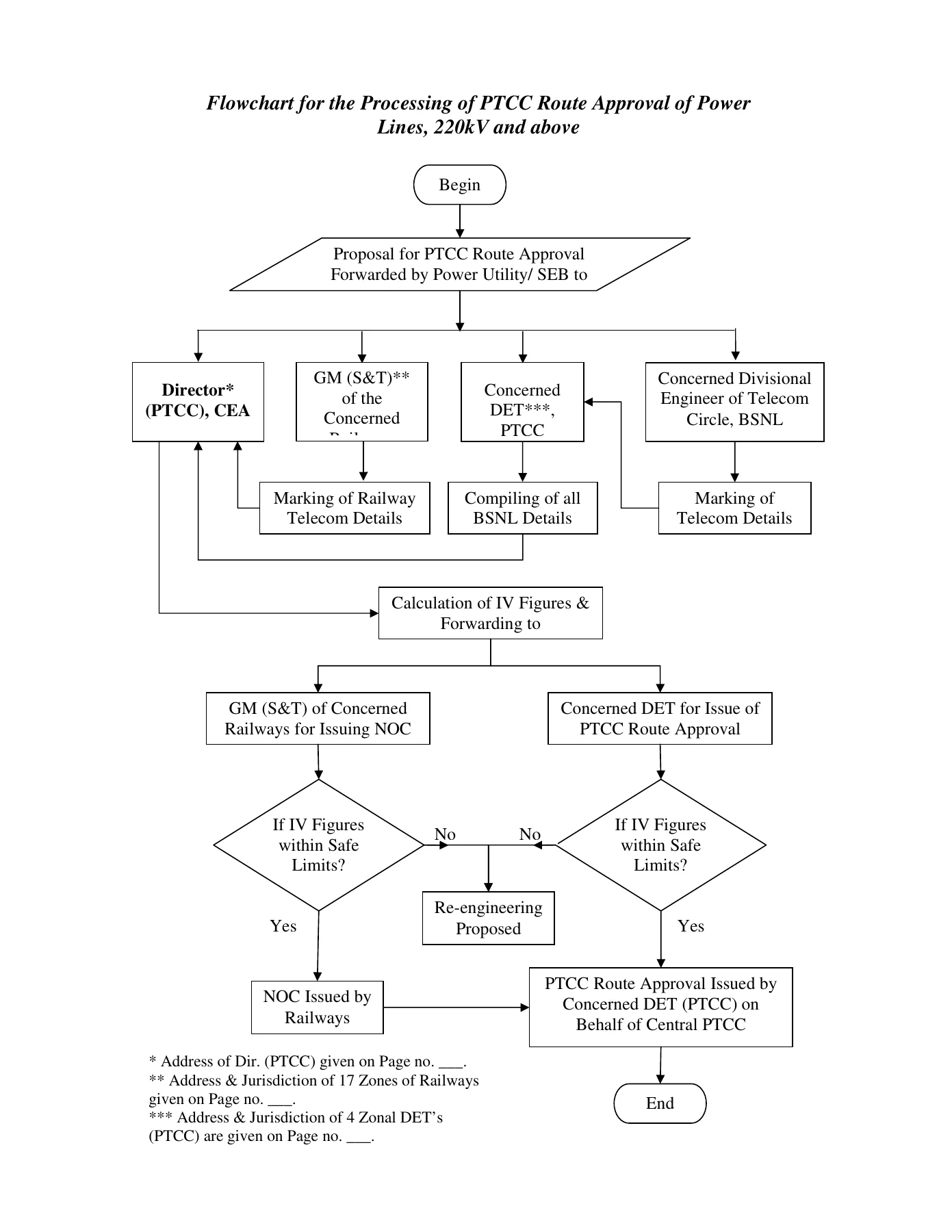
- Chapter III – Procedure for Clearance of PTCC Cases of Power and Telecommunication Lines: Power transmission lines including power cables, power lines exceeding 132 kV, power lines of 33 kV D/C and above up to 132 kV D/C, power lines above 11 kV up to 33 kV S/C, power lines of 11 kV, telecom lines, questionnaires, addresses of zonal railways, flowcharts for processing PTCC route approval.
- Chapter IV – Simplified Procedure for Co-ordination of Power Lines up to 33 kV: Principle of low frequency inductive coordination, determining minimum safe separation, estimating induced voltage, protection of telecommunication circuits, tap lines, more than one power line, extensions to existing lines, step-by-step examination procedure.
- Chapter V – Guidelines for Processing PTCC Cases of Power Lines 66 kV and Above: Determination of mutual coupling, effective SLG fault current, induced voltages, evaluation of screening factor, procedure to calculate fault currents at intermediate points, typical power system illustrations, computation of fault currents.
- Chapter VI – Code of Practice for Protection at Crossings: Classification of power lines, crossings between power and telecommunication lines, joint use of poles, guards, crossings with low/medium voltage lines, high voltage Category I and II, extra high voltage lines, power lines with telecommunication wires on line supports.
- Chapter VII – Low Frequency Induction Test: Introduction, procedure, preparation, instruments, conduction of test, interpretation of test results, statistical analysis, precautions, example calculations.
- Chapter VIII – Code of Practice for Protection from Earth Potential Rise: Introduction, locations prone to EPR, factors affecting EPR, EPR limits and hazard zone, measurement of EPR zone, protection measures, precautions for working staff.
- Chapter IX – Mutual Coupling Calculations as per CCITT Directives: Two detailed worked examples with full summarising tables and final results.
- Chapter X – Screening Factors Applicable for Power Cables, Telecommunication Cables and Railway Tracks: Approximate values of screening factors at fundamental frequency (50 Hz) as per CCITT recommendations.
- Chapter XI – Information about Electrical Inspectors and Statutory Provisions: Appointment of Chief Electrical Inspector, addresses of Chief Electrical Inspectors by state, regional offices, extracts from the Electricity Act 2003 (Sections 159, 160, 161, 164).
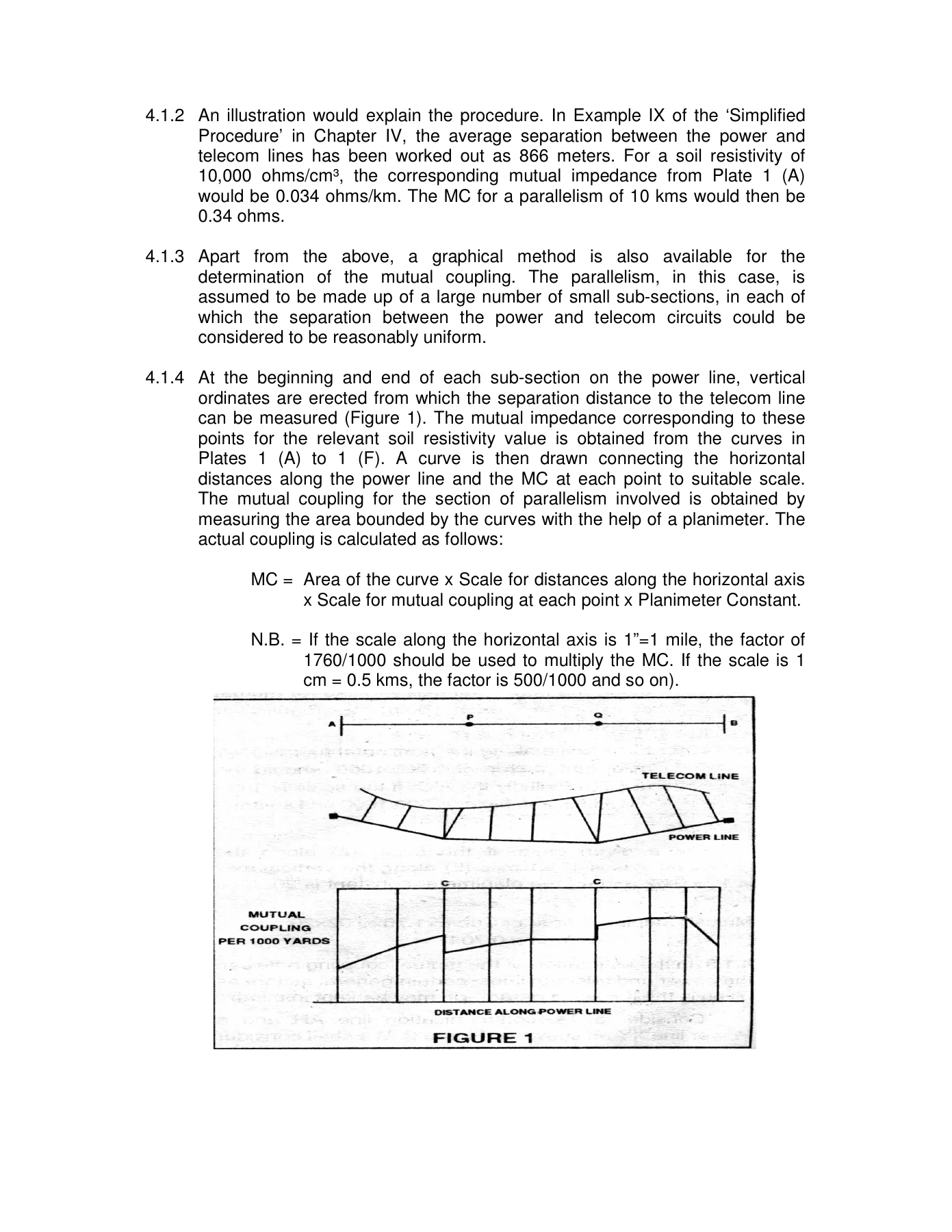
Beyond the core chapters, the manual includes extensive appendices covering questionnaire proformas, procedures for estimating average separation, measurement of soil resistivity using the Evershed Earth Tester, graphs and plates for fault current and induced voltage calculations, statistical tables for ‘t’ distribution, power contact protector details, and a comprehensive glossary of abbreviations.
What This Manual Enables You to Do
The PTCC Manual 2010 equips engineers and technical officers with the complete methodology for assessing and mitigating electromagnetic interference between power lines and telecommunication circuits. It provides the formulas, graphs, and procedures needed to calculate induced voltages under single line-to-ground fault conditions on power lines ranging from 11 kV to 400 kV.
Key technical capabilities covered include determining minimum safe separation distances based on soil resistivity and fault current levels, evaluating the screening effects of earth wires, cable sheaths, and railway tracks, conducting low frequency induction tests with statistical analysis of results, and designing protective measures using gas discharge tubes, power contact protectors, and re-engineering solutions.
The manual also details the complete PTCC route approval process, including the questionnaires to be submitted, the flowcharts for processing cases at Central and State levels, the time limits for each stage of clearance, and the cost apportionment rules between power and telecom authorities. This makes it an essential reference for anyone preparing or reviewing PTCC clearance applications.
For engineers working on railway electrification projects, the manual provides specific guidance on coordination with railway block circuits, including AC immunity levels of various block instruments and the conditions under which earth return telegraph circuits must be converted to metallic return.
Why This Manual Matters
Section 160 of the Electricity Act 2003 mandates that every person generating, transmitting, distributing, supplying, or using electricity must take all reasonable precautions to avoid injuriously affecting telegraphic, telephonic, or electric signaling communication by induction or otherwise. The PTCC Manual 2010 provides the technical framework for complying with this statutory requirement.
With the massive expansion of India’s transmission network — from 1,92,535 circuit-kilometers of 220 kV and above lines at the end of the 10th Plan to planned additions of 95,000 circuit-kilometers in the 11th Plan and 1,80,000 in the 12th Plan — the co-ordination challenges between power and telecom infrastructure have never been greater. This manual provides the standardized procedures and technical criteria that enable both sectors to expand safely and efficiently.
The manual is equally relevant for State Electricity Boards, Central Power Utilities, BSNL, MTNL, Indian Railways, and Defence communication networks, all of which participate in the PTCC framework. Private power developers and infrastructure companies involved in transmission line construction will also find this manual indispensable for obtaining PTCC route approvals.
IMAGES PREVIEW
Instant PDF Delivery
The Central Electricity Authority PTCC Manual 2010 is delivered as an instant PDF download upon payment. There is no shipping, no waiting for a physical book, and no restrictions on which device you use to read it. Whether you are working from a desktop in the office, a laptop in the field, or a tablet during site visits, you can access the full manual immediately. The PDF is printable, allowing you to create reference copies for team members or field kits as needed.
This is not a scanned image-only document — it is a complete technical manual with all chapters, appendices, tables, graphs, and flowcharts intact, ready for you to search and reference on any PDF reader.
Reviews
There are no reviews yet.