
Clark TMG12-25 TMG13-20X EPG15-18 Electric Forklift Service Manual SM-616 – PDF Download
Original price was: $59.95.$39.95Current price is: $39.95.
The complete Clark SM-616 service manual for TMG 12-25, TMG 13-20X and EPG 15-18 electric forklifts. 576 pages covering every system from battery and motor controls to hydraulics, uprights and brakes. Instant PDF download.
Description
Clark TMG12-25, TMG13-20X & EPG15-18 Electric Forklift Service Manual
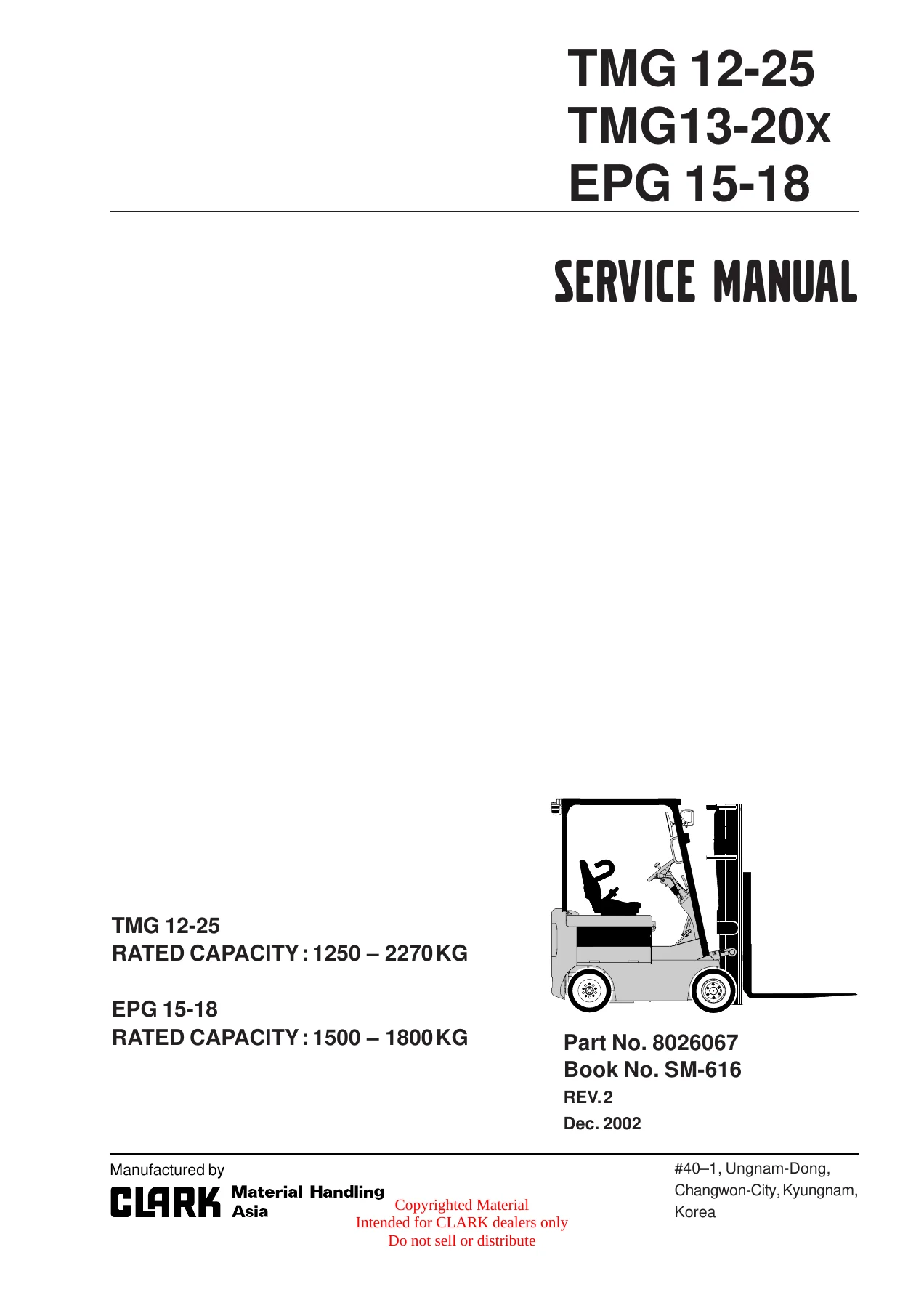
This is the complete Clark service manual covering the TMG 12-25, TMG 13-20X and EPG 15-18 electric counterbalance forklifts. Published under Book No. SM-616 (Part No. 8026067, Revision 2, December 2002), this is the same service documentation Clark issued to its dealer network for the maintenance, diagnosis and overhaul of these trucks. Every Group is present, from daily planned maintenance through to full teardown and rebuild of the drive axle, motors, controllers, hydraulic system and upright. Rated capacities are 1250-2270 kg for the TMG 12-25 and 1500-1800 kg for the EPG 15-18.
File Details
- Manual Type: Service Manual
- Brand: Clark Material Handling Company
- Models Covered: TMG 12-25, TMG 13-20X, EPG 15-18
- Rated Capacity: TMG 12-25: 1250-2270 kg / EPG 15-18: 1500-1800 kg
- Language: English
- Pages: 576
- Format: PDF
- Book No.: SM-616
- Part No.: 8026067
- Revision: REV.2
- Date: December 2002
Chapters Covered
- Group SA – Safe Maintenance
- Group PS – Periodic Service
- Group 12 – Battery
- Group 13 – Wiring, Switches, and Instruments
- Group 16 – Electric Motors
- Group 17 – Contactors
- Group 19 – Motor Controls
- Group 20 – Drive Axle
- Group 22 – Wheels and Tires
- Group 23 – Brakes
- Group 25/26 – Steering
- Group 29/30 – Main Hydraulic System
- Group 32 – Tilt Cylinders
- Group 34 – Uprights
- Group 38 – Counterweight and Chassis
- Group 40 – Specifications
Safe Maintenance and Periodic Service
Group SA sets out the safety foundation for every job in this manual: lifting, jacking and blocking procedures, chaining the upright in the raised position, raising the drive wheels, raising the rear or the entire truck, and towing a disabled truck. It also reproduces the safety sign and message system Clark uses throughout the book. Group PS then translates that into a working maintenance program – the TMG and EPG service charts, lubrication points, planned maintenance procedures, and a PM inspection form. Maintenance intervals are given for normal, severe and extreme operating conditions, so the schedule can be adjusted to the actual environment the truck works in.
Battery Service (Group 12)
Everything needed to handle and service the traction battery safely: battery handling precautions, removal and installation procedures, maintenance requirements, cleaning methods, charging guidance, electrolyte checks, specific gravity and load testing, record keeping, and the correct static chain and terminal installation. The manual also covers vent cap care and battery compartment cleaning. This is the Group that keeps the heart of an electric truck alive.
Wiring, Switches and Instruments (Group 13)
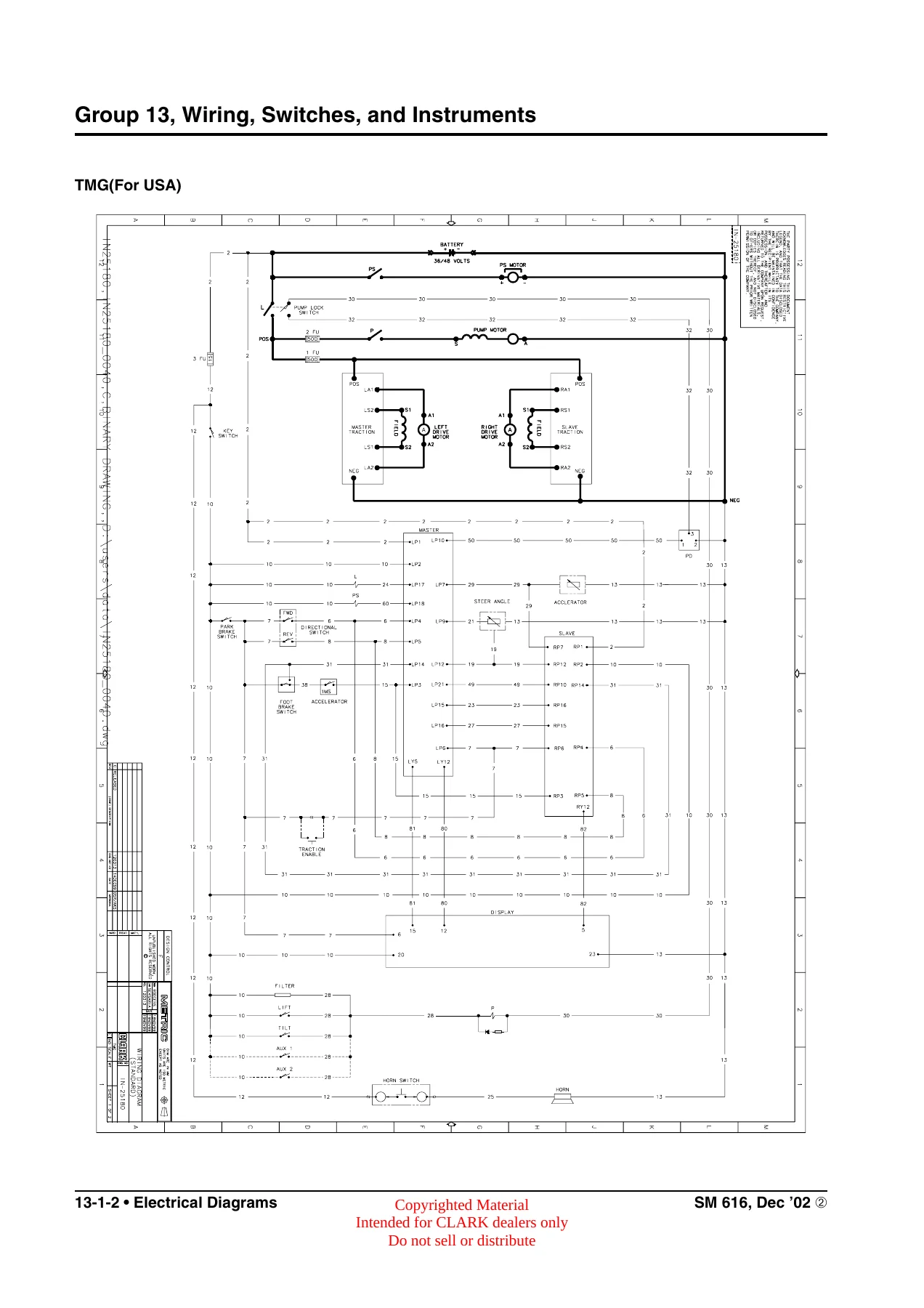
Group 13 carries the full electrical documentation for both the TMG and EPG ranges, including circuit schematic diagrams and wiring diagrams. It also provides general electrical service tips, safe preparation procedures, power cable inspection, connector repair, torquing and routing guidance. Component-level sections cover the accelerator control switch, service brake switch, parking brake switch, directional control switches, lift and tilt pump switches, steer angle sensor (with check and adjustment procedures), and the instrument panel with its full symbol and status code legend.
Electric Motors (Group 16)
Specifications and descriptions for the two drive motors, the lift pump motor and the steering pump motor, including brush data, insulation classes, armature and field resistance values, and terminal torque. Inspection and troubleshooting covers motor cleanliness, insulation testing with a 500-volt megger or VOM, brush and commutator inspection, and the brush wear chart. Complete overhaul procedures follow for the drive motors, lift pump motor and steer pump motor, with exploded views, disassembly, component inspection and reassembly steps.
Contactors and Motor Controls (Groups 17 and 19)
Group 17 covers the line contactor, main pump contactor and power steering pump contactor – specifications, removal and replacement, and overhaul with contact set replacement. Group 19 is the largest electrical group: the GE CTS450 transistor motor controllers, including specifications, motor characteristics, solid-state reversing, performance features like creep speed, controlled acceleration, current limit, regenerative braking and field weakening, plus system protective overrides (SRO, PMT, thermal protection, low voltage). The sequence of operations is documented step by step, from normal off state through battery connection, key switch closure, park brake checks, direction selection, traction control activation, brake pedal regen and plugging. Handset operation and the full function list are included, followed by the diagnostic status codes – over 65 codes with symptoms, causes, and corrective actions. Controller removal and replacement closes the group.
Drive Axle (Group 20)
Specifications for the separate left and right drive axle housings, including fluid type and capacity, mounting bolt torque and fill plug torque. Troubleshooting covers the common drive axle complaints. Fluid level check and change procedures are given. Removal and installation requires removing the battery and upright first, and the procedure is fully illustrated. The overhaul section takes the drive unit apart in sub-assemblies – ring gear shaft, input pinion gear carrier and drive axle shaft – with cleaning, inspection, reassembly, bearing preload setting, and the spiral bevel and hypoid tooth bearing contact chart for correct gear mesh.
Wheels and Tires (Group 22)
Cushion and pneumatic tire specifications for both TMG and EPG models, drive and steer wheel removal and installation with the crisscross bolt tightening sequence and torque values. Cushion tire replacement, pneumatic tire maintenance precautions, inspection and minor repair, wheel disassembly and tire removal, directional tread mounting, and both air and nitrogen filling procedures are covered. Tire pressure checking and adjustment is documented for each model.
Brake System (Group 23)
Caliper brake specifications, minimum lining thickness, DOT 3 fluid requirement and pedal freeplay. Fluid check, fill and bleed procedures are given first. Pedal and master cylinder removal, replacement and adjustment follows, with component illustrations and torque values. Brake caliper removal and replacement, parking brake removal, replacement and adjustment (including the 15% grade holding test), and complete brake overhaul with carrier and lining removal, caliper disassembly, parts inspection and assembly are all documented.
Steering System (Groups 25/26)
Hydrostatic power steering specifications, relief pressure setting, fastener torques and a full description of the load-sensing steering system. Troubleshooting covers no steering, hard steering, high handwheel turns, free-spinning handwheel, jerky steering, wrong direction, kickback, slow response, chatter and other symptoms. Steering column and component removal and replacement covers the key switch, handwheel, horn contact ring, directional control assembly, detent spring, tilt lock, steering gear and lower column, with torque values throughout. Relief pressure check and adjustment, steering gear overhaul (with separate procedures for the TMG USA and EPG15-18/TMG Except USA units), steer axle service including trunnion bearings, wheel bearings, steer angle sensor, steer cylinder and linkage, and steer cylinder and steer pump overhaul complete the group.
Main Hydraulic System (Groups 29/30)
Hydraulic system specifications including fluid type, pump type, sump capacity, filter type, main and auxiliary relief valve settings, rated flow for each spool, flow control settings, and maximum pressure drop at rated flow. Fluid level check, filter change, breather maintenance and fluid change procedures. Troubleshooting covers noisy pump, no delivery, failure to build pressure, low output, foaming fluid, overheating, external leakage, shaft seal leakage and more. Pressure check and adjustment procedures cover both the main and auxiliary relief valves plus flow control adjustment. Main hydraulic pump overhaul and main hydraulic control valve removal and overhaul with exploded views of the inlet/lift section, tilt/auxiliary section, and outlet/aux section are included.
Tilt Cylinders (Group 32)
Double-acting tilt cylinder specifications, maximum operating pressure, tilt ranges and fastener torques. Drift test procedure with allowed limits, drift causes and remedies, racking check, forward and backward adjustment, and tilt flow control adjustment. Removal and installation procedures with parts inspection, and full overhaul with disassembly, inspection and reassembly.
Uprights (Group 34)
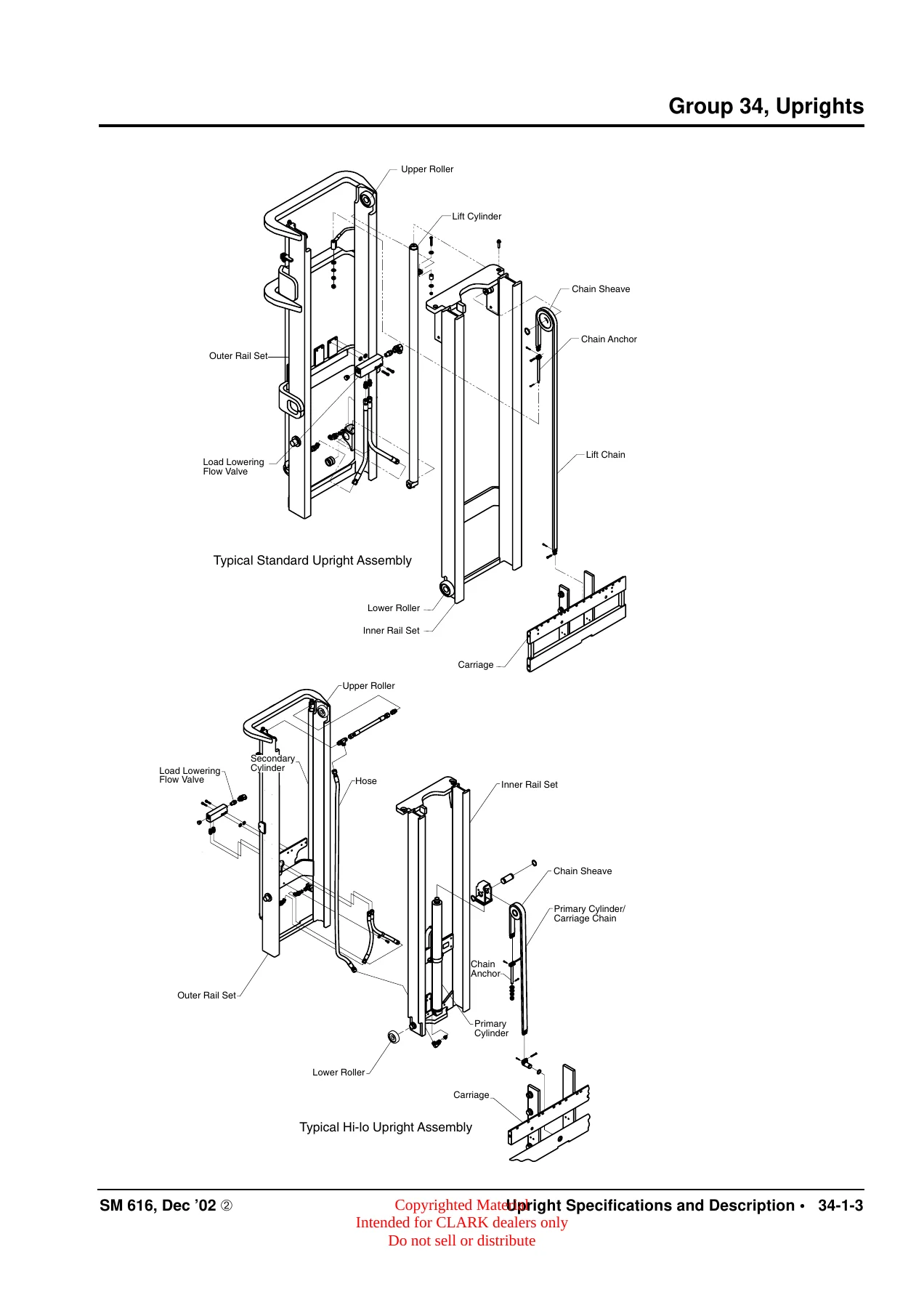
The largest mechanical group. Upright specifications and description, including cylinder types by upright number, drift limits and fastener torques. Troubleshooting covers upright noise, no lift, sluggish lift, sluggish lowering, load bounce, mis-staging, external leakage and cylinder drift. Basic and extended inspection procedures cover forks (alignment, bending, fatigue, wear, heel wear, hanger wear, latch), lift chains (stretch, length, tension), carriage and upright weldments, rollers and cylinders. Roller clearance checks and shim adjustment are documented with the roller side clearance chart and oversize roller guidance. Cylinder removal, shimming, overhaul and replacement follows, then chain inspection, adjustment and replacement for standard, TSU and Hi-Lo uprights. Fork and carriage removal and replacement, and upright removal and replacement close the group.
Counterweight, Chassis and Specifications (Groups 38 and 40)
Group 38 covers counterweight specifications and the critical removal and installation procedure, overhead guard removal and installation, and floor plate, seat and seat deck removal and installation. Group 40 is the reference section: nameplate and decal locations and content, warning decals, operator safety decals, polarity and battery disconnect warnings, hand safety and keep-away-from-forks decals. General specifications include capacities for every model, truck weights and axle weights, parking brake test, travel speeds, turning radius, drift limits, lift speeds, and a consolidated critical fastener torque table. Group-specific specifications for motors, contactors, motor controls, drive axle, wheels and tires, brakes, steering, hydraulics, tilt cylinders, uprights and counterweight are all collected here, plus the hydraulic fitting tightening procedure.
Why This Manual Matters
Clark electric forklifts are built to work hard, and keeping them working means following the right procedures with the right specifications. A TMG 12-25 or EPG 15-18 that is serviced with generic torque values, wrong fluid types or guessed diagnostic steps will not stay productive for long. The SM-616 manual gives you the actual Clark numbers: relief pressures, bearing preloads, brush wear limits, chain stretch allowances, controller status code meanings, and the sequence in which systems energise so you can trace a fault logically rather than by guesswork.
Whether you are running a fleet, operating a single truck, or working as a technician, having the complete service documentation for these models means you can perform scheduled maintenance properly, diagnose electrical and hydraulic faults accurately, and overhaul major components – motors, drive axle, steering gear, hydraulic pump and control valve, upright cylinders – to the same standard Clark expected from its own dealer network. The manual covers every Group from SA through to 40, with illustrations, exploded views, wiring diagrams, hydraulic schematics and diagnostic tables throughout.
IMAGES PREVIEW
Instant PDF Delivery
This Clark TMG12-25, TMG13-20X and EPG15-18 service manual is delivered as a PDF download immediately after payment. There is no shipping, no waiting for a physical book, and no restrictions on where you use it. Open it on a laptop, tablet or phone in the workshop, print the pages you need for the job at hand, and keep the complete manual on file for every service and repair. It is the full SM-616 documentation, all 576 pages, ready to use.
Reviews
There are no reviews yet.