
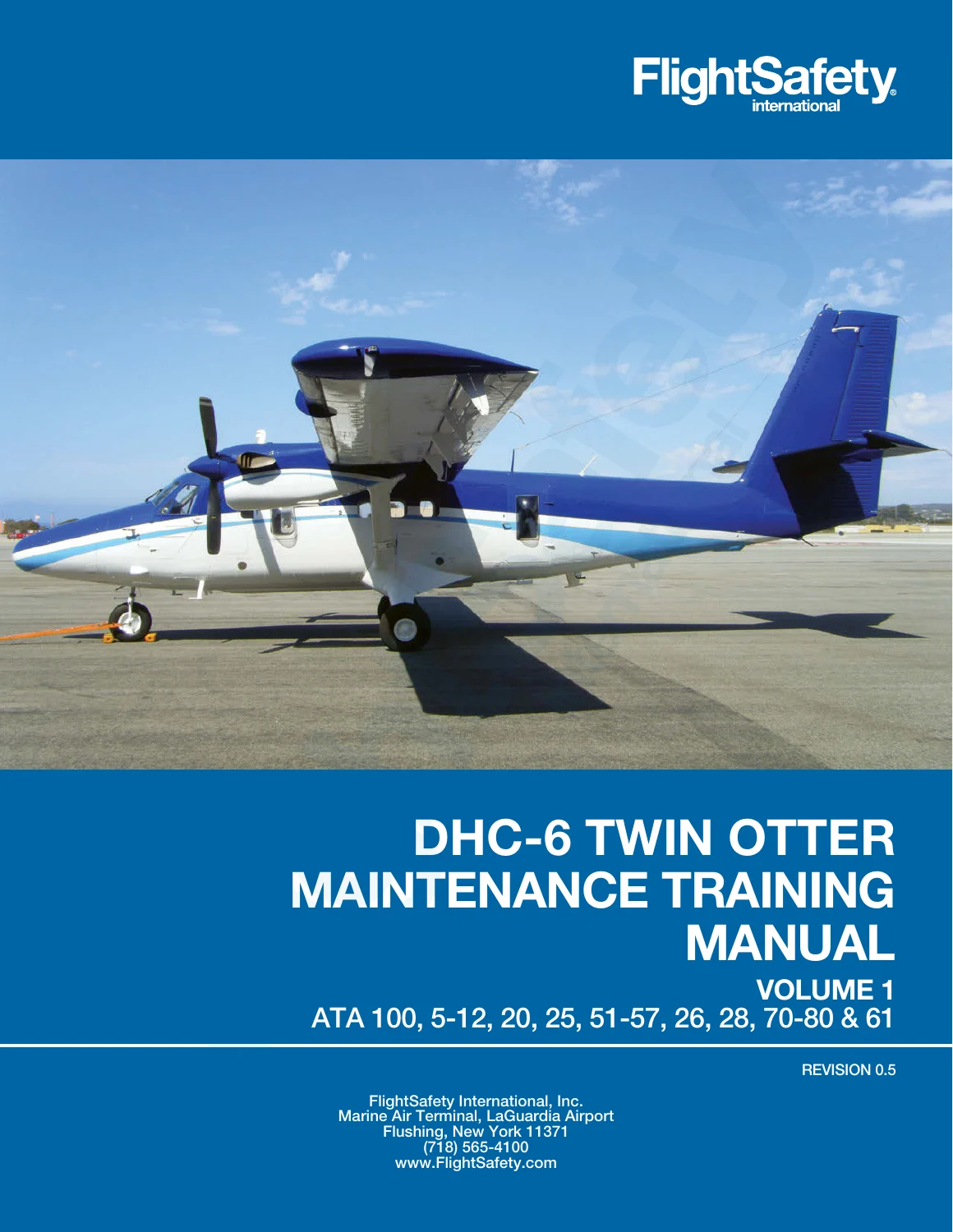
FlightSafety DHC-6 Twin Otter Series 100, 200 & 300 Maintenance Training Manual Volume 1
Original price was: $36.95.$22.95Current price is: $22.95.
Comprehensive FlightSafety International maintenance training manual Volume 1 covering ATA chapters 100, 5-12, 20, 25, and 51-57 for de Havilland DHC-6 Twin Otter Series 1, 100, 200, and 300 aircraft equipped with PT6A engines.
Description
FlightSafety DHC-6 Twin Otter Series 100, 200 & 300 Maintenance Training Manual Volume 1
The FlightSafety DHC-6 Twin Otter Series 100, 200 & 300 Maintenance Training Manual Volume 1 provides professional-grade systems training and technical maintenance instruction for line technicians, airframe mechanics, and ground support personnel servicing de Havilland DHC-6 utility and commuter aircraft. Prepared by FlightSafety International in accordance with Air Transport Association (ATA) format guidelines, this volume consolidates factory maintenance data, general airframe standards, inspection schedules, and practical workshop practices across primary twin-turboprop airframe systems.
File Details
- Document Type: Aircraft Maintenance Training Manual (Volume 1)
- Publisher: FlightSafety International
- Applicable Aircraft: de Havilland DHC-6 Twin Otter (Series 1, Series 100, Series 200, Series 300)
- Powerplant Coverage: Pratt & Whitney Canada PT6A-20, PT6A-27, and PT6A-34 turboprop installations
- Format: High-resolution downloadable PDF
- Page Count: 62 pages
- Language: English
- Edition / Revision: Second Edition, Revision 0.5 (December 2017)
Chapters Covered
ATA 100 – Aircraft General & Documentation
Introduction to ATA 100 specification format, standard numbering systems (chapter, section, subject breakdown), page numbering conventions, list of effective pages, mandatory publication requirements (AMM, WDM, IPC, CMM, SRM, NDT, WBM), de Havilland associated publications, test classifications (operational, functional, and bench tests), and technical bulletin indices (Service Bulletins, TABs, and MMEL).
ATA 5-12 – Aircraft General & Servicing
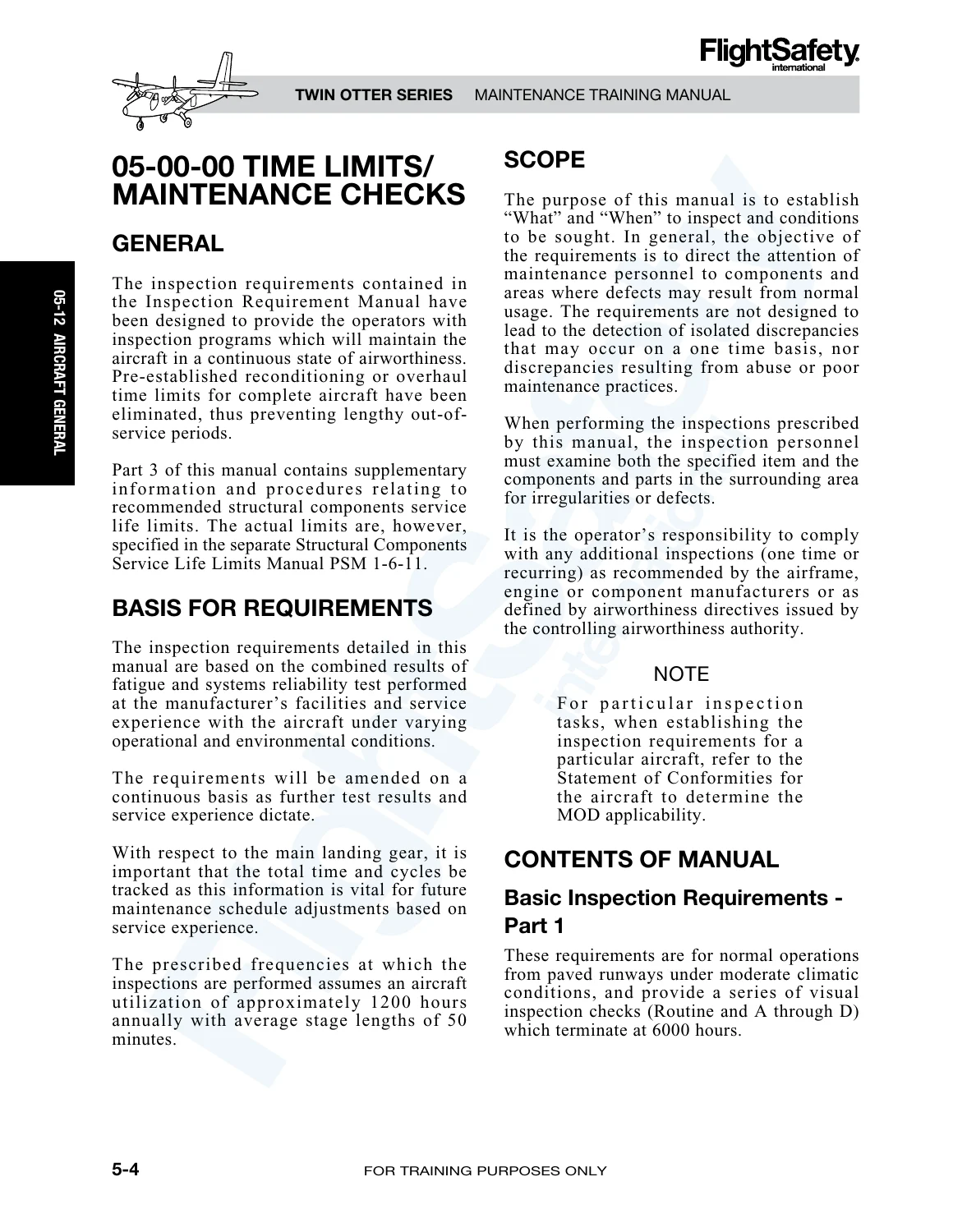
Scheduled maintenance requirements and time limits based on 1,200 annual flight hours; standard inspection cycles (‘Routine’ 7-day checks, ‘A’ 125-hour checks, ‘B’ 250-hour checks, ‘C’ 500-hour checks, and ‘D’ 6,000-hour component overhauls); Equalized Maintenance for Maximum Availability (EMMA) 48-check schedule; Low Utilization Maintenance Program (LUMP); High Intensity Radiated Fields (HIRF) and lightning strike protection; principal aircraft dimensions, stations, waterlines, and ground clearances; reference jig points at station 109.32 for symmetry checks; aircraft, fuselage, wing, engine, and propeller hoisting and slinging configurations; fuselage and gear jacking locations; floor seat rail spirit leveling and weighing criteria; ground towing and taxiing cautions (1,500 psi brake accumulator check, torque link disconnect); parking, gust lock rigging, mooring ropes, and complete ground support equipment (GSE) tooling catalogs; interior and exterior placards and markings; system servicing and replenishment points (fuel, oil, hydraulic, pneumatic, and oxygen); engine compressor wash routines; window and polyvinyl chloride upholstery cleaning; and cold weather de-icing and anti-icing protocols using freezing point depressant (FPD) fluids.
IMAGES PREVIEW
ATA 20 – Standard Airframe Practices
Standard procedures for fluid line and fitting torquing (AN818 and NAS591 nuts, tapered pipe threads, oxygen system safety and Teflon tape rules); thread lubrication tables; adhesive bonding using General Electric PSA529/SRC-18 two-part resin and catalyst; structural fastener torquing sequences, offset adapter dial reading formulas, overtorqued fastener scrappage, and red lacquer identification; Alodine 1200S and Touch-N-Prep 1132 chemical conversion coating manual application and deoxidizing; hard film (Grade 1) and soft film (Grade 2, Grade 3) corrosion preventive compounds; weather sealing methods (faying surface, fillet, dome seal fasteners, anchor nuts, and aerodynamically flush butt joints); radio frequency induction silver brazing for 7×7 and 7×19 corrosion-resistant steel flight control cables; proof load testing; 7×19 and 7×7 control cable wear limits, broken wire inspection criteria, and Aeroshell 22 lubrication; electrostatic discharge (ESD) handling of static-sensitive avionics and integrated circuits; structural electrical bonding and grounding procedures, resistance testing with milliohm meters (2.5 milliohm threshold), and potting sealing; plumbing line bonding intervals; and antenna installation with conductive gaskets and fillet sealing.
ATA 25 – Equipment & Furnishings
Flight compartment seating adjustment, inertia reels, and harnesses; commuter cabin configurations (basic 20-seat, mixed seating Mod S.O.O. 6102, 19-seat Mod S.O.O. 6103, and 18-seat with wardrobe Mod S.O.O. 6104); utility cabin interiors (20-seat Mod S.O.O. 6105 and 13-seat folding configuration Mod S.O.O. 6106); customer option self-contained galley commissary unit (Mod S.O.O. 6175) with heated beverage circuitry; chemical toilet compartment (Mod S.O.O. 6136) and vent system; front, rear, and cabin cargo tie-down layouts and weight limitations; and emergency equipment including first aid stowage and the Kannad 406 MHz emergency locator transmitter (ELT) operation, self-test sweep tones, remote switch arming, buzzer locating, and lithium battery maintenance.
ATA 51-57 – Airframe Structures
Structural composition utilizing 2024 aluminum alloy, semi-monocoque skin-stringer assemblies, and 7075-T7351 stress-corrosion replacements; fatigue life thresholds (fuselage 66,000 hours / 132,000 flights, station 219 lower transverse frame, and wing struts); fuselage zoning across five major sections; long nose baggage compartment construction (Mod 6/1077) with composite honeycomb core radome and 300 lb floor capacity; and short nose pre-mod hinged nose cap compartment structure with 200 lb rating.
Together, these technical modules provide technicians and maintenance planners with complete, authoritative guidance for airframe servicing, component inspection intervals, and hangar-level repair practices on high-utilization or low-utilization Twin Otter airframes.
Scheduled Inspection Programs & Maintenance Management
Understanding scheduled maintenance intervals is critical for commercial operators. This DHC-6 Twin Otter maintenance training manual provides clear breakdowns of both the standard phased inspection program and the Equalized Maintenance for Maximum Availability (EMMA) system. The standard schedule breaks down visual inspections, system operational checks, and functional tests from 125 flying hours up through 6,000-hour ‘D’ checks. For operations flying fewer than 875 hours annually, the manual details the Low Utilization Maintenance Program (LUMP), allowing operators to space EMMA checks at 60-day intervals over an 8-year cycle without compromising structural integrity or regulatory compliance.
Airframe Practices, Fastener Torques & Systems Rigging
Technicians will find precise maintenance standards in ATA 20 for everyday hangar tasks. Detailed tables specify maximum and minimum torque values for aluminum alloy and steel tubing assemblies, thread lubrication materials across hydraulic, fuel, and oxygen lines, and formulas for calculating torque wrench dial readings when using offset adapters. Step-by-step procedures outline chemical conversion coating touch-ups using Alodine 1200S and Touch-N-Prep pens, weather sealant preparation and application profiles, induction brazing proof testing for flight control cables, and milliohm electrical bonding checks to protect sensitive systems against lightning strikes and High Intensity Radiated Fields.
Professional Workshop Capability & Instant Digital Delivery
Whether performing routine pre-flight inspections, ground towing, cabin reconfigurations between passenger and freight roles, or deep structural repairs on wing and fuselage assemblies, this FlightSafety DHC-6 Twin Otter Series 100, 200 & 300 Maintenance Training Manual Volume 1 delivers the exact technical instructions and factory tolerances needed to keep your aircraft flying safely and in complete regulatory compliance. Having direct access to approved ground support tooling part numbers, sling configurations, and system servicing capacities eliminates guesswork and prevents costly maintenance errors. Delivered as an instant downloadable PDF, you can access this comprehensive training manual immediately on your desktop, laptop, or shop tablet, or print selected reference pages directly for hands-on use on the hangar floor.
Reviews
There are no reviews yet.