
★ TRUSTED BY 321,897+ PROFESSIONALS WORLDWIDE
🏢
Trusted Business
Verified & Licensed
🛡️
Virus Free Files
100% Safe Downloads
🔒
Secure Payment
SSL Protected
Instant Delivery
Available Immediately
Sale!

GE HealthCare Revolution Apex & Revolution CT Technical Reference Manual 5871355-1EN Rev 2 (2023)

Original price was: $49.95.Current price is: $29.95.

406-page GE HealthCare technical reference for Revolution Apex and Revolution CT systems, covering safety, QA phantom testing, planned maintenance, dose and image-quality performance, system specifications, Quantix™ 160 X-ray tube data, CT acceptance testing, networking, operating modes, and radiotherapy planning requirements. Direction 5871355-1EN, Revision 2, May 2023.

Instant PDF Download
Available immediately
💾
Save to Your Device
Download & keep forever
🛡️
Antivirus Scanned
100% virus-free
🌍
Trusted Worldwide
175,000+ customers

Description

GE HealthCare Revolution Apex & Revolution CT Technical Reference Manual 5871355-1EN Rev 2 (2023)

The GE HealthCare Revolution Apex & Revolution CT Technical Reference Manual 5871355-1EN Rev 2 (2023) is a detailed technical reference for the Revolution Apex and related Revolution CT configurations identified in the document. It concentrates on safety, quality assurance, radiation dose and image-quality performance, planned maintenance, system specifications, X-ray tube data, CT operating theory, acceptance testing, and radiotherapy treatment-planning requirements. Revision 2 is dated May 2023 and applies to Revolution CT 1.0 software 22MW25.xx for the covered systems.

This is not a general service-repair manual for unrestricted component replacement. The document states that designated service personnel should use the proper service manuals when servicing the system. Its role is different: it provides the technical performance, QA, maintenance-schedule, measurement, acceptance-test, dose, and specification information used to understand and verify scanner performance.

File Details

  • Manual type: Technical Reference Manual
  • Brand: GE HealthCare
  • Models: Revolution Apex™, Revolution™ CT with Apex edition, Revolution Apex™ Plus, Revolution™ CT ES with Apex edition, Revolution Apex™ Select, Revolution Apex™ Elite, Revolution™ CT Power
  • Direction number: 5871355-1EN
  • Revision: 2
  • Revision date: May 2023
  • Applicable software: Revolution™ CT 1.0 software 22MW25.xx
  • Language: English
  • Page count: 406 pages
  • File format: PDF

Quality Assurance, Dose and Performance Reference

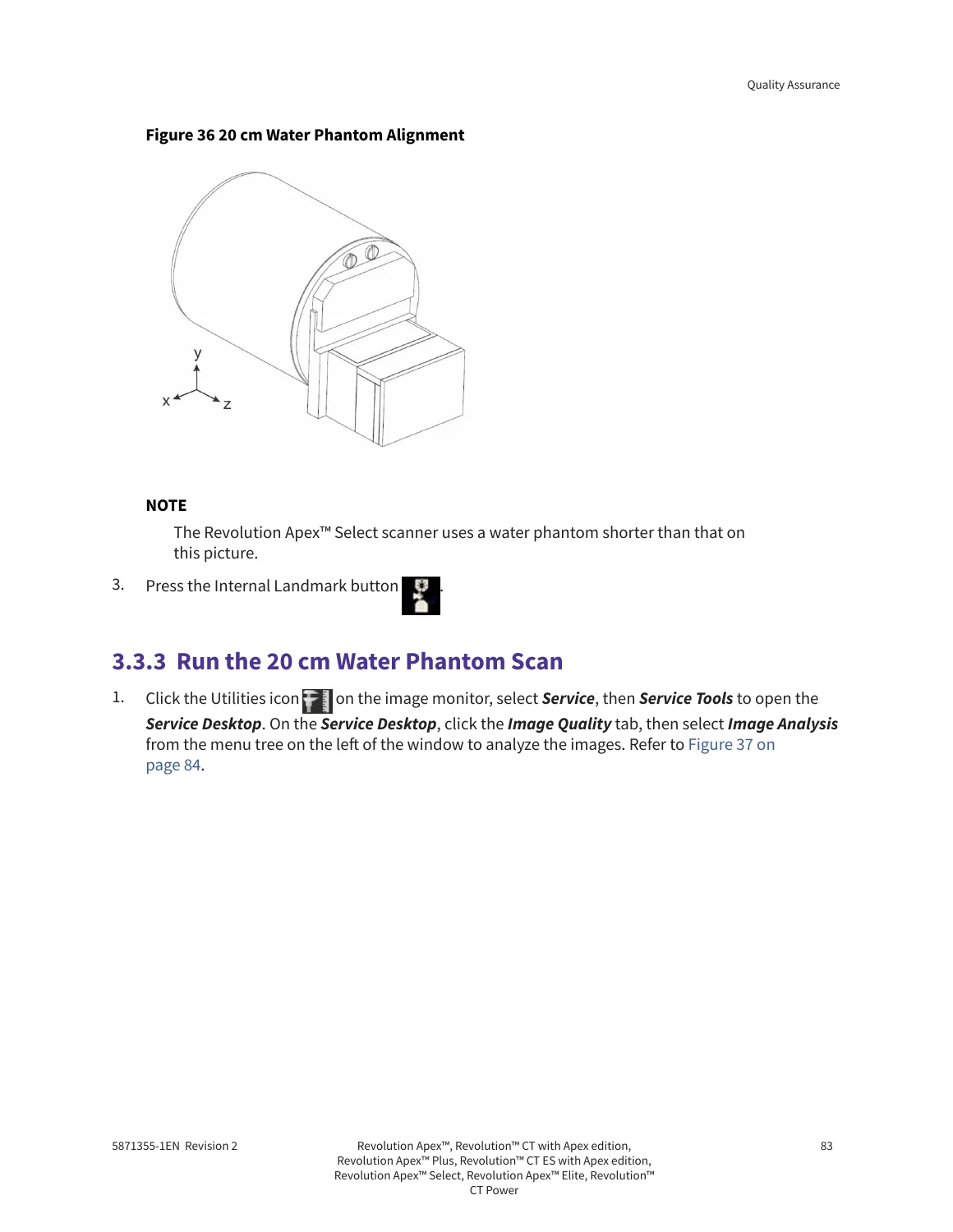
A major portion of this Revolution Apex technical reference manual is devoted to quality assurance and measurable system performance. The QA chapter includes a testing schedule, 20 cm Water Phantom scans, QA Phantom scans, phantom handling, protocol references, image-analysis reports, representative images, and separate QA data forms for 160 mm and 80 mm systems and for 40 mm systems. The procedures describe positioning and scanning the phantoms, using Image Analysis, checking protocol results, and recording performance data.

The dose and performance material extends beyond routine QA. It covers dose information, stray radiation measurements, deterministic effects, noise, modulation transfer function (MTF), nominal slice thickness, and sensitivity profile. This makes the manual useful when checking whether the scanner is performing within the documented technical framework and when reviewing the parameters that affect radiation output and image quality.

Planned Maintenance and System Technical Data

The planned-maintenance section provides a structured PM schedule for the covered Revolution Apex and Revolution CT systems using the Quantix™ 160 tube. Scheduled items include preliminary PM checks, room-condition inspection, gantry inspection, alignment-light inspection, gantry fans and blowers, scanner desktop and system cabinet PM, UPS battery checks, covers and filters, axial-drive filter cleaning, gantry bearing lubrication, gantry assembly bolt inspection, tube heat-exchanger filter cleaning, detector and DTS PM, PDU checks, table checks, kV/mA/scan-time verification, focal-spot validation and calibration, and image-quality testing.

The system-specification chapters add the electrical and radiation-performance reference data needed around that maintenance work. Topics include compatible certified components, component rating plates, laser alignment lights, main power supply, nominal electric power, CT system X-ray tube ratings, equivalent filtration, half-value layer, kV/mA/exposure-time accuracy, electromagnetic compatibility, and operating, shipping, and short-term storage environmental specifications. A dedicated Quantix™ 160 X-ray tube chapter provides tube model information, operating environment, X-ray characteristics, tube assembly and insert details, environmental health and safety information, markings, and routine maintenance.

CT Operation, Networking and Imaging Functions

The manual also explains CT operating theory and the principal scanner subcomponents, including the X-ray source, detector, gantry, power distribution unit, table, system cabinet, and scanner desktop. It describes how the X-ray source and detector operate and gives configuration information for the detector coverage used by 160 mm, 80 mm, and 40 mm systems.

Network sections document the purpose of connecting the scanner to a network, network-interface technical specifications, information flows, required network characteristics and configuration, compatibility, and hazardous situations that can arise from IT-network failure. Operational-mode coverage includes Scout, Axial, Cine, VolumeShuttle™, Helical, Cardiac Axial, Cardiac Helical, ECG-Modulated mA, SmartTrack, Gemstone Spectral Imaging, and SmartStep. Additional technical topics cover image display, scout-based attenuation characterization, CT perfusion, total scan time, automatic exposure control, slice-thickness reference noise index, SmartmA, Organ Dose Modulation, and Auto Prescription concepts including patient-size estimation and Size Adjusted Noise Index.

Complete PDF Bookmark Tree

Complete Bookmarks

The complete bookmarks in the “GE HealthCare Revolution Apex & Revolution CT Technical Reference Manual 5871355-1EN Rev 2 (2023)” are as follows:

This user document is part of a setp. 3
Revision Historyp. 3
Contentsp. 5
1 User Informationp. 11
1.1 Introductionp. 11
1.2 User Documentationp. 11
1.3 Product Differencesp. 12
1.4 GE Approved Accessories, Components and Compatible 3rd Party Medical Devicesp. 13
2 Safetyp. 17
2.1 General Safety Guidelinesp. 17
2.2 Safety Conventionsp. 18
2.3 Symbols and Warning Labelsp. 19
2.3.1 Symbolsp. 19
2.3.2 Equipment Warning Labelsp. 24
2.3.2.1 Laser Warning Labelsp. 24
2.3.2.2 X-ray Warning Labelsp. 26
2.3.2.3 Table Warning Labelsp. 26
2.3.2.4 Power Distribution Unit (PDU) Warning Labelsp. 28
2.3.2.5 Scanner Desktop Labelsp. 29
2.3.2.6 External Accessory Labelsp. 29
2.4 Radiation Safetyp. 33
2.5 Implantable Device Safetyp. 38
2.6 Electrical Safetyp. 39
2.7 Electromagnetic Compatibility Safetyp. 42
2.8 Fire Safetyp. 43
2.9 Mechanical Safetyp. 43
2.9.1 General Mechanical Safetyp. 43
2.9.2 Patient Positioningp. 44
2.9.2.1 Remote Controlled Patient Positioning RCP AVIMOS Safetyp. 49
2.9.3 Gantry Air Inletsp. 50
2.10 Use of Defibrillatorp. 51
2.11 Emergency Devices and Emergency Egressp. 51
2.12 Laser Safetyp. 55
2.13 Reconstructed Image Orientationp. 57
2.14 Data Safetyp. 59
2.15 Application Specific Safety Topicsp. 61
2.15.1 Axial and Helical Scanningp. 61
2.15.2 Cardiac Imagingp. 62
2.15.3 CT Integrated Cardiac Modulep. 64
2.15.4 Advanced Application Safetyp. 64
2.15.5 Measurementsp. 64
2.15.6 Segment Toolsp. 65
2.15.7 Filming and Saving Imagesp. 66
2.15.8 Head Imagingp. 66
2.15.9 Interventional Scanningp. 67
2.15.9.1 Interventional Optionsp. 68
2.15.9.2 Table Floatp. 68
2.15.10 GSI Scanningp. 69
2.15.10.1 Image Qualityp. 70
2.15.10.2 Measurementsp. 71
2.15.10.3 Window Width and Window Levelp. 71
2.15.10.4 Imaging Reliabilityp. 72
2.15.10.5 Metal Artifact Reduction (MAR)p. 72
2.15.10.6 Image Filtersp. 73
2.15.11 Deep Learning Image Reconstruction (DLIR)p. 74
2.15.12 Max Field of View (MaxFOV 2) Reconstruction DFOV Greater than 50.0 cmp. 74
2.15.13 VolumeShuttle™ (Axial)p. 76
2.15.14 Auto Positioningp. 77
2.16 Application Software Safetyp. 78
2.17 Accuracy of Measurementsp. 78
2.17.1 Measure Distance for Axial, Helical, and Cine Imagesp. 78
2.17.2 Measure Distance for Scout Imagesp. 78
2.17.3 Measure Anglep. 80
2.17.4 Voxel Dimensionsp. 80
2.17.5 ROIp. 80
2.17.6 CT Numberp. 81
2.17.6.1 CT Number Mean and Standard Deviationp. 81
2.17.6.2 CT Number Accuracyp. 82
2.17.7 Range, Precision and Accuracy of Displayed Valuesp. 82
2.18 Accessory Safetyp. 83
2.19 Maintenance and Cleaning and Disinfectionp. 87
2.19.1 General Cleaning and Disinfectionp. 87
2.19.2 Cleaning and Disinfection Agentsp. 88
2.20 Hazardous Substancesp. 89
2.21 System Performancep. 90
3 Quality Assurancep. 91
3.1 Introductionp. 91
3.2 Quality Assurance Testing Schedulep. 91
3.3 20 cm Water Phantom Scansp. 92
3.4 QA Phantom Scansp. 102
3.5 Quality Assurance Referencep. 111
3.5.1 20 cm Water Phantom and QA Phantomp. 111
3.5.2 Proper Handling and Care of Phantomsp. 112
3.5.3 20 cm Water Phantom Protocolsp. 113
3.5.3.1 20 cm Water Phantom Protocols for 160 mm and 80 mm systemsp. 113
3.5.3.2 20 cm Water Phantom Protocols for 40 mm systemsp. 118
3.5.4 Image Analysis Report — 20 cm Water Phantom Protocolsp. 122
3.5.4.1 Image Analysis Report — 20 cm Water Phantom Protocols for 160 mm and 80 mm systemsp. 122
3.5.4.2 Image Analysis Report — 20 cm Water Phantom Protocols for 40 mm systemsp. 125
3.5.5 QA Phantom Protocolsp. 128
3.5.5.1 QA Phantom Protocols for 160 mm and 80 mm systemsp. 128
3.5.5.2 QA Phantom Protocols for 40 mm systemsp. 136
3.5.6 Image Analysis Report — QA Phantom Protocolsp. 142
3.5.6.1 Image Analysis Report — QA Phantom Protocols for 160 mm and 80 mm systemsp. 143
3.5.6.2 Image Analysis Report — QA Phantom Protocols for 40 mm systemsp. 143
3.5.7 Representative Imagesp. 144
3.6 QA Data Formsp. 146
3.6.1 QA Data Forms for 160 mm and 80 mm systemsp. 146
3.6.2 QA Data Forms for 40 mm systemsp. 148
4 Planned Maintenancep. 151
4.1 Planned Maintenance Schedulep. 151
5 Dose and Performancep. 155
5.1 Dosep. 155
5.1.1 Dosep. 155
5.1.1.1 General Informationp. 155
5.1.1.2 CTDI Definitionsp. 156
5.1.1.2.1 CTDI100p. 156
5.1.1.2.2 CTDIfree airp. 157
5.1.1.2.3 CTDIwp. 158
5.1.1.2.4 CTDIvolp. 158
5.1.1.3 CTDI100 Measurement Methodp. 159
5.1.1.3.1 Non-GSIp. 160
5.1.1.3.1.1 Overviewp. 160
5.1.1.3.1.2 Phantom Setupp. 162
5.1.1.3.1.3 Collimations less than or equal to 40 mmp. 165
5.1.1.3.1.4 Collimations greater than 40 mmp. 166
5.1.1.3.2 GSIp. 169
5.1.1.4 CTDI100, CTDIw and Adjustment Factorsp. 169
5.1.1.4.1 Non-GSIp. 169
5.1.1.4.2 GSIp. 174
5.1.1.5 CTDIvolp. 182
5.1.1.5.1 Axial and Helical CTDIvolp. 183
5.1.1.5.2 Smart Coverage CTDIvolp. 184
5.1.1.5.3 Scout CTDIvolp. 186
5.1.1.5.4 CTDI Maximum Deviationp. 188
5.1.1.6 Peak Skin Dosep. 188
5.1.1.7 Dose Length Product (DLP)p. 191
5.1.1.8 Max Z Location CTDIvolp. 192
5.1.1.9 SmartStep Dose Displayp. 192
5.1.1.10 Geometric Efficiencyp. 193
5.1.1.11 Dose Profilep. 194
5.1.1.12 Reproducibility of Radiation Outputp. 200
5.1.1.13 Linearity of Radiation Outputp. 201
5.1.1.14 Radiation Fieldp. 202
5.1.1.15 Conversion factors for CTDIvol and DLP for Pediatric Body SFOVp. 203
5.1.2 Stray Radiation Measurementsp. 203
5.1.3 Dose Deterministic Effectsp. 210
5.2 Noisep. 212
5.3 Modulation Transfer Function (MTF)p. 213
5.4 Nominal Slice Thickness and Sensitivity Profilep. 214
6 System Specificationsp. 217
6.1 Compatible Certified Componentsp. 217
6.2 Component Rating Platesp. 217
6.3 Laser Alignment Lightsp. 231
6.4 Main Power Supplyp. 232
6.5 Nominal Electric Powerp. 232
6.6 CT System X-ray Tube Ratingsp. 233
6.7 Quality Equivalent Filtrationp. 247
6.8 Half Value Layerp. 248
6.9 kV, mA, and Exposure Time Accuracy and Measurementp. 248
6.10 Electromagnetic Compatibilityp. 250
6.11 Environmental Specificationsp. 260
6.11.1 Operating Environmentp. 260
6.11.2 Non-Operating Environment (Shipping)p. 260
6.11.2.1 System, excluding Scanner Desktop LCD display monitor(s), gantry covers, and water-filled calibration/IQ phantomsp. 260
6.11.2.2 Water-filled calibration/IQ phantomsp. 260
6.11.2.3 Scanner Desktop LCD display monitor(s):p. 260
6.11.2.4 Gantry Coversp. 260
6.11.3 Non-Operating Environment (Short-term storage up to 6 months)p. 261
7 Quantix™ 160 X-ray Tube Specificationsp. 263
7.1 X-ray Tube Model Numbersp. 263
7.2 Operating Environmentp. 263
7.3 X-ray Characteristicsp. 263
7.4 Quantix™ 160 X-Ray Tube Assemblyp. 264
7.5 Quantix™ 160 X-Ray Tube Insertp. 270
7.6 Environmental Health and Safety (EHS) Informationp. 279
7.7 Symbols Used in Markingsp. 280
7.8 Routine Maintenancep. 281
7.9 Manufacturer Addressp. 281
8 General Informationp. 283
8.1 Introductionp. 283
8.2 CT Operation Theoryp. 283
8.3 General Informationp. 286
8.4 Networkp. 288
8.4.1 Purpose of Revolution Apex™, Revolution™ CT with Apex edition, Revolution Apex™ Plus, Revolution™ CT ES with Apex edition, Revolution Apex™ Select, Revolution Apex™ Elite, Revolution™ CT Power Scanner Connection to Networkp. 288
8.4.2 Network Interface Technical Specificationsp. 289
8.4.3 Network Information Flows Specificationsp. 289
8.4.4 Required characteristics and configuration for network support of Revolution Apex™, Revolution™ CT with Apex edition, Revolution Apex™ Plus, Revolution™ CT ES with Apex edition, Revolution Apex™ Select, Revolution Apex™ Elite, Revolution™ CT Power Scanner specificationsp. 292
8.4.4.1 Remote Host Parametersp. 293
8.4.4.2 Archive Node Settingsp. 293
8.4.5 Network Compatibilityp. 293
8.4.6 Hazardous Situations Due to Failure of IT—networkp. 299
8.5 System Operational Modesp. 299
8.5.1 Overviewp. 299
8.5.2 Scoutp. 299
8.5.3 Axialp. 300
8.5.4 Cinep. 300
8.5.5 VolumeShuttle™ (Axial)p. 300
8.5.6 Helicalp. 301
8.5.7 Cardiac Axialp. 301
8.5.8 Cardiac Helicalp. 302
8.5.9 ECG-Modulated mAp. 302
8.5.9.1 Electrocardiograph Tube Current Modulationp. 302
8.5.9.2 ECG-Modulated mA Theoryp. 302
8.5.10 SmartTrackp. 304
8.5.11 Gemstone Spectral Imagingp. 304
8.5.12 SmartStepp. 306
8.6 Image Displayp. 307
8.7 Scout Based Attenuation Characterizationp. 313
8.8 CT Perfusionp. 317
8.8.1 Purpose of CT Perfusionp. 317
8.8.2 Components of a CT Perfusion Studyp. 318
8.8.2.1 Body perfusion considerationsp. 319
8.8.2.2 Perfusion acquisition typesp. 319
8.8.2.3 Scan parameter effects on dosep. 320
8.8.2.3.1 kV effects on dosep. 320
8.8.2.3.2 mA effects on dosep. 320
8.8.2.4 Considerations for peak skin dosep. 320
8.8.2.5 Required image attributes for perfusion imagingp. 321
8.8.2.6 Contrast injection considerationsp. 321
8.8.2.7 Other considerations and referencesp. 321
8.8.2.8 Recommended readingp. 322
8.9 Total Scan Timep. 323
8.10 Automatic Exposure Controlp. 323
8.11 Slice Thickness Reference Noise Index and Noise Index Valuesp. 327
8.12 SmartmA/ODMp. 328
8.12.1 SmartmAp. 328
8.12.1.1 SmartmA backgroundp. 329
8.12.1.2 SmartmA theoryp. 330
8.12.1.3 Referencesp. 331
8.12.1.4 SmartmA FAQsp. 331
8.12.2 SmartmAp. 336
8.12.3 Organ Dose Modulation (ODM)p. 337
8.13 Auto Prescriptionp. 338
8.13.1 Overviewp. 338
8.13.2 Background: Impact of kV changes on CT Imagingp. 338
8.13.3 Auto Prescription Key Concepts and Theoryp. 340
8.13.4 Reference Size Patientp. 340
8.13.5 Estimating Patient Size and Patient Size Unitsp. 341
8.13.6 Clinical Taskp. 343
8.13.7 Size Adjusted Noise Index (SANI)p. 344
9 CT Acceptance Testingp. 351
9.1 Introductionp. 351
9.2 Positioning of the Patient Supportp. 351
9.2.1 Test Equipmentp. 351
9.2.2 Test Procedurep. 351
9.2.3 Data Evaluation and Acceptance Criteriap. 354
9.2.4 Action to be takenp. 355
9.3 Patient Positioning Accuracyp. 355
9.4 Preview Image Accuracy Testp. 360
9.5 Tomographic Section Thicknessp. 363
9.6 Dosep. 369
9.7 Noise, Mean CT Number and Uniformityp. 373
9.8 Spatial Resolution (High Contrast)p. 376
9.9 Automatic Exposure Controlp. 378
9.9.1 Test Equipmentp. 378
9.9.2 Test Procedurep. 378
9.9.2.1 Size-dependent modulation evaluation for Adult Body protocol elementsp. 378
9.9.2.2 Size-dependent modulation evaluation for Pediatric Body protocol elementsp. 379
9.9.2.3 Longitudinal modulation evaluationp. 380
9.9.3 Data Evaluation and Acceptance Criteriap. 382
9.9.3.1 Size-dependent modulation evaluation for Adult Body protocol elementsp. 382
9.9.3.2 Size-dependent modulation evaluation for Pediatric Body protocol elementsp. 382
9.9.3.3 Longitudinal modulation evaluationp. 382
9.9.3.4 Action to be takenp. 382
9.10 Baseline Valuesp. 382
9.10.1 Establishment of Baseline Valuesp. 383
9.10.2 Frequency of Testingp. 383
9.11 Additional Criteria for Constancy Testsp. 383
9.11.1 Dosep. 383
9.11.2 Noise, Mean CT Number, and Uniformityp. 383
9.11.3 Spatial Resolution (High Contrast)p. 384
9.12 Frequency of Constancy Testsp. 384
9.13 Acceptance Testing after a Major Service Actionp. 384
10 Radiotherapy Treatment Planningp. 385
10.1 Requirements for Providing Images for Radiotherapy Treatment Planning (RTP)p. 385
10.1.1 Introductionp. 385
10.1.1.1 Quality assurance for computed-tomography simulators and the computed-tomography simulation process: Report of the AAPM Radiation Therapy Committee Task Group No. 66p. 385
10.1.2 Alignment of the top of the Patient Supportp. 385
10.1.2.1 Alignment of the Patient Support in the vertical plane (tilt)p. 385
10.1.2.2 Alignment of the Patient Support in the horizontal planep. 385
10.1.2.2.1 The axis of the horizontal movement of the top of the Patient Support to be perpendicular to the x-axis of the Tomographic Plane.p. 385
10.1.2.2.2 The difference between the center of the top of the Patient Support and the sagittal light marker. Please note, external laser lights shall be used for this test. Test Equipment and Accessory Toolsp. 387
10.1.3 Top of the Patient Supportp. 389
10.1.4 Table sag (stiffness of the Patient Support)p. 390
10.1.5 Integral light markers for Patient markingp. 390
10.1.6 Typical scan mode to provide images for RTPp. 390
10.1.6.1 CT images can be used for RTP typical operating conditions.p. 390
10.1.6.2 GE Reference Protocolsp. 391
10.1.6.3 Noise, Mean CT Number and Uniformity with RTP characteristics are as follows:p. 391
10.1.7 HU-value conversionp. 391
10.1.8 Geometric accuracy of image datap. 392
10.1.8.1 Gantry tiltp. 392
10.1.8.2 Angular alignment of CT imagesp. 392
10.1.8.3 Accuracy of image z-position for helical scansp. 394
Appendix A Abbreviationsp. 399
A.1 Abbreviationsp. 399
Appendix B Dose Information Referencep. 403
B.1 Dose Information Referencep. 403

Acceptance Testing and Radiotherapy Planning

Revision 2 specifically updates the CT Acceptance Testing chapter to comply with changes in DIN standards. The chapter describes acceptance testing based on IEC 61223-3-5:2019 and includes patient-support positioning, patient-positioning accuracy, preview-image accuracy, tomographic section thickness, dose, noise, mean CT number and uniformity, high-contrast spatial resolution, automatic exposure control, baseline values, constancy-test criteria and frequency, and acceptance testing after a major service action. Test equipment, test procedures, data evaluation, acceptance criteria, and required actions are included where applicable.

The radiotherapy treatment-planning section addresses requirements for providing CT images for RTP. It covers alignment and characteristics of the patient-support top, table sag, integral light markers for patient marking, a typical scan mode for RTP image generation, HU-value conversion, and geometric accuracy of image data. These pages are particularly relevant where CT image geometry and positioning need to be evaluated for treatment-planning workflows.

Chapters Covered

  • 1 User Information
    • Introduction
    • User Documentation
    • Product Differences
    • GE Approved Accessories, Components and Compatible 3rd Party Medical Devices
  • 2 Safety
    • General Safety Guidelines
    • Safety Conventions
    • Symbols and Warning Labels
    • Radiation Safety
    • Implantable Device Safety
    • Electrical Safety
    • Electromagnetic Compatibility Safety
    • Fire Safety
    • Mechanical Safety
    • Use of Defibrillator
    • Emergency Devices and Emergency Egress
    • Laser Safety
    • Reconstructed Image Orientation
    • Data Safety
    • Application Specific Safety Topics
    • Application Software Safety
    • Accuracy of Measurements
    • Accessory Safety
    • Maintenance and Cleaning and Disinfection
    • Hazardous Substances
    • System Performance
  • 3 Quality Assurance
    • Introduction
    • Quality Assurance Testing Schedule
    • 20 cm Water Phantom Scans
    • QA Phantom Scans
    • Quality Assurance Reference
    • QA Data Forms
  • 4 Planned Maintenance
    • Planned Maintenance Schedule
  • 5 Dose and Performance
    • Dose
    • Noise
    • Modulation Transfer Function (MTF)
    • Nominal Slice Thickness and Sensitivity Profile
  • 6 System Specifications
    • Compatible Certified Components
    • Component Rating Plates
    • Laser Alignment Lights
    • Main Power Supply
    • Nominal Electric Power
    • CT System X-ray Tube Ratings
    • Quality Equivalent Filtration
    • Half Value Layer
    • kV, mA, and Exposure Time Accuracy and Measurement
    • Electromagnetic Compatibility
    • Environmental Specifications
  • 7 Quantix™ 160 X-ray Tube Specifications
    • X-ray Tube Model Numbers
    • Operating Environment
    • X-ray Characteristics
    • Quantix™ 160 X-Ray Tube Assembly
    • Quantix™ 160 X-Ray Tube Insert
    • Environmental Health and Safety (EHS) Information
    • Symbols Used in Markings
    • Routine Maintenance
    • Manufacturer Address
  • 8 General Information
    • Introduction
    • CT Operation Theory
    • General Information
    • Network
    • System Operational Modes
    • Image Display
    • Scout Based Attenuation Characterization
    • CT Perfusion
    • Total Scan Time
    • Automatic Exposure Control
    • Slice Thickness Reference Noise Index and Noise Index Values
    • SmartmA/ODM
    • Auto Prescription

    IMAGES PREVIEW

    GE HealthCare Revolution Apex & Revolution CT Technical Reference Manual 5871355-1EN Rev 2 (2023) — PDF page 1 preview
    GE HealthCare Revolution Apex & Revolution CT Technical Reference Manual 5871355-1EN Rev 2 (2023) — PDF page 93 preview
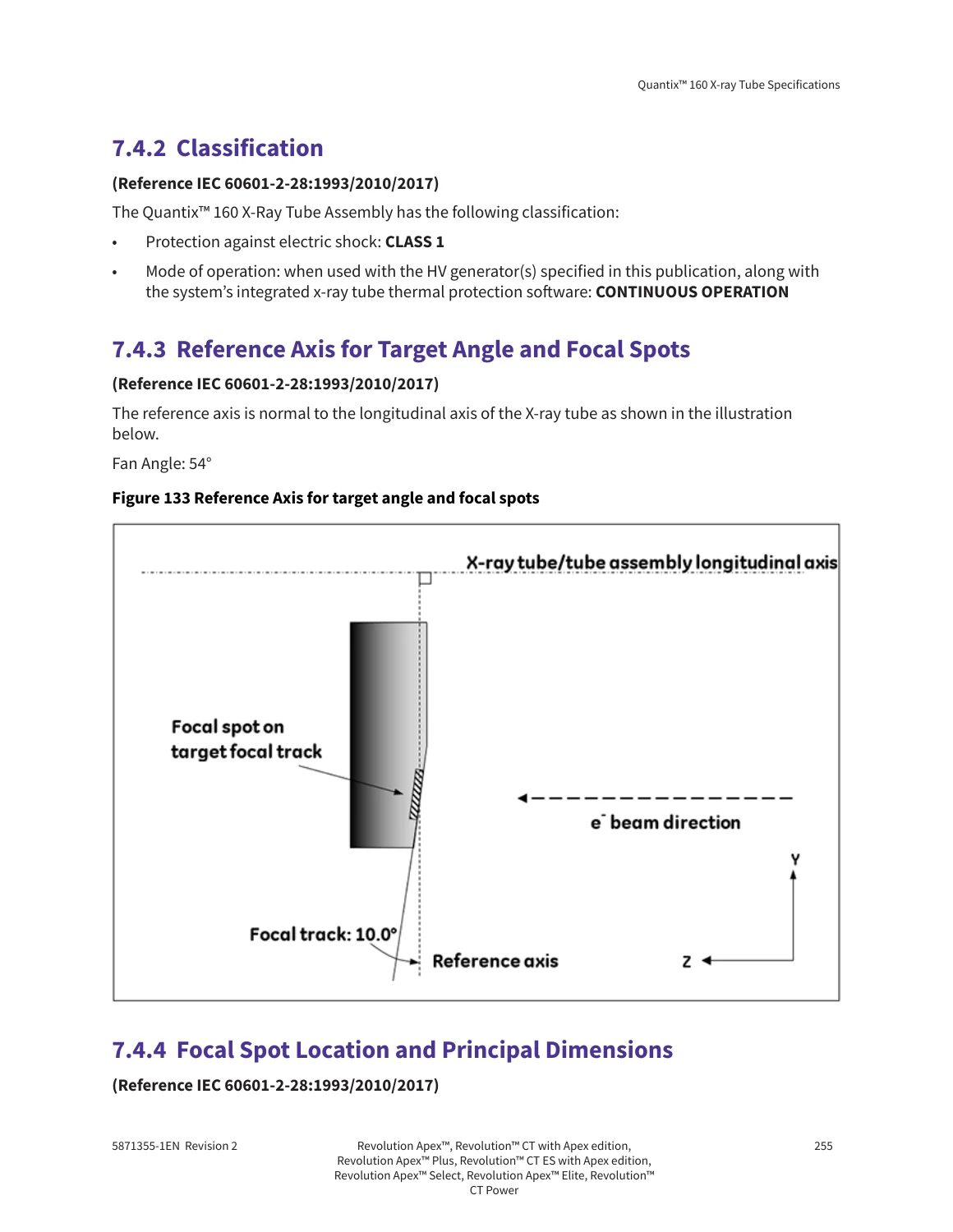
    GE HealthCare Revolution Apex & Revolution CT Technical Reference Manual 5871355-1EN Rev 2 (2023) — PDF page 265 preview

  • 9 CT Acceptance Testing
    • Introduction
    • Positioning of the Patient Support
    • Patient Positioning Accuracy
    • Preview Image Accuracy Test
    • Tomographic Section Thickness
    • Dose
    • Noise, Mean CT Number and Uniformity
    • Spatial Resolution (High Contrast)
    • Automatic Exposure Control
    • Baseline Values
    • Additional Criteria for Constancy Tests
    • Frequency of Constancy Tests
    • Acceptance Testing after a Major Service Action
  • 10 Radiotherapy Treatment Planning
    • Requirements for Providing Images for Radiotherapy Treatment Planning (RTP)
  • Appendix A Abbreviations
  • Appendix B Dose Information Reference

Taken as a whole, the manual gives trained users and technical personnel a broad reference for scanner safety, performance verification, QA testing, scheduled maintenance checks, dose and image-quality evaluation, equipment specifications, operational theory, network requirements, acceptance testing, and RTP-related image requirements. The coverage is centered on understanding and confirming system performance rather than replacing the separate installation or service manuals referenced by GE HealthCare.

Technical Reference for QA, Performance Checks and Planned Maintenance

Use the GE HealthCare Revolution Apex & Revolution CT Technical Reference Manual 5871355-1EN Rev 2 (2023) when you need the documented procedures and specifications behind QA phantom testing, dose and image-quality checks, planned-maintenance scheduling, CT acceptance tests, system electrical and X-ray data, Quantix™ 160 tube information, or technical operating references for the covered scanners. Having the correct revision helps technicians and qualified users work from the published procedures, performance criteria, safety information, and specifications rather than relying on memory or incomplete notes.

Delivered as an instant PDF after purchase – no shipping delay. Open it on a computer, tablet, or phone and print the pages you need for the job, QA session, maintenance check, or technical reference.
Reviews

There are no reviews yet.

Be the first to review “GE HealthCare Revolution Apex & Revolution CT Technical Reference Manual 5871355-1EN Rev 2 (2023)”

What Our Customers Say

★★★★★ Live reviews from customers
Loading customer reviews...
0
    0
    Your Cart
    Your cart is emptyReturn to Shop
    🛒
    Recently Purchased
    🕒 verified order