
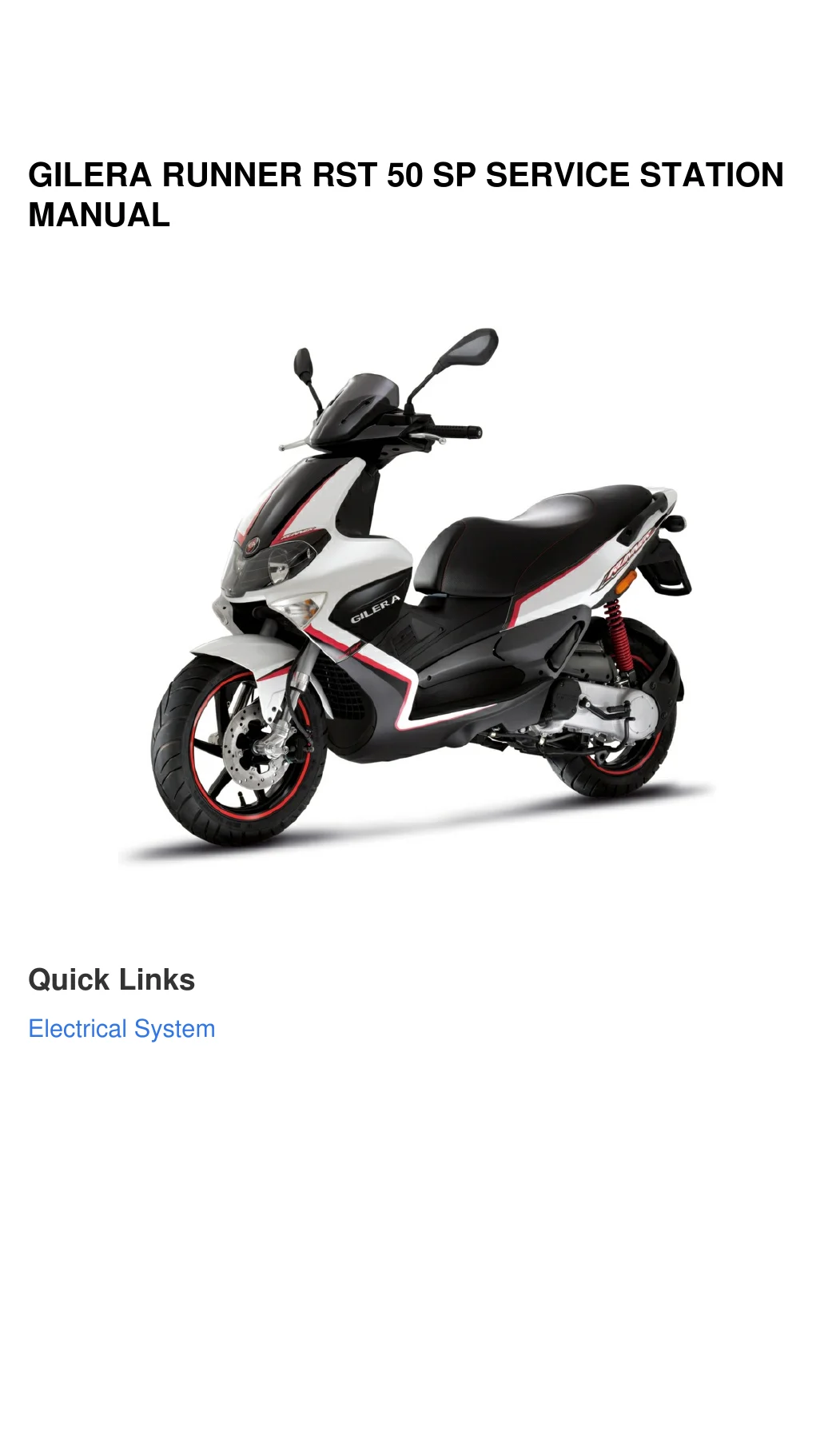
Gilera Runner RST 50 SP Service Station Manual – Complete PDF Workshop & Repair Guide
Original price was: $41.95.$27.95Current price is: $27.95.
The complete 193-page Gilera Runner RST 50 SP Service Station Manual from Piaggio & C. S.p.A. Covers the Piaggio Hi-PER2 PRO 49cc two-stroke engine, Dell’Orto PHVA 17.5 ID carburettor, automatic transmission, brakes, suspension, electrical system and full chassis procedures with factory torque values and special tool references.
Description
Gilera Runner RST 50 SP Service Station Manual
This is the complete Service Station Manual for the Gilera Runner RST 50 SP, the liquid-cooled 50cc scooter built around the Piaggio Hi-PER2 PRO two-stroke engine. Published by Piaggio & C. S.p.A. in 2007 and running 193 pages, it covers every major system on the machine — from the Dell’Orto PHVA 17.5 ID carburettor and automatic variator transmission to the front fork, disc brakes and full electrical harness. This is the document Piaggio-Gilera dealers used in the workshop, and it remains the most detailed single reference available for the Runner RST 50 SP today.
File Details
- Manual type: Service Station Manual (workshop / repair manual)
- Brand: Gilera (Piaggio & C. S.p.A.)
- Model: Runner RST 50 SP
- Engine: Piaggio Hi-PER2 PRO, single-cylinder two-stroke, 49 cm³
- Language: English
- Page count: 193
- File format: PDF
- Publisher: PIAGGIO & C. S.p.A. — After-Sales, Pontedera
- Publication date: 2007
Chapters Covered
- Characteristics
- Tooling
- Maintenance
- Troubleshooting
- Electrical System
- Engine from Vehicle
- Engine
- Suspensions
- Braking System
- Cooling System
- Chassis
- Pre-Delivery
Characteristics & Technical Data
The opening chapter lays out the vehicle identification data — frame prefix ZAPC46100 and engine prefix M461M — alongside the full dimensional and mass table, fluid capacities, wheel and tyre sizes, ignition and charging specifications, and the Dell’Orto PHVA 17.5 ID carburettor settings. Tightening torques are broken down by assembly group (steering, frame, front suspension, front brake, rear brake, engine), and overhaul data includes cylinder-to-piston fitting clearances, piston ring end gaps, crankshaft axial play and the shim system for setting cylinder base gasket thickness.
Tooling
Every special tool referenced in the procedures is catalogued here with its Piaggio stores code and a photograph — bearing extractors and drivers, flywheel puller, crankcase splitting plate, steering ring nut wrench, water pump impeller stop, pin lock fitting tool, stroboscopic timing light and the digital multimeter. This chapter is essential if you plan to follow the factory procedures exactly.
Maintenance
The maintenance chart sets out the service schedule at 1000 km, 5000 km, 15000 km, 20000 km, 30000 km, 40000 km and 60000 km, with the operations required at each interval. Individual procedures are then covered in detail: checking spark advance with a stroboscopic gun, spark plug inspection and replacement, hub oil level check and replacement, air filter cleaning and re-oiling, cooling system level check, brake fluid top-up, and headlight beam adjustment.
Troubleshooting
This section is organised by symptom rather than by system. Poor performance, rear wheel spinning at idle, starting difficulties, excessive oil consumption and exhaust smoke, engine cutting out at full throttle or at idle, excessive exhaust noise, engine overheating and SAS malfunctions are each broken down into possible causes with the corresponding corrective action. Transmission and brake symptoms — clutch grabbing, insufficient braking, brake overheating, heavy steering, noisy suspension — are treated the same way.
Electrical System
Starting with conceptual wiring diagrams for the ignition, lighting, turn indicators and instrument panel, this chapter then moves through the individual circuits: stator and pick-up resistance checks, voltage regulator diagnostics for all five breakdown modes, fuse replacement, sealed and dry-charge battery servicing, and the full pin-out of the digital instrument unit connector. The digital dashboard display functions — fuel gauge, coolant temperature, clock, speedometer, odometer and trip meter — are identified by callout letter.
Engine from Vehicle
The removal sequence for pulling the engine out of the frame is documented step by step with photographs: exhaust and SAS box removal, rear brake calliper, carburettor cover, air filter, mixer command transmission, electrical connections, cooling and fuel lines, and finally the swing arm pin and shock absorber bolt. Each step includes the relevant locking torque.
Engine
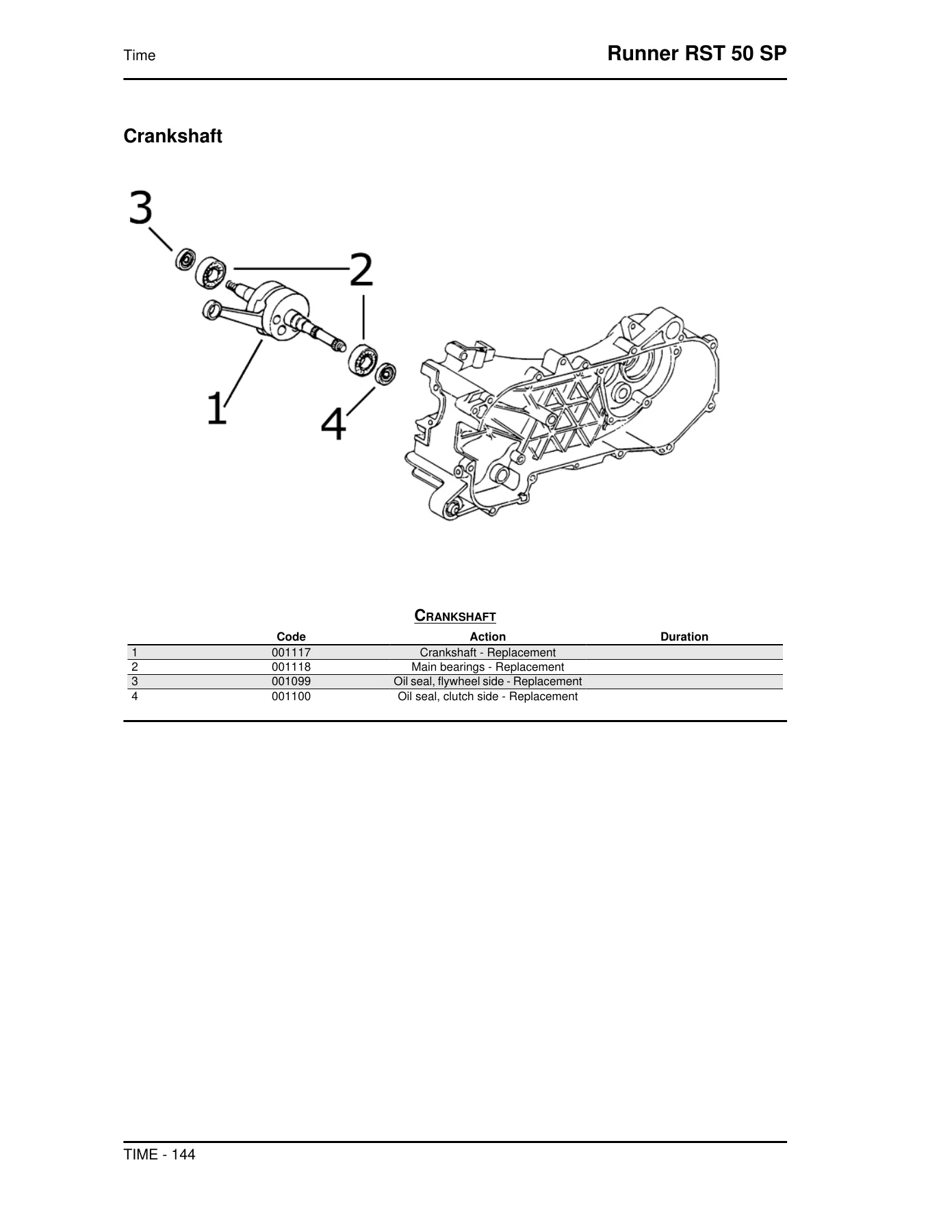
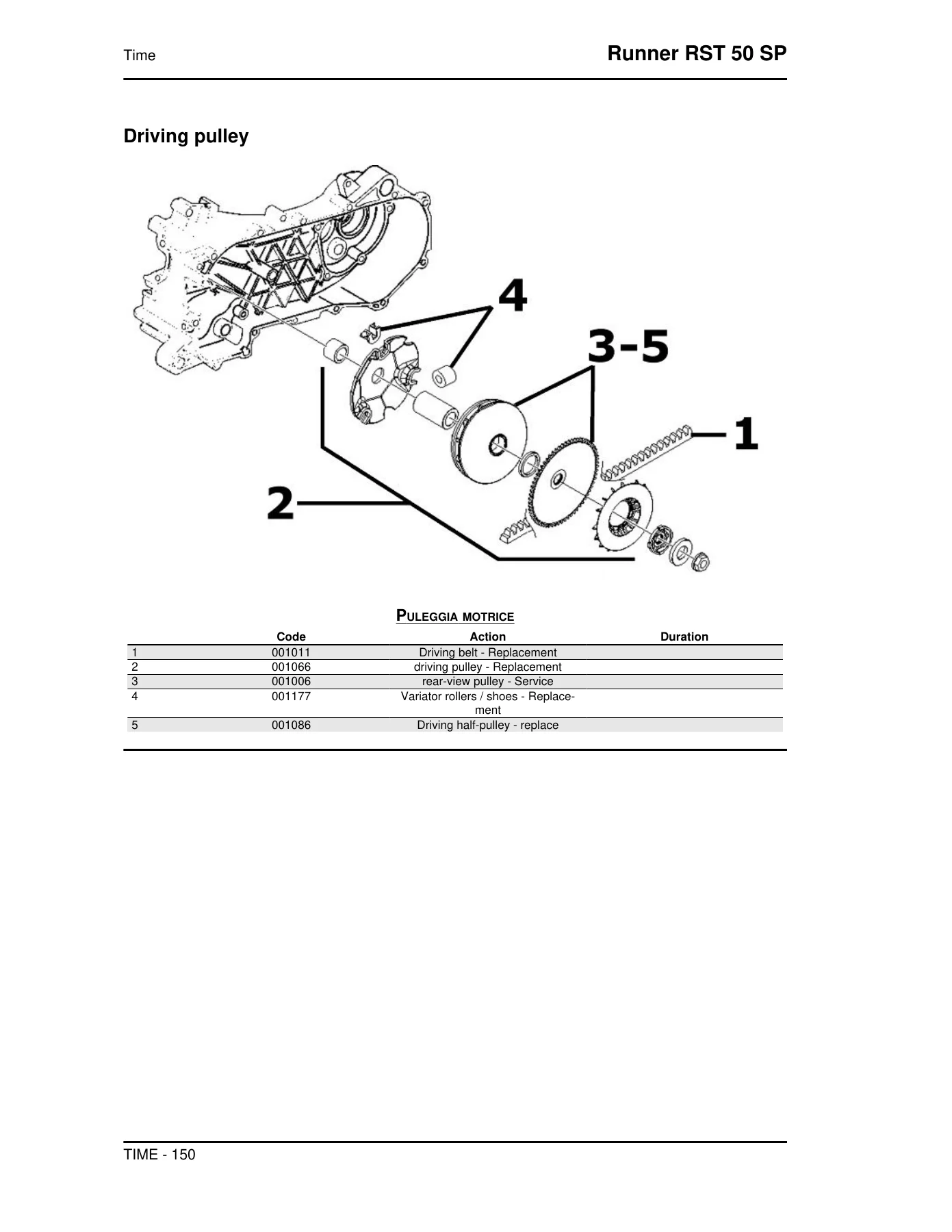
This is the largest chapter and covers the automatic transmission in full — transmission cover removal, kickstart, driven pulley shaft bearing, driven pulley and clutch disassembly and inspection, clutch spring measurement, drive belt wear limits, driving pulley and roller case inspection, and refitting procedures with torque values. The end gear section covers hub cover, wheel axle and bearings. The flywheel cover, stator, flywheel magneto and starter motor are each treated separately. Cylinder and timing system procedures include intake manifold, cylinder head, cylinder and piston disassembly, small end, wrist pin, piston and ring inspection, and gasket selection using the piston position check tool. The crankcase chapter documents splitting the halves, crankshaft removal and bearing replacement, crankshaft alignment checking, and refitting with Loctite 510. Lubrication covers crankshaft oil seals and the oil pump removal and refitting procedure, and fuel supply covers the vacuum-operated membrane pump test.
Suspensions
Front wheel removal and hub overhaul, handlebar removal and refitting, front fork overhaul including damper removal and sealing ring replacement, steering column bearing replacement, steering lock nut procedure, rear wheel removal, shock absorber replacement and centre-stand service are all covered with torque values and special tool references.
Braking System
Both the front and rear callipers are documented with overhaul procedures, pad replacement, disc inspection and the system bleed procedure using a MityVac pump. The front brake pump and hydraulic line fitting torques are listed, along with the minimum pad thickness and disc thickness limits.
Cooling System
Water pump overhaul covers impeller shaft removal, oil seal replacement and shaft refitting using the special spanner and punch. Thermostat removal, bench testing for opening temperature and refitting are documented.
Chassis
The bodywork chapter covers seat removal, handlebar covers, headlight assembly, frame central cover, legshield, knee-guard, ignition switch removal in both the “off” and “lock” positions, front wheel housing, taillight, footrest, side fairings, air filter, helmet bay, fuel tank, front mudguard, radiator fan, expansion tank, mixture oil tank, battery and lower cover. Pre-delivery inspection and road test procedures close out the manual.
Why This Gilera Runner RST 50 SP Service Manual Matters
If you own, maintain or repair a Runner RST 50 SP, this manual gives you the same information the Piaggio-Gilera dealer network used when these scooters were current. Every torque figure, fluid capacity, service limit and diagnostic step is printed as the factory intended — no guesswork, no generic advice. The engine chapter alone justifies the download, covering the complete teardown and rebuild of the Hi-PER2 PRO two-stroke, the automatic variator and clutch, the end gear reduction, the water pump and the oil pump. The electrical chapter lets you trace a no-spark condition from the stator through the pick-up and regulator to the ignition coil, and the troubleshooting chapter puts the likely cause and fix in front of you before you start removing parts.
Because this is a digital PDF, the entire manual is available the moment your payment clears — no shipping, no waiting for a printed book to arrive. Read it on a laptop, tablet or phone in the workshop, or print just the pages you need for the job at hand. The exploded-view illustrations, wiring diagrams, tightening torque tables and overhaul clearance charts are all reproduced at full size. Whether you are adjusting the idle mixture on the Dell’Orto PHVA 17.5 ID, replacing the drive belt, overhauling the front fork, bleeding the brakes or pulling the engine out of the frame, this Gilera Runner RST 50 SP Service Station Manual is the reference you want open on the bench.
IMAGES PREVIEW

Reviews
There are no reviews yet.