
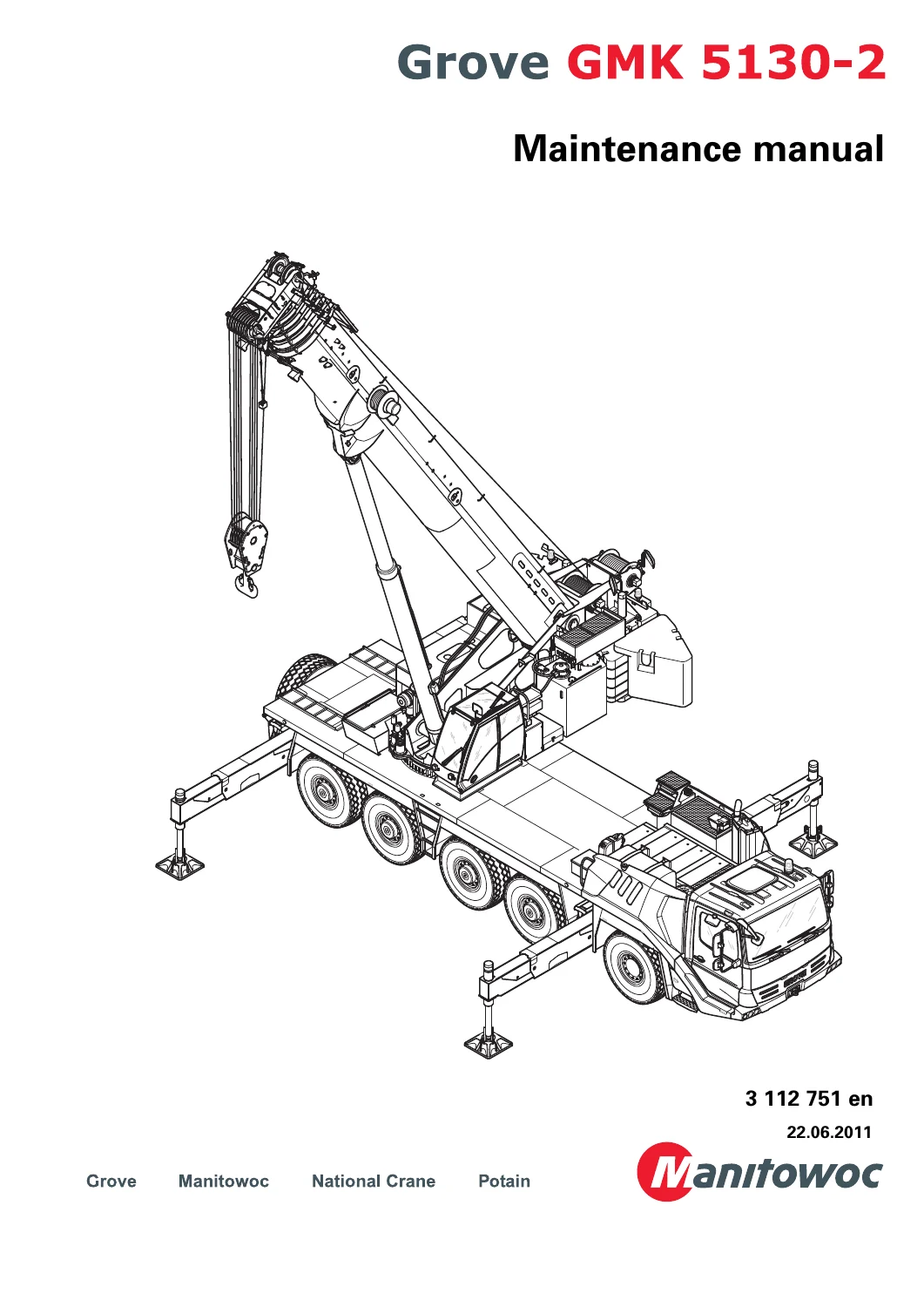

Grove GMK 5130-2 All-Terrain Mobile Crane Maintenance Manual (2011) – 3 112 751 en
Original price was: $39.95.$24.95Current price is: $24.95.
Comprehensive factory maintenance manual for the Grove GMK 5130-2 all-terrain mobile crane. Covers complete carrier and superstructure scheduled servicing, Megatrak suspension, drivetrain, hydraulics, boom telescoping, hoist winches, and torque specifications.
Description
Grove GMK 5130-2 All-Terrain Mobile Crane Maintenance Manual (2011) – 3 112 751 en
Maintain the peak operational safety, lifting precision, and long-term durability of your heavy lifting equipment with the official Grove GMK 5130-2 All-Terrain Mobile Crane Maintenance Manual (2011) – 3 112 751 en. Specifically prepared by Manitowoc Crane Group Germany GmbH for certified crane technicians, fleet managers, and independent heavy-equipment specialists, this exhaustive 320-page technical document details step-by-step preventative maintenance schedules, fluid management routines, torque requirements, and critical mechanical checks across both carrier and superstructure assemblies.
File Details
- Manual Type: Factory Maintenance Manual
- Equipment Brand: Grove / Manitowoc Crane Group Germany GmbH
- Model: GMK 5130-2 All-Terrain Mobile Crane (10x6x10 and 10x8x10 Drive Variants)
- Document Number: 3 112 751 en
- Publication Date: 22.06.2011
- Language: English
- Page Count: 320 pages
- File Format: PDF
Chapters Covered
- 1 General Notes – Using the maintenance manual; Warnings and symbols; Maintenance instructions; Notes concerning the electronic ESX control; Safety instructions for welding work; Definition of positional references; Conversion table for US measurements
- 2 Safety and Environmental Protection – Safety rules; Securing against unauthorized use; Handling substances which are harmful to the environment
- 3 Cleaning – General cleaning regulations (initial three months vs. subsequent operation); Overview of subassemblies easily damaged when cleaning
- 4 Run-In Regulations – Additional run-in maintenance for the carrier; Additional run-in maintenance for the superstructure
- 5 Maintenance Overview – Maintenance intervals; Maintenance plans (D, W, M 1, M 3, M 6, M 12, Y 2, Y 3, Y 5, Y 6, Y 10); Periodic inspections; Load hook inspection; Measures required for winch monitoring (theoretical service life calculations and logbook recording)
- 6 Lubricants and Consumables – Lubricants list; Lubricant applications and fill quantities; Refrigerants; Consumables (fuel, coolant admixtures, AdBlue urea, windscreen washer, heating fuel)
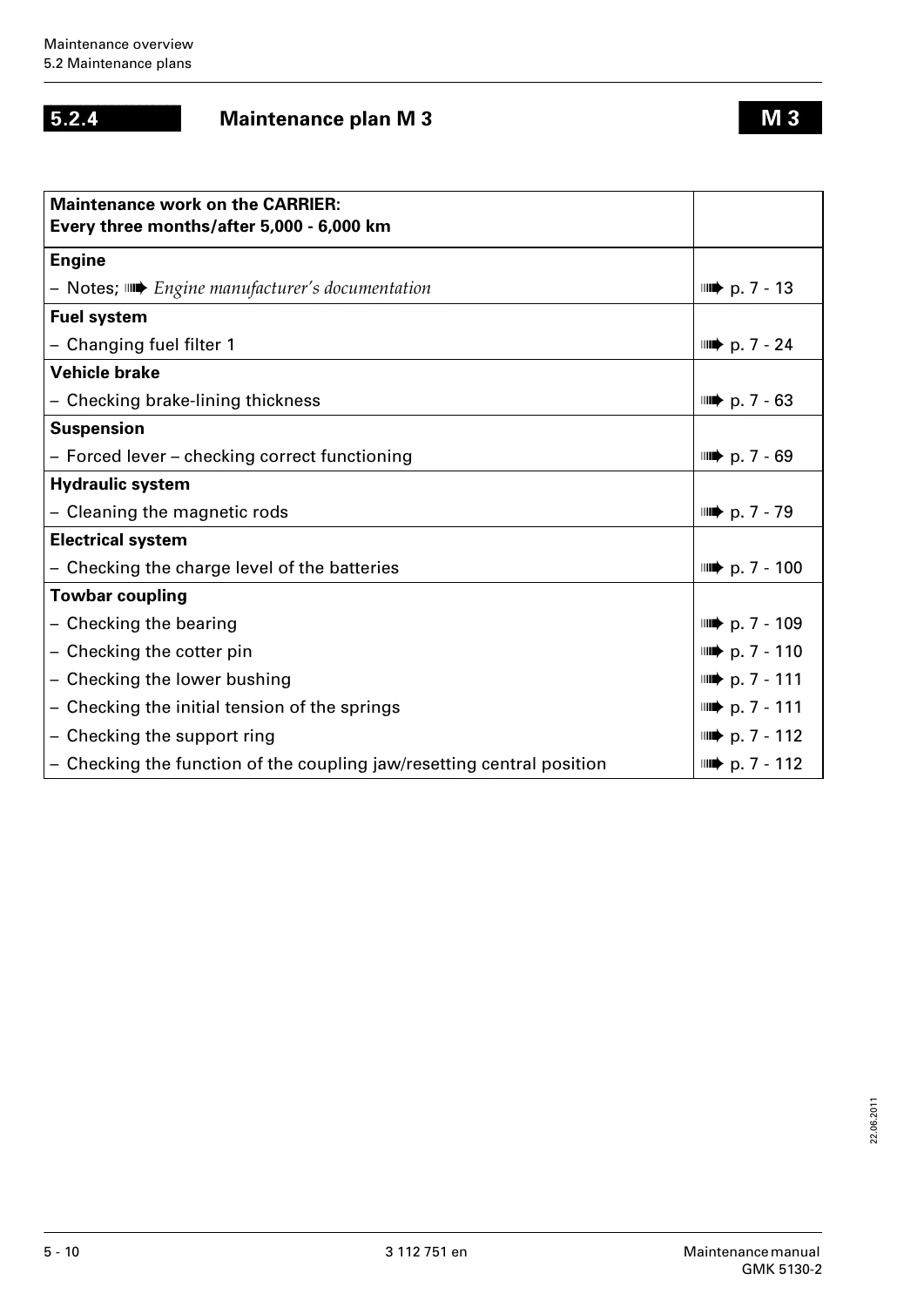
- 7 Maintenance Work on the Carrier – General instructions and covers; Consumables quality via on-board computer; Maintenance overview; Maintenance symbols; Engine checks, oil topping, drain valve retrofit, air filter, and coolant; Fuel system water drainage and dual filter replacement; Exhaust system with SCR catalytic converter and AdBlue tank; Transmission inspection, oil level check, and synthetic oil replacement; Two-stage transfer case (10x6x10 and 10x8x10); Axle lines (centre drives, final drives, and cardan shaft greasing); Wheels, tires, and 650 Nm wheel nut torquing; Vehicle drum brake lining wear inspection; Megatrak suspension struts, forced levers, and 40-bar nitrogen accumulators; Steering hydraulic leak testing and bleeding; Compressed air system drainage and air dryer desiccant cartridge replacement; Carrier hydraulic system inspection, oil sampling, ventilation filter, and fluid renewal; Central lubrication system filling and bleeding; Electrical battery care, acid siphon checks, and lighting; Air conditioning condenser cleaning, hose inspection, and R134a charging; Towbar coupling wear limits and central position alignment; Outrigger slide beam lubrication, cab doors, and socket pins
- 8 Maintenance Work on the Superstructure – General instructions and covers; Maintenance overview and ECOS display symbols; Superstructure engine checks, air filters, coolant, and oil renewal; Fuel system primary and secondary filter servicing; Hoist winches (main and auxiliary) oil inspection, brake holding test, and gear oil changing; Slewing gear inspection, pressure testing (200 bar brake check), and oil change; Ball slewing bearing gear teeth spraying, bolt retorquing, and precision tilting play measurement; Superstructure hydraulic tank, ventilation filter, pressure accumulators, oil sampling, and filter cartridge replacement; Main boom derricking cylinder piston rod lubrication, 5-stage telescopic slide face pasting (PAL1), and locking pin greasing (RHUS SW 2); Hoist ropes winding verification, wire breakage discard criteria, replacement, and lowering limit switch calibration; Cable drums and slip ring assembly cleaning; Central lubrication system; Hook block sheaves and axial bearing lubrication; Electrical lights, xenon illumination warnings, and battery maintenance; Crane cab air-conditioning system; Cab sliding door rails and connecting pins
- 9 Longer Periods Out of Service – Decommissioning procedures; Periodic bi-weekly functional runs; Preservation guidelines and recommissioning
- 10 Torques – Standard metric pre-tensioning torques (8.8, 10.9, 12.9); Special torques (suspension brackets, steering clamp straps, wheel nuts, ball slewing bearing bolts, rope wedges)
- 11 Spare Parts Required for Maintenance – Carrier lighting bulbs and superstructure lamps; Carrier consumable spare parts (filters, gaskets, brake shoes); Superstructure spare parts
- Appendix – Winch service life monitoring log tables; Ball slewing bearing tilting play measurement report sheets
Together, these eleven detailed sections provide service technicians with an uncompromising, end-to-end preventative maintenance roadmap. From initial post-delivery run-in inspections to comprehensive 10-year major overhauls, the documentation ensures all critical subsystems operate precisely to manufacturer specifications.
Rigorous Carrier Mechanical and Chassis Maintenance
The chassis maintenance chapter delivers detailed instructions for servicing both 10x6x10 and 10x8x10 GMK 5130-2 driveline configurations. Technicians are provided with complete fluid and filter service procedures for the carrier engine (requiring 38.0 liters of DB 228.5 SAE 5W-30), manual transmission (16.6 liters of synthetic DB 235.11 SAE 75W-90), two-stage transfer case (12.6 liters on 10x6x10, 14.0 liters on 10x8x10), intermediate centre axle drives, and planetary wheel hub final drives. Special attention is directed to the Megatrak independent hydropneumatic suspension, detailing the replenishment of Rivolta S.K.D. 170 gear oil in the ten suspension struts, checking suspension mounting torques up to 900 Nm, verifying the mechanical operation of forced levers, and recharging integrated nitrogen pressure accumulators to 40 bar.
Braking and pneumatic systems are thoroughly supported, including wear limit measurements for duplex and simplex brake shoe linings (recommending renewal when lining thickness reaches 6 mm or wear steps), compressed air drier cartridge replacement, and systematic condensation draining. The guide covers the full SCR exhaust emission control system, defining fill procedures for the 40-liter AdBlue urea tank, heater valve inspections, and biennial urea pump filter replacements to avoid engine output derating.
Superstructure Hydraulics, Boom Telescoping, and Winch Safety
The superstructure section addresses the high-demand lifting components that define all-terrain crane performance. Comprehensive coverage is provided for the 820-liter superstructure hydraulic system, detailing precise sampling at the control block gauge ports to analyze ISO-VG 32 viscosity, Vi index (≥ 150), contamination thresholds (NAS 1638 Class 7 / ISO 4406 18/16/13), and moisture levels (≤ 100 ppm) before scheduling fluid renewal. Procedures outline dual filter element replacement, magnetic rod de-sludging, and multi-stage air bleeding.
For the five-section telescopic boom, the manual specifies exact lubrication protocols for slide faces using PAL1 paste applied via brush or pressurized spray gun, and internal locking pin lubrication using RHUS SW 2 grease. Winch monitoring instructions mandate theoretical service life tracking (power unit group M3, load spectrum L1, factor Km = 0.125, theoretical life 3,200 hours) to prevent catastrophic fatigue failure. Hoist rope evaluation protocols cover visible wire break cluster limits across regular lay and lang lay ropes, diameter necking thresholds (≥ 10% to 15%), and mechanical adjustment of the five-turn drum lowering limit switches.
Ball Slewing Ring Care and Specialized Torques
Slewing system longevity is secured through detailed maintenance routines for the twin slewing gearboxes, hydraulic brake pressure testing to 200 bar, and open-gear drive tooth lubrication using Ceplattyn 300 adhesive spray. A dedicated procedure explains how to set up a dial gauge (precision 0.01 mm) on the turntable with a 28.5 t counterweight and 50-50-50-50-0 boom configuration to measure slewing ring tilting play across four 90-degree quadrant angles (-135°, -45°, +45°, +135°), establishing wear limits against the 3.2 mm factory maximum. Complete torque tables provide tightening specifications for M16 through M36 hardware, including 650 Nm wheel nuts, 79 Nm rope clamps, and 1,395 Nm (manual wrench) / 1,550 Nm (hydraulic tool) slewing bearing retaining bolts.
Professional Capability and Instant PDF Delivery
Owning the Grove GMK 5130-2 All-Terrain Mobile Crane Maintenance Manual (2011) – 3 112 751 en gives crane owners, rigging contractors, and service workshops complete technical independence. Adhering to manufacturer maintenance schedules and exact torque values safeguards your multi-million dollar asset against unexpected jobsite breakdowns, protects operator safety, maintains warranty validity, and upholds certified lifting compliance. Delivered as an instant high-resolution PDF download immediately upon checkout, this digital manual contains zero waiting time and no shipping delays. Store it directly on your laptop, field tablet, or smartphone for immediate access in the workshop or cab, or print hard-copy job cards for technical crews on site.




Reviews
There are no reviews yet.