
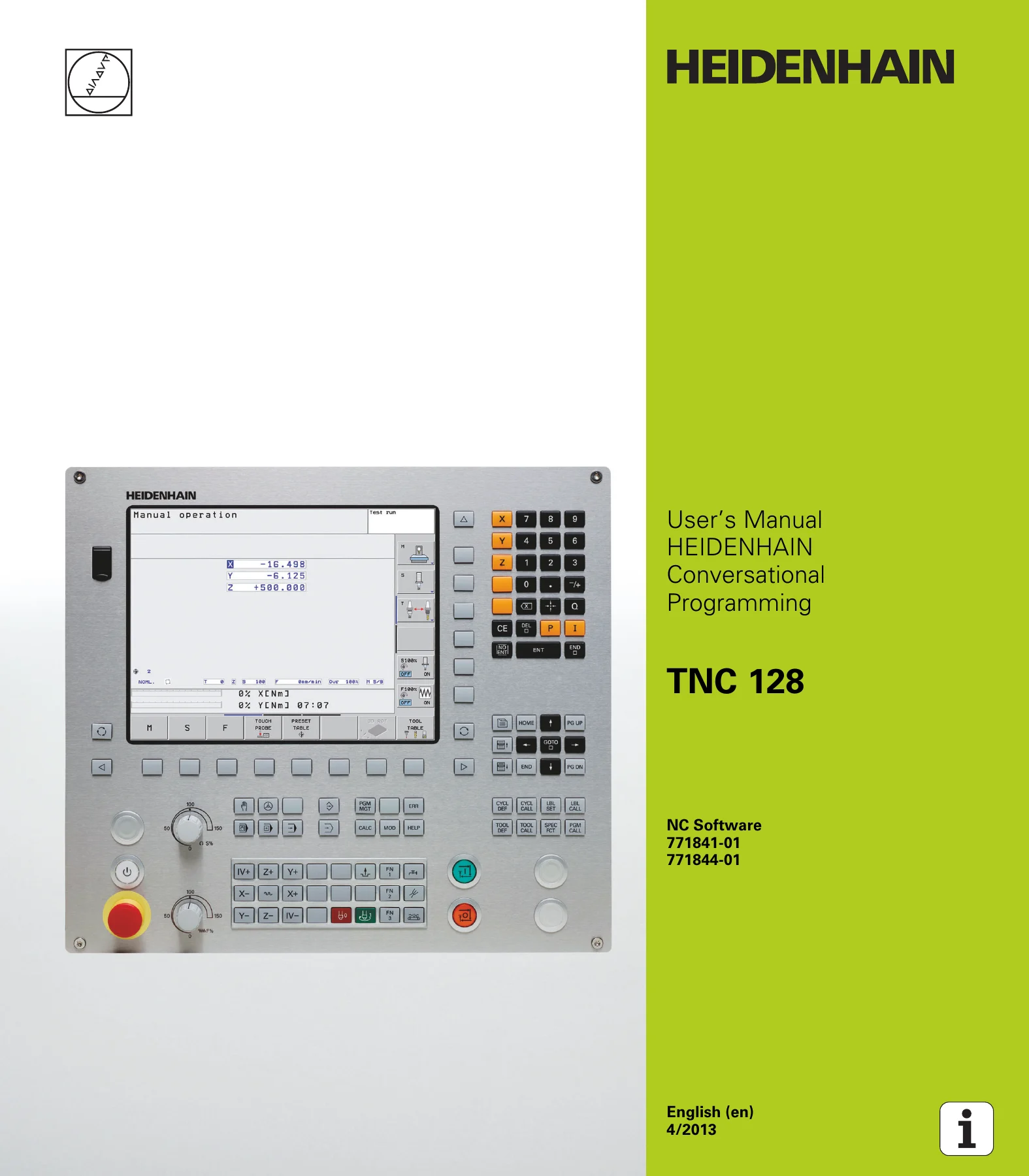
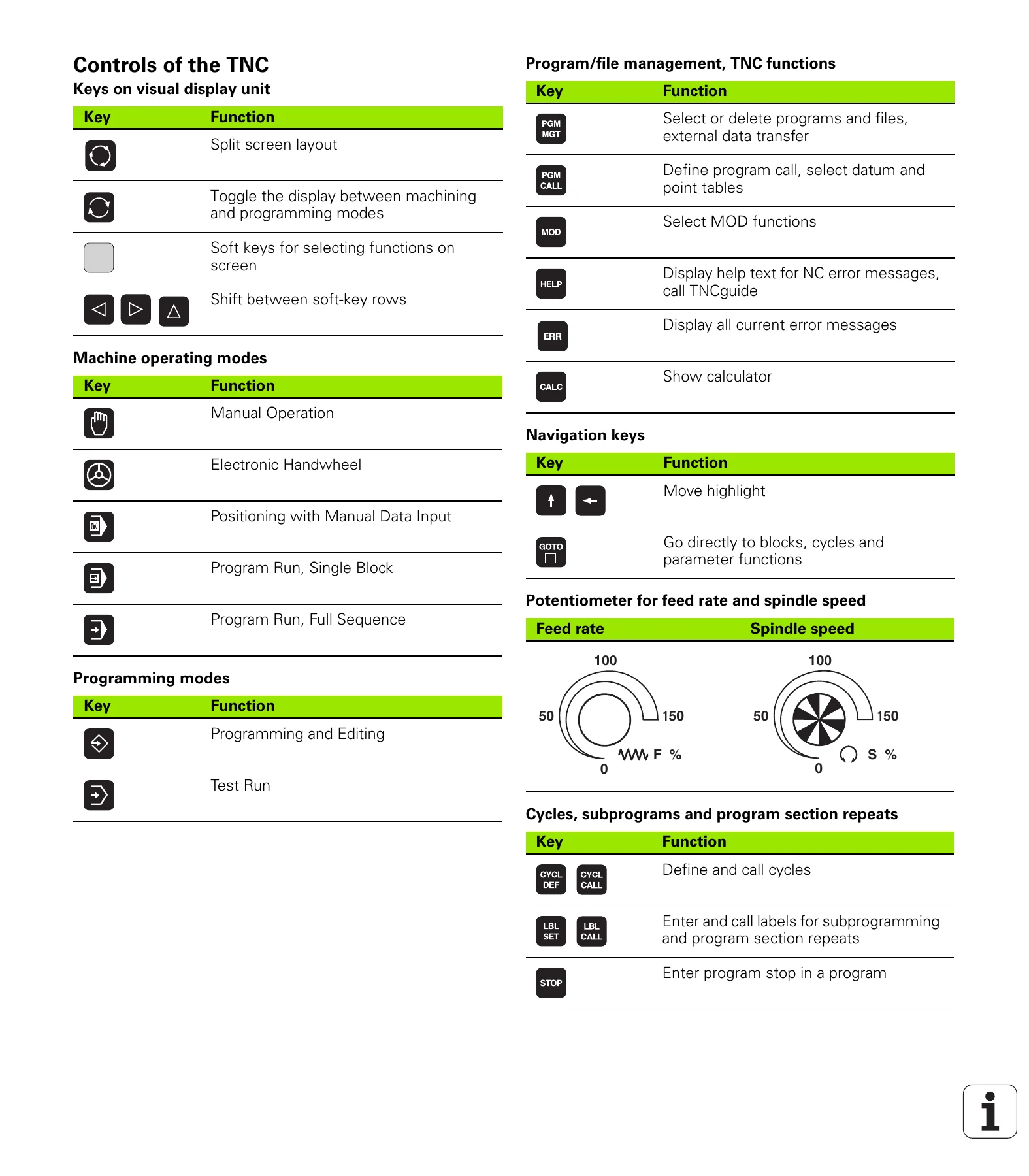
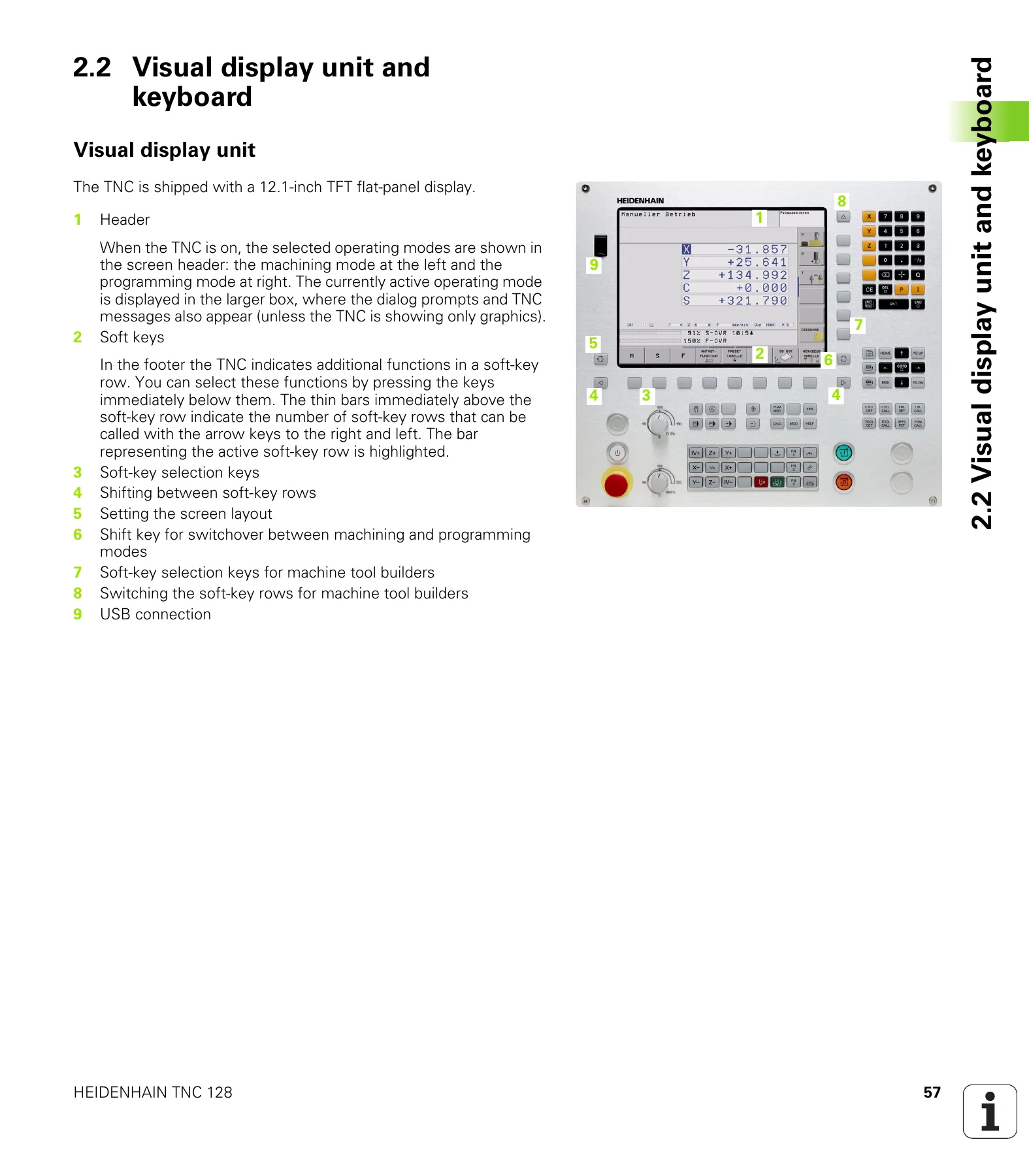
HEIDENHAIN TNC 128 Conversational Programming User’s Manual – 2013 PDF Edition
Original price was: $39.95.$24.95Current price is: $24.95.
Complete 505-page HEIDENHAIN TNC 128 Conversational Programming User’s Manual (doc. 819494-20, 4/2013, NC software 771841-01 / 771844-01). Covers programming fundamentals, file management, tool data, Q parameters, fixed cycles, coordinate transformations, touch probe cycles, manual operation, test run and program run, and MOD functions.
Description
HEIDENHAIN TNC 128 Conversational Programming Manual – File Details
- Manual type: User’s Manual – Conversational Programming
- Brand: HEIDENHAIN
- Control model: TNC 128
- NC software: 771841-01 (TNC 128); 771844-01 (TNC 128 Programming Station)
- Document number: 819494-20
- Edition / date: Ver00, SW01, 4/2013
- Language: English (en)
- Page count: 505 pages
- File format: PDF
Chapters Covered in This TNC 128 Programming Manual
- First steps with the TNC 128 – machine switch-on, programming the first part, graphical testing, tool setup, workpiece setup, running the first program
- Introduction – the TNC 128, HEIDENHAIN conversational format, visual display unit and keyboard, operating modes, status displays, window manager, 3-D touch probes and electronic handwheels
- Programming: Fundamentals, file management – position encoders and reference marks, reference systems, absolute and incremental positions, datum setting, BLK FORM workpiece blank, creating and editing programs, search function, file manager, data transfer, network and USB devices
- Programming: Programming aids – screen keyboard, comments, program structuring, integrated calculator, programming graphics, error messages, context-sensitive help system (TNCguide)
- Programming: Tools – feed rate F, spindle speed S, tool numbers and names, tool length and radius, delta values, TOOL DEF and the tool table, calling tool data, tool change, length and radius compensation
- Programming: Tool movements – paraxial positioning blocks, radius compensation, miscellaneous functions M
- Subprograms and program section repeats – labels, nesting, separate program as subprogram
- Q parameters – basic arithmetic, trigonometric functions, circle calculations, if-then decisions, checking and changing Q parameters, FN 14 to FN 37, SQL table access, entering formulas directly, string parameters, preassigned Q parameters
- Miscellaneous functions – M91/M92 machine-referenced coordinates, M94, M103, M136, M140, M141
- Special functions – freely definable tables, file functions, TRANS DATUM coordinate transformations, text files
- Manual operation and setup – switch-on and switch-off, moving machine axes, spindle speed, feed rate and M functions, datum setting without a touch probe, preset table, calibrating and using the 3-D touch probe
- Positioning with manual data input (MDI) – programming and executing simple machining operations in $MDI
- Test run and program run – graphics display modes, workpiece blank in the working space, test run, program run, interrupting and resuming, mid-program startup, optional block skip
- MOD functions – software numbers, code numbers, RS-232 data interface settings, Ethernet interface, position display types, unit of measurement, operating times
- Fundamentals of cycles – available cycle groups, working with fixed cycles, PATTERN DEF, POLAR PATTERN (220), CARTESIAN PATTERN (221), point tables
- Drilling, boring and thread cycles – CENTERING (240), DRILLING (200), REAMING (201), BORING (202), UNIVERSAL DRILLING (203), BACK BORING (204), UNIVERSAL PECKING (205), SINGLE-LIP DEEP-HOLE DRILLING (241), TAPPING NEW (206), RIGID TAPPING NEW (207)
- Fixed cycles: Pocket milling / stud milling / slot milling – RECTANGULAR POCKET (251), RECTANGULAR STUD (256)
- Cycles: Coordinate transformations – DATUM SHIFT (7), DATUM SHIFT with datum tables, DATUM SETTING (247), MIRROR IMAGE (8), SCALING FACTOR (11), AXIS-SPECIFIC SCALING (26)
- Cycles: Special functions – DWELL TIME (9), PROGRAM CALL (12), ORIENTED SPINDLE STOP (13)
- Touch probe cycles – general information, touch probe table, fundamentals of tool measurement, calibrating the TT (480), calibrating the wireless TT 449 (484), measuring tool length (481), radius (482) and both (483)
- Tables and overviews – machine-specific user parameters, pin layouts and connecting cables, technical information, input ranges, fixed cycle and M function overview tables
The HEIDENHAIN TNC 128 Conversational Programming User’s Manual is the reference that ships with the TNC 128 workshop-oriented straight cut control, written for milling, drilling and boring machines with up to three axes. Across 505 pages it takes a programmer from the first switch-on and the first BLK FORM workpiece blank definition through to multi-level subprogram nesting, parametric Q-parameter programming with SQL table access, and fully defined drilling, pocket and coordinate transformation cycles. Everything in the manual is written in the HEIDENHAIN plain-language conversational format, with the corresponding soft-key dialogs, NC block examples and parameter tables reproduced block by block so the same code can be entered at the control.
What a Programmer Gets From This TNC 128 Manual
The first third of the book establishes the programming foundation: the Cartesian reference system and how the TNC 128 assigns tool, principal and secondary axes, absolute versus incremental dimensioning, reference mark crossing on switch-on, and the structure every HEIDENHAIN conversational program follows from BEGIN PGM through END PGM. File management is treated in full detail, including directories and paths, copying and tagging files, protecting programs, importing tool tables, data transfer to external media, network drives and USB devices.
Tool handling is documented right down to the column abbreviations used in the TOOL.T table – L, R, R2, DL, DR, DR2, LCUTS, ANGLE, TL, RT, TIME1, TIME2, CUR_TIME, TYPE, DOC, PLC, PTYP, TP_NO, T_ANGLE, LAST_USE – together with the separate columns required for automatic tool measurement (CUT, LTOL, RTOL, R2TOL, DIRECT., R_OFFS, L_OFFS, LBREAK, RBREAK). Tool length and radius compensation formulas are given explicitly, including how delta values from the TOOL CALL block and the tool table combine.
Parametric programming occupies a substantial chapter: FN 0 through FN 5 arithmetic, FN 6 through FN 13 trigonometry and angle calculation, FN 23 and FN 24 circle data from three or four points, the FN 9 to FN 12 conditional jumps, and the less common FN 14 error messages, FN 16 formatted print output, FN 18 system data read, FN 19 and FN 29 PLC transfer, FN 20 NC/PLC synchronization and FN 37 export. The SQL section covers BIND, SELECT, FETCH, UPDATE, INSERT, COMMIT and ROLLBACK with worked NC block examples, and the string parameter section covers DECLARE STRING, concatenation, TOCHAR, SUBSTR, TONUMB, INSTR, STRLEN, STRCOMP and CFGREAD.
Cycles, Touch Probes and Program Run
The cycle portion of the manual is effectively a second reference inside the same file. Each drilling, boring, pecking and tapping cycle is presented with its cycle run sequence, programming notes, a full parameter list with input ranges, and a commented NC block example – for instance the parameter sets for Cycle 200 DRILLING, Cycle 203 UNIVERSAL DRILLING with decrement and chip breaking, Cycle 205 UNIVERSAL PECKING with deepened starting point, and Cycle 241 SINGLE-LIP DEEP-HOLE DRILLING with separate entry and exit spindle speeds. Pocket and stud machining is covered by Cycle 251 and Cycle 256 with roughing, floor finishing and side finishing alternatives, path overlap factor and climb or up-cut selection.
Coordinate transformations, PATTERN DEF point patterns, POLAR PATTERN and CARTESIAN PATTERN, and point tables with the FADE column are all documented, along with the full set of machine-referenced and contouring M functions – M91, M92, M94, M103, M136, M140 and M141. The touch probe chapter covers the touch probe table abbreviations, the DIST, SET_UP, F, FMAX, F_PREPOS and TRACK settings, calibration of a cable-connected or infrared probe, datum setting in any axis, circle center and center line datums, workpiece measurement with a 3-D touch probe, and the TT tool measurement cycles 480, 481, 482, 483 and 484 including the spindle speed and probing feed rate formulas.
Around the programming content sit the operational chapters: Manual Operation and Electronic Handwheel, Positioning with Manual Data Input, Test Run with plan view, three-plane projection and 3-D view plus detail magnification and machining time measurement, Program Run Full Sequence and Single Block, mid-program startup, returning to the contour, and the MOD functions for software numbers, code numbers, serial and Ethernet interface settings, position display types, units and operating times. The closing chapter reproduces the machine-specific user parameter list and the technical information tables, including input format and unit ranges for positions, tool numbers, spindle speeds, feed rates, dwell times, scaling factors, labels and repeat counts.
Who This HEIDENHAIN TNC 128 Manual Is For
Machine operators setting up a TNC 128 for the first time will find the step-by-step first-part walkthrough, the datum setting procedures and the touch probe calibration routines. Programmers writing conversational code at the control will use the cycle parameter tables, the Q-parameter function reference and the NC block examples as a working look-up. Workshop owners and maintenance staff get the interface pin layouts, the machine parameter tree and the error message and log file procedures in the same document.
Having the correct parameter names, input ranges and dialog sequences on hand matters on a control like the TNC 128, where a single wrong Q-parameter reference or a mis-set 2nd set-up clearance changes the machining result. This manual supplies those values as HEIDENHAIN published them for NC software 771841-01 and 771844-01, rather than as second-hand notes.
IMAGES PREVIEW
Delivered as an instant PDF download after payment – no shipping, no waiting. The file opens on any computer, tablet or phone, can be printed for the shop floor, and can be searched on screen for a cycle number, Q parameter or error code while you are standing at the machine.
Reviews
There are no reviews yet.