
Hitachi ZX470-7 ZX670-7 ZX870-7 Hydraulic Excavator Operator’s Manual – ENMJAQ-EN1-1
Original price was: $29.95.$18.95Current price is: $18.95.
Complete English-language operator’s manual for the Hitachi ZX470-7, ZX670-7 and ZX870-7 class hydraulic excavators (including ZX490LCH-7, ZX530LCH-7, ZX690LCH-7, ZX690LCR-7, ZX890LCH-7 and ZX890LCR-7). Covers machine operation, safety, monitoring, maintenance intervals, specifications, hydraulic circuits and troubleshooting in one instant-download PDF.
Description
The Hitachi ZX470-7, ZX670-7 and ZX870-7 Hydraulic Excavator Operator’s Manual is the full factory operating guide for three large Hitachi excavator families in a single document, published under manual part number ENMJAQ-EN1-1. Everything an operator, fleet manager or site technician needs to run, move, load, maintain and troubleshoot these machines safely is gathered here in one English-language PDF. Whether you are sitting in the cab of a ZX490LCH-7 for the first time or keeping a mixed fleet of ZX690LCR-7 and ZX890LCH-7 machines working, this is the reference that stays with the machine.
File Details
- Manual type: Operator’s Manual (Original Instruction)
- Brand: Hitachi Construction Machinery
- Manual part number: ENMJAQ-EN1-1
- Publisher: Hitachi Construction Machinery (Europe) N.V., Amsterdam, The Netherlands
- Language: English
- File format: PDF
- Approximate page count: 654
- Models covered: ZX470-7 class (ZX490LCH-7, ZX530LCH-7), ZX670-7 class (ZX690LCH-7, ZX690LCR-7), ZX870-7 class (ZX890LCH-7, ZX890LCR-7)
Chapters Covered
- Machine Numbers – product identification number locations on the machine, engine, travel motor, swing motor, hydraulic pump, cab, boom, arm and bucket
- Intended Use – design purpose, approved attachments, modification policy and warranty position
- Safety (S-1 to S-54) – signal words, protective clothing, cab precautions, seat belt use, travel and swing safety, lifting applications, high-pressure fluids, fire prevention, battery handling, aftertreatment warnings, communication terminal precautions, ROPS notes and visibility maps
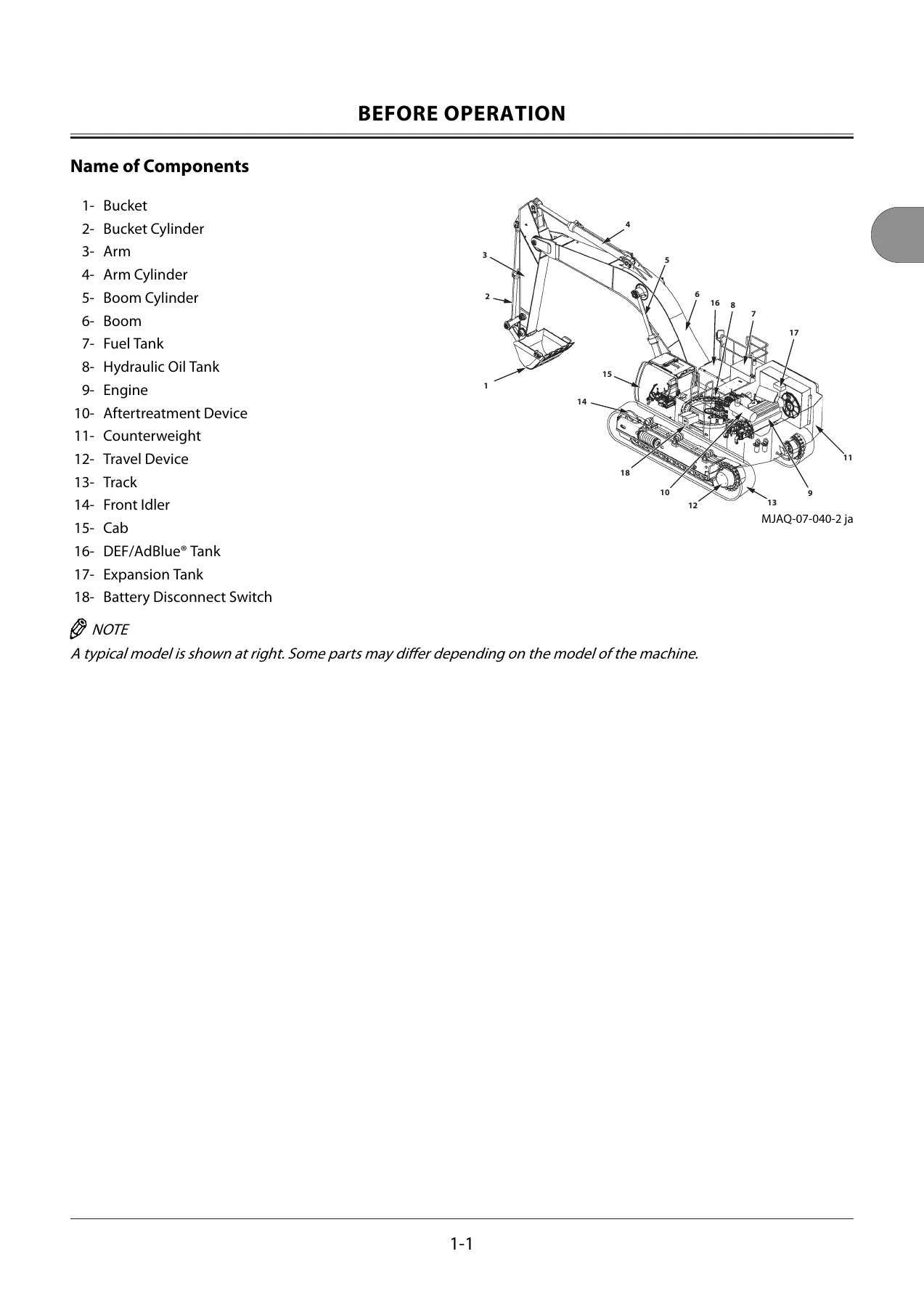
- Before Operation – component names and locations, getting on and off the machine, aftertreatment device overview
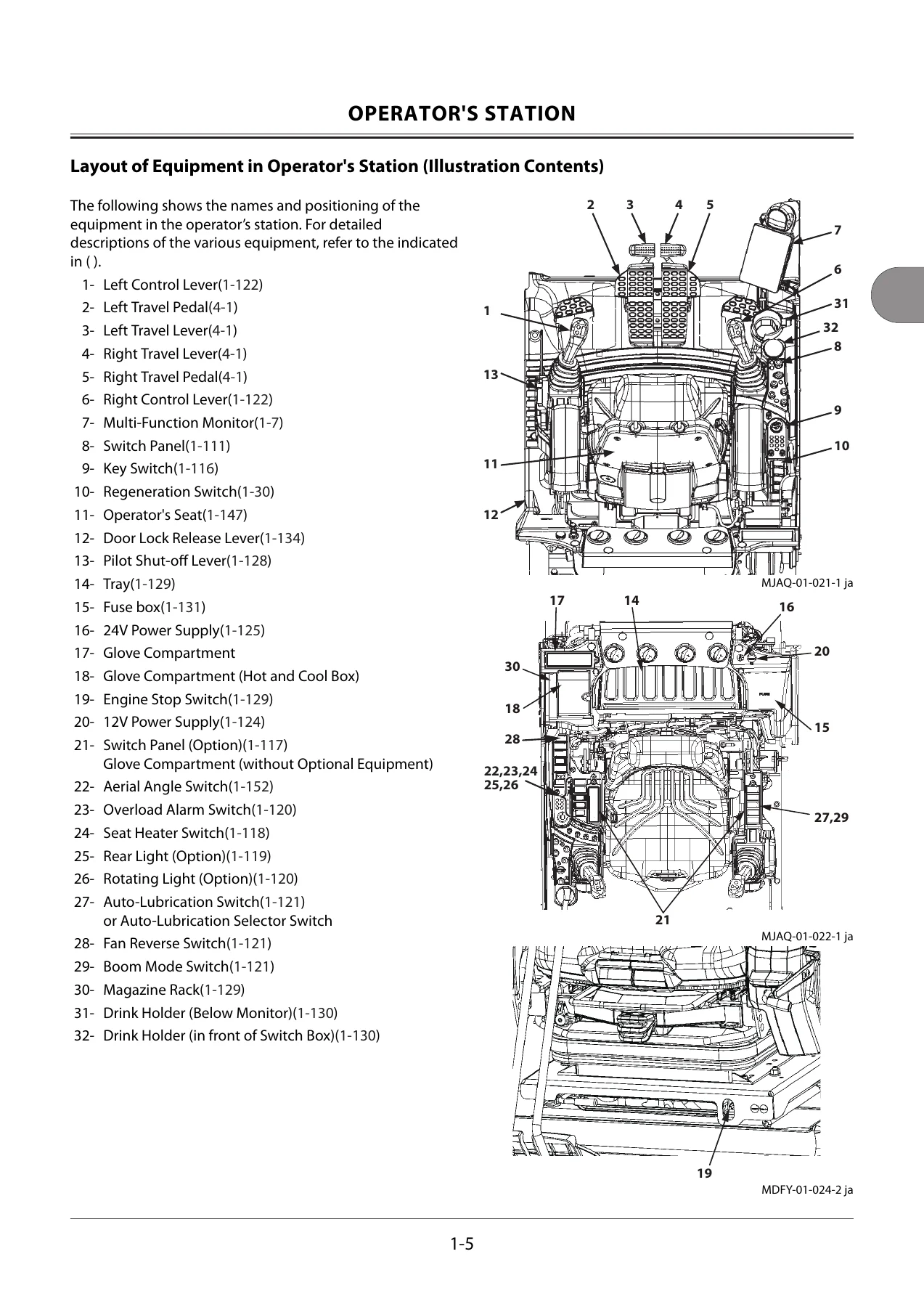
- Operator’s Station – multi-function monitor and switch panel, air conditioner, audio system, key switch, pilot shut-off lever, wipers and washers, fuse boxes, cab door and window operation, seat and console adjustment, seat belt, aerial angle (surround view) camera system, mirror adjustment, emergency exit, battery disconnect switch
- Break-In – first 50 and first 100 hour operating and service guidance
- Operating the Engine – daily checks, starting at normal and cold temperatures, checking instruments, jump starting with a booster battery, stopping the engine, auto shut-down at extremely low temperatures
- Driving the Machine – travel levers and pedals, travel mode switch, soft ground operation, raising a track with the boom and arm, retrieval, water and mud operation, parking on slopes, high-speed travel precautions
- Operating the Machine – control lever patterns (ISO and H-type), warming-up procedure, engine speed control, auto-idle, auto shut-down, aftertreatment manual regeneration, attachment selection, power boost, power modes (ECO, PWR, H/P), backhoe and grading technique, pilot accumulator and hydraulic pressure release, lowering the boom in an emergency
- Transporting – road transport, loading and unloading on a trailer, fastening chains and cables, lifting the machine, exhaust pipe for transport
- Maintenance (7-1 to 7-246) – complete inspection and maintenance interval tables, greasing points, engine oil and filter change, transmission and gear oils, hydraulic oil and full-flow, drain, pilot and air breather filters, fuel main and pre-filter replacement, air cleaner service, cooling system and coolant change, air conditioner service, electrical system and battery, bucket teeth and linkage adjustment, track sag adjustment, seat belt replacement, torque tables for every major fastener group, aftertreatment device checks, DEF/AdBlue SCR system service, aerial angle camera checks
- Hydraulic Circuit – hydraulic schematics for the ZX470-7, ZX670-7 and ZX870-7 classes
- Maintenance Under Special Environmental Conditions – muddy, rainy, snowy, coastal, dusty, rocky, falling-stone and freezing-weather operation
- Storage – storing the machine and precautions before restarting after long-term storage
- Troubleshooting – engine auxiliaries, starting problems, control levers, hydraulic system, drive function, swing function, engine speed and pump control symptoms with causes and remedies
- Specifications – dimensions, working ranges, shoe types, bucket types, engine power and CO2 emission values for each class
- Optional Attachments and Devices – switchable automatic or manual lubricator, fuel feed device with filter, control levers (H type), attachment pedal for breaker and crusher, hydraulic breakers and crushers, three-way valve operation, breaker and crusher operation precautions
- Index – alphabetical symbol index
What makes this document genuinely useful is the way it was put together for the whole family at once. Rather than a single model walkthrough, the manual carries parallel specifications, working ranges, shoe and bucket charts and torque tables for six machine variants, so a workshop with a ZX490LCH-7 on one side and a ZX890LCR-7 on the other can use the same reference for both. The maintenance chapter is built around illustrated interval tables, and the torque tables cover everything from engine cushion rubber mounting bolts to swing bearing and track shoe fasteners, which means the correct value for a specific joint is never more than a page away. The troubleshooting chapter is organised by symptom – no hydraulic functions, only one actuator inoperable, upperstructure does not swing, engine speed will not change – and lists the likely cause and the corrective action so a machine can be brought back into service quickly. The dedicated aftertreatment and DEF/AdBlue sections reflect the emission-control systems fitted to these machines and explain manual regeneration, regeneration inhibit and fluid handling in plain terms.
What This Manual Enables You to Do
This Hitachi ZX470-7 ZX670-7 ZX870-7 operator manual supports the practical daily jobs that keep a large excavator productive: correctly pre-start checking the machine, starting it in cold weather, selecting the right power mode for the work, understanding the multi-function monitor and its alarms, using the aerial angle surround-view system, and shutting the machine down the right way. It also covers the tasks that protect the machine long-term – greasing the right pins at the right interval, changing hydraulic oil and filters on schedule, replacing fuel filter elements, bleeding the fuel system after a filter change, adjusting track sag, checking bucket teeth and O-rings, and reading the torque tables before tightening anything structural. For the site technician or owner-operator handling their own maintenance, this is the level of detail that prevents a small oversight turning into a hydraulic pump failure or a premature aftertreatment fault.
Why Correct Information Matters Here
Large excavators are unforgiving machines. Operating on a slope steeper than the manual allows, running with the wrong hydraulic oil interval, or striking the ground with the bucket teeth all carry consequences that show up weeks later as cracks, leaks or premature component wear. Having the actual Hitachi procedures and specification figures on hand means the right torque, the right fluid, the right interval and the right operating limit are used every time, rather than guessed at. The safety chapter is written to be read before the machine is started, not after an incident, and the visibility maps and ROPS notes are specific to these model classes.
IMAGES PREVIEW
Instant PDF Delivery
The manual is delivered as a downloadable PDF immediately after purchase. There is no shipping, no waiting and no physical binder to lose. The file can be opened on a laptop, tablet or smartphone, so it is available on the job site, in the service bay or back at the office. Pages can be printed whenever a paper copy is more practical – a torque table taped to the workshop wall, a maintenance schedule in the cab, or a safety checklist for a new operator. Once downloaded, the file is yours to keep and reference for the life of the machine.


Reviews
There are no reviews yet.