
Honda XRV750T Shop Manual 1995 Service Repair PDF Download
Original price was: $44.95.$27.95Current price is: $27.95.
Complete 468-page Honda XRV750T Shop Manual dated December 1995, covering maintenance, 742 cm3 V-twin engine service, fuel and cooling systems, transmission, suspension, hydraulic brakes, electrical systems, wiring and troubleshooting.
Description
Honda XRV750T Shop Manual – complete service coverage
This Honda Shop Manual is dedicated to the XRV750T and is organized as a workshop reference from basic model identification through complete mechanical, chassis and electrical service. The manual combines step-by-step service procedures with specifications, standard values, service limits, torque information, routing details, wiring diagrams and troubleshooting. It is especially useful when a repair moves beyond routine maintenance and the technician needs the correct sequence, measurement or adjustment for the XRV750T rather than a generic motorcycle procedure.
File Details
- Manual type: Honda Shop Manual
- Brand/model: Honda XRV750T
- Language: English
- Pages: 468
- File format: PDF
- Date of issue: December 1995
Identify the motorcycle before starting work
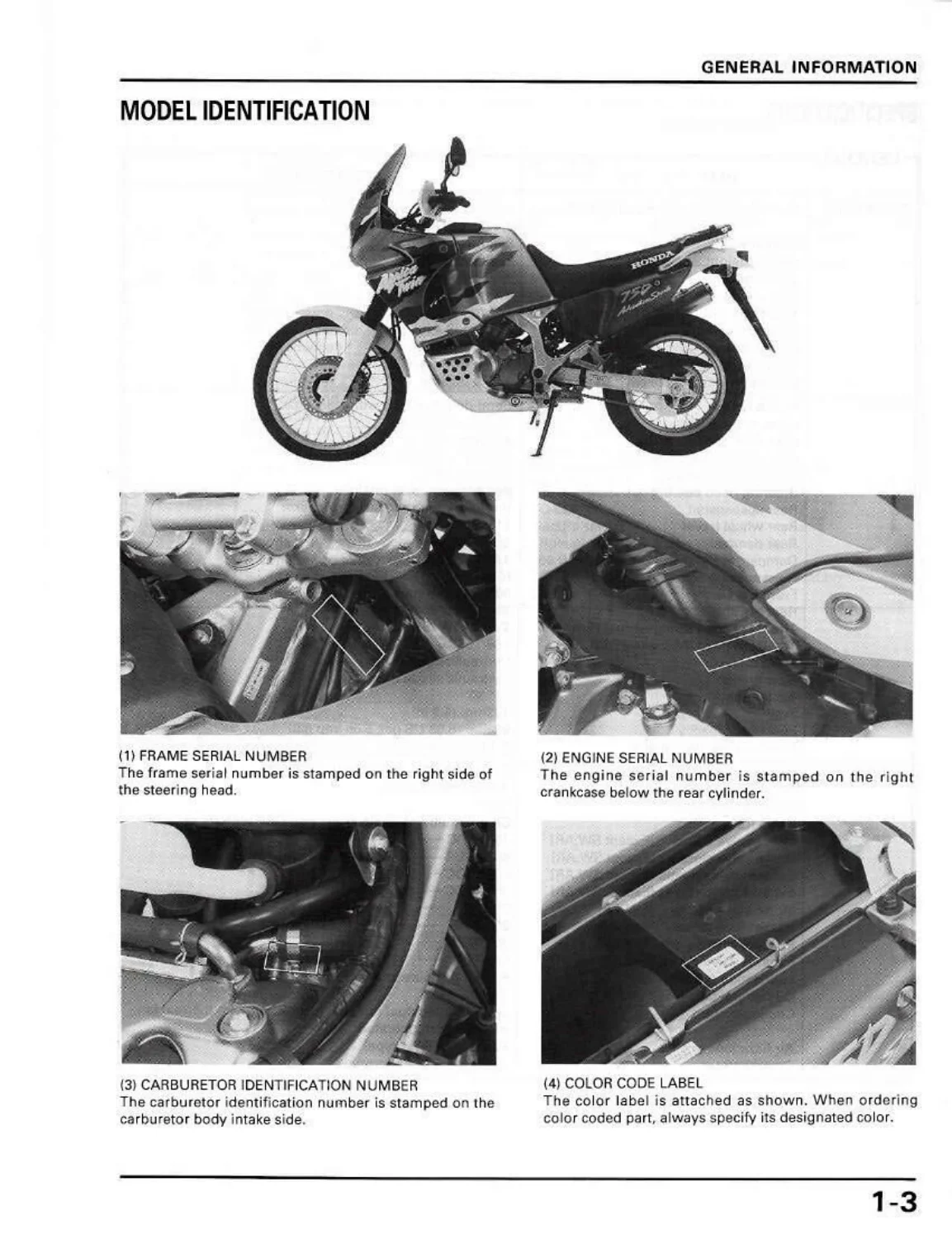
The opening general-information section is practical rather than ceremonial. It shows where the frame serial number, engine serial number, carburetor identification number and color-code label are located on the motorcycle. The manual also distinguishes market type codes used throughout the procedures: ED for European direct sales, E for U.K., F for France, G for Germany full power, GII for Germany 50 PS limited, ND for North Europe, SW for Switzerland and AR for Austria. Those distinctions matter because several specifications and electrical or carburetion settings differ by type.
The same opening section establishes service rules, general safety, torque values, tools, lubrication and seal points, plus cable and harness routing. That makes it a useful starting point before dismantling: you can verify the variant, check the required value and see where lines or wiring should sit when the machine goes back together.
Chapters Covered
- 1. General Information – general safety, service rules, model identification, specifications, torque values, tools, lubrication and seal points, cable and harness routing.
- 2. Frame/Body Panels/Exhaust System – body and frame-mounted parts, panels and exhaust-system service.
- 3. Maintenance – scheduled inspection, adjustment and routine service procedures.
- 4. Lubrication System – engine lubrication, oil pressure, oil-pump inspection and related service data.
- 5. Fuel System – dual carburetors, fuel delivery, jetting, pilot-screw settings, float level, synchronization and idle adjustment.
- 6. Cooling System – coolant, radiator, thermostat, fan-related service and cooling-system checks.
- 7. Engine Removal/Installation – procedures for removing and refitting the engine assembly.
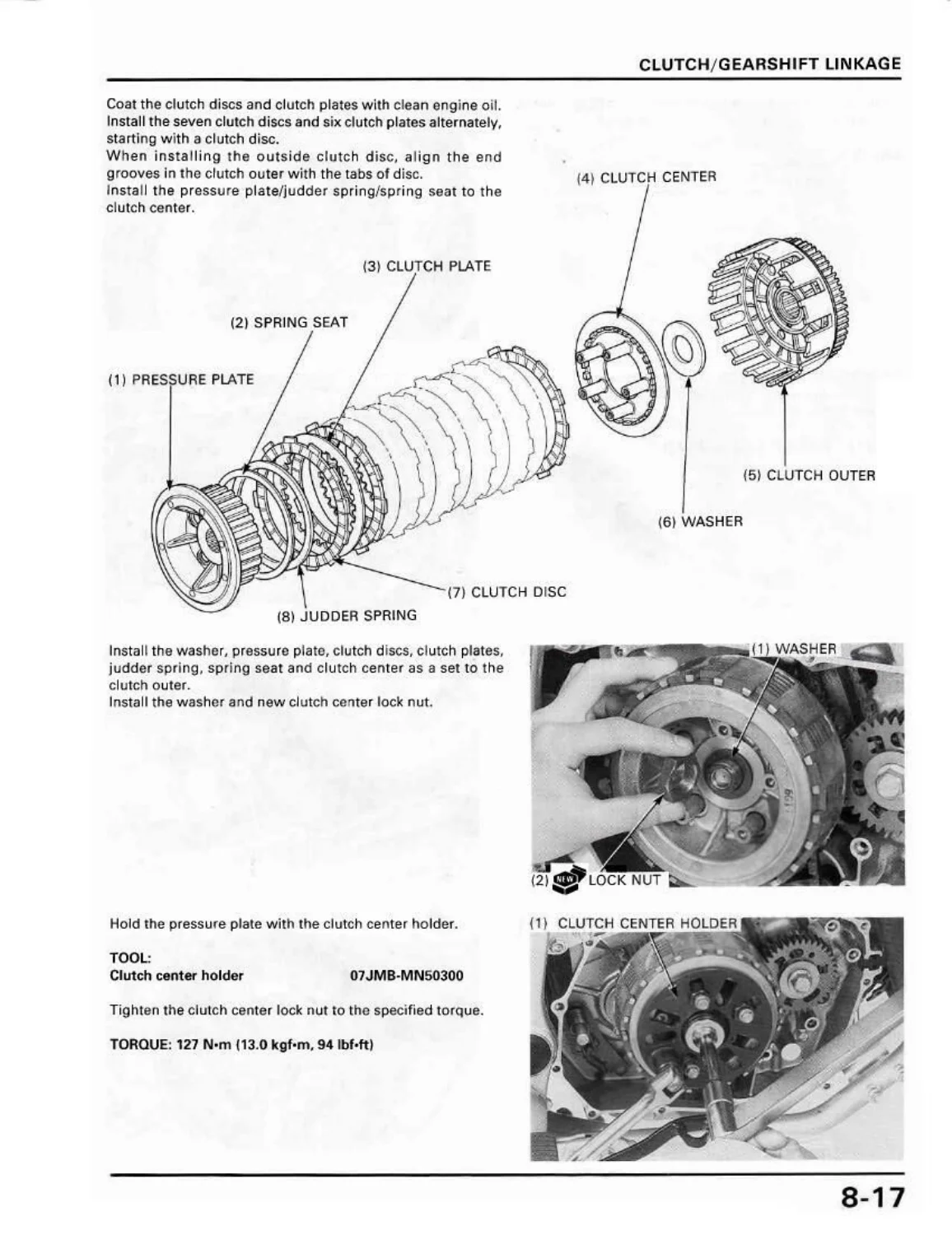
- 8. Clutch/Gearshift Linkage – clutch parts, clutch adjustment and gearshift-linkage service.
- 9. Alternator/Starter Clutch – alternator and starter-clutch inspection and service.
- 10. Cylinder Head/Valves – cylinder-head service, valve clearances, guides, seats, springs, camshaft and rocker components.
- 11. Cylinder/Piston – cylinder dimensions, pistons, rings, clearances and service limits.
- 12. Crankshaft/Transmission – crankshaft and transmission disassembly, inspection and gear-train service.
- 13. Front Wheel/Suspension/Steering – front wheel, 43.0 mm telescopic fork, steering and related measurements.
- 14. Rear Wheel/Suspension – rear wheel, Pro-Link rear suspension, shock absorber and drive-chain service.
- 15. Hydraulic Brake – front double-disc and rear single-disc hydraulic brake service.
- 16. Battery/Charging System – battery and charging-system checks.
- 17. Ignition System – ignition-system testing and service, including type-dependent system information.
- 18. Electric Starter – starter circuit and starter-motor service.
- 19. Lights/Meters/Switches – lighting, instruments, meters and switch circuits.
- 20. Wiring System – wiring information and diagrams.
- 21. Troubleshooting – fault-finding guidance for locating service problems.
Taken together, the chapters cover the complete path from identifying the exact XRV750T type and carrying out scheduled maintenance to opening the engine, servicing the transmission and suspension, rebuilding hydraulic brake components and tracing electrical faults. The organization also makes it possible to move between a procedure and the specification or limit needed to judge the part being inspected.
Useful XRV750T service data at the bench
The specification pages are unusually valuable because they collect both general machine data and detailed service standards. The engine is listed as a 742 cm3, 52-degree V-twin with an 81.0 x 72.0 mm bore and stroke and a 9.0:1 compression ratio. The manual gives a wet multi-plate clutch, five-speed constant-mesh transmission and type-dependent final-drive ratios, along with gear ratios from first through fifth. Fuel-system data identifies 36 mm constant-velocity dual carburetors and provides type-specific carburetor codes, main and slow jets, pilot-screw positions, float level, carburetor vacuum difference and idle speed.
Lubrication data includes 2.4 litres for an oil drain, 2.6 litres with an oil-filter change and 3.2 litres after disassembly, together with the specified oil classifications and SAE 10W-40 viscosity. Cooling data gives 2.03 litres for radiator and engine plus 0.4 litre for the reserve tank, a thermostat opening range of 80-84 C and a 50 percent coolant mixture with soft water. Cylinder-head pages include compression, valve clearances, camshaft dimensions, valve guides, seats, springs and rocker-arm service values, while the cylinder/piston pages carry measurement points and wear limits.
Chassis, suspension, brakes and electrical work
The manual is equally detailed away from the engine. It lists a 43.0 mm front-fork inner-tube diameter, 220 mm front-wheel travel, 214 mm rear-wheel travel and a Pro-Link rear suspension with a gas-filled shock absorber. Front fork fluid capacity is 648 cm3 per leg and the rear shock reservoir is specified with nitrogen gas pressure. Tyre sizes, cold pressures, drive-chain slack and chain identification are included in the chassis specifications. Brake coverage matches the motorcycle’s hydraulic double-disc front and single-disc rear arrangement, so inspection and repair can be referenced against the actual XRV750T configuration.
Electrical chapters continue through the battery, alternator, ignition, starter, lights, meters, switches and complete wiring section. The general specifications identify a triple-phase output alternator rated at 360 W at 5,000 min-1, while ignition type differs for some market versions. That type-sensitive information is one reason the model-identification pages are worth checking before testing or replacing components.
Why this manual is worth having
Use this XRV750T Shop Manual when you need to service carburetors, set valve clearances, inspect cylinders and pistons, work on the clutch or transmission, rebuild suspension or brakes, diagnose charging and ignition faults, or follow the wiring system without guessing at specifications. Correct procedures, torque information, adjustment values and service limits help you decide what can be reused, what needs adjustment and what must be replaced. After payment, the manual is supplied as an instant PDF download with no shipping; it can be read on a phone, tablet or computer and printed for workshop use.

Reviews
There are no reviews yet.