
Hyundai Robex R220LC-9S Excavator Service Manual PDF Download
Original price was: $36.95.$21.95Current price is: $21.95.
Shop service manual for the Hyundai Robex R220LC-9S crawler excavator, including Long Reach and High Walker variants. Covers machine specs, hydraulics, electrical and CAPO mechatronics systems, troubleshooting charts, performance tests, and component disassembly.
Description
Hyundai Robex R220LC-9S Excavator Service Manual PDF Download
This Hyundai Robex R220LC-9S Excavator Service Manual PDF Download is the workshop reference written for technicians working on the Robex R220LC-9S crawler excavator family. Hyundai Heavy Industries prepared it so shop personnel can understand how each major device is built, how the hydraulic and electrical circuits behave in single and combined operation, and how to judge wear, diagnose faults, and reassemble components to the stated torque and performance limits.
Coverage is not limited to the standard 5.68 m boom / 2.92 m arm machine. Dimension sheets, working-range diagrams, and lifting tables also document the R220LC-9S Long Reach configuration with the 8.2 m boom and 6.3 m arm, and the R220LC-9S High Walker undercarriage. Standard and optional track shoes, bucket sizes, and counterweight notes are listed with the machine specifications.
File Details
- Manual type: Service manual (workshop)
- Brand / model: Hyundai Robex R220LC-9S (also Long Reach and High Walker)
- Language: English
- Page count: 737
- File format: PDF
- Publisher shown: Hyundai Heavy Industries Co., Ltd.
Machine Identity and Major Specs
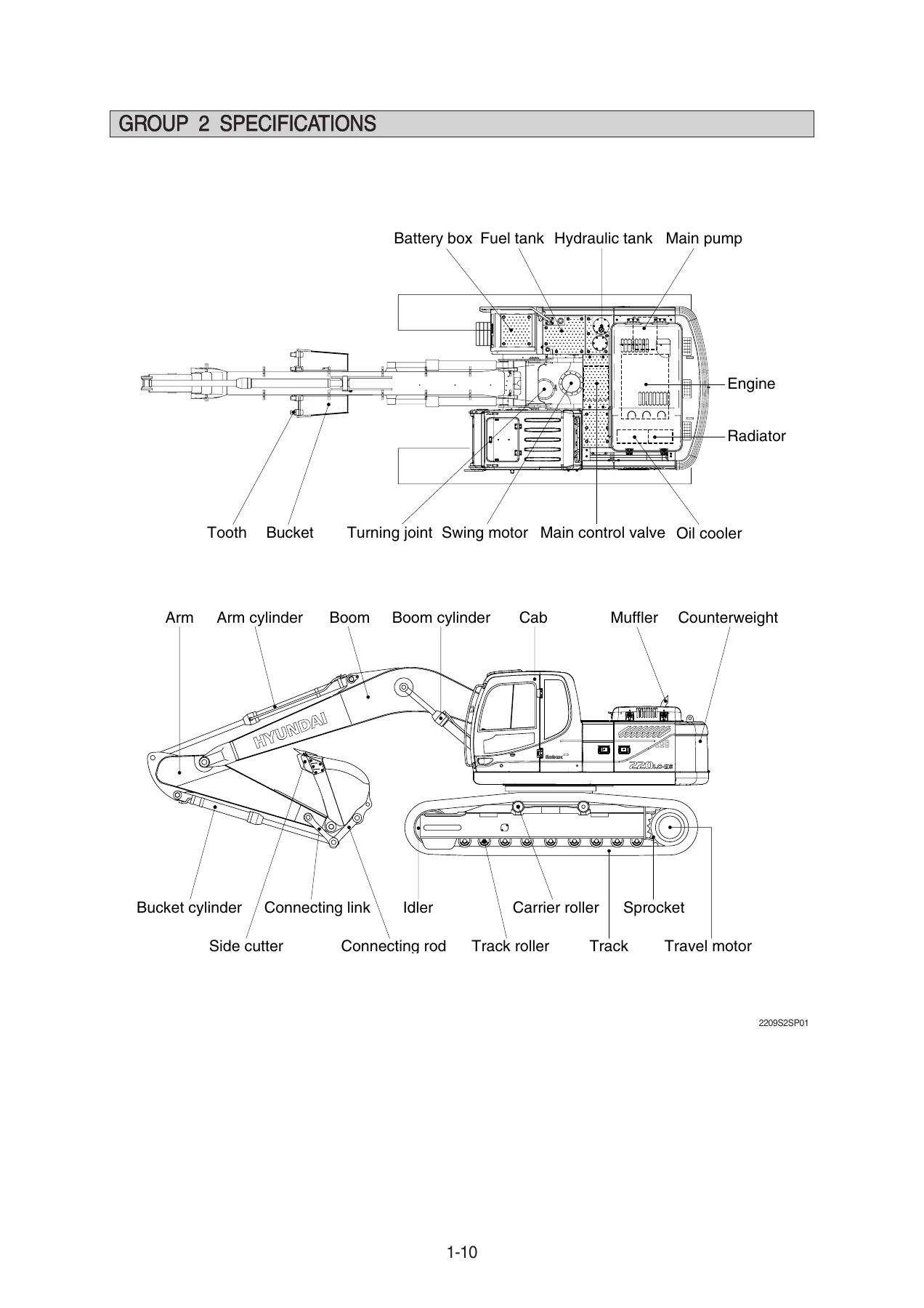
The specification section identifies the powerplant as a Cummins 6BTAA water-cooled, 4-cycle turbocharged diesel: 6 cylinders in-line, 102 × 120 mm bore and stroke, 5880 cc displacement, 17.3:1 compression ratio, 150 Hp (112 kW) at 1950 rpm SAE J1995, and 62.6 kgf·m (453 lbf·ft) maximum torque at 1500 rpm. High idle is given as 2150 ± 50 rpm and low idle as 1050 ± 100 rpm. Starting motor, 24 V-50 A Delco Remy alternator, and dual 12 V × 100 Ah batteries are specified with the engine package.
On the standard R220LC-9S with 5.68 m boom and 2.92 m arm the book lists 21900 kg operating weight, 0.92 m³ SAE heaped standard bucket, 3.4 / 5.3 km/hr travel speeds, 11.5 rpm swing speed, 35° (70%) gradeability, 0.46 kgf/cm² ground pressure on 600 mm shoes, and 21100 kg maximum traction force. Long Reach weight is 24360 kg with a 0.51 m³ bucket and 800 mm shoes; High Walker weight is 23160 kg with 660 mm minimum ground clearance. Working-range tables cover 2.0 m, 2.40 m, 2.92 m, and 3.90 m arms on the standard boom plus the 6.3 m Long Reach arm, including digging reach, depth, dump height, and SAE/ISO bucket and arm forces with power-boost values in brackets.
Hydraulic hardware is specified as variable-displacement tandem axial piston main pumps at 2 × 117 cc/rev, 350 kgf/cm² (380 kgf/cm² power boost), and 2 × 222 l/min at 1900 rpm; a 15 cc/rev gear pump for pilot oil; a 9-spool two-block main control valve; swing motor at 151 cc/rev with 265 kgf/cm² relief; and a variable-displacement axial piston travel motor at 350 kgf/cm² relief. Boom, arm, and bucket cylinder bore / rod / stroke sizes are given, with Long Reach arm and bucket cylinders called out separately. Fluid capacities include 24 l engine oil, 5.0 l swing drive oil, 5.8 l × 2 final drives, 160 l hydraulic tank / 275 l system, 400 l fuel, and 35 l coolant.
IMAGES PREVIEW
Chapters Covered
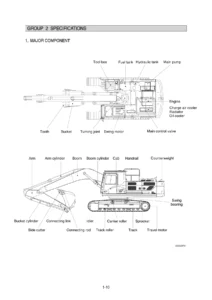
- Section 1 General: Safety hints; Specifications (dimensions, working range, weight breakdown, lifting capacities, major-component specs, recommended oils)
- Section 2 Structure and Function: Pump device; Main control valve; Swing device; Travel device; RCV lever; RCV pedal
- Section 3 Hydraulic System: Hydraulic circuit; Main circuit; Pilot circuit; Single operation; Combined operation
- Section 4 Electrical System: Component location; Electric circuit; Electrical component specification; Connectors
- Section 5 Mechatronics System: Outline; Mode selection; Automatic deceleration; Power boost; Travel speed control; Automatic warming up; Engine overheat prevention; Variable power control; Attachment flow control; Anti-restart; Self-diagnostic system; Engine control; EPPR valve; Monitoring system; Fuel warmer
- Section 6 Troubleshooting: Before troubleshooting; Hydraulic and mechanical system; Electrical system; Mechatronics system
- Section 7 Maintenance Standard: Operational performance test; Major components; Track and work equipment
- Section 8 Disassembly and Assembly: Precautions; Tightening torque; Pump device; Main control valve; Swing device; Travel device; RCV lever; Turning joint; Boom, arm and bucket cylinder; Undercarriage; Work equipment
- Section 9 Component Mounting Torque: Engine, electric, hydraulic, undercarriage, structure, and work equipment mounting values
Taken together, the Hyundai Robex R220LC-9S Excavator Service Manual PDF Download walks a technician from how oil leaves the tandem pump, through the two-block main control valve and pilot RCV circuits, out to swing, travel, and work-equipment actuators, then back through cooler and return filter. Electrical pages map starting, charging, lighting, and sensor circuits and give connector part numbers. The mechatronics section explains the CAPO engine-and-pump control logic used with cluster type 1 (P / S / E modes) and cluster type 2 (M / H / S modes), EPPR power-shift pressure, auto-decel to 1150 then 1000 rpm, warming-up below 30°C, overheat derate above about 100–105°C, ESL password start limit, and cluster gauges and error codes. Shop sections then give removal order, seal replacement notes, air-bleed steps, and mounting torques so the same machine can be put back together and performance-tested.
Hydraulics, Electrical, and Shop Work
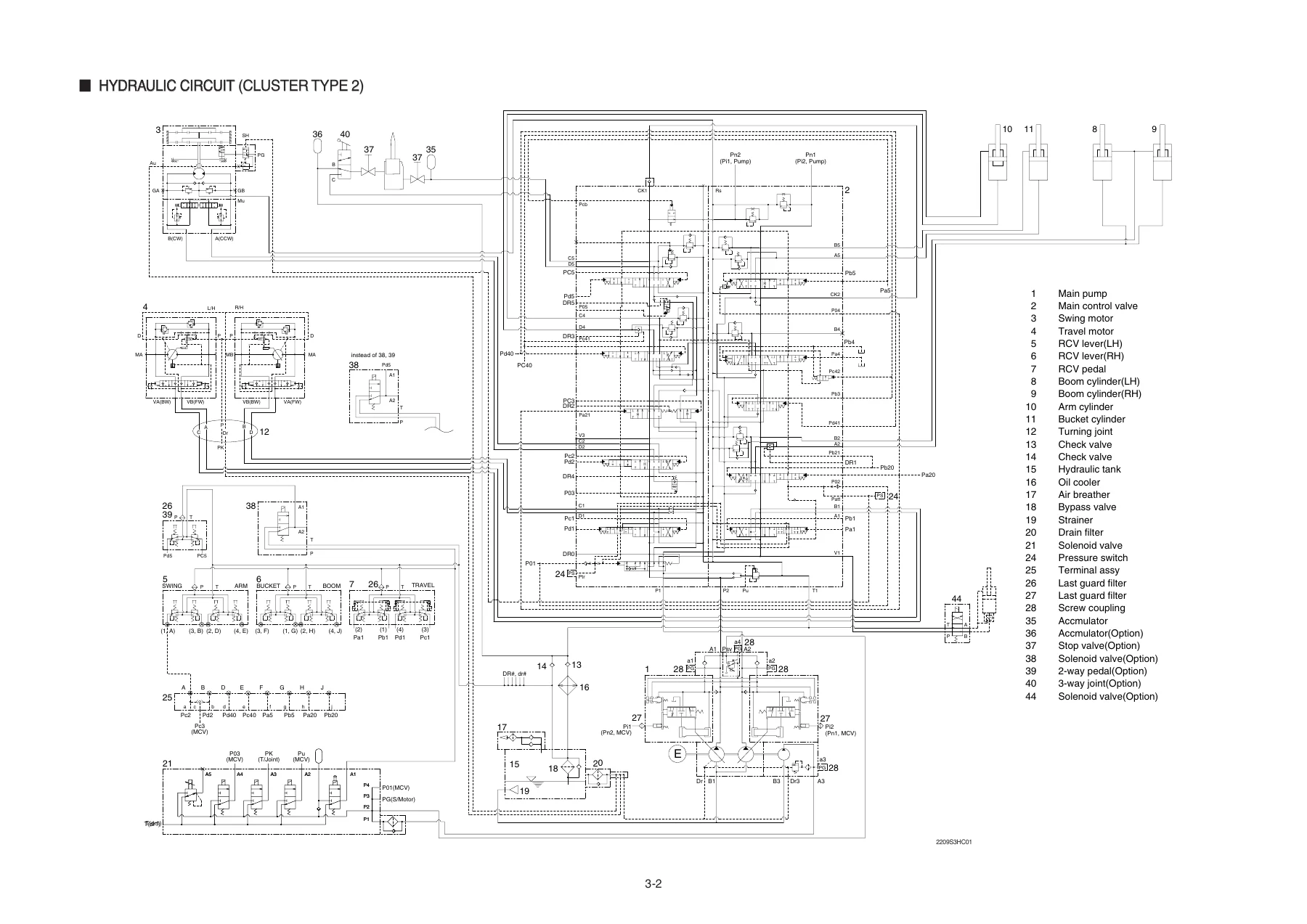
Hydraulic circuit drawings for both cluster types show the main pump, main control valve, swing and travel motors, RCV lever and pedal, boom / arm / bucket cylinders, turning joint, cooler, strainer, drain and last-guard filters, and optional stop-valve and 3-way joint hardware. Single-operation narratives explain boom up/down (including boom holding), arm in/out with regeneration, bucket, swing, and travel. Combined-operation pages cover boom-plus-arm, boom-plus-swing priority, and travel-plus-front combinations that matter when the machine feels slow on one function only.
Troubleshooting is chart-based: cloudy or contaminated hydraulic oil, engine starts but nothing moves, all actuators slow with engine speed still on spec (P-mode 2100 ± 50 rpm, S-mode 2000 ± 50 rpm, E-mode 1900 ± 50 rpm on cluster type 1), engine stall with EPPR pressure checks, warning-lamp circuits for coolant, air cleaner, engine oil pressure, and hydraulic oil temperature, and no-start conditions at the fuel cut-off solenoid. Engine internal repair is not a standalone disassembly group in this book; engine-power complaints are directed to Cummins after the machine-side pump and EPPR checks.
Section 7 performance tests require warmed oil at 50 ± 5°C and cover engine speed by mode, travel speed and mistrack, swing speed, work-equipment cycle times, control-lever stroke and effort, pilot primary pressure, travel-speed select pressure, swing-brake release pressure, main-pump delivery, and main relief setting. Disassembly groups then take the pump, main control valve, swing and travel devices, RCV lever, turning joint, cylinders, undercarriage, and work equipment apart and back together, with air-bleed plugs on pump, swing, and travel motors after install.
What This Manual Lets You Do
With the Hyundai Robex R220LC-9S Excavator Service Manual PDF Download a shop can identify the correct R220LC-9S, Long Reach, or High Walker configuration, set relief and pilot pressures to the printed values, trace a dead function through the hydraulic or electrical path, read cluster and MCU fault codes, replace a pump, valve, motor, cylinder, or turning joint in the documented order, and confirm travel, swing, and digging performance against the maintenance-standard tests. Using the printed pressures, idle speeds, cylinder sizes, and mounting torques avoids guessed settings that overheat oil, stall the engine, or leave a swing brake dragging. The file is delivered as an instant PDF after payment — no shipping wait — and can be opened on a computer, tablet, or phone and printed for the bench.
Reviews
There are no reviews yet.