
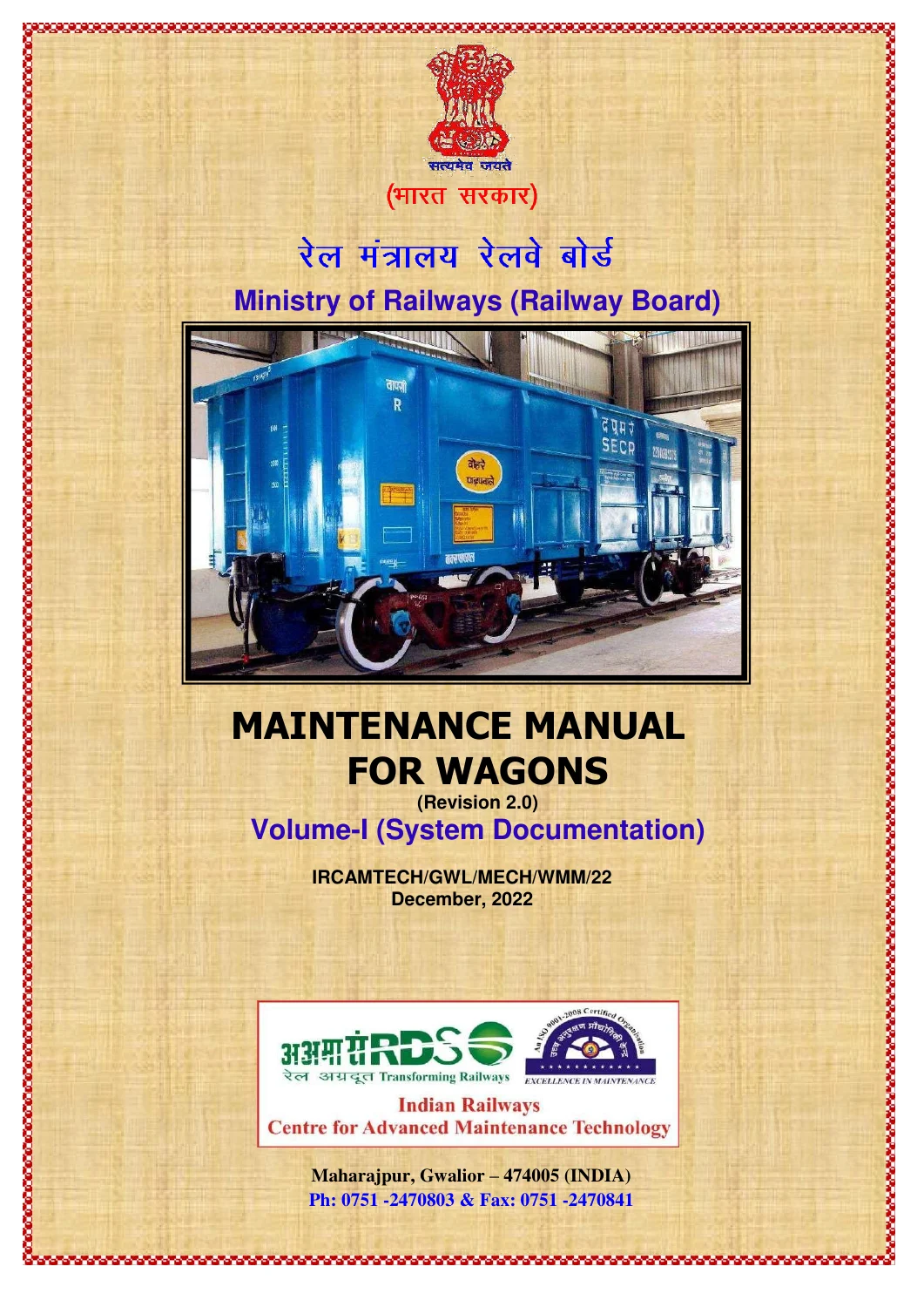
Indian Railways Wagon Maintenance Manual Volume I System Documentation Revision 2.0 – December 2022
Original price was: $44.95.$26.95Current price is: $26.95.
Official technical maintenance manual for Indian Railways freight stock, covering system documentation, yard examination, workshop overhaul, CASNUB bogies, air brake systems, and structural repairs.
Description
Complete System Documentation for Broad Gauge Freight Stock
The Indian Railways Wagon Maintenance Manual Volume I System Documentation Revision 2.0 – December 2022 is the definitive master engineering standard issued by the Centre for Advanced Maintenance Technology (CAMTECH) under the Ministry of Railways, Government of India. This comprehensive manual establishes fleetwide statutory maintenance rules, workshop procedures, yard inspection regimes, and overhaul standards across the entire broad gauge (BG) freight rolling stock network. Designed for mechanical engineers, carriage and wagon (C&W) supervisors, workshop technicians, and depot managers, this documentation incorporates recent design updates, 25-tonne heavy haul wagon variants, Dedicated Freight Corridor (DFC) stock, automated wayside fault detection interfaces, and modernized digital Freight Maintenance Management (FMM) systems.
Comprehensive Technical Details and File Specifications
- Manual Type: Official Railway Rolling Stock Maintenance Manual & System Documentation
- Document Identification: IRCAMTECH/GWL/MECH/WMM/22
- Revision / Edition: Revision 2.0 (Superceding December 2015 edition)
- Issue Date: December 2022
- Issuing Authority: Centre for Advanced Maintenance Technology (CAMTECH), Maharajpur, Gwalior (M.P.), Indian Railways
- System Architecture: Volume-I: System Documentation (Covers design, examination, scheduled maintenance, overhaul, and Railway Board / RDSO instructions)
- Applicable Gauge: Broad Gauge (1676 mm)
- Language: English
- Total Page Count: 685 pages
- File Format: Portable Document Format (.pdf)
Exhaustive Freight Rolling Stock Coverage
This technical volume provides detailed mechanical documentation, dimensional drawings, clearance tolerances, and maintenance periodicity tables across all major classes of freight wagons operated on Indian Railways and Dedicated Freight Corridors:
- Open Wagons: Comprehensive procedures for BOXN, BOXNHL (stainless steel 22.9t/25t axle load), BOY, BOYEL, BOXNM1, BOXNEL, BOXNHS, BOXNHSM1, BOXNHA, BOXNLW, BOXNLWM1, BOST, BOSTM1, BOSTHS, BOSTHSM1, BOSTHSM2, BOSTHSM3, BOXNHAM, BOXNR (upgraded rehabilitation), BOMN (military flat/open), BOXNRHS, BOXNS (25t axle load with LWLH25 bogie), BOXNM2, BOXNLWM2, and BOXNHSM2.
- Covered Wagons: Complete structural and maintenance instructions for BCN, BCNM1, BCNHSM1, BCNA, BCNAM1, BCNAHS, BCNAHSM1, BCNHL (all production variants and door modifications), BCCN double-decker automobile rake units, BCCW cement wagons, BCBFG food grain hoppers, BCFC, and BCFCM wagons.
- Flat & Well Wagons: Service guidelines for BRN, BRN22.9, BRN22.9M1, BRNA, BRNAHS, BRNAM1, BRNM1, BFNS steel coil flats, BRHNEHS track relaying train flats, BRSTN heavy vehicle rail flats, BWTB well wagons, BFNS22.9, BFNSM22.9, BFNV, and BWBL wagons.
- Hopper Wagons: Overhaul and operational documentation for BOBSN, BOBSNM1, BOBR, BOBRM1, BOBRN bottom-discharge coal hoppers, BOBRNM1, BOBRNHS, BOBRNHSM1, BOBRNEL, BOBYN ballast hoppers, BOBYN22.9, BOBYNHS, BOBYNM1, and BOBYNHSM1.
- Tank Wagons: Rigorous maintenance, hydraulic pressure testing, and inspection standards for liquid cargo tank barrels on BTPN (POL petroleum tank), BTPGLN (liquefied petroleum gas), BTCS (caustic soda), BTAP (alumina), BTALN / BTALNM (ammonia), BTFLN, BTFLNM1, and BTOH wagons.
- Container Flat Wagons: Operating parameters, Automatic Twist Lock (ATL) inspections, and maintenance guidelines for BLLA/BLLB longer container flats, BLCA/BLCB low platform container flats, BLCAM/BLCBM upgraded flats, and BLCS 25t container flats.
- Brake Vans & Auto Car Carriers: System specifications for BVZI (bogie brake van with ICF trolley), BVZC (4-wheeler), BVCM (CASNUB 22HS bogie), and specialized BCACM / BCACBM covered double-decker car-carrier rakes.
IMAGES PREVIEW
Complete Chapters and Institutional Sections
- Chapter 1: Introduction — General maintenance philosophy, important parameters of all freight wagon types (axle loads, bogie variants, suspension spring configurations, permissible loaded/empty speeds on Indian Railways and DFC routes), standard infrastructure for wagon depots, numbering conventions, and technical rulebook cross-references (IRCA Part III, G-33, G-70, G-72, G-81, G-95, G-97, G-113).
- Chapter 2: Maintenance, Warranty & Condemnation — Systematic warranty inspection of newly built wagons, failure attribution reporting, C&W record management, examination periodicity, Routine Overhaul (ROH) procedures for CASNUB bogie wagons, wagon repair categorization (Petty, Medium, Special, and Categories A/B/C for BOXN), codal life standards (35 to 45 years), structural audit guidelines for codal life extension (WMI-001-Structural Audit-2022), premature condemnation policies, departmental wagon utilization, and complete POH/ROH interval tables.
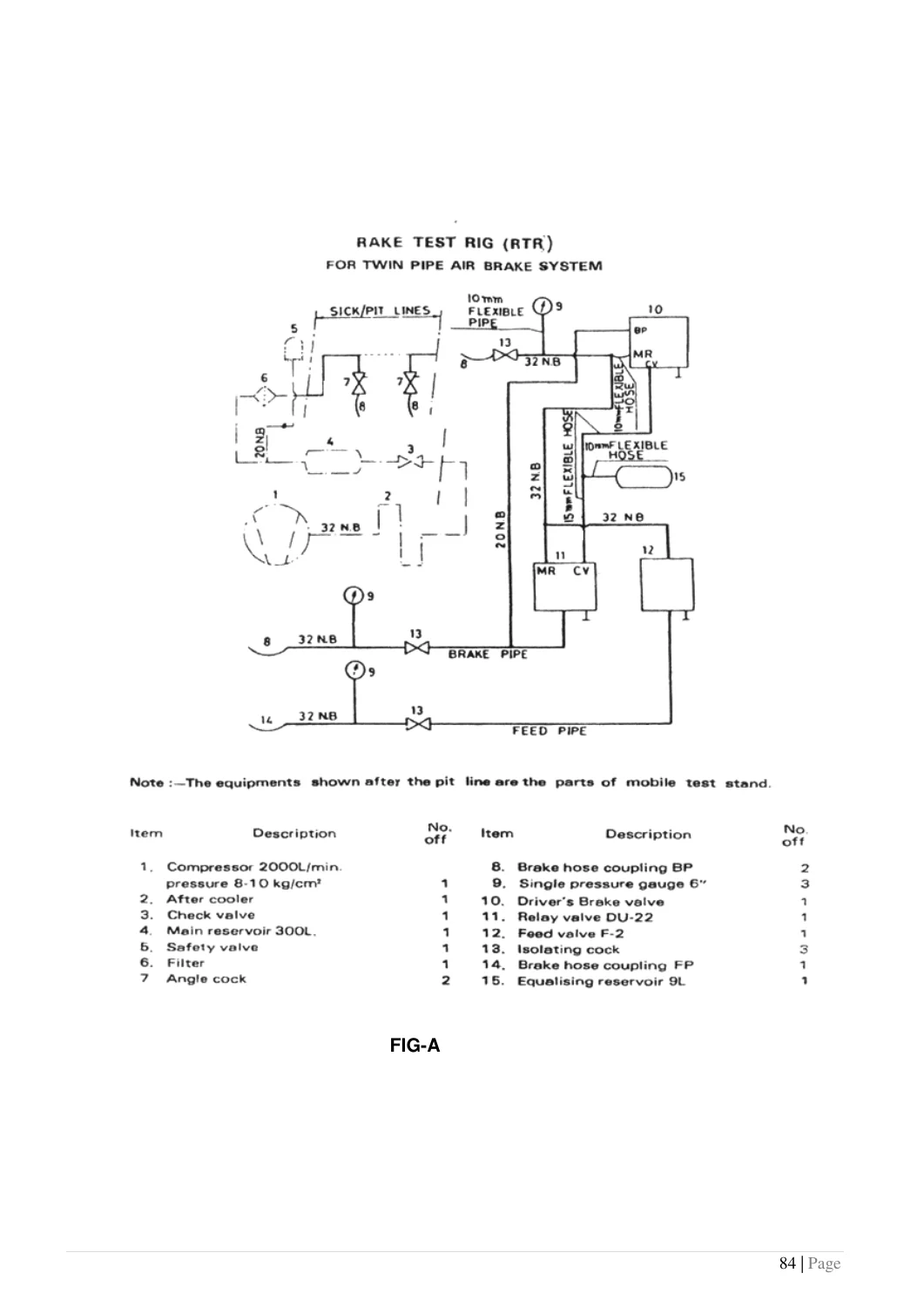
- Chapter 3: Yard Maintenance — Nodal examination point classification, freight train examination patterns (End-to-End, Premium rakes with 12+3 days validity, Close Circuit CC rakes with 7500 km / 30+5 days validity), Guard-Driver (GDR) joint check protocols and door securing checklists, rolling-in / terminating examinations, single-pipe and twin-pipe air brake testing using mobile Rake Test Rigs (RTR), Bogie Mounted Brake System (BMBS) troubleshooting and remedies, Brake Power Certificate (BPC) calculation and issuance, safety certification for departmental stock,CASNUB nominal clearances, wear limits, and container rake maintenance.
- Chapter 4: Wagon Body — Superstructure construction of open, covered, flat, well, and hopper wagons, failure modes, corrosion prevention and surface preparation, rejectable safety defects, sickline and ROH repairs, standardized panel patching procedures for BOXN/BCN, welded patch execution, cold and hydraulic jack straightening for bulged ends, watertightness testing and sealing, door maintenance for mild steel and BCNHL wagons (Original, Mod-I, Mod-II, and retrofittable sliding doors), welding precautions near CTRBs, BOXN to BOXNR stainless steel upgraded rehabilitation (IRS:M44 / CRF hat sections), lock bolting procedures and installation standards, and the 11-digit national wagon numbering scheme with check digit calculation algorithm.
- Chapter 5: Under Frame — Structural composition of broad gauge underframes (solebars, headstocks, longitudinals, crossbars, bolsters, center sills), manufacturing tolerances, alignment inspection, cleaning and de-rusting, headstock straightening devices, crack reclamation in center sills and cross members, solebar splicing and double-flanged patch plate fitment (IRCA Part III compliance), floor plate replacement, BVZI brake van drooping end restoration, center pivot top bracket replacement, and official underframe modification directives.
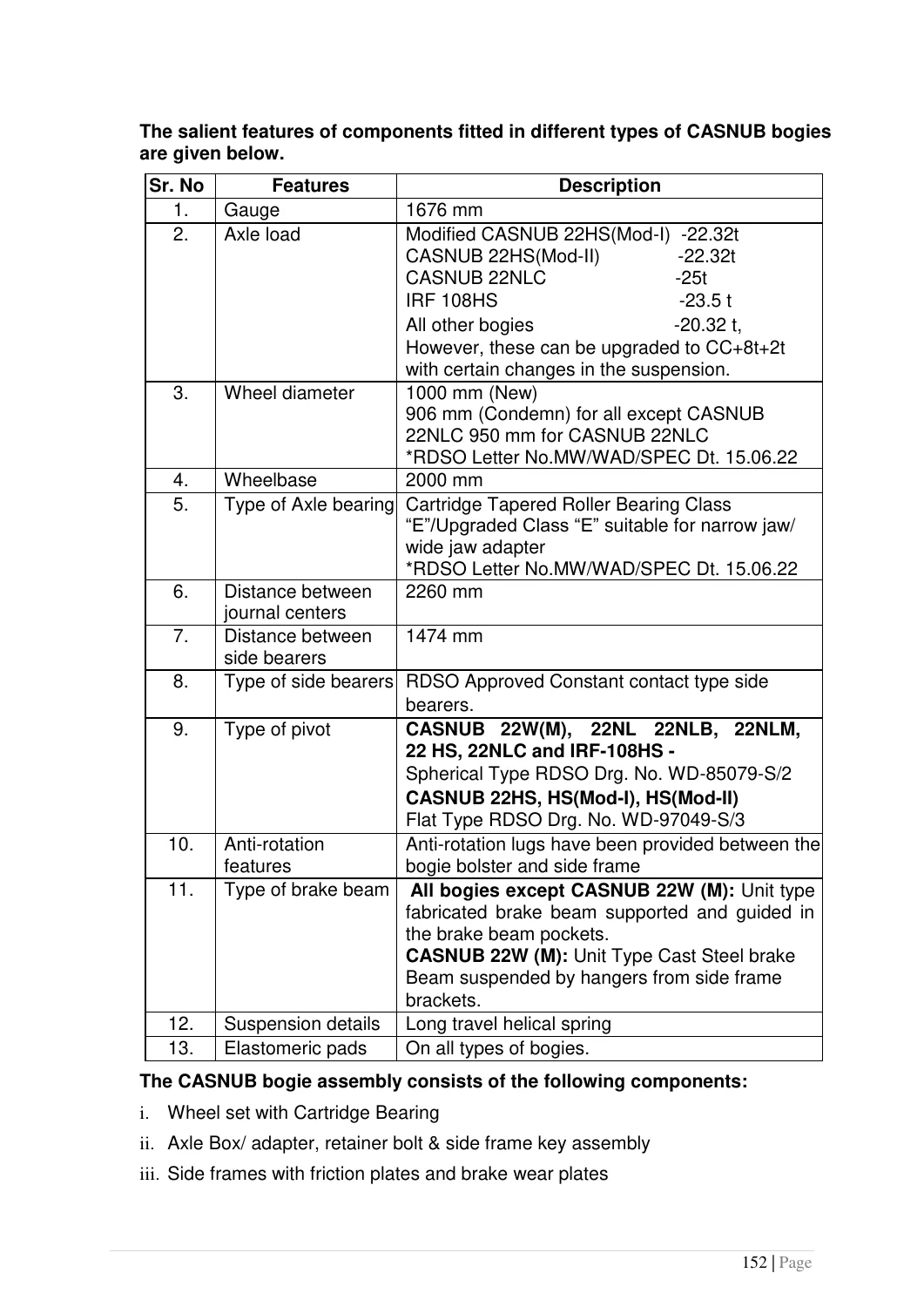
- Chapter 6: Bogies and Suspension — Detailed engineering and servicing of CASNUB bogie families [22W, 22W(M), 22NL, 22NLB, 22NLM, 22HS, 22HS(Mod-I), 22HS(Mod-II), 22NLC, and IRF-108HS], LCCF 20(C), and LWLH25 25t bogies; complete disassembly and assembly procedures; bolster pocket slope liners and column friction plates; spring nest configurations (outer, inner, snubber grouping by free height within 3 mm); friction shoe wedge wear limits; center pivot bowl and spherical/flat pivot welding repairs; elastomeric pads and constant contact side bearers (PU and metal-bonded rubber); fabricated and cast brake beam reclamation; wheelset maintenance, axle ultrasonic testing (UST), wheel hub stamping, journal screw thread reclamation, and intermediate worn wheel profiles (WD-89060/S-2).
- Chapter 7: Air Brake System — Operating principles of single-pipe and twin-pipe graduated release air brake systems, common pipe bracket, intermediate sandwich piece, brake pipe hoses and palm couplings, cut-off angle cocks, brake cylinders, dirt collectors, auxiliary reservoirs, train manager emergency brake valves, SAB slack adjusters (IRSA-600/IRSA-600J ‘A’ and ‘e’ dimensions), in-depth overhaul and test bench procedures for C3W and KE distributor valves, Single Wagon Test Rig (SWTR) testing proforma, Rake Test Rig (RTR) leakage testing, brake power calculations, composite brake blocks, and Bogie Mounted Brake System (BMBS) integration with load sensing APM devices.
- Chapter 8: Draw and Buffing Gear — Inspection, reclamation, and condemnation of Centre Buffer Coupler (CBC) assemblies (AAR tight-lock and standard E/F types), high-tensile couplers, knuckle wear parameters using G-76 contour gauges, anti-creep mechanisms, striker casting wear liners, draft gear overhaul and reconditioning for Miner RF-361 and Cardwell Westinghouse Mark-50, coupler drop and buffer height limits (1030 mm loaded to 1105 mm empty), and train parting mitigation action plans.
- Chapter 9: Tank Wagon — Constructional peculiarities of barrel bodies, dished ends, and cradle mountings; POH periodicity; degassing and cleaning procedures for corrosive and inflammable chemicals; internal and external barrel inspection; hydraulic pressure testing parameters (water jacket and direct pressure); welding repair protocols on barrel shells; relief valves, master discharge valves, and vapor extractor maintenance; safety precautions during loading/unloading; and grounding wire maintenance to eliminate overhead catenary (OHE) electrical risks.
- Chapter 10: Special Types of Wagons — Specific design, structural, and running gear features of BOXNCR stainless steel open wagons, BLC low-platform container flat units (5-car integral rakes), BLLA/BLLB broad gauge long container flats, and BCACBM bi-level auto-carrier rakes.
- Chapter 11: Infrastructure Facilities — Standardized machinery, plant layouts, testing equipment, compressed air distribution, welding stations, lighting illumination levels (100 to 150 Lux), cemented pathways, and pathway dimensions required for Category A examination yards, world-class detachment-free yards, air brake ROH depots, and specialized stainless steel repair lines.
- Chapter 12: Freight Maintenance Management & Way-Side Detection Equipment — Full architectural overview of the Freight Maintenance Management (FMM) digital enterprise portal, integration with FOIS (Freight Operating Information System), ICMS, and IRWMS; automated wagon lifecycle tracking; and technical operational briefings on wayside rolling stock monitoring equipment, including Wheel Impact Load Detectors (WILD), Radio Frequency Identification (RFID) wagon tracking, Acoustic Bearing Detectors (ABD), and Hot Axle Box Detectors.
- Appendices I through XII & Appendices A through E — Tippler installation requirements (G-33), comprehensive freight modification compendium, directory of rolling stock manufacturers and railway workshops, wheel and axle cold-stamping details, mandatory replacement items list for POH and ROH, stainless steel wagon maintenance manual (Appendix-VI), long-haul train train-handling instructions, C&W supervisor inspection checklists, BCACBM operational norms, unit exchange spares schedules, complete dimensional layout drawings (Appendix-A), standardized Brake Power Certificate (BPC) formats (Appendix-B), warranty rejection handling guidelines (Appendix-C), upgraded high-tensile CBC technical specifications WD-70-BD-10 Rev.3 (Appendix-D), and yard/online CTRB failure investigation reporting proformas (Appendix-E).
This single bare reference manual equips mechanical personnel, rolling stock engineers, and maintenance contractors with an authoritative, unified knowledge base. Rather than relying on scattered circulars and piecemeal policy letters, technicians can access definitive assembly clearances, torque values, condemning limits, pneumatic performance curves, and structural welding repair schemes directly from this official CAMTECH system documentation.
Critical Technical Parameters, Wear Limits, and Clearances
The manual provides explicit numerical thresholds and shopfloor tolerances essential for passing safety examinations and qualifying rolling stock for service:
- CASNUB Bogie Clearances: Side frame to bolster lateral clearance is maintained at 18 mm for CASNUB 22W(M)/NLB/NLC and 25 mm for 22HS/LCCF20(C)/LWLH25; longitudinal clearance between side frame column and bolster land surface is 6 mm; clearance between bolster rotation stop lug and side frame anti-rotation lug is 4 mm (sum of both sides).
- CTRB Adapter Wear Tolerances: Maximum permissible wear limits for cartridge roller bearing adapters include 0.7 mm thrust shoulder depth, 4.0 mm crown lugs, 3.5 mm crown seat thickness, and 3.0 mm adapter side lugs.
- Brake Rigging & Piston Stroke Limits: Standard piston strokes for conventional open/covered stock (BOXN, BCN, BRN, BTPN) are 85±10 mm empty and 130±10 mm loaded; high-capacity variants (BOXNHL, BCNHL) specify 85±10 mm empty and 120±10 mm loaded; Bogie Mounted Brake System (BMBS) cylinders require 54±10 mm; BVZI brake van piston stroke is fixed at 32 mm. Brake block condemning thickness is strictly 10 mm, with a minimum yard leaving thickness of 20 mm. Slack adjuster control dimension ‘A’ is set to 70+2/-0 mm (27+2/-0 mm on BOBRN).
- Air Brake Pneumatic Pressures: Standard operating pressure from locomotive/rig is 5.0 kg/cm² for Brake Pipe (BP) and 6.0 kg/cm² for Feed Pipe (FP). Tail-end brake van pressures must register a minimum of 4.8 kg/cm² BP / 5.8 kg/cm² FP on trains up to 56 wagons, and 4.7 kg/cm² BP / 5.7 kg/cm² FP on trains exceeding 56 wagons. The maximum allowable BP/FP leakage rate across the entire rake is 0.25 kg/cm² per minute.
- Underframe Structural Audit Limits: Center sill CRF single-piece sections have a nominal thickness of 10 mm (8 mm minimum acceptable); CRF ‘Z’ sections have a nominal thickness of 6 mm (7 mm minimum after adding standard 3.15 mm stiffener plate); ISMC-300 rolled sections require 7.4 mm nominal (7.8 mm minimum with stiffener plate). Bolster top/bottom flange condemning limits are 8 mm (from 10 mm nominal), and web thickness minimum is 8 mm to 10 mm depending on wagon class.
- Codal Life and Overhaul Periodicity: Codal service life is established at 35 years for BOXN/BOY/BOBRN/BOBSN, 38 years for BOBYN, 40 years for BCN/tank stock, and 45 years for BTPN. Periodic Overhaul (POH) intervals range from 4.5 to 6 years for standard freight stock and 2 years for BVZI brake vans, supported by Routine Overhauls (ROH) every 18 to 24 months.
Professional Workshop Reference and Instant Digital Delivery
Whether you are executing a center sill crack gouging and reinforcement weld, setting up an automatic Rake Test Rig for twin-pipe leakage verification, overhauling a C3W distributor valve, re-profiling worn wheelsets to intermediate profiles, or auditing rolling stock for codal life extension, the Indian Railways Wagon Maintenance Manual Volume I System Documentation Revision 2.0 – December 2022 gives you the exact engineering protocols required by the Railway Board and RDSO. Having this authoritative 685-page manual on hand prevents costly rake detachments, eliminates non-standard yard repairs, prevents train parting incidents, and guarantees total compliance with statutory safety parameters. Delivered as an instant high-resolution digital PDF download immediately upon checkout, this document can be viewed on desktop computers, workshop diagnostic tablets, or mobile devices in the field, and is fully printable for depot work benches and inspection gantries.
Reviews
There are no reviews yet.