
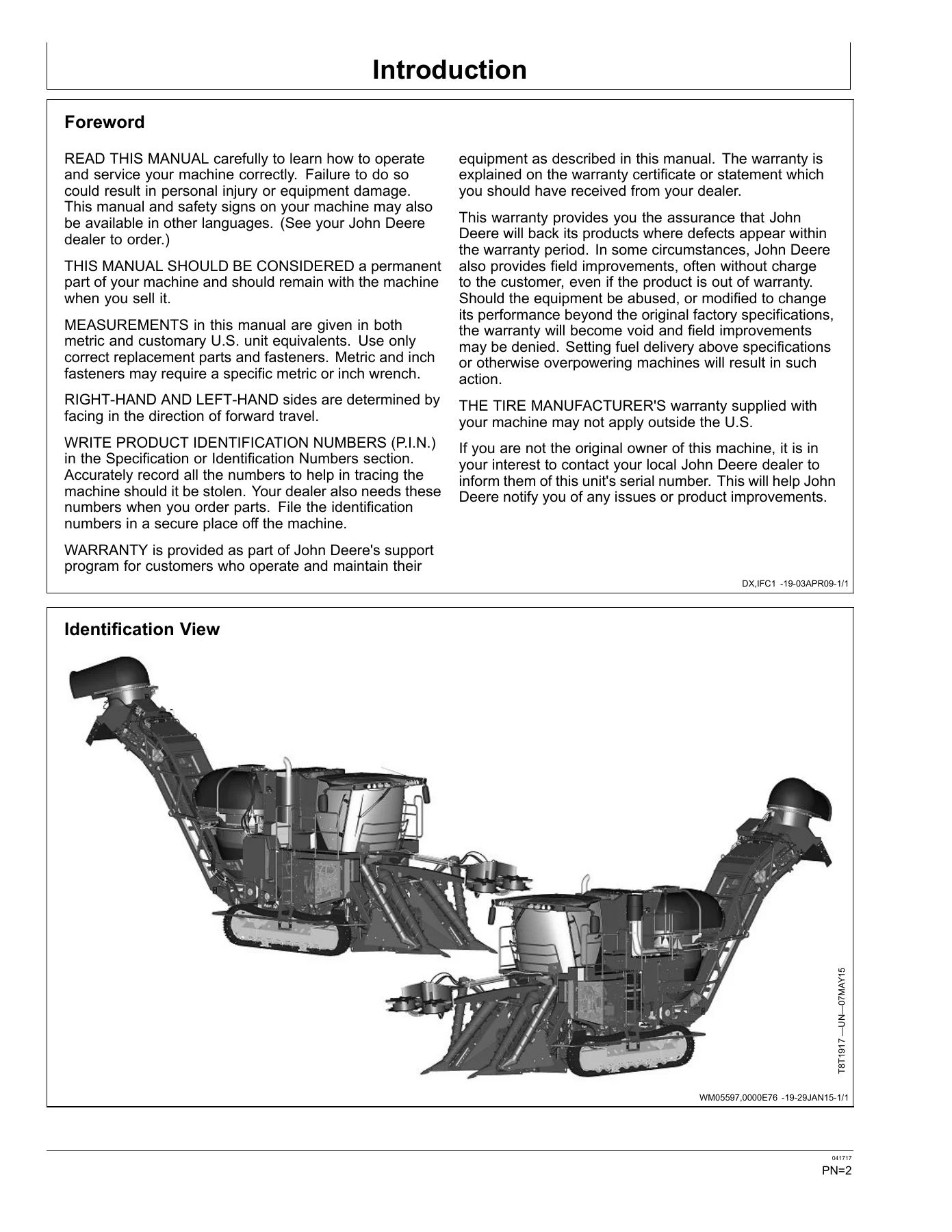
John Deere CH570 CH670 Sugar Cane Harvester Operator Manual OMCXT20713
Original price was: $39.95.$24.95Current price is: $24.95.
Complete John Deere Operator’s Manual for CH570 and CH670 Sugar Cane Harvesters (S.N. 170001—), document OMCXT20713 Issue D7. Full operating, safety, maintenance and troubleshooting coverage in a 382-page instant PDF.
Description
John Deere CH570 CH670 Sugar Cane Harvester Operator Manual — OMCXT20713
This is the complete John Deere Operator’s Manual covering the CH570 and CH670 Sugar Cane Harvesters, serial number 170001 and up. Published under document number OMCXT20713, Issue D7 (English), this 382-page manual is the reference John Deere wrote for the person sitting in the cab and the person servicing the machine — from the daily pre-start checks through to the calibration procedures and torque values used at rebuild time.
Whether you run one harvester or a fleet, the John Deere CH570 CH670 Sugar Cane Harvester Operator Manual is what turns guesswork into procedure. Every control on the CommandTouch armrest, every harvesting function, every lubrication interval and every diagnostic trouble code in this machine is documented here, in the order John Deere intended you to use it.
File Details
- Manual type: Operator’s Manual
- Brand: John Deere
- Models covered: CH570 and CH670 Sugar Cane Harvesters
- Serial number range: 170001—
- Document number: OMCXT20713
- Issue / Revision: Issue D7
- Language: English
- Page count: 382 pages
- File format: PDF (instant download)
Chapters Covered
The manual is organised into the standard John Deere section groups, each with its own numbered page block so a printed copy stays usable in the field:
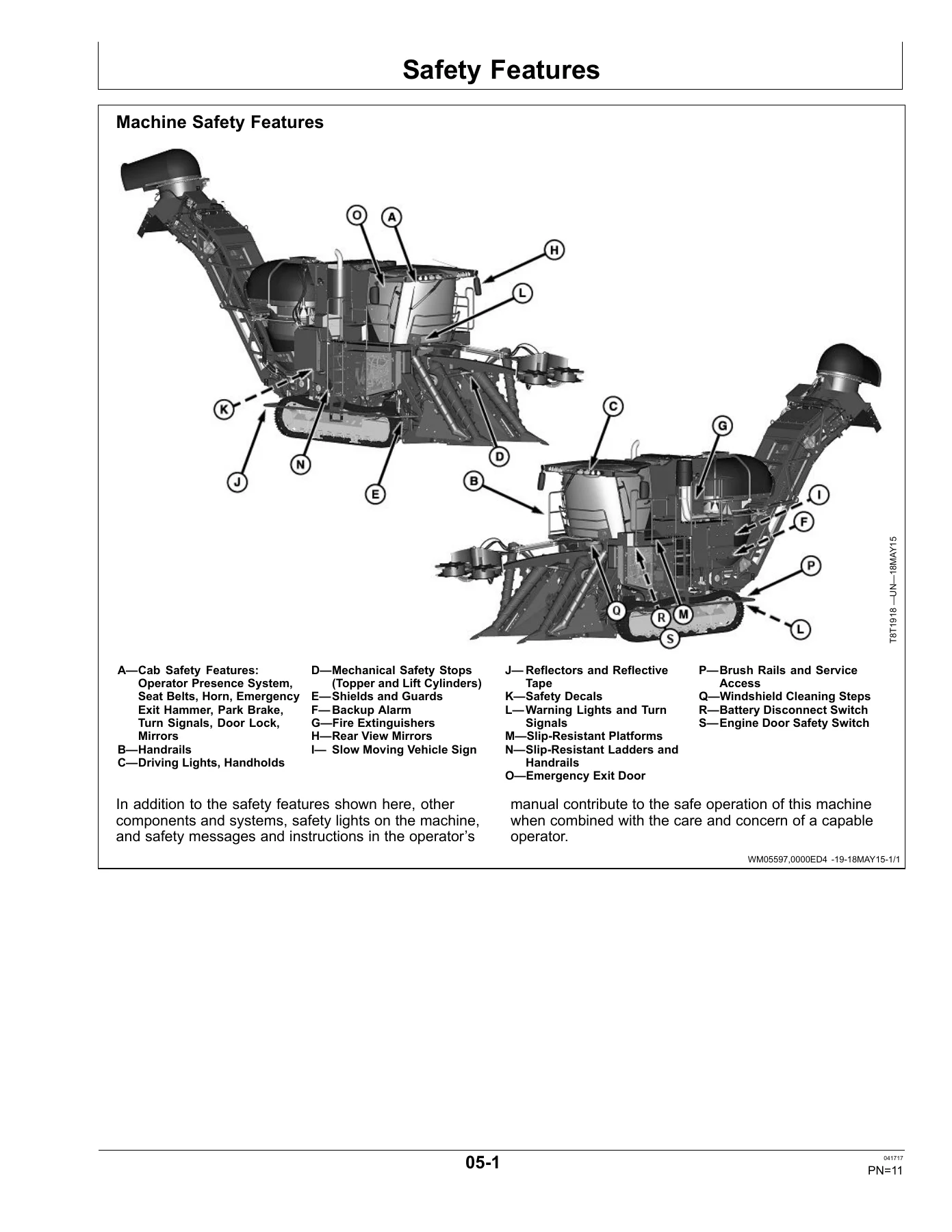
- Safety — recognising safety information, following safety instructions, seat belts, the instructional seat, supporting the machine properly, safe maintenance practice, emergency exit, tilting the cab, keeping passengers and children off the machine, protecting bystanders, backover accidents, steps and handholds, electronic components and brackets, preventing machine runaway, service safety, ventilated work areas, shields and guards, protective clothing, fuel handling, fire response, static electricity when refuelling, emergency preparation, hot exhaust, high-pressure spray, high-pressure fuel systems, drive belts, accumulator systems, battery handling, pressurised fluid lines, cooling systems, safety lights and devices, cylinder safety stops, safe transport, paint removal before welding, high-pressure fluids, hillside and slope caution, elevator safety, electrical power lines, parking, tire recommendations and safe tire service, keeping hands away from knives, avoiding moving parts, staying clear of harvesting units, decommissioning and recycling, and removing accumulated crop debris
- Safety Signs — replacing safety signs, operator’s manual sign, repair and maintenance sign, seat belt sign, emergency exit sign, burn and smoke inhalation sign, service and operation signs, low-hanging power line sign, starter sign, topper disk and topper assembly signs, hot surface, cooling fan and cooling system signs, hydraulic oil and gas under pressure sign, raise cab sign, base cutter sign, chopper drum and extractor fan signs, extractor and elevator area signs, crop divider signs, and side knife signs (if equipped)
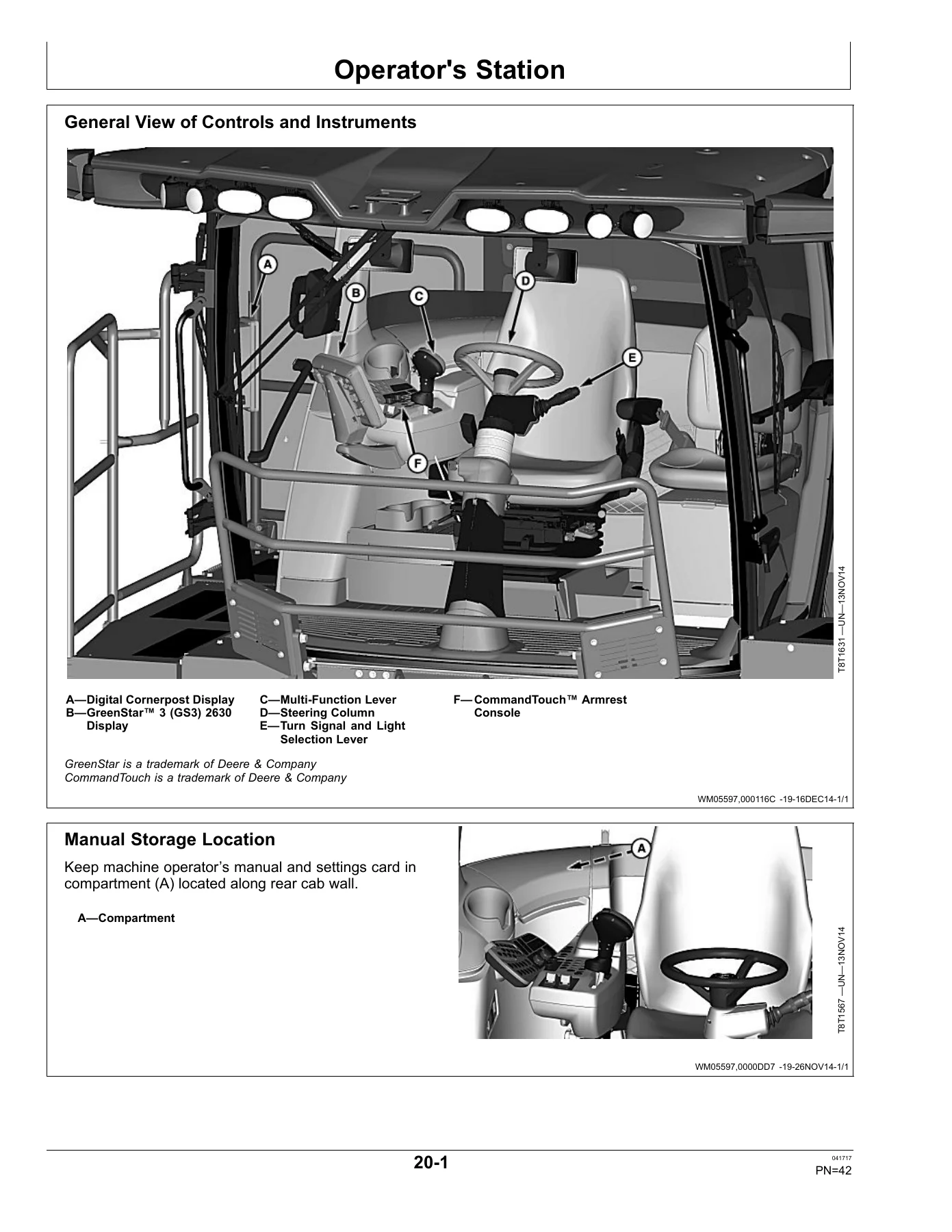
- Operator’s Station — general view of controls and instruments, manual storage location, emergency exit, brake pedals (wheel machines), floor pedals (track machines), elevator swing pedals, adjusting floor pedals, seat safety switch, ComfortCommand operator’s seat adjustment (Style A and Style B), left-hand armrest and seat back adjustment, instructional seat, refrigerator (if equipped), seat belts, armrest control console and armrest display adjustment, auxiliary power outlet strip, fire extinguishers and locations, steering column, windshield wiper and washer switch, side wiper switches, and the Service ADVISOR diagnostic connector
- Overhead Control Panel — panel layout, aftermarket radios, programming the radio for local area frequency, radio controls, antenna, and communications/CB radio mounting
- CommandTouch Armrest Console — armrest console controls, harvesting functions switch, auxiliary functions switch, engine speed switches, travel speed switches (wheel and track machines), park brake switch, positive traction switch, road transport disconnect switch, propulsion encoder, multi-function lever controls, lever and palm adjustment, harvesting functions quick stop switch, CommandARM controls, operator interface controls, topper switches, crop divider tilt switches, side knife switches, primary and secondary extractor switches, knockdown roller tilt switches, elevator switches, ClimaTrak automatic temperature control, light switches and radio function switches
- Lights and Signals — light switches, front and rear lighting locations, side lighting locations, turn signals, cab interior light and map light
- Digital Cornerpost Display — upper cornerpost display and lower cornerpost display
- GreenStar 3 2630 Display Screens — armrest display navigation, display navigation, display icon identification, Sugarcane Main screen, lower region information and configuration, detail machine information, floating crop dividers and contour base cutter height control, alarm and operator controls setup, primary extractor screen, engine setup screen, maximum harvester speed and steering aggressiveness, track steer bias, varitorque, elevator screen, harvester activity monitor, shift configuration, row width adjustment, data download, diagnostics readings and calibrations, brightness and boundary box colour, regional settings and units, diagnostic readings and display tests, message center, layout manager and access manager applications
- Operating the Engine — avoiding hot exhaust, accessing the engine compartment, battery disconnect switch, engine idling, starting the engine, using a booster battery or charger, and cold weather warm-up
- Driving the Harvester — driving or transporting on public roads, travel speeds, moving the harvester, park brake switch, parking the harvester, and backup alarm
- Operating the Harvester — sugar cane flow, topper system and its operation, crop dividers, floating side walls, outer and inner side skirt adjustment, crop divider height and tilt, knockdown rollers, base cutter (CH570 and CH670 angles, front and rear plate adjustment, operation), feed rollers, butt-lifter feed roller, billet length manual adjustment, chopper system and operation, elevator basket, primary extractor, elevator system, secondary extractor, and elevator discharge flap
- Floating Crop Divider and Contour Base Cutter Height Control — system calibration, crop divider pressures and base cutter target height, end of row heights, advanced setup, operating the floating crop dividers, operating the contour base cutter height control, setting the base cutter pressure target range, and monitoring crop divider position
- Harvesting Hints and Harvesting Sugar Cane — harvesting tips, safety tips, harvesting conditions, planting for mechanical harvesting, harvesting a field, standard harvesting, harvesting over a ditch, harvesting on a headland, pulling a wagon on the first row, and harvesting a large field
- Transporting the Harvester — loading procedure and towing procedure
- Fuel, Lubricants and Coolant — Tier 3/Stage IIIA/MAR-I emission control engines, fuel handling safety, static electricity risk, diesel fuel and its properties, handling and storing diesel fuel, lubricity, fuel testing, BioDiesel fuel, cold weather operation, supplemental additives, diesel engine coolant for wet sleeve cylinder liners (Tier 2/Stage II and Tier 3/Stage III), warm temperature climates, testing coolant freeze point, water quality for mixing, COOL-GARD II coolant extender, break-in oil, Tier 2 and Tier 3 engine oil, service interval for high altitude operation, oil and filter service intervals, Oilscan and CoolScan, oil filters, fuel filters, alternative and synthetic lubricants, lubricant storage and mixing, hydraulic fluid, pump drive/base cutter/chopper gear case oil, final drive gear oil and grease
- Lubrication, Maintenance and Intervals — emission-related information, important considerations, servicing at specified intervals, checking the hour meter, parts catalog, service records, component locations, and the full service interval charts from first 100 hours through every 4500 hours
- Fluids Analysis — sample collection schedule, engine oil sample collection, final drive oil sample collection, hydraulic fluid sample collection and coolant sample collection
- Maintenance by Interval — first 100 hours, every 25 hours or daily, every 50 hours, every 100 hours, every 250 hours, every 500 hours, every 1000 hours, every 1500 hours, every 2000 hours, every 3000 hours, every 4500 hours, and as-required procedures
- Service — Electrical System — welding near electronic control units, keeping ECU connectors clean, battery disconnect switch, fuse center, ground connections, lights and harnesses, battery handling and servicing, halogen bulb safety, cab headlight and halogen bulb replacement and adjustment, topper boom light, HID Xenon light replacement and adjustment, beacon light, front turn signal, tail lights, field lights, cab interior light and map light
- Wheels and Tires — safe tire service, tire information, front wheel hub bearing greasing, tools for changing a tire, changing a tire, tire performance, checking pressure, tire failure, proper air inflation, over-inflation, under-inflation and sidehill harvesting
- Tracks — track components, carrier roller lubrication, removing and installing track shoes, track alignment and track tension adjustment
- Jack Locations
- Fire Prevention — recommended fire prevention, extinguisher operation, charging the water fire extinguisher, handling fuel safely, preparing for emergencies, removing accumulated crop debris, extinguisher locations, fire response and engine compartment cleaning
- Machine Cleanout — periodic cleanout and annual cleanout
- Storage — preparing the machine for storage and removing it from storage
- Troubleshooting — engine, electrical system, lubrication system, cooling system and air intake
- Diagnostic Trouble Codes — accessing the DTC menu and DTC priorities
- Calibration Procedures — when to calibrate and calibration error codes
- Specifications — fluid capacities, component specifications, engine specifications, dimensions, weight, torque specifications, and unified inch and metric bolt and screw torque values
- Machine Identification Numbers — interpreting the Product Identification Number, identification numbers, product identification plate, P.I.N., engine serial number, pump drive gear case serial number, chopper gear case serial number, keeping proof of ownership and keeping machines secure
Taken as a whole, the John Deere CH570 CH670 Sugar Cane Harvester Operator Manual works on two levels. The first is the cab: how the topper, crop dividers, knockdown rollers, base cutter, feed rollers, chopper, extractors and elevator all interact, what each armrest switch does, how the GreenStar 3 2630 pages are configured, and how the floating crop divider and contour base cutter height control systems are calibrated and operated. The second is the service bench: what fluid goes in which compartment, how much of it, at what torque the hardware is tightened, how often each bearing and pivot is greased, and how to read the diagnostic trouble codes when a warning appears.
What This Manual Lets You Do
The CH570 and CH670 are specialised machines with a long list of wear points — base cutter blades, chopper blades and timing, elevator chain tension and wear strips, extractor fan balance, crop divider scrolls, knockdown roller tilts and track tension. This manual gives you the published adjustment figures and the published procedures for all of them, rather than a workshop guess.
It also contains the complete lubrication and maintenance interval charts, broken down by hours, so nothing gets missed between harvests — including the first 100-hour service, which is where most machines either get set up properly or don’t.
Diagnostic and calibration content is included: diagnostic trouble code access and priorities, plus calibration procedures for base cutter height, crop divider positions and pressures, hydro handle position, steering wheel position, primary extractor and varitorque.
Delivery
IMAGES PREVIEW
The John Deere CH570 CH670 Sugar Cane Harvester Operator Manual (OMCXT20713) is delivered as an instant PDF download. No shipping, no waiting — the file is available immediately after checkout and opens on any phone, tablet, laptop or desktop. Print the sections you need for the workshop and keep the rest on the device in the cab.


Reviews
There are no reviews yet.