
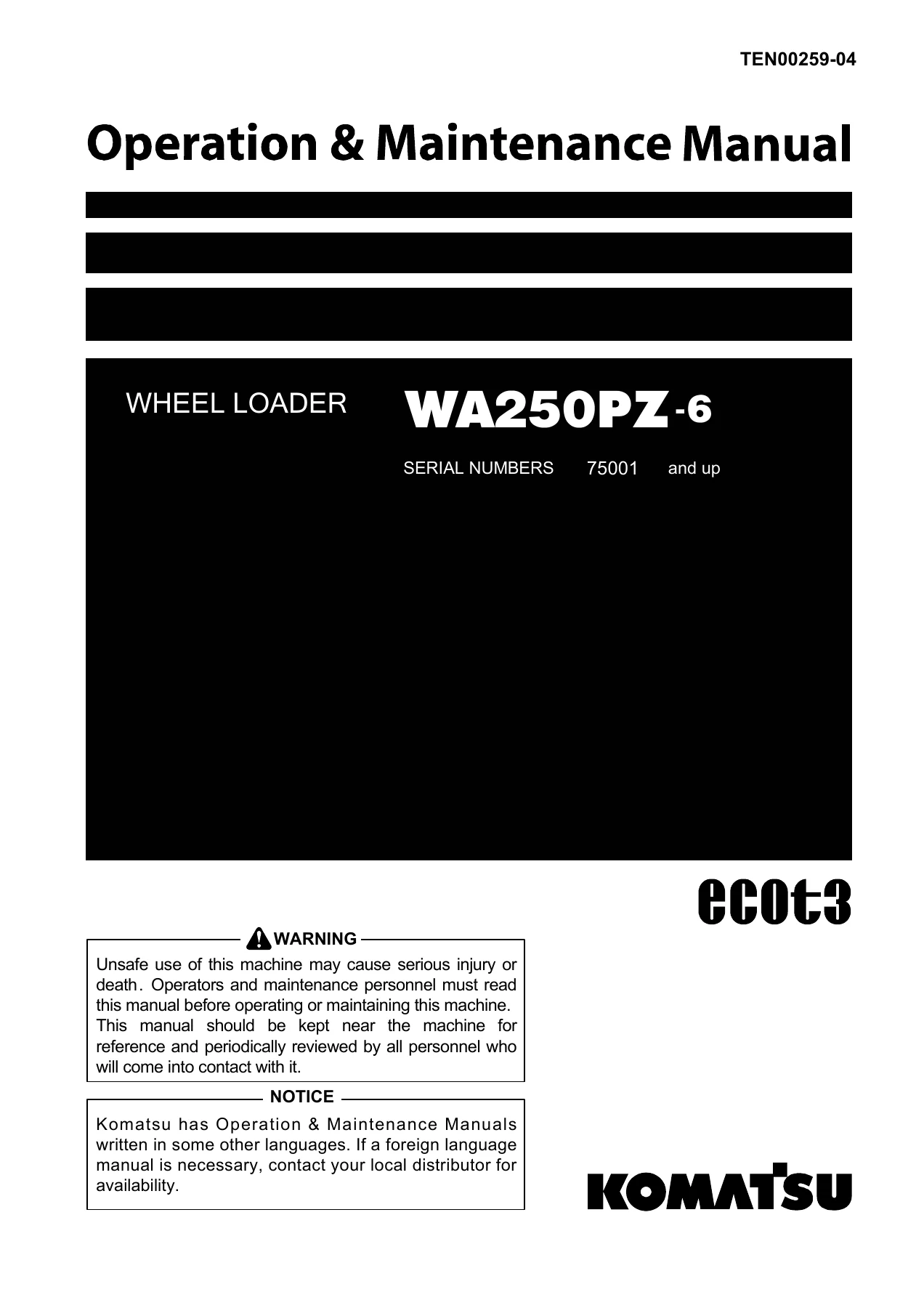
Komatsu WA250PZ-6 Wheel Loader Operation & Maintenance Manual – TEN00259-04
Original price was: $29.95.$18.95Current price is: $18.95.
Complete Komatsu WA250PZ-6 Wheel Loader Operation & Maintenance Manual. Document TEN00259-04, covering serial numbers 75001 and up. 309 pages of operation, maintenance, troubleshooting, and specifications. Instant PDF download.
Description
Komatsu WA250PZ-6 Wheel Loader Operation & Maintenance Manual — TEN00259-04
This Komatsu WA250PZ-6 Wheel Loader Operation & Maintenance Manual is the complete factory document for machines with serial numbers 75001 and up. Published under document number TEN00259-04 in October 2009, it covers the operation, inspection, and maintenance of the WA250PZ-6 wheel loader in full. Every procedure, specification, and safety requirement that Komatsu expects operators and maintenance personnel to follow is contained in this manual.
Whether you are running the machine daily, carrying out scheduled service, or diagnosing a fault, this WA250PZ-6 wheel loader manual gives you the exact information required. It is not a generic guide — it is the document written specifically for this model, covering the Komatsu SAA6D107E-1 engine and the machine’s HST, hydraulic, brake, steering, and electrical systems.
File Details
- Manual Type: Operation & Maintenance Manual
- Brand: Komatsu
- Model: WA250PZ-6
- Serial Numbers: 75001 and up
- Document Number: TEN00259-04
- Publication Date: October 2009
- Language: English
- File Format: PDF
- Page Count: 309 pages
Chapters Covered
- Before Reading This Manual — Safety Information, Introduction, Use of Machine, Front/Rear/Left/Right Directions, Visibility from Operator’s Seat
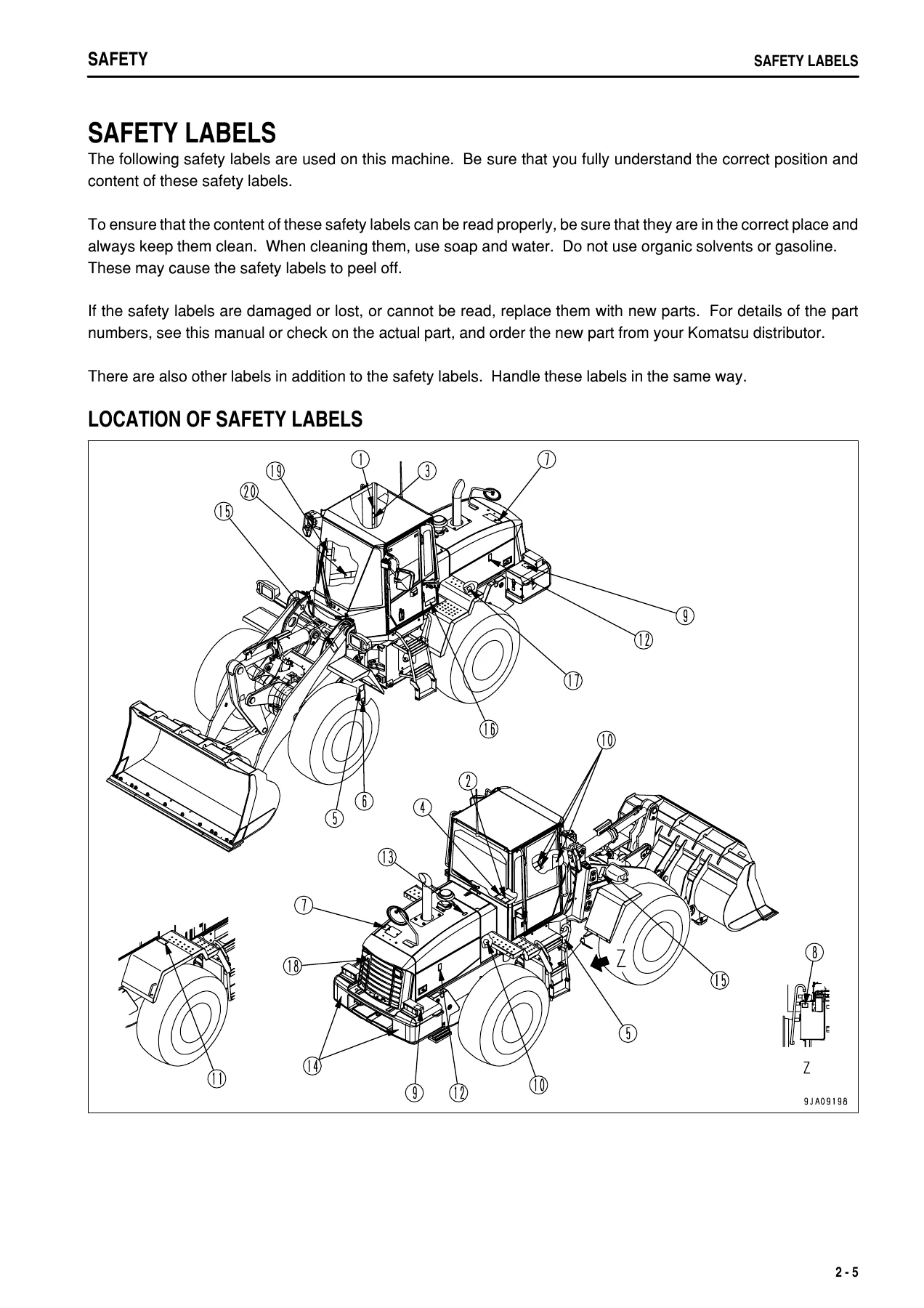
- Safety — Safety Labels and Their Locations, General Precautions Common to Operation and Maintenance, Fire Prevention, Getting On and Off the Machine, Articulating Portion, Protective Structures, Unauthorized Modification, Attachments and Options, Engine Exhaust in Buildings
- Precautions for Operation — Jobsite Investigation, Working on Loose Ground, High-Voltage Cables, Visibility, Signs and Signals, Asbestos Dust, Starting Engine, Cold Areas, Booster Cables, Checks Before Operation, Traveling Forward and Reverse, Traveling on Slopes, Brakes, Operating Precautions, Prohibited Operations, Snow and Ice, Parking, Transportation, Towing
- Precautions for Maintenance — Warning Tags, Workplace Cleanliness, Authorized Personnel, Stopping Engine, Two Workers for Engine-Running Maintenance, E.C.S.S. Switch, Attachments, High Places, Working Under Machine, Proper Tools, Welding, Battery, Hammer, High-Temperature Coolant and Oil, High-Pressure Oil and Fuel, Hoses and Piping, Noise, Accumulator and Gas Spring, Compressed Air, Air Conditioner, Waste Disposal, Window Washer Fluid
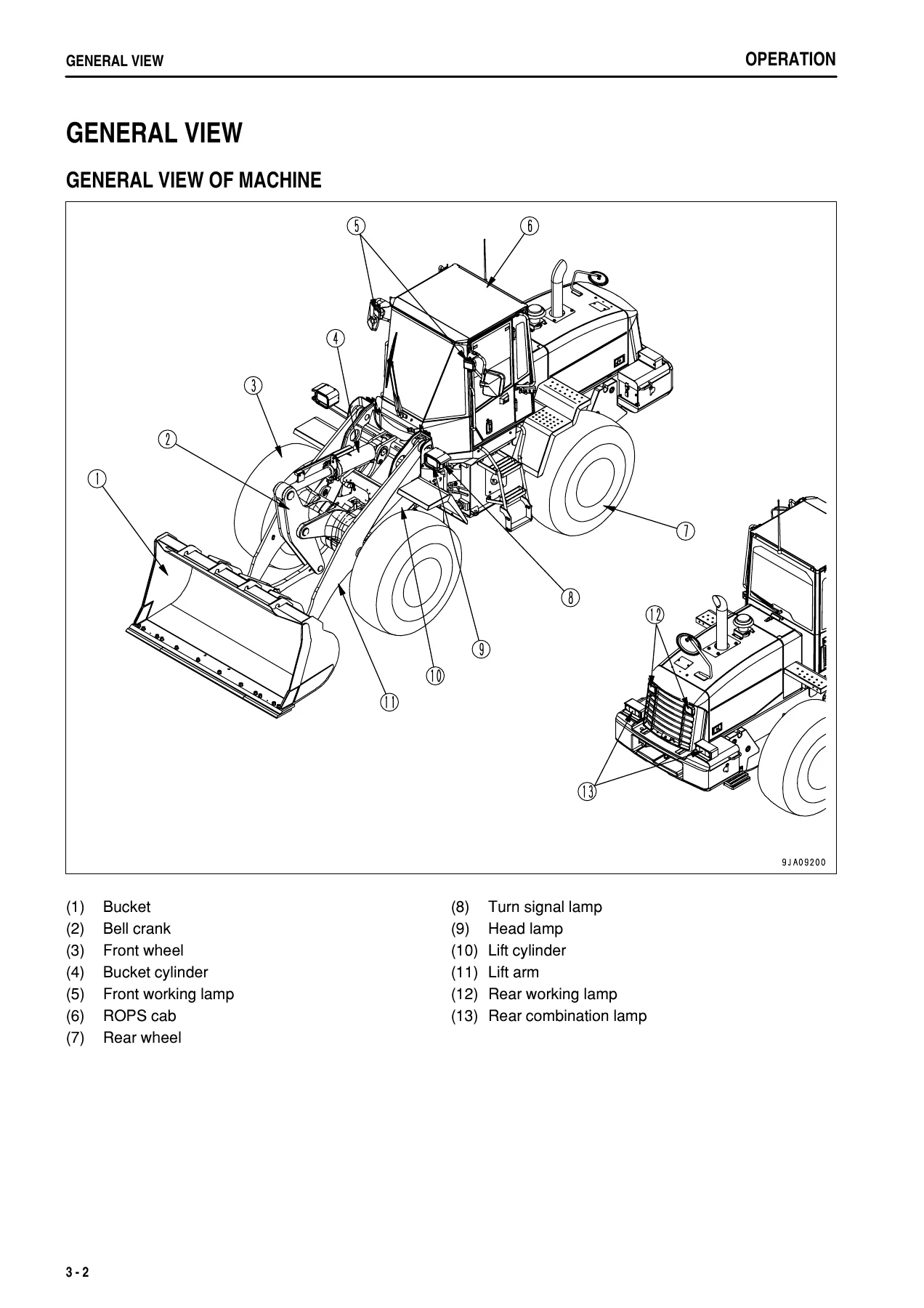
- Operation — General View, Explanation of Components (Machine Monitor, Switches, Control Levers and Pedals, Cab Doors and Windows, Fuse, Power Outlet, Storage Box, Radio, Air Conditioner, Cab Wiper)
- Operation — Check Before Starting Engine, Walk-Around Check, Machine Monitor Check, Coolant Level, Engine Oil Level, Water Separator, Air Cleaner, Fuel Level, Electric Wiring, Tire Pressure, Washer Spray, Wiper, Horn, Defroster, Locks, Emergency Exit, Seat Adjustment, Seat Belt, Mirror Adjustment, Steering Tilt, Frame Lock Bar, Starting Engine, Checks After Starting, Warming-Up, Moving the Machine, Changing Direction, Stopping, Steering
- Work Possible Using Wheel Loader — Digging Operations, Loading Piled Soil, Digging and Loading on Level Ground, Leveling Operations, Pushing Operation, Load and Carry Operations, Loading Operations, Cross Drive Loading, V-Shape Loading, Piling Up Loads
- Handling Hydraulic Quick Coupler — Removing Attachment, Installing Attachment
- Adjusting Work Equipment Posture — Boom Kickout, Bucket Positioner, Fork Positioner
- Parking Machine, Checks After Completion of Operation, Locking
- Handling the Tires — Tire Pressure, Tire Selection, Load and Carry Method
- Transportation — Loading and Unloading with Trailers, Lifting Machine
- Cold Weather Operation — Fuel and Lubricants, Coolant, Battery, Precautions After Work, After Cold Weather
- Long-Term Storage — Before, During, After Storage
- Troubleshooting — Electrical System, Chassis (HST, Axle, Brake, Parking Brake, Steering), Hydraulic System, Engine
- Maintenance — Guides to Maintenance, Outlines of Service, Wear Parts List
- Recommended Fuel, Coolant, and Lubricant — According to Ambient Temperature, Recommended Brands
- Standard Tightening Torques for Bolts and Nuts — Torque List
- Periodic Replacement of Safety Critical Parts
- Maintenance Schedule Chart — Initial 10, 250, 1000 Hours; When Required; Every 50, 100, 250, 500, 1000, 2000, 4000, 8000 Hours
- Service Procedure — Air Cleaner Element, Cooling System, Transfer Case Oil, Axle Oil, Axle Breather, Air Conditioner Condenser, Window Washer Fluid, Radiator and Cooler Fins, Cutting Edge, Bucket Teeth, Air Conditioner Refrigerant, Slow Blow Fuse, Accumulator Function, Tire Selection and Inflation, Fuel Breather Filter, Lubrication, Engine Oil and Filter, Fuel Pre-Filter, Fuel Main Filter, Transfer Case Oil Change, HST Oil Filter, Hydraulic Tank Oil and Filter, Hydraulic Tank Breather, HST Drain Filter, Axle Oil Change, Brake Circuit Strainer, Brake Disc Wear, PPC Accumulator, Alternator, Valve Clearance, Vibration Damper, Water Pump, Starting Motor, High-Pressure Piping Clamps, Fuel Spray Prevention Cap
- Specifications
- Attachments, Options — Selecting Bucket and Tires, Handling Fork Tool, Method of Using 3 Levers, Handling Machines Equipped with KOMTRAX
- Index
The manual’s seven sections build on each other. Safety comes first, establishing the non-negotiable rules for working around and on the machine. The operation section then explains every control, monitor, and procedure needed to run the WA250PZ-6 correctly. Maintenance follows with a complete schedule and step-by-step procedures. Troubleshooting provides diagnostic paths when something goes wrong. Specifications give the machine’s key dimensions, weights, capacities, and travel speeds. The attachments section covers buckets, tires, forks, and the KOMTRAX system. An index closes the manual for quick reference.
What the Komatsu WA250PZ-6 Operation & Maintenance Manual Covers
This WA250PZ-6 operation and maintenance manual goes well beyond a basic owner’s guide. It documents the machine’s complete maintenance schedule from the initial 10-hour service through the 8000-hour interval, with each procedure written for a technician working on the machine. Fluid capacities are listed for the engine oil pan, transfer case, hydraulic system, axles, cooling system, and fuel tank. Tightening torques are given for standard bolts, hydraulic hoses, and specific components like the axle level plug, wheel hub bolts, and cutting edge bolts.
The maintenance procedures cover air cleaner element cleaning and replacement, cooling system flushing and coolant mixing ratios, transfer case oil level checks and changes, axle oil level and changes, radiator and cooler fin cleaning with the fan reverse rotation function, bolt-on cutting edge turning and replacement, bucket teeth replacement, air conditioner checks, slow blow fuse replacement, accumulator function checks, tire selection and inflation pressure, fuel breather filter cleaning, lubrication points with grease fitting locations, engine oil and filter changes, fuel pre-filter and main filter replacement, HST oil filter element replacement, hydraulic tank oil and filter changes, hydraulic tank breather element replacement, HST drain filter replacement, axle oil changes, brake circuit strainer cleaning, brake disc wear checks, PPC accumulator function checks, alternator checks, engine valve clearance checks, vibration damper inspection, water pump checks, starting motor checks, high-pressure piping clamp inspection, and fuel spray prevention cap inspection.
The troubleshooting chapter gives a structured approach to diagnosing problems. For the electrical system, it lists symptoms like a lamp that does not glow brightly or flickers, a battery charge circuit caution lamp that stays on, abnormal noise from the alternator, a starting motor that does not turn or disengages early, and a preheating pilot lamp that does not light up — with probable causes and remedies for each. The chassis section covers HST, axle, brake, parking brake, and steering problems. The hydraulic system section addresses bucket lifting power, cylinder movement, oil bubbles, and oil pressure. The engine section covers oil pressure warnings, coolant temperature warnings, starting problems, exhaust color, and abnormal noise.
Specifications include the machine weight of 12,725 kg (28,059 lb), normal load of 3,520 kg (7,762 lb), bucket capacity of 2.2 m³ (2.9 cu.yd) heaped, Komatsu SAA6D107E-1 diesel engine producing 103 kW (138 HP) at 2,000 rpm, overall length of 7,550 mm, overall height of 3,200 mm, overall width of 2,470 mm, minimum ground clearance of 465 mm, bucket width of 2,550 mm, dumping clearance of 2,785 mm, dumping reach of 1,125 mm, bucket dump angle of 48 degrees, minimum turning radius of 5,875 mm, permissible towing load of 8,400 kg, and travel speeds ranging from 4.0-13.0 km/h in 1st to 38.0 km/h in 4th for both forward and reverse.
Fluid capacities are specified as follows: engine oil pan 25.5 liters (6.74 US gal) specified and 23 liters (6.08 US gal) refill, transfer case 6.5 liters (1.72 US gal) specified and 5.0 liters (1.32 US gal) refill, hydraulic system 135 liters (35.67 US gal) specified and 67 liters (17.70 US gal) refill, axle (front and rear each) 18 liters (4.76 US gal), cooling system 22 liters (5.81 US gal), and fuel tank 186 liters (49.14 US gal).
The safety section is extensive. It covers safety labels and their locations on the machine, with the actual label content reproduced. It details precautions for operating near electric cables with a voltage-to-safe-distance table, precautions for working in articulating areas, roll-over and falling-object protective structures, fire prevention, proper use of handrails and steps, seat belt use, and the requirement to stop the engine before maintenance. It also covers high-temperature coolant and oil hazards, high-pressure oil and fuel hazards, battery handling, tire handling, and the proper disposal of waste materials.
The operation section explains the machine monitor in detail — the character display portion, emergency stop items, caution items, inspection and maintenance items, pilot display portion, meter display portion, and central warning lamp. It documents the action code displays E01, E02, and E03, the failure code display, and the filter and oil replacement time display. It covers the starting switch, speed range selector switch, variable shift control dial, quick coupler attachment switch, cooling fan auto reverse rotation switch, directional selector switch actuation switch, traction control switch, max traction switch, wiper switches, lamp switches, turn signal lever, dimmer switch, working lamp switches, hazard lamp switch, directional selector switch, cigarette lighter, room lamp switch, rear heated wire glass switch, attachment selection switch, directional lever, work equipment control lever, work equipment lock lever, accelerator pedal, brake pedal, parking brake lever, auxiliary control lever, steering tilt lock lever, cap and cover with lock, frame lock bar, towing pin, grease pump, cab doors and windows, emergency escape door, fuse boxes, power outlets, storage box, radio, air conditioner, and cab wiper.
Get the Complete Komatsu WA250PZ-6 Operation & Maintenance Manual
This manual gives you the capability to operate, maintain, and troubleshoot the WA250PZ-6 correctly. Every maintenance interval, fluid capacity, torque value, safety procedure, and diagnostic path is documented in one place. Whether you are performing a 500-hour service, diagnosing an HST fault, or adjusting the boom kickout, the procedure and specifications are at hand.
Using the correct procedures and specifications matters because the WA250PZ-6 is a complex machine with interconnected systems. An incorrect fluid, a missed torque value, or a misunderstood fault code can lead to premature wear, component failure, or unsafe operation. This manual eliminates guesswork by giving you the manufacturer’s own information.
IMAGES PREVIEW
Delivery is instant. After payment, the PDF is available for download immediately. There is no shipping, no waiting for a physical book, and no risk of a lost or damaged copy. The file opens on any device and can be printed for use in the shop or kept on a phone or tablet for quick reference in the cab.
Reviews
There are no reviews yet.