
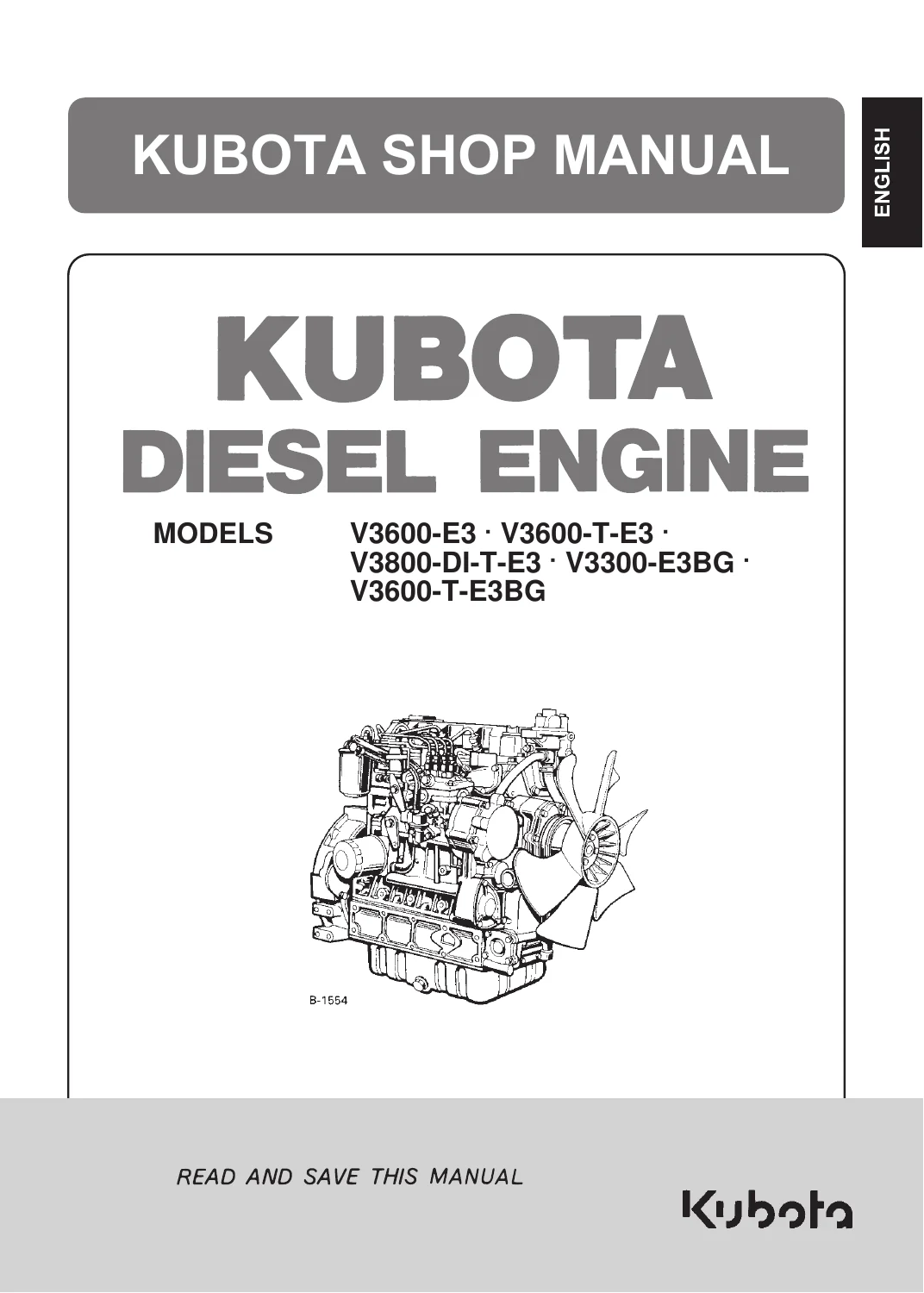
Kubota V3600-E3B, V3600-T-E3B, V3800DI-T-E3B, V3300-E3BG, V3600-T-E3BG Diesel Engine Workshop Manual
Original price was: $39.95.$24.95Current price is: $24.95.
Complete factory workshop manual for Kubota V3-E3B, V3-E3CB, and V3-E3BG series diesel engines (V3600-E3B, V3600-T-E3B, V3800DI-T-E3B, V3600-E3CB, V3600-T-E3CB, V3800DI-T-E3CB, V3300-E3BG, V3600-T-E3BG, V3800DI-T-E3BG). Contains comprehensive mechanical mechanism theory, full overhaul servicing, fuel injection pump timing, electronic governor diagnostics, and detailed factory specifications.
Description
Document Information & Technical File Details
- Manual Type: Workshop Manual (Shop Manual / WSM)
- Brand: Kubota
- Engine Series: V3-E3B Series, V3-E3CB Series, V3-E3BG Series
- Covered Engine Models: V3600-E3B, V3600-T-E3B, V3800DI-T-E3B, V3600-E3CB, V3600-T-E3CB, V3800DI-T-E3CB, V3300-E3BG, V3600-T-E3BG, V3800DI-T-E3BG
- Language: English
- Format: Digital PDF
- Total Page Count: 203 pages
- Publication Date: October 2007 (Kubota Corporation 2007)
- Supplemental Reference: Kubota Diesel Engine Mechanism Workshop Manual (Code No. 9Y021-01876)
Chapters Covered in This Workshop Manual
- General
- Engine Identification — Model Name and Engine Serial Number Coding, E3B Emission Classifications (Tier 3, Interim Tier 4, Tier 4, Stage IIIA), Cylinder Numbering Sequence
- General Precautions — Workshop Cleanliness, Disassembly Etiquette, Genuine Parts Usage, Snap Ring & Seal Orientation, Engine Run-In Procedures
- Maintenance Check List — Complete Interval Schedule for Daily, 50-Hour, 250-Hour, 500-Hour, 1000-Hour, 1500-Hour, 3000-Hour, 1-Year, and 2-Year Periodic Service
- Check and Maintenance Procedures — Engine Oil and Filter Replacements, Fan Belt Tension Measurement, Fuel Line & Filter Inspection, Air Cleaner Servicing, Water Jacket Flushing & Antifreeze Selection, Valve Clearance Adjustment, Battery Specific Gravity, Injection Nozzle Pressure Testing, Injection Pump Spill Timing, and Turbocharger Inspection
- Special Tools — Compression Testers, Oil Pressure Gauges, Injection Pump Pressure Testers, Bushing Replacement Drivers, Oil Seal Tools, Valve Guide Replacers, Crankcase Alignment Jigs, and Restoring Tools
- Mechanism
- Engine Body — Two-Piece Crankcase Construction (Crankcase 1 & Crankcase 2), Standard Dual-Idle Gear Train vs. Optional Single-Idle Gear Train, Half-Floating Cylinder Head Cover, Three-Valve E-TVCS Combustion System, Four-Valve E-CDIS Center Direct Injection System, MoS2 Coated Pistons, Built-In Dynamic Balancer
- Lubricating System — Trochoid Oil Pump Flow Dynamics and Water-Cooled Plate-Type Oil Cooler
- Cooling System — Flow Control Thermostat with Anti-Hunting Notch, Bottom Bypass Water Circulation
- Fuel System — Bosch Type Mini Injection Pump, All-Speed Mechanical Governor Dynamics, Electronic Governor Isochronous Speed Control, Shape-Memory Mechanical Cold Start Advance Timer, Throttle Injection Nozzles, Two-Stage DI Double-Spring Nozzles, and Fine Spill Port (F.S.P.) Rate Shaping
- Turbocharger System — Radial Inflow Turbocharger Construction and Boost Pressure Compensator Actuator
- Intake System — Manifold-Mounted Intake Air Grid Heater
- Exhaust Gas Recirculation (EGR) System — Internal EGR via Two-Stage Exhaust Camshaft Lobes and External Mechanical EGR with Cooled EGR Heat Exchanger, Thermo Valve, Diaphragm EGR Valve, and Crankcase Reed Valve
- Servicing
- Troubleshooting — Diagnostic Flowcharts for Starting Failures, Starter Inoperation, Rough Running, White/Blue Smoke, Black/Dark Smoke, Insufficient Power, Lubricant Consumption, Fuel Dilution, Oil Pressure Faults, Overheating, and Electronic Governor Glow Lamp Error Blink Codes
- Servicing Specifications — Factory Tolerances and Allowable Wear Limits across Engine Body, Lubrication, Cooling, Fuel, and Electrical Systems
- Tightening Torques — General Hardware Fastener Torque Ratings and Detailed Special Use Torques for Main Fasteners
- Checking, Disassembling and Servicing — Step-by-Step Teardown, Component Inspection, Measurement, Cleaning, Reassembly, and Setting Procedures across all Engine Subassemblies
This factory workshop manual provides engine technicians, field service mechanics, and equipment rebuilders with an end-to-end technical authority on the Kubota V3 series. It delivers deep, actionable insight encompassing mechanical operational theory, exact factory rebuild specifications, diagnostic fault isolation, and full procedural teardown and assembly instructions directly from the manufacturer.
IMAGES PREVIEW
Engine Architecture & Mechanical Engineering Details
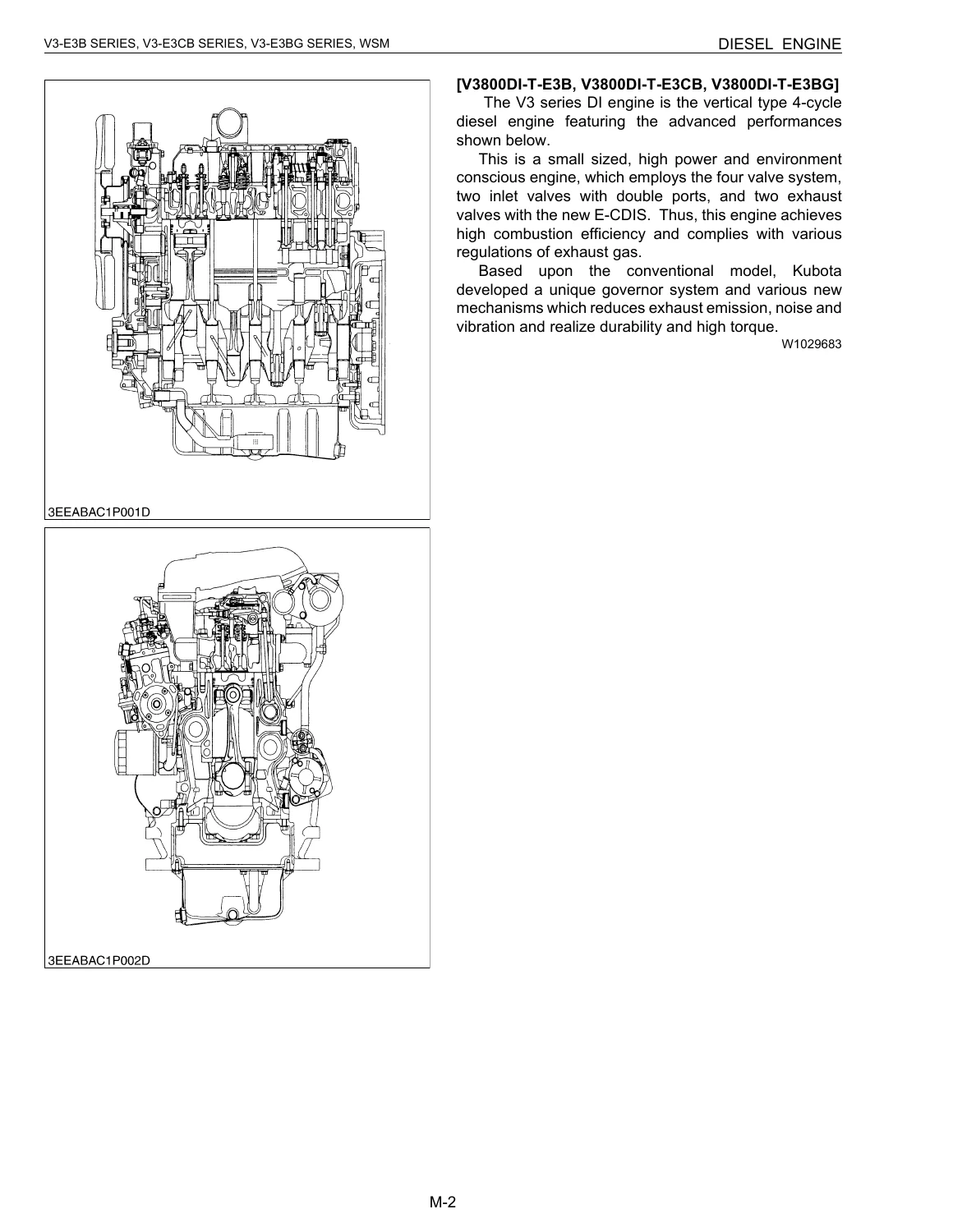
The Kubota V3600-E3B, V3600-T-E3B, V3800DI-T-E3B, V3300-E3BG, V3600-T-E3BG Diesel Engine Workshop Manual covers two advanced combustion families built on Kubota’s high-rigidity two-piece crankcase platform. The indirect injection (IDI) engines, including the naturally aspirated V3600-E3B, turbocharged V3600-T-E3B, generator-drive V3300-E3BG, and V3600-T-E3BG, utilize a specialized three-valve-per-cylinder head arrangement comprising two intake valves fed through double intake ports and a single exhaust valve. Actuated through an overhead rocker arm and intake bridge arm assembly, this architecture optimizes swirl and intake inertia within Kubota’s proprietary E-TVCS spherical pre-combustion chamber. In contrast, the direct injection (DI) models—including the V3800DI-T-E3B and V3800DI-T-E3BG—feature a four-valve configuration with center direct injection (E-CDIS). Here, dual intake and dual exhaust valves are actuated by dedicated bridge arms, positioning a multi-hole injector vertically in the dead center of the cylinder bore to spray directly into a reentrant piston crown bowl for superior combustion efficiency and reduced exhaust emissions.
A critical mechanical distinction detailed in this Kubota service manual is the timing gear arrangement. Standard engine models utilize a robust dual-idle gear train featuring two intermediate idle gears linking the crankshaft gear, camshaft gear, balancer gears, and injection pump gear. However, designated optional models bearing the ‘C’ suffix (such as the V3600-E3CB, V3600-T-E3CB, and V3800DI-T-E3CB) incorporate an optional single-idle gear train. Because this design reverses the rotational direction of the fuel camshaft, the high-pressure fuel injection lines for cylinders 2 and 3 are physically cross-routed over each other to preserve the strict 1-3-4-2 firing order. The workshop manual provides exact gear mesh alignment mark illustrations (1TC alignment at cylinder No. 4 TDC) and backlash specifications (0.0440 to 0.193 mm) to ensure accurate timing reassembly.
Further mechanical refinements documented include the linerless cylinder bore construction for superior heat dissipation, half-floating cylinder head covers insulated with rubber seals to attenuate upper valvetrain noise, solid lubricant molybdenum disulfide (MoS2) coated piston skirts to reduce piston slap and prevent scuffing under severe operating conditions, and built-in dynamic balancer shafts fitted in the lower crankcase to counter second-order harmonic vibrations inherent in four-cylinder engines.
Fuel Injection, Emissions Management & Governing Systems
Technicians working on these industrial powerplants will find extensive technical documentation covering Kubota’s specialized fuel delivery and emission technologies. Fuel pressurization relies on a Bosch Type Mini in-line pump driven by an independent governor shaft rotating at twice conventional speeds to deliver rapid throttle response under sudden load changes. For direct-injection variants, the injection pump incorporates a Fine Spill Port (F.S.P.) mechanism that controls the initial delivery rate while retarding injection timing at lower engine speeds to significantly cut combustion noise and NOx formation. Fuel injection nozzles are matched to combustion requirements: IDI models employ Denso OPD mini throttle nozzles with flat-cut needle valve geometry to suppress diesel knock, while DI engines utilize advanced two-stage dual-spring injector holders that deliver pre-lift throttling at 18.64 to 19.61 MPa before transitioning into main injection at 23.54 to 24.52 MPa.
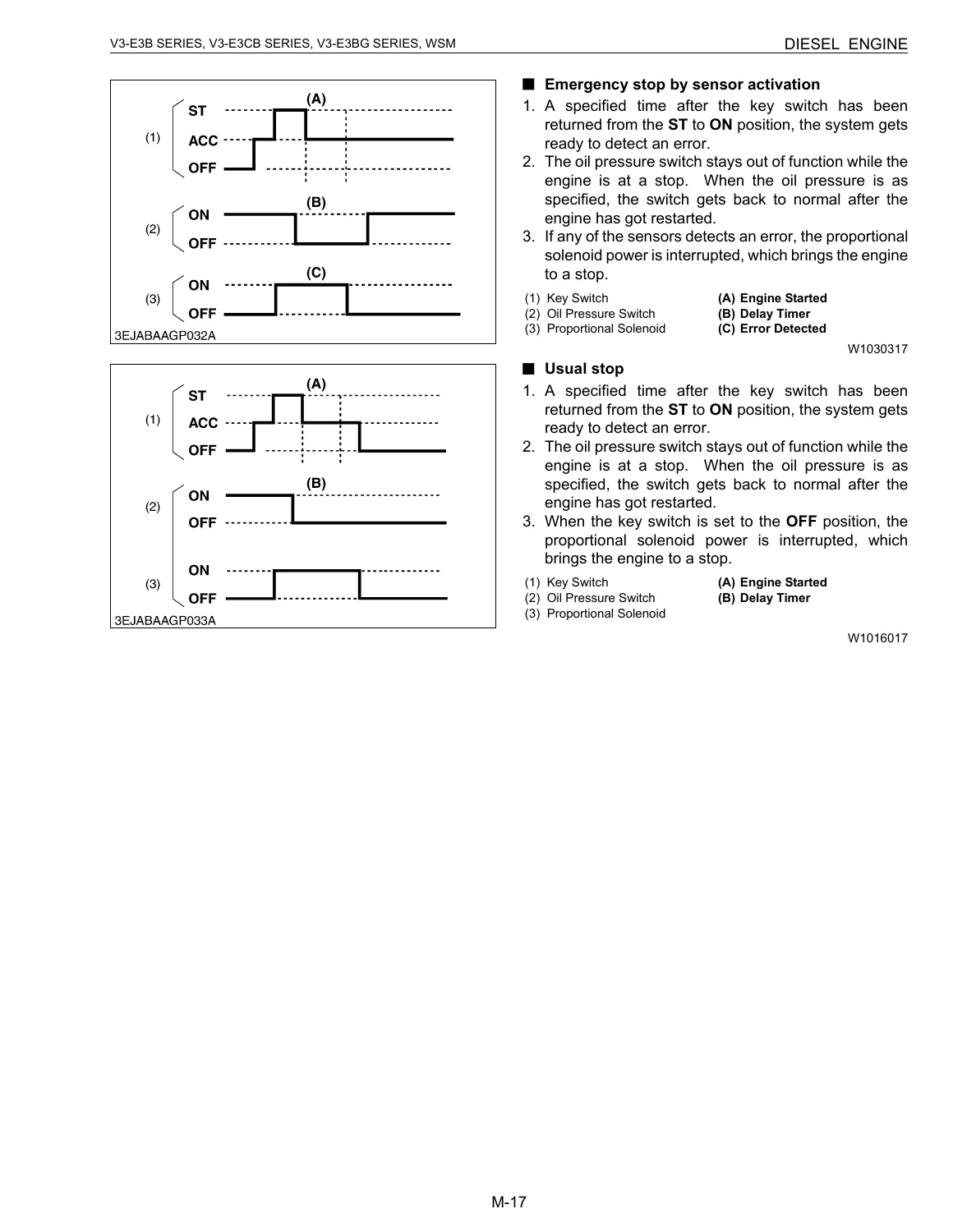
Cold starting performance is reinforced by a thermal and speed-governed mechanical injection advance timer located on the fuel camshaft gear. Utilizing a shape-memory spring mechanism, this assembly advances injection timing at engine oil temperatures below 30°C (86°F), returning to standard timing as oil temperatures reach 70°C (158°F). On generator-specification models, the manual details the electronic governor system comprising an electronic control unit (ECU), flywheel magnetic speed sensor, and pulse-width-modulated (PWM) proportional actuator solenoid. The manual includes complete software block diagrams, emergency automatic shutdown circuits (monitoring oil pressure, coolant temperature, and alternator charging status), and glow lamp flash code diagnostic tables enabling fast electrical troubleshooting.
To satisfy Tier 3 and Stage IIIA emission standards, the workshop manual details both internal and external Exhaust Gas Recirculation (EGR) systems. The V3600-T-E3B employs an internal EGR system engineered with dual-stage exhaust camshaft lobes that re-open the exhaust valve during the intake stroke to draw inert exhaust gases back into the cylinder. On the V3800DI-T-E3B, an external mechanical EGR system is utilized, integrating a water-cooled multi-tube EGR cooler, a boost-pressure actuated mechanical EGR diaphragm valve, a coolant temperature thermo valve, and a one-way crankcase reed valve to regulate gas flow without electrical sensors.
Workshop Overhaul Procedures, Tolerances & Fabrication Data
Every major overhaul procedure is laid out with step-by-step disassembly sequences, inspection checkpoints, and reassembly precautions. Technicians are guided through cylinder head overhaul, including valve recessing measurement (-0.20 to 0.00 mm on IDI intake; 0.60 to 0.80 mm on DI intake), valve seat angle cutting (45° and 60° angles), valve stem-to-guide oil clearances (0.040 to 0.085 mm), and selective cylinder head gasket replacement. To achieve correct piston top clearance (1.05 to 1.27 mm on V3600; 0.701 to 0.930 mm on V3800DI-T), the manual provides a precise selection chart based on measured piston protrusion or recessing using 1-notch, 2-notch, or notchless head gaskets.
Detailed service instructions also cover crankshaft end play measurement (0.15 to 0.31 mm; limit 0.50 mm), main journal and crankpin oil clearance verification using Plastigauge, connecting rod alignment testing, piston pin bushing replacement, and relief valve spring inspection. Furthermore, because several critical overhaul procedures require dedicated workshop tools, the manual includes complete engineering fabrication drawings with exact metric dimensions for building shop tools such as the injection pump pressure tester, small-end bushing press tools, balancer bushing drivers, timer gear pullers, and the timer zero-degree restoring jig.
Professional Capability, Factory Precision & Instant PDF Delivery
Armed with the Kubota V3600-E3B, V3600-T-E3B, V3800DI-T-E3B, V3300-E3BG, V3600-T-E3BG Diesel Engine Workshop Manual, equipment owners, agricultural mechanics, and industrial plant technicians can execute every level of service with absolute confidence. Whether you are conducting routine 500-hour oil and filter maintenance, resetting valve bridge lash, dialing in spill timing on the flywheel, diagnosing an electronic governor fault code, or performing a bare-block engine overhaul, this document provides the exact factory tolerances, tightening torques, and structural procedures mandated by Kubota engineering. Relying on verified manufacturer data prevents costly assembly errors, protects high-pressure fuel injection components, and ensures your diesel powerplant operates at peak fuel efficiency and factory reliability. Available for immediate digital download upon purchase, this PDF format manual provides instantaneous access on any PC, laptop, tablet, or smartphone without shipping delays, and can be printed in full or by individual section for convenient hands-on reference in the workshop.
Reviews
There are no reviews yet.