
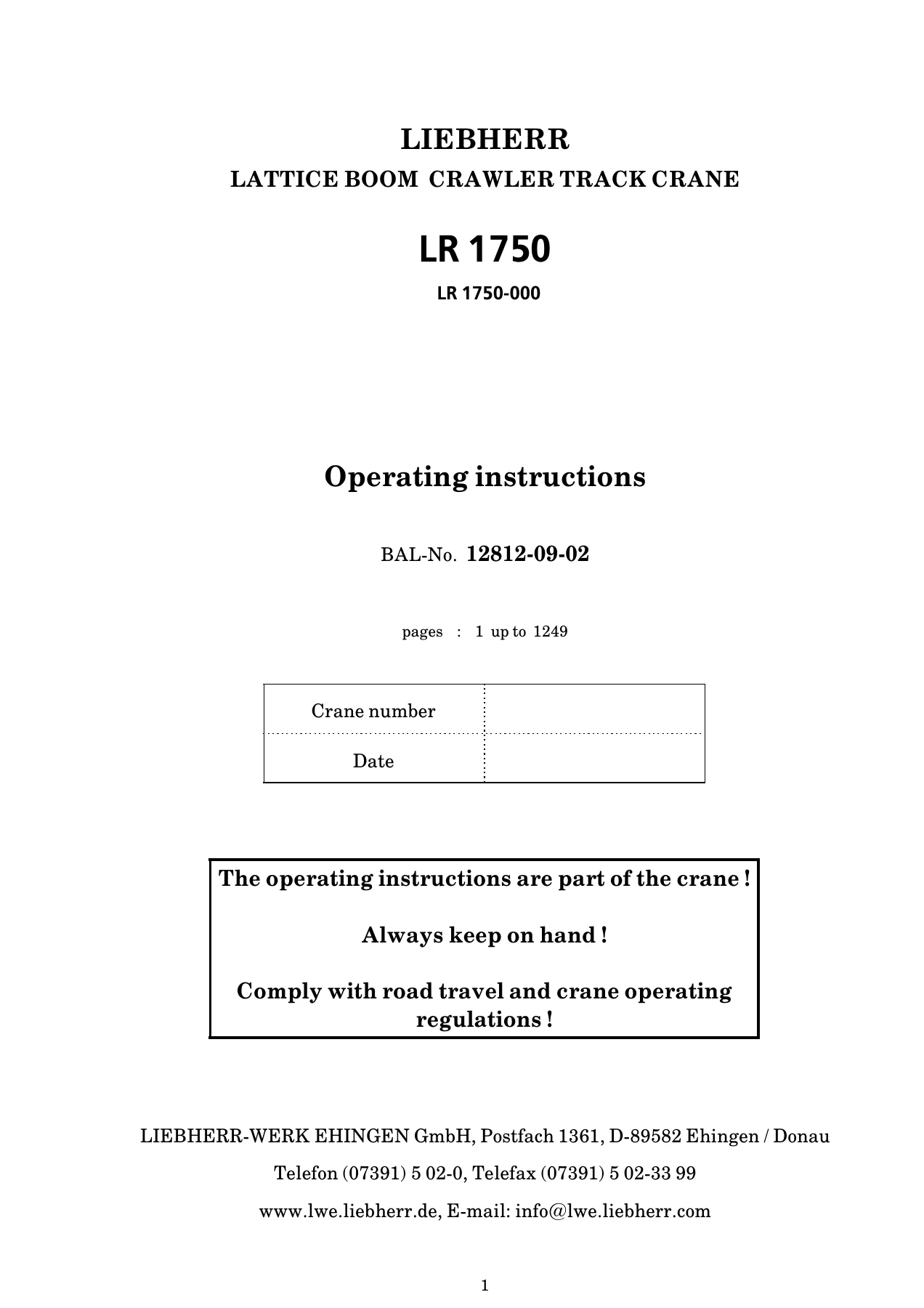
Liebherr LR 1750 Lattice Boom Crawler Crane Operating Instructions Manual 12812-09-02 – PDF
Original price was: $44.95.$27.95Current price is: $27.95.
Complete 1,249-page Liebherr operating instructions for the LR 1750 and LR 1750-000 lattice boom crawler track crane, issued as BAL-No. 12812-09-02. Covers assembly, LICCON setup, boom systems, ballast, cable reeving, maintenance and inspections.
Description
Liebherr LR 1750 Operating Instructions – BAL-No. 12812-09-02
This is the complete operating instructions document for the Liebherr LR 1750 and LR 1750-000 lattice boom crawler track crane, published by Liebherr-Werk Ehingen GmbH under document number BAL-No. 12812-09-02. The manual runs across 1,249 pages and is written for the crane operator and the assembly crew, covering everything from the terminology used on the machine to crane assembly, LICCON configuration, boom and jib combinations, ballast handling, load charts, service intervals and recurring inspections.
Because the LR 1750 is a large crawler crane with several interchangeable boom systems, the operating instructions are structured around equipment configurations rather than around a single fixed setup. The document repeatedly states that the LICCON overload safety device must be set to match the actual equipment configuration on the machine – the chapters on boom combinations, slewing platform ballast and derrick ballast explain exactly how each configuration is built, pinned, guyed, erected and taken down.
File Details
- Manual type: Operating instructions
- Brand: Liebherr
- Model: LR 1750 / LR 1750-000
- Document number: BAL-No. 12812-09-02
- Language: English
- Page count: 1,249 pages (pages 1 up to 1249)
- File format: PDF
Chapters Covered
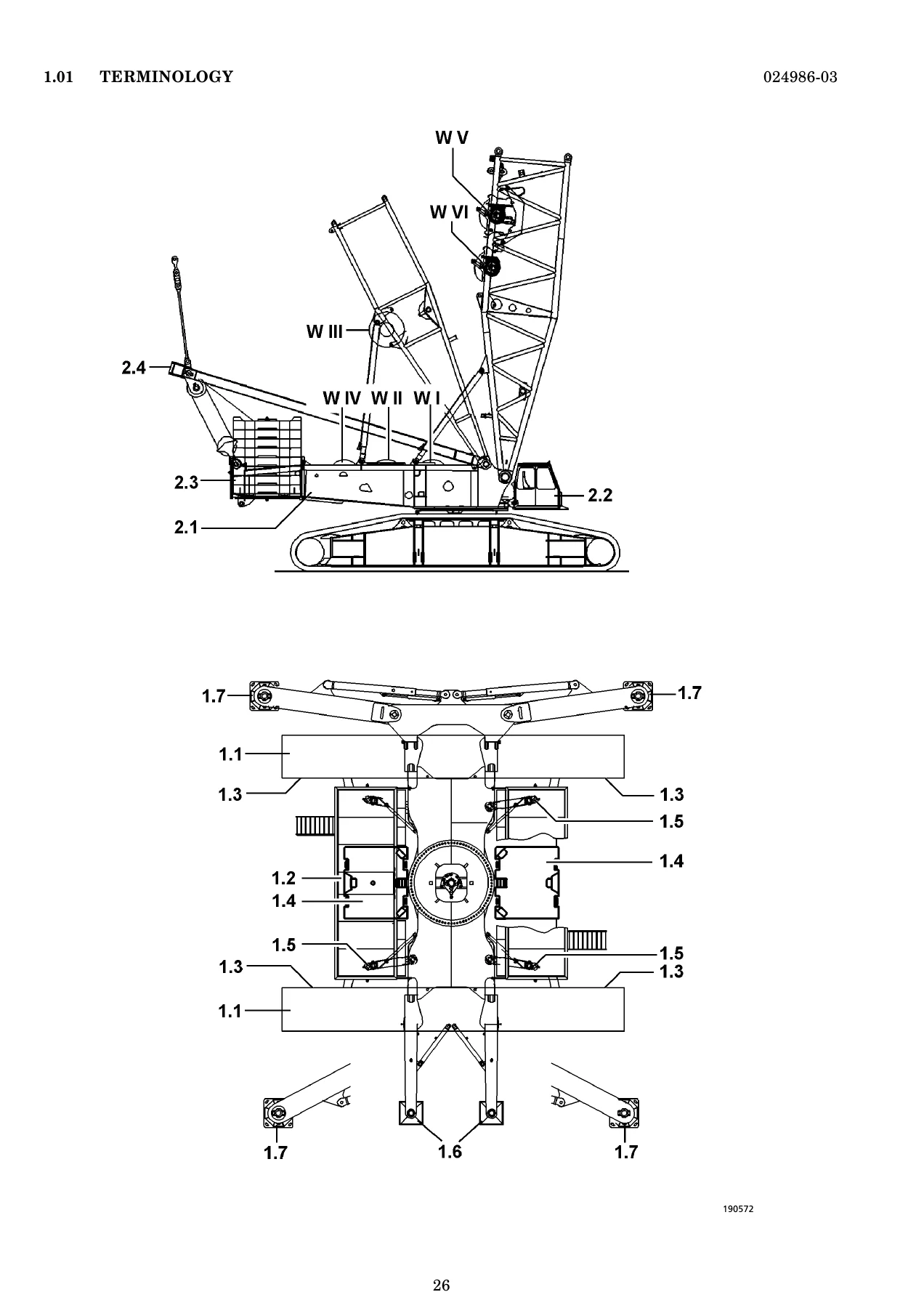
- Chapter 1 – Description of the Crane: Terminology, product description, technical data, load tackle, workplace emission values, speeds, transport weights and centres of gravity
- Chapter 2 – Safety: Operational planning, safety-technical notes, requirements of the crane operator, selecting an operating site, slopes and trenches, permissible ground-bearing load, grounding the crane and the load, thunderstorms, welding on the load, auxiliary power supply, working near transmitters, hand signals, wind conditions, interruption of crane work, parking the crane
- Chapter 3 – Crane Assembly: Installation of crawler gear, installation of slewing platform with Quick Connection, central ballast (20 t / 45 t / 95 t and 110 t configurations), crane support and support control units, installation conditions and maximum permissible slewing platform ballast
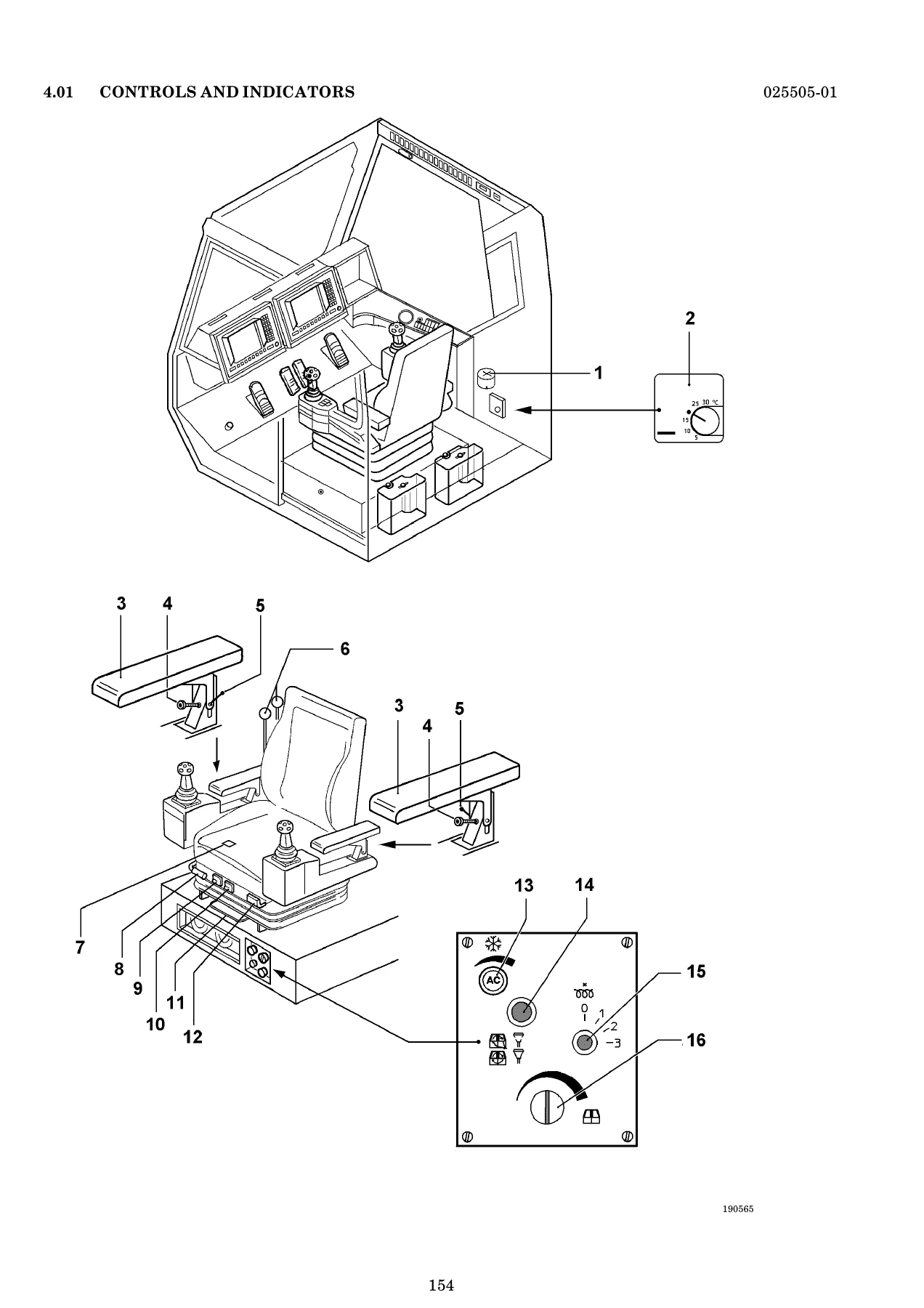
- Chapter 4 – Operation of the Superstructure: Controls and indicators, LICCON computer system (Set up, Operation, Control Parameter, Support and Engine monitoring programs), starting up the crane, safety devices, crane operation, cable reeving plans, slewing platform ballast, working with a load, two-hook operations
- Chapter 5 – Equipment: SA-bracket, attachment lattice mast systems, S/SL boom combination, SD boom combination, SDW boom combination, WV attachment, radio remote control, 60 t boom nose, ballast trailer, suspended ballast, auxiliary jib HS (SL2 / SL3HS / SL4HS / SL8HS / SL7DHS), installation boom S3, SLK boom, pin pulling device
- Chapter 6 – Additional Equipment: Heating and emergency control
- Chapter 7 – Service and Maintenance: Servicing and maintenance, maintenance intervals on crane chassis, maintenance intervals on crane superstructure, maintenance instructions, lubrication chart and filling capacities, lubricant table, diagnostics
- Chapter 8 – Crane Inspections: Repeat crane inspections, code of practice for examination and discard of crane wire ropes, testing of safety controls on relapse supports, checking and filling the relapse accumulator cylinders, inspection and maintenance of tension columns
- Chapter 9 – General Notes: Guidelines to prevent fires in the engine area and important service work to be performed
Taken as a whole, the LR 1750 operating instructions give the reader a full working picture of the machine: how the crawler carriers, centre section and slewing platform go together, how each lattice boom system is pinned and guyed, how the LICCON computer is configured to match what is actually bolted to the crane, and what the operator is required to check before, during and after a lift.
Boom Systems and Attachment Configurations
The manual documents the full range of lattice boom systems used on the LR 1750, including the S main boom, the SL main boom, the SW combination with luffing lattice jib, the SD and SDW derrick combinations, the WV attachment, the auxiliary jib HS variants and the SLK articulated boom. Each combination is presented with its permissible lengths and the derrick boom length where one is used, for example S boom combinations from 21.0 m to 84.0 m, SD combinations with S from 35.0 m to 140.0 m and D at 31.5 m, SL combinations from 28.0 m to 105.0 m, SW with S from 35.0 m to 63.0 m and W from 28.0 m to 105.0 m, and SL7DHS from SL 105.0 m to 147.0 m with D at 31.5 m and HS at 6.0 m.
Hoisting height curves for these systems are included, along with the reeving plans that show how the hoist cable is routed between the pulley head and each hook block – from the single pulley 50 t block up to the 2 x 11 pulley 600 t double hook block. Asymmetric reeving rules, permissible hook block combinations and the cable lock and hoist limit switch weight fitting procedure are all set out in the cable reeving chapter.
Safety, Ballast and Load Handling
A significant part of the document is devoted to the conditions that must be satisfied before a load is lifted. That includes the permissible ground-bearing load tables, minimum safety distances from overhead lines by rated voltage, the rules for slopes and trenches, and the restrictions on wind speed. It also covers the ballast side of the machine: slewing platform ballast plate combinations up to 245 t on the slewing platform itself and up to 250 t on the extended slewing platform, plus the ballast trailer and suspended ballast arrangements with their own radii, support cylinder procedures and difference-force monitoring between the left and right ballast guying.
The manual also explains the derrick ballast overload safety logic on monitor 1, including test point 1 minimum and maximum force limits, what happens when the derrick ballast lifts off the ground, and which crane movements are shut off at each stage of utilisation.
Service, Lubrication and Recurring Inspections
The maintenance portion of the document is unusually detailed for an operating manual. It lists maintenance intervals for the crane chassis and the crane superstructure, filling capacities for the travel gear boxes, winches, slewing gear, pump transfer case, hydraulic tank, engine oil and coolant, and a multilingual lubricant table specifying the approved oils and greases for each application and ambient temperature band. The diagnostics chapter explains the bus system layout, how to read LICCON error codes, how to work through the multi CPU test system and how to carry out LSB sensor programming.
Chapter 8 sets out the recurring inspection obligations, including the theoretical service life calculation for the hoist winches with worked examples, the discard criteria for crane wire ropes in line with ISO 4309, and the inspection checklists for the crawler middle section, cross beam, crawler track, slewing platform frame, lattice jib, brackets, pulley head, guy rods and lattice boom.
What This Manual Lets You Do
With the Liebherr LR 1750 operating instructions on hand, a crane operator or assembly crew can work through the full setup sequence for a given job: selecting the correct equipment configuration, ballasting the slewing platform or derrick to match the load chart, erecting the boom system, setting the LICCON parameters and reeving numbers, and confirming that every limit switch and safety device is in place before the first lift. It supports the day-to-day decisions as well, such as verifying ground pressure, checking overhead line clearances, judging wind limits, and knowing which movements are shut off by the overload safety at any given utilisation.
Because the manual is configuration-driven, it is also the reference that tells you what is and is not permitted on this machine – which boom lengths can be lifted in flying installation, which counterweight combinations are allowed for a given support base, where the guy rods must be pinned, and which pins must be removed before the crane is put back into operation. Getting these details wrong on a crane of this size is not a minor matter, and the document is direct about that throughout.
IMAGES PREVIEW
Delivered as an instant PDF download, the manual can be opened on a laptop, tablet or phone in the cab, printed for the site office, or kept on file for reference during assembly and maintenance planning. There is no shipping and no waiting – the file is available immediately after checkout.

Reviews
There are no reviews yet.