
Manitou ML MT Series 3-E2 Telehandler Operator’s Manual 547848 EN – PDF Download
Original price was: $52.95.$34.95Current price is: $34.95.
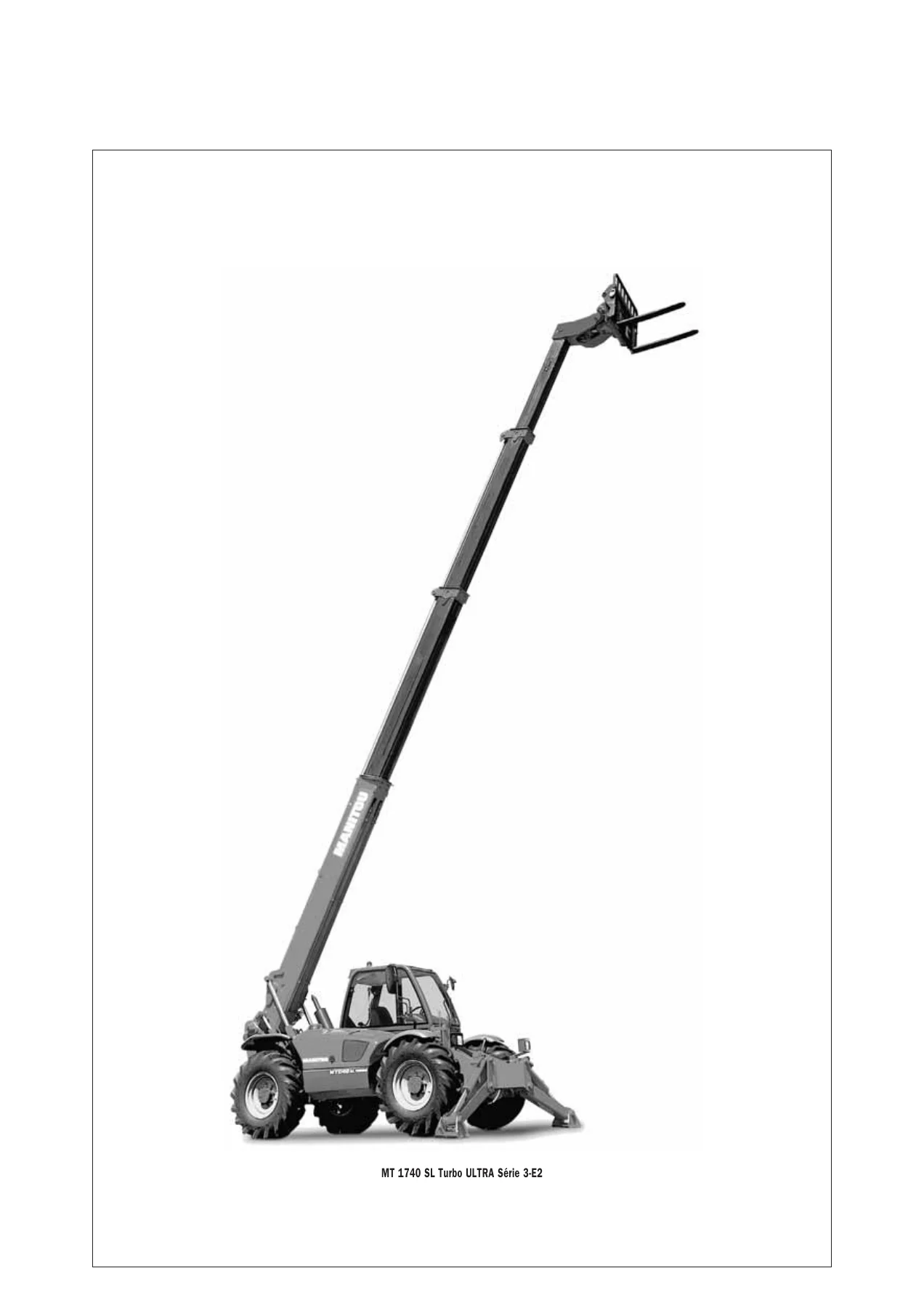
Complete operator’s manual for Manitou ML 635, MT 940 L, MT 1235 S, MT 1240 L, MT 1335 SL, MT 1340 SL, MT 1435 SL, MT 1440 SL and MT 1740 SL Turbo Serie 3-E2 telehandlers. Covers operating, safety, maintenance and attachment procedures. Document 547848 EN, dated 02/05/2007, 233 pages.
Description
This is the complete operator’s manual for the Manitou ML and MT Series 3-E2 range of telescopic lift trucks, published under document number 547848 EN and dated 02/05/2007. It covers the ML 635 Turbo, MT 940 L Turbo, MT 1235 S and Turbo, MT 1240 L Turbo and ULTRA, MT 1335 SL and Turbo, MT 1340 SL Turbo and ULTRA, MT 1435 SL and Turbo, MT 1440 SL, Turbo and Turbo ULTRA, and MT 1740 SL Turbo and ULTRA models. Everything the operator, fleet supervisor or service technician needs to run, inspect and maintain these machines safely is contained in this one document.
File Details
- Manual type: Operator’s Manual
- Brand: Manitou
- Series: ML/MT Serie 3-E2
- Document number: 547848 EN
- Date of issue: 02/05/2007
- Language: English
- Page count: 233
- File format: PDF
Chapters Covered
- 1 – Operating and Safety Instructions
- 2 – Description
- 3 – Maintenance
- 4 – Adaptable Attachments in Option on the Range
1 – Operating and Safety Instructions
This chapter establishes the full safety and operating framework for the ML and MT Series 3-E2 telehandlers. It covers operator authorisation and qualifications, assessment of the lift truck’s suitability for the job, adaptation to standard environmental conditions (operation between -15 °C and +35 °C, ventilation requirements for indoor use, electromagnetic compatibility limits of 10 V/m, and vibration exposure guidance under Directive 2002/44/EC), and restrictions on modifying the machine. The operating instructions section walks through pre-start checks, driver’s cab rules, starting, driving, stopping and public highway use. Load handling is treated in depth: attachment choice, load mass and centre of gravity (the load chart is based on a 500 mm load centre from the fork face), the longitudinal stability alarm, transverse attitude, and procedures for taking up and laying loads on tyres and on stabilisers. Platform (ORH) operation, radio-control use, general maintenance instructions and long-term storage procedures are also included.
2 – Description
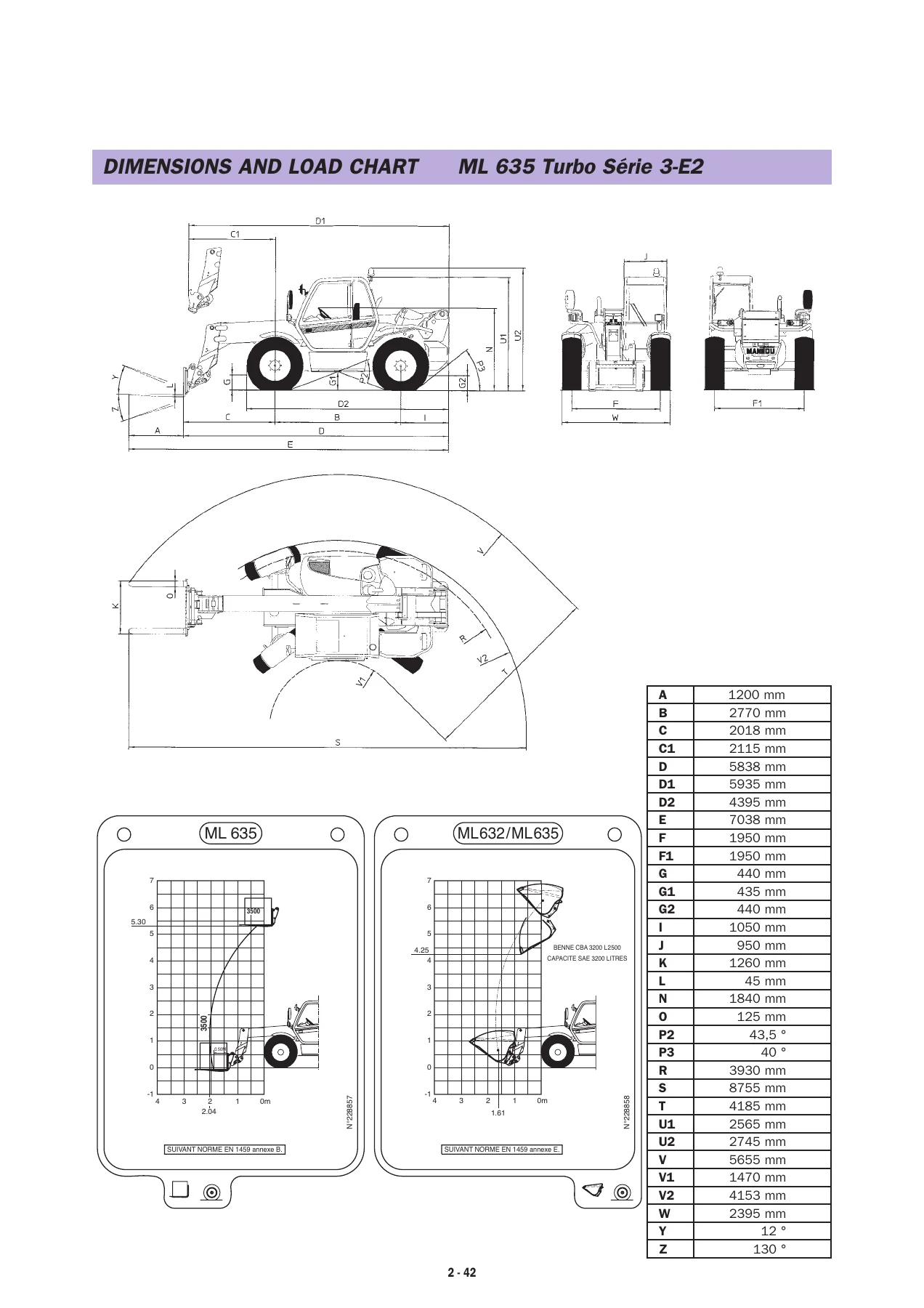
This is the reference chapter. It contains the characteristics tables for every model in the range — engine type (Perkins 1104C-44 and 1104C-44T), cooling circuit, transmission (Turner Powertrain Systems with Sachs torque converter), front and rear axles (DANA), brakes, electric circuit (12 V, 110 Ah, 750 A battery), tyres (with pressures, tyre loads and contact surface areas for both hard and light ground), hydraulic circuit (pump type, capacity, flow rates at 2300 and 1600 rpm, pressures and filtration), sound pressure levels in the cab, travel speeds, standard lift heights, rated capacities, axle weights, tensile strain at the coupling hook and break-out force with bucket. Dimensions and load charts for every model follow, then the instruments and controls layout (numbered 1 through 39, from driver’s seat to tilting corrector indicator), the towing pin and hook, and the description and use of electric and hydraulic options — cutting-off of simple and aggravating hydraulic movements, Cleanfix self-cleaning fan, Digicode and Fintronic anti-theft systems, preheating rod, jib head electrovalve, trailer locking, rear hydraulic control predisposition and the single side-shift carriage (TSDL).
3 – Maintenance
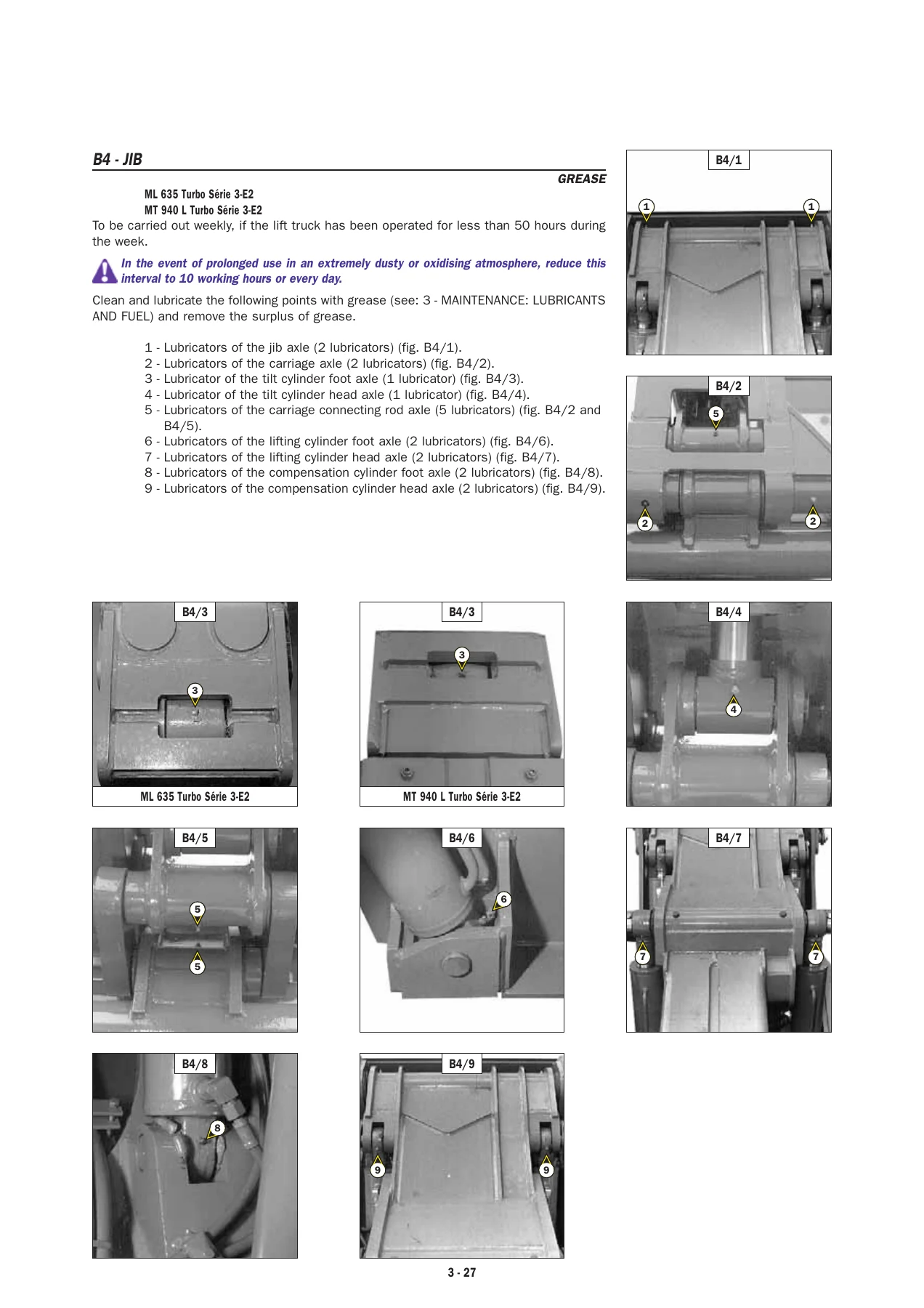
The maintenance chapter opens with the filters, cartridges and belts reference (part numbers and change intervals per model), the lubricants and fuel specifications (capacities, recommendations and part numbers for engine, transmission, hydraulics, braking, cab and axles), and the complete servicing schedule — daily or every 10 hours, every 50 hours, every 250 hours, every 500 hours, every 1000 hours, every 2000 hours, occasional maintenance and every two years for air conditioning. Individual procedures are then set out in full: engine oil level and drain, engine oil filter change, cooling liquid level and drain, fuel level and fuel tank cleaning, cyclonic prefilter clean, transmission oil level and strainer, hydraulic oil level, hydraulic return and pressure oil filter cartridges, brake fluid level, windscreen washer liquid, tyre pressures and wheel nut torque (630 N.m ± 15%), jib pads, dry air filter cartridge and safety cartridge, radiator core and condenser core, fan belt, alternator belt and compressor belt tension, angle gear box oil level and drain, parking brake check and adjustment, cab ventilation filter, front and rear axle differential oil levels, front and rear wheels reducers oil levels, greasing points across the jib, carriage, tilt cylinder, lifting cylinder, compensation cylinder, universal joints, tilting corrector and stabilisers, seat belt inspection, wheel change procedure, towing and transport, headlamp adjustment, fuel system bleeding, and the two-year air conditioning service.
4 – Adaptable Attachments in Option on the Range
This chapter covers the interchangeable attachments available for the ML and MT Series 3-E2 range. It details the procedures for picking up and laying attachments with different locking systems: attachment without hydraulics and hand locking device, attachment without hydraulics and hydraulic locking device, hydraulic attachment with hand locking device, and hydraulic attachment with hydraulic locking device — with model-specific instructions for each variant. Technical features of the attachments are listed: floating fork carriages (TFF), floating forks, standardized swinging fork carriers (PFB), carriages with side-shift (TDL and TDLA), standardized forks, load back rests, building buckets (CBC), loading buckets (CBR), grain buckets (CBA), 4×1 buckets, multipurpose buckets (CBM), buckets with grab (CBG and variants), concrete buckets (BB, BBH, BBG, BBHG), spout buckets (GL), manure forks with grab (FFGR), crane jibs (P, PT, PO, PC) and winches (H3T, H4T). Attachment shields and protectors are also listed.
What This Manual Lets You Do
With the Manitou ML MT Series 3-E2 operator’s manual in hand, you can carry out daily and periodic maintenance on every model in the range without guesswork. You can check and top up engine oil, coolant, transmission oil, hydraulic oil, brake fluid and windscreen washer. You can adjust fan, alternator and compressor belts. You can clean and change air, fuel, transmission and hydraulic filters. You can grease every lubrication point on the jib, carriage, axles, universal joints and stabilisers. You can check tyre pressures and wheel nut torque. You can adjust the parking brake. You can change a wheel safely on the roadside. You can bleed the fuel system after a filter change or a run-dry. You can set headlamp aim. You can follow the correct picking-up and laying procedures for every approved attachment, from floating forks to grain buckets to crane jibs and winches. And you can understand the safety systems — the longitudinal stability alarm, the simple and aggravating hydraulic movement cut-outs, the anti-theft systems — that keep the machine and its operator safe.
Why This Matters
Manitou telehandlers are expensive, hard-working machines. Running them on guesswork leads to premature wear, damaged hydraulics, overheated transmissions, failed brakes and, in the worst cases, tipped loads and injured operators. The servicing schedule in this manual is the manufacturer’s own schedule, with the correct intervals and the correct lubricants. The torque figures, tyre pressures, oil capacities and belt tensions are the values Manitou specifies for these machines, not generic workshop estimates. The load charts tell you exactly what each model can lift at each reach and height, on tyres or on stabilisers, with the standard attachment or an approved optional one. The operating and safety instructions explain how to handle loads, how to travel on slopes, how to work near power lines, how to use the longitudinal stability alarm correctly and how to react when it warns you. Following this manual is how you protect the machine, the load, the operator and everyone else on site.
IMAGES PREVIEW
Instant PDF Delivery
The manual is delivered as a PDF file immediately after payment. There is no shipping, no waiting for a courier and no physical book to lose. You can open it on a laptop, tablet or smartphone in the cab, in the workshop or on site. You can print the pages you need — a load chart for the machine you are running, a greasing diagram for the service you are doing, a torque table for the job in front of you. The file is the complete document: all 233 pages, all four chapters, every model in the ML and MT Series 3-E2 range, exactly as Manitou published it under document number 547848 EN.


Reviews
There are no reviews yet.