
Mitsubishi Logisnext FB10-8 FB15-8 FB18-8 FB20-8 FB25-8 FB30-8 FB35-8S Electric Forklift Operation & Maintenance Manual – PDF
Original price was: $52.95.$34.95Current price is: $34.95.
Complete Operation & Maintenance Manual for Mitsubishi Logisnext FB10-8, FB15-8, FB18-8, FB20-8, FB25-8, FB25-8LB, FB25-8V, FB30-8, FB30-8V and FB35-8S electric counterbalanced forklift trucks. Covers safety, operating controls, operation, maintenance, specifications and service data. Instant PDF download.
Description
Mitsubishi Logisnext FB10-8 to FB35-8S Electric Forklift — Operation & Maintenance Manual
This is the complete Operation & Maintenance Manual for the Mitsubishi Logisnext FB10-8, FB15-8, FB18-8, FB20-8, FB25-8, FB25-8LB, FB25-8V, FB30-8, FB30-8V and FB35-8S series of counter-balanced electric forklift trucks. Published under document number OMBBE-7P0170 in October 2017, it is the manual that ships with the truck and is written for both the operator and the supervising technician. It covers daily preoperational checks, the full instrument and control layout, safe load handling, battery care and charging, periodic inspection schedules, and the specifications and service data needed to keep the truck running correctly.
File Details
- Manual Type: Operation & Maintenance Manual
- Brand: Mitsubishi Logisnext
- Models Covered: FB10-8, FB15-8, FB18-8, FB20-8, FB25-8, FB25-8LB, FB25-8V, FB30-8, FB30-8V, FB35-8S
- Document Number: OMBBE-7P0170
- Issued: October 2017
- Language: English
- File Format: PDF
Chapters Covered
- 1. SAFETY
- 2. OPERATING CONTROLS
- 3. OPERATION
- 4. MAINTENANCE
- 5. SPECIFICATIONS & SERVICE DATA
- 6. INDEX
Chapter 1 — Safety
This chapter opens with the safety alert symbol and signal-word definitions used throughout the manual, then moves into supervisor-level accident prevention: training operators to stack and unstack safely, sending home tired or unwell operators, wearing the correct protective gear, and keeping fire extinguishers and first-aid kits in place. It explains how to plan a working area with marked travel lanes and posted speed limits, how to keep pedestrians and unauthorised vehicles out, and how to maintain adequate lighting and level, dry ground. It also covers proper and improper uses of the truck, choosing the right truck for the job, pre-operation inspections, transporting the truck on a trailer or lifting it in an emergency, travelling on public roads, and the rules on modifications. Later sections explain how the lift truck works, the load-handling fundamentals, parking, inspection and service safety, and preventing vehicle fires. A full set of caution-plate illustrations is included.
Chapter 2 — Operating Controls
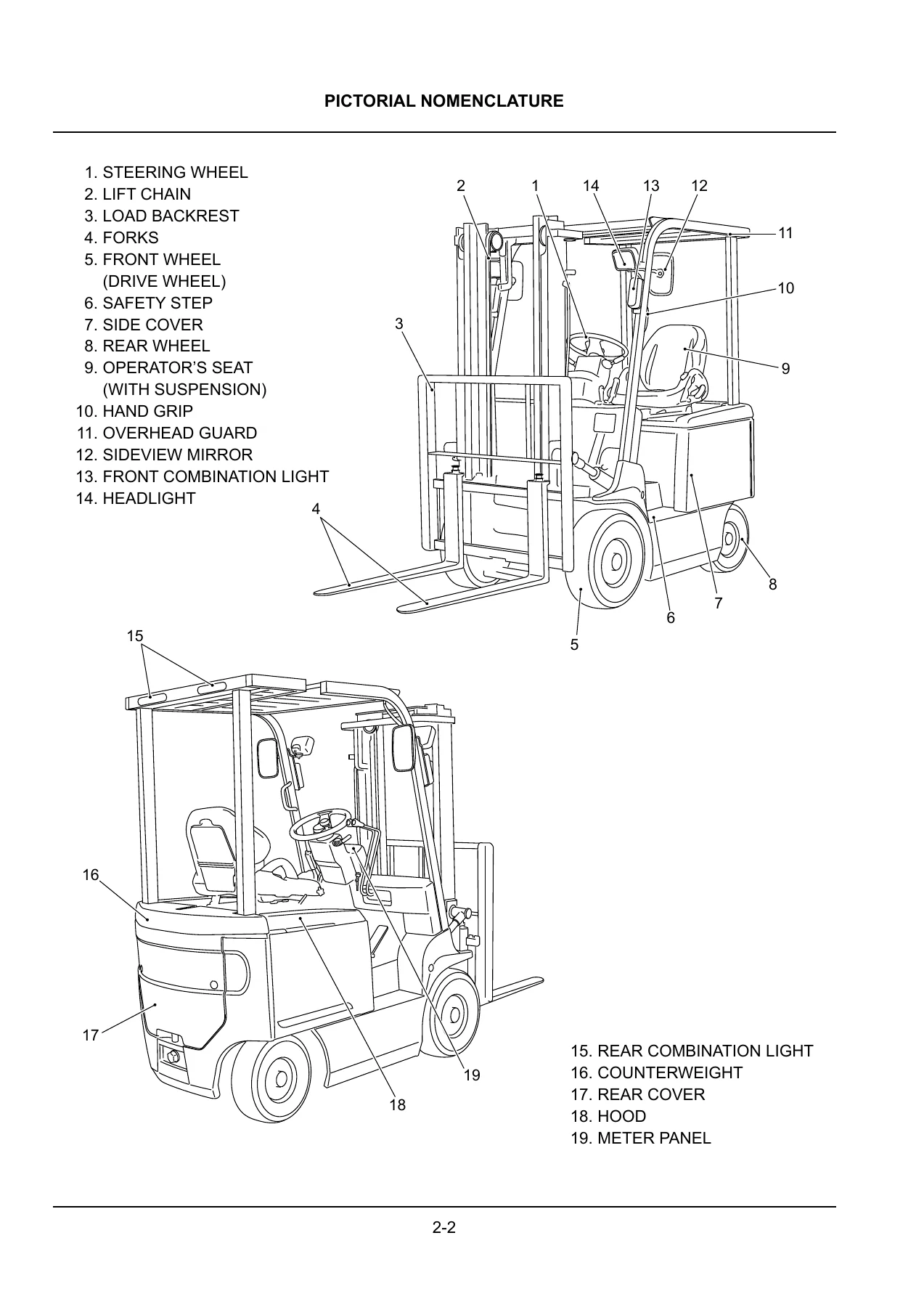
A pictorial nomenclature spread identifies the steering wheel, lift chains, load backrest, forks, drive and rear wheels, safety step, side covers, suspension seat, hand grip, overhead guard, sideview mirror, headlights and combination lights. The instruments and controls section walks through the key switch, combination lighting and turn-signal switch, horn button, meter panel and key pad, and the S.P.E. power-mode button. It explains the regenerative braking system in both brake-regeneration and switch-back regeneration forms, the error screen and controller/motor overheat warnings, the power-consumption screen, the interlock system and how to release it, and the parking-brake alarm. Levers and pedals are covered in detail, including the F/R lever, steering wheel, parking brake lever, tilt steering wheel lever, lift lever, tilt lever, brake pedal and accelerator pedal, plus the truck body features such as the seat suspension, seat belt, documents pocket, hood stopper, overhead guard, load backrest, tow pin, fork stoppers, fork lock bolt, safety step and hand grip. Optional equipment such as the rear work light, beacon light, forward travel chime, load meter and fork positioning laser is also described.
Chapter 3 — Operation
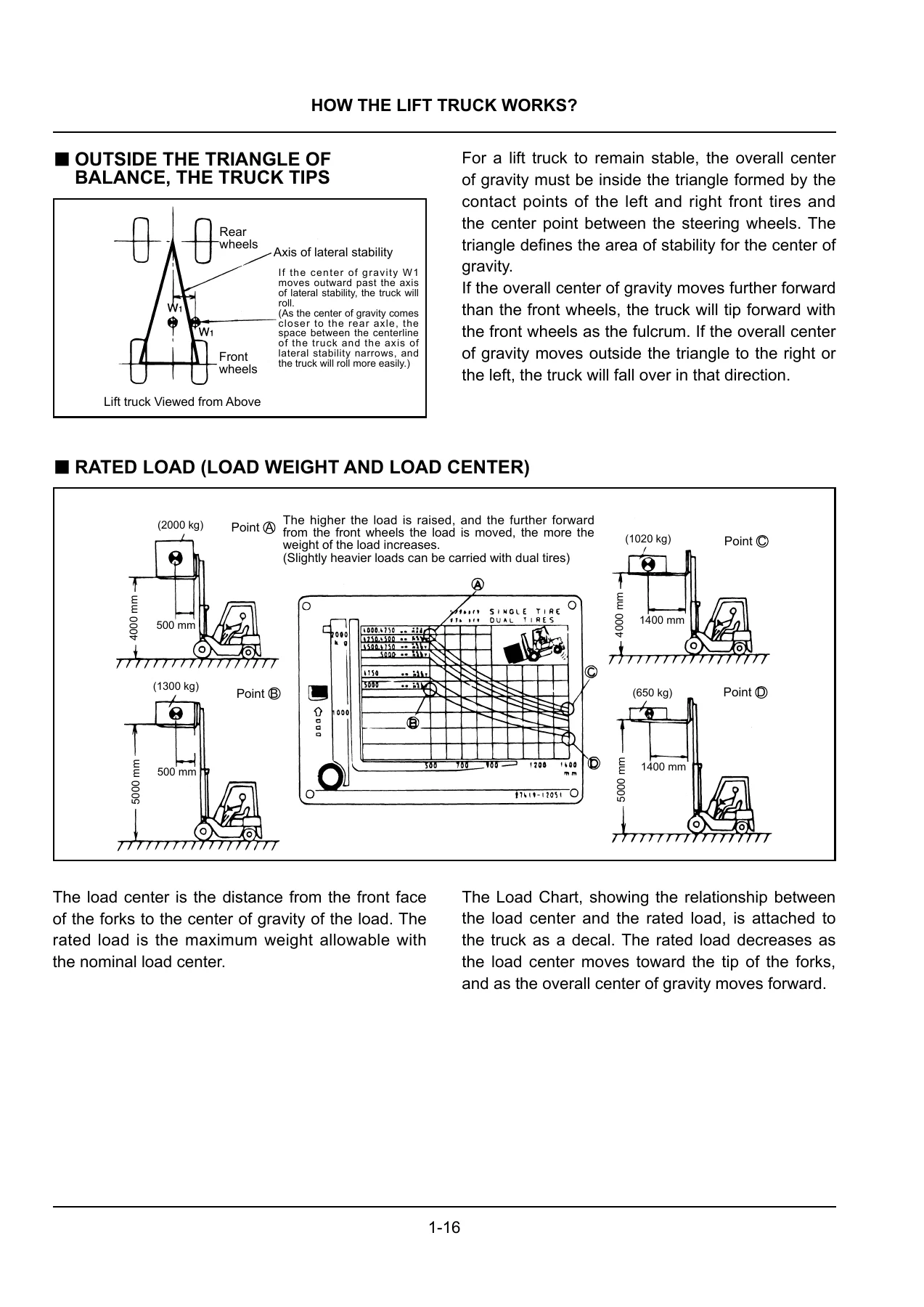
This chapter explains proper operation during the break-in period, the relationship between load and truck stability, basic load centre and rated load, and the stability triangle that determines whether the truck tips. It covers travelling and starting on a slope, transporting the lift truck by trailer including ramp angles and ramp length, moving a disabled truck in an emergency, and general operating technique. A substantial section is dedicated to handling and charging the battery, including daily charge, equalising charge, auxiliary charge and super equalising charge procedures, battery electrolyte level checks, specific-gravity conversion at various temperatures, and the power-supply equipment requirements for the battery charger. Load handling is covered step by step: pick-up, stacking, unstacking and storing. The chapter closes with daily and long-term storage, operating after long-term storage, the prohibition on washing the truck body and battery with water, a table of washable and non-washable items, and the cold-storage specification truck options (CS35, FCS35, FCS45 and the fishery FC specification).
Chapter 4 — Maintenance
The maintenance chapter begins with general rules on inspection and a detailed preoperational checklist: general truck condition, oil and water leaks, tyre condition and inflation pressures, hub-nut torque checks, overhead guard, brake fluid level, rear combination lights, licence number plate light, hydraulic oil level, hydraulic piping and cylinders, load backrest, forks, fork stoppers and fork lock bolt, headlight and front combination light, battery electrolyte level and battery stopper, seat belt, operator seat and steering column adjustment, sideview mirror, parking brake lever, load handling levers, lights, turn signals, horn, brake pedals, mast operation and lift-chain tension. It explains how to replace tyres and repair a flat, how to adjust the operating force of the parking brake lever, and then lays out the full periodic inspection and periodical replacement schedule for safety parts. Weekly (50 operating hours), monthly (200 operating hours), 3-month (600 operating hours), 6-month (1200 operating hours) and annual (2400 operating hours) checks are each listed, followed by the periodical check schedule covering the electric system, power train, hydraulic system, safety devices and lubricants.
Chapter 5 — Specifications & Service Data
Specifications are given for the EXB, EXE and EXN model variants, covering maximum load, basic load centre, maximum lifting height, free lift, fork lifting speed, travelling speeds in S, P and E modes, gradeability, minimum turning radius, minimum aisle width, overall dimensions, wheel base, tread, fork size and spacing, truck weight and mast weight. Travelling and hydraulic motor ratings are listed, along with battery capacity, charger input and output ratings, travelling speed control unit, load control unit and tyre sizes and inflation pressures. Load charts are reproduced for each model. Service data includes brake pedal height and play, parking brake lever operating force, control valve relief set pressures, vibration and sound pressure level, replacing light bulbs and fuse capacities. Bolt and nut torque values are grouped by component — mast support cap bolts, rear axle mount bolts, rear wheel hub bolts, front axle mount bolts, front wheel hub bolts and drive shaft mount bolts — and refill capacities with recommended lubricants are tabulated. The chapter ends with truck serial number location, serial numbers of major components, genuine parts and lubricants, and a record page.
Why This Manual Matters for Your FB-Series Forklift
Electric counterbalanced forklifts are heavy, high-voltage machines, and the FB10-8 through FB35-8S series is no exception. Getting a load calculation wrong, charging a battery with the wrong procedure, or missing a periodic inspection can lead to a tipped truck, a burnt-out drive motor or an exploded battery. This Mitsubishi Logisnext FB series operation and maintenance manual gives you the exact figures and sequences the manufacturer specifies — load charts, tyre pressures, hub-nut torques, relief set pressures, chain tension adjustment, brake fluid type, hydraulic oil grades, battery electrolyte specific gravity at temperature, and the full 50/200/600/1200/2400-hour service schedule. For a workshop, a fleet manager or an owner-operator, that means jobs can be planned and completed without guesswork.
IMAGES PREVIEW
Instant PDF Delivery
The manual is delivered as an instant PDF download after payment — no shipping, no waiting for a printed copy. Read it on a laptop, tablet or phone in the workshop, or print the pages you need for the job at hand. Keep a copy on the truck for quick reference during pre-operation checks, and another in the office for planning periodic maintenance. Because it is a digital file, you can search within it, zoom into the load charts and torque tables, and reprint worn pages as often as you like.
Reviews
There are no reviews yet.