
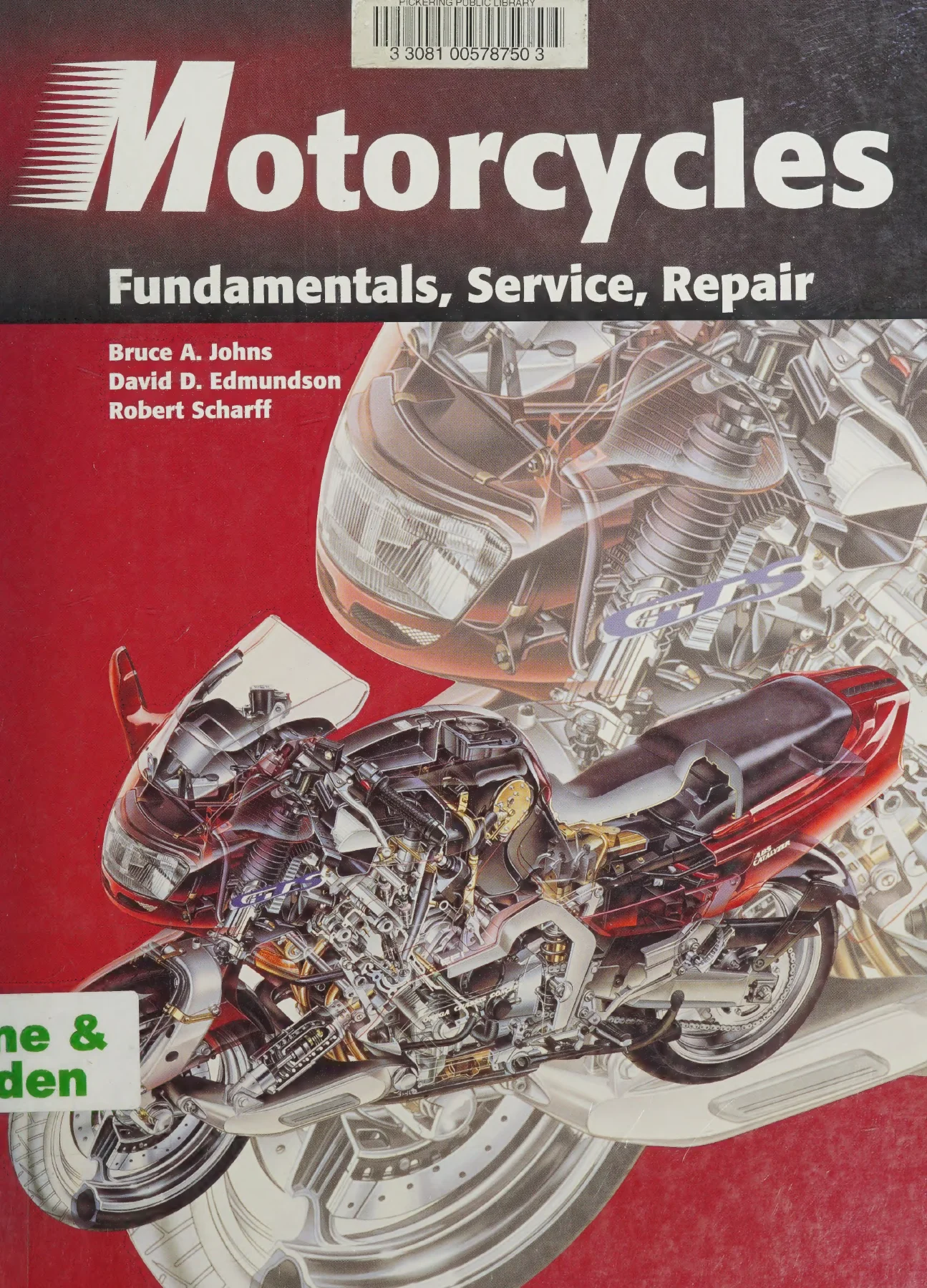
Motorcycles Fundamentals, Service and Repair 3rd Edition 1999 – Motorcycle, ATV & Scooter Repair Textbook PDF
Original price was: $34.95.$20.95Current price is: $20.95.
Third edition technical textbook covering motorcycle, ATV, and scooter fundamentals, maintenance, diagnosis, service, repair, engine overhaul, electrical systems, fuel systems, brakes, suspension, transmission, tune-up, tools, measurements, and workshop practices. Written in general terms for multiple makes and models, with extensive diagrams, service procedures, troubleshooting material, and repair illustrations.
Description
Motorcycles Fundamentals, Service and Repair 3rd Edition 1999 – Motorcycle, ATV & Scooter Repair Textbook PDF is a comprehensive technical training and reference book by Bruce A. Johns, David D. Edmundson, and Robert Scharff. The third edition is designed to prepare readers to work on motorcycles and, because of their similar engineering, also covers all-terrain vehicles and scooters. Its material is written in general terms that apply across motorcycle, ATV, and scooter makes and models rather than being a model-specific factory service manual.
The book combines operating theory with workshop practice. It explains how systems are built and how they function before moving into testing, maintenance, diagnosis, disassembly, repair, measurement, overhaul, reassembly, adjustment, and general service. Numerous illustrations support the written material, including component drawings, operating diagrams, system layouts, exploded views, measurement examples, troubleshooting charts, and service procedures.
File Details
- Manual type: Technical training textbook and general service/repair reference
- Coverage: Motorcycles, ATVs, and scooters
- Edition: Third edition
- Publisher: The Goodheart-Willcox Company, Inc.
- Copyright: 1999
- Language: English
- Page count: 568 PDF pages
- File format: PDF
- ISBN: 1-56637-479-0
- Library of Congress Catalog Card Number: 98-23297
Designed for Broad Motorcycle, ATV and Scooter Service Training
The Motorcycles Fundamentals, Service and Repair 3rd Edition 1999 – Motorcycle, ATV & Scooter Repair Textbook PDF is not limited to one brand, model, engine size, or production year. It develops transferable service knowledge that applies to a wide range of machines. The introduction specifically describes coverage of operation, construction, design, testing, maintenance, and repair, with motorcycles receiving the main emphasis and ATV and scooter systems included where appropriate.
Early chapters establish how two-stroke and four-stroke engines work, how torque and power are produced, and how the major vehicle systems interact. The material then progresses into workshop safety, tool selection, precision measurement, fasteners, service literature, and systematic diagnosis before treating each major mechanical and electrical system in greater depth.
Workshop Tools, Measurement and Diagnostic Practice
A substantial part of this motorcycle service and repair textbook is devoted to the practical skills needed before major repairs can be performed accurately. It explains hand tools, sockets, torque wrenches, electrical test equipment, engine service tools, special service tools, wheel and suspension tools, cleaning equipment, power tools, and general shop machinery.
Precision measurement coverage includes outside, inside, and depth micrometers, dial calipers, telescoping gauges, dial indicators, dial bore gauges, feeler gauges, Plastigage, compression gauges, vacuum gauges, fluid pressure gauges, spring testers, and graduated cylinders. Examples show how measurements are used for cylinder condition, bearing clearance, shaft end play, runout, gear backlash, spring pressure, compression testing, carburetor synchronization, and other service work.
The diagnostic material stresses a systematic approach rather than replacing parts at random. Topics include verifying the customer complaint, collecting operating-condition information, classifying permanent and intermittent faults, narrowing the fault to a system, isolating the cause, confirming the diagnosis, completing the repair, and verifying the result afterward.
Engine, Fuel and Electrical Systems
The engine chapters explain both four-stroke and two-stroke designs, including valve trains, camshaft arrangements, pistons, rings, cylinders, crankshafts, crankcases, ports, combustion chambers, bearings, and engine construction. Later overhaul chapters move beyond theory into inspection, measurement, reconditioning, crankshaft and connecting-rod work, cylinder service, bearing checks, oil-system inspection, reassembly, timing, engine installation, initial running, break-in, and post-overhaul checks.
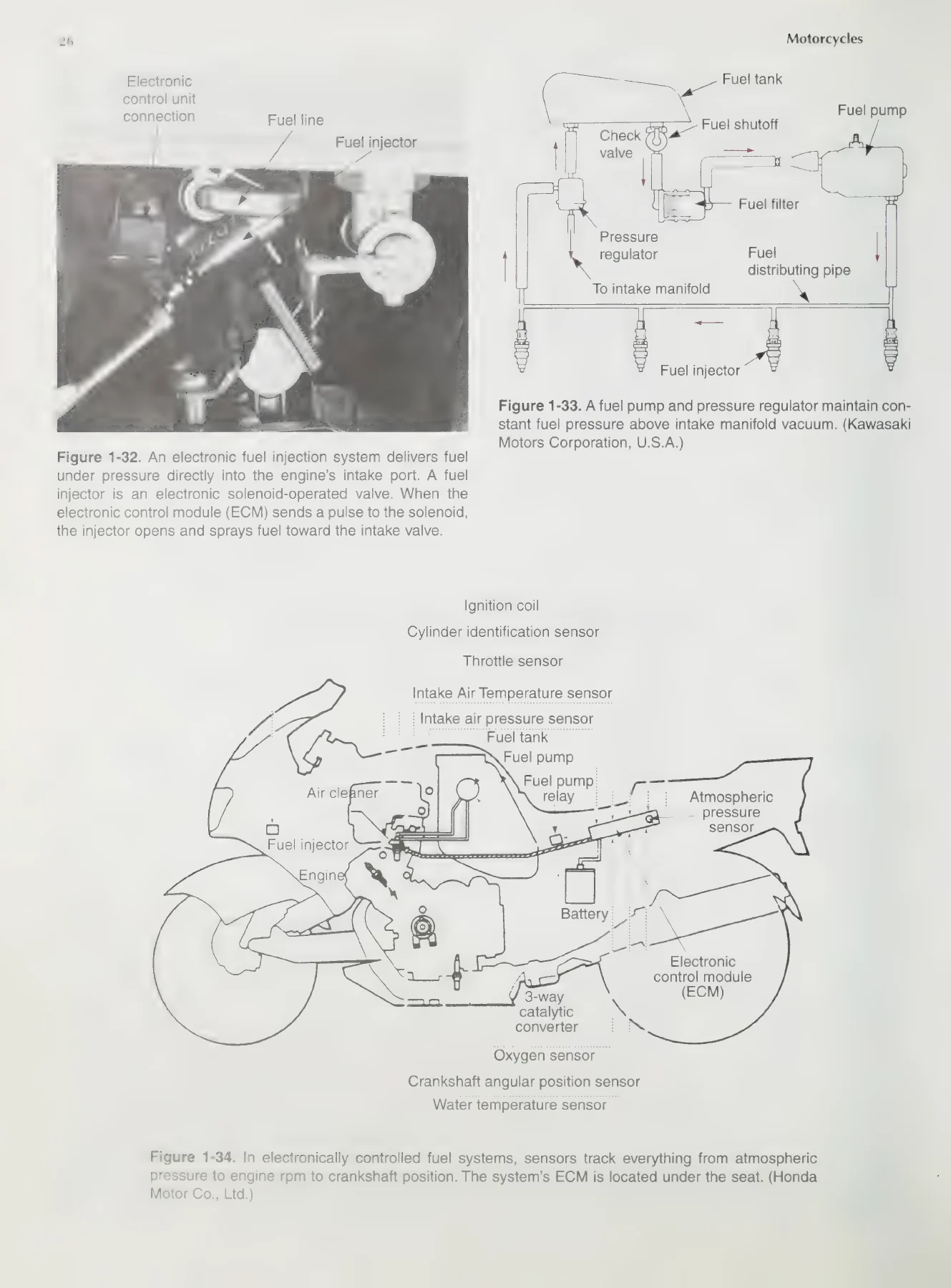
Fuel-system coverage includes tanks, petcocks, lines, pumps, filters, air cleaners, intake manifolds, throttle controls, carburetor principles, different carburetor types, idle mixture and speed adjustment, synchronization, float-level work, jet changes, carburetor removal, cleaning, inspection, rebuilding, installation, and final adjustment. Electronic fuel injection is also covered, including electronic control modules, injectors, throttle bodies, pressure regulators, sensors, control-system operation, warning-light diagnosis, and fault-code checking.
Electrical subjects range from basic electrical and electronic theory to batteries, charging systems, starting motors, ignition systems, wiring, schematics, test equipment, soldering, crimp terminals, and troubleshooting. Charging-system sections discuss alternators, rectification, voltage regulation, output testing, stator checks, charging-coil tests, parasitic draw, and fault diagnosis. Ignition coverage includes battery-and-coil ignition, electronic ignition, magneto systems, digitally controlled systems, CDI and DC/CDI arrangements, ignition timing, spark plugs, and common running problems.
Chassis, Brakes, Suspension and Power Transmission
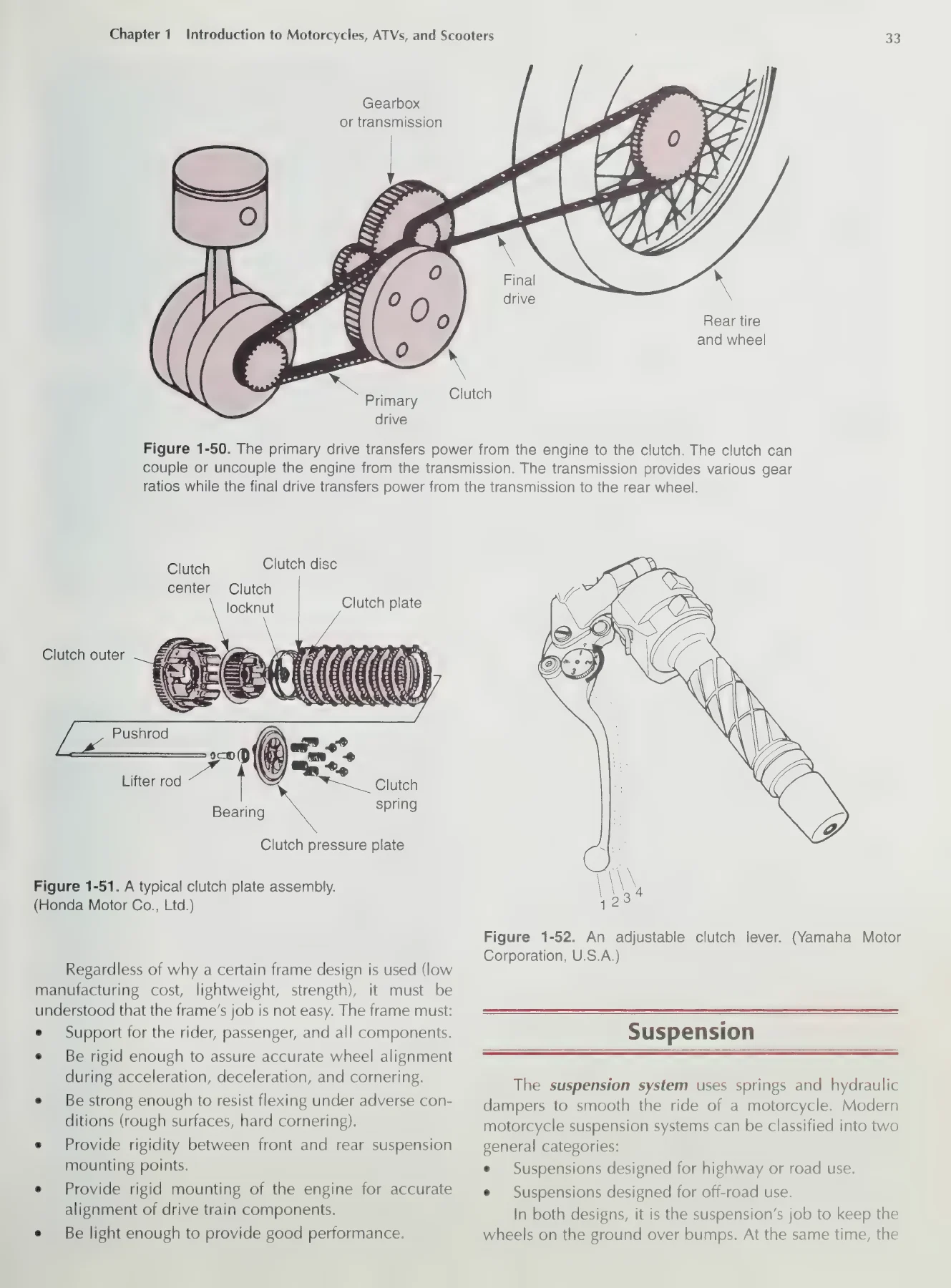
Mechanical systems outside the engine receive similarly detailed treatment. Power transmission coverage explains primary gear, chain, and belt drives; multi-plate and centrifugal clutches; manual and automatic transmissions; gear selector mechanisms; chain, belt, and shaft final drives; starting systems; and the principles of gear reduction and torque multiplication.
Wheel and tire chapters address wire, cast, and stamped wheels, wheel inspection, bearing replacement, spoke tightening and replacement, rim repair, wheel lacing and truing, tire construction, tire inspection, tire service, storage, and troubleshooting. Brake coverage includes mechanical and hydraulic operation, drum and disc brakes, wheel removal and installation, brake service, master-cylinder and caliper rebuilding, linked braking systems, anti-lock braking systems, component functions, ABS operation, and brake-system troubleshooting.
The frame and suspension chapter examines several frame designs, steering geometry, front suspension layouts, telescopic forks, pivoting-link systems, swingarms, shock absorbers, steering dampers, front suspension service, rear suspension systems, inspections, and ATV four-wheel alignment. Accessory systems include lighting, warning and indicator circuits, instrument panels, switches, horns, communication systems, and cruise control.
Engine Removal, Overhaul and Reassembly
Major repair work is developed through dedicated chapters on engine and power-transmission disassembly, two-stroke engine overhaul, four-stroke engine overhaul, and transmission overhaul. Engine removal preparation includes cleaning the vehicle, draining fluids, disconnecting electrical systems and control cables, removing carburetion or fuel-injection components, disconnecting the final drive, lifting the engine from the motorcycle, organizing parts, identifying mating components, and using holders and pullers.
Two-stroke overhaul material covers cylinder and piston inspection, damage diagnosis, measurements, decarbonizing, boring and honing, connecting-rod and bearing clearance, crankshaft condition, lower-end work, crankcase sealing, seal installation, torque sequences, leak testing, ignition timing, engine installation, and initial start-up.
Four-stroke overhaul sections cover top-end inspection, camshaft wear, cylinder-head reconditioning, piston and cylinder inspection, bearing measurements, oil-pump condition, oil passages, engine balancers, crankshaft and connecting-rod work, bearing installation, crankshaft and transmission shaft installation, sealing compounds, balancer timing, piston rings, cylinders, cam timing, engine installation, break-in, and post-overhaul checking.
Transmission overhaul extends into primary-drive service, clutch inspection and repair, transmission disassembly, shaft end play, shift mechanisms, transmission measurements, kickstart inspection, transmission shimming and reassembly, chain and belt drive inspection, shaft-drive service, and diagnosis of drive problems.
Chapters Covered
- Chapter 1 – Introduction to Motorcycles, ATVs, and Scooters: technician roles; motorcycle, ATV and scooter designs; two-stroke and four-stroke engines; power characteristics; fuel, electrical, cooling, lubrication, exhaust, transmission, chassis, wheels, brakes and accessories.
- Chapter 2 – Shop Safety and Environmental Protection: personal safety; protective equipment; shop hazards; fire prevention; environmental protection; hazardous materials and waste handling.
- Chapter 3 – Tools, Measuring Instruments, and Shop Equipment: hand tools; service tools; test equipment; precision measurement; parts cleaning; machining; grinders; hydraulic presses; welding.
- Chapter 4 – Fasteners, Gaskets, and Diagnostic Procedures: fasteners; torque; thread repair; gaskets and seals; service manuals; technical bulletins; troubleshooting methods.
- Chapter 5 – Basic Electrical and Electronic Theory: electrical theory; electronic components; batteries; wiring; schematics; system maintenance; electrical diagnosis and repair.
- Chapter 6 – Engines: four-stroke and two-stroke construction; valve trains; camshafts; pistons; cylinders; crankshafts; crankcases and ports.
- Chapter 7 – Fuel Systems: fuel-system components; gasoline; carburetors; adjustments; rebuilding; electronic fuel injection; ECM self-diagnostics.
- Chapter 8 – Battery and Charging Systems: batteries; alternators; rectifiers; regulators; charging-system service, testing and troubleshooting; electric starting motor.
- Chapter 9 – Ignition Systems: ignition operation; coils; timing; spark plugs; electronic, magneto and CDI systems; ignition-related running problems.
- Chapter 10 – Lubrication Systems: oil functions; two-stroke lubrication; four-stroke lubrication; system maintenance and troubleshooting.
- Chapter 11 – Cooling Systems: air-cooled and liquid-cooled engines; coolant, radiator, thermostat, pump, fan, hoses; cooling-system service and diagnosis.
- Chapter 12 – Exhaust Systems and Emissions: exhaust-system operation and service; turbochargers; emission controls; catalytic converters; noise-control systems.
- Chapter 13 – Power Transmission Systems: primary drives; clutches; manual and automatic transmissions; gear selection; chain, belt and shaft final drives; starting mechanisms.
- Chapter 14 – Wheels and Tires: wheel construction; inspection and service; bearings; spokes; lacing and truing; tire design, inspection, service and troubleshooting.
- Chapter 15 – Brakes: mechanical and hydraulic brakes; drum and disc systems; brake maintenance and repair; master cylinder and caliper rebuilding; linked brakes and ABS.
- Chapter 16 – Frame and Suspension Systems: frame designs; inspection; front and rear suspension; steering geometry; shock absorbers; suspension diagnosis; ATV wheel alignment.
- Chapter 17 – Accessory Systems: lighting; indicator circuits; gauges; switches; horn circuits; communication systems; cruise control.
- Chapter 18 – Engine and Power Transmission Disassembly: engine removal preparation; electrical and cable disconnection; fuel-system disassembly; final-drive disconnection; engine removal; part organization and disassembly sequence.
- Chapter 19 – Two-Stroke Engine Overhaul: piston and cylinder service; boring and honing; lower-end inspection; crankshaft diagnosis; seals; reassembly; leak testing; timing; initial start-up.
- Chapter 20 – Four-Stroke Engine Overhaul: cylinder head, camshaft, piston and cylinder work; bearings; oil system; crankshaft and rod inspection; reassembly; cam timing; break-in and post-overhaul checks.
- Chapter 21 – Power Transmission Overhaul: primary-drive repair; clutch service; transmission inspection and reassembly; final-drive service and troubleshooting.
- Chapter 22 – Tune-Up and General Service: inspections; filters; battery; cooling system; lubrication; tires and wheels; spark plugs; compression and leak-down testing; ignition timing; carburetor adjustment; valve and cam-chain adjustment; maintenance schedules.
- Chapter 23 – The Business of Motorcycle, ATV, and Scooter Service: employment; shop roles; storage; liability; field work.
- Appendix: diagnostic charts; conversion charts; abbreviations; glossary; index.
Taken as a whole, the book gives a technician a structured route from basic mechanical and electrical theory through measurement and diagnosis to complex repair work. It supports understanding why a system operates as it does, selecting suitable tools, measuring components correctly, recognizing wear or malfunction, following logical troubleshooting steps, and carrying out service or overhaul work with appropriate safety precautions.
Useful for Learning, Workshop Reference and Repair Preparation
This motorcycle, ATV and scooter repair textbook is especially useful when you need a broad technical reference rather than instructions for one specific machine. It can help with engine diagnosis, compression and leak-down testing, carburetor work, EFI understanding, battery and charging checks, ignition troubleshooting, cooling and lubrication service, brake work, suspension inspection, wheel and tire service, clutch and transmission repair, two-stroke and four-stroke overhaul, tune-up procedures, workshop measurement, and general troubleshooting.
Because the book teaches general service principles across many makes and models, model-specific specifications and procedures should still be checked against the applicable service literature for the machine being repaired. The value of this reference is in understanding the systems, tools, diagnostic methods, service practices, and overhaul techniques that underpin professional motorcycle repair.
Build the Skills to Diagnose, Service and Repair Motorcycle Systems
The Motorcycles Fundamentals, Service and Repair 3rd Edition 1999 – Motorcycle, ATV & Scooter Repair Textbook PDF supports everything from learning fundamental engine operation to carrying out major inspection, diagnosis, disassembly, rebuilding, and reassembly work. Correct measuring methods, systematic troubleshooting, proper fastener handling, service procedures, safety practices, and component inspection all matter when reliable repairs are the goal.
IMAGES PREVIEW
After payment, the manual is supplied as an instant PDF download with no physical shipping required. Save the file to your computer, phone, or tablet for convenient reference, and print the pages you need for workshop use.

Reviews
There are no reviews yet.