
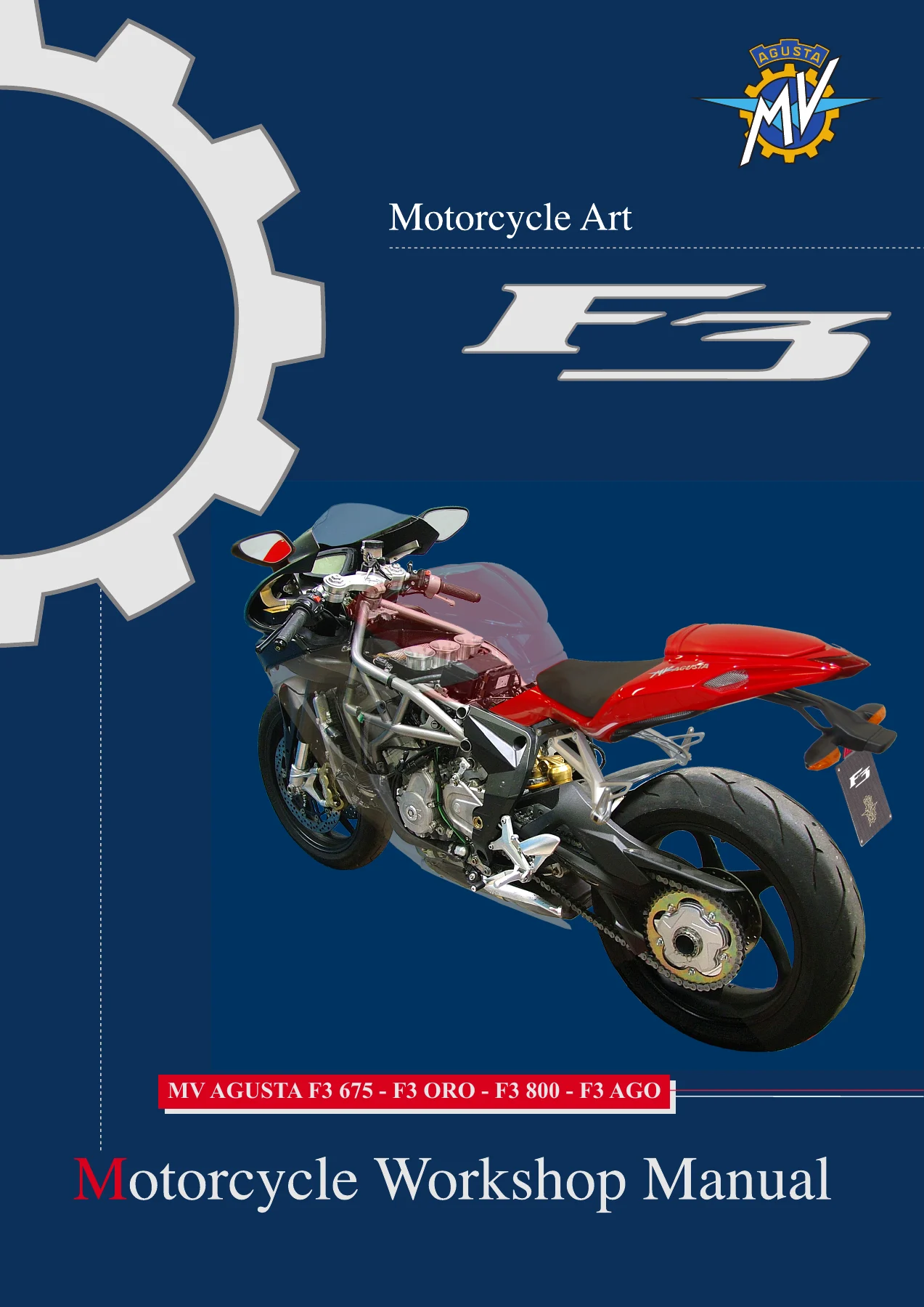
MV Agusta F3 675 F3 800 F3 ORO F3 AGO Motorcycle Workshop Manual Edition 3
Original price was: $39.95.$24.95Current price is: $24.95.
Complete 2014 Edition 3 motorcycle workshop manual for MV Agusta F3 675, F3 ORO, F3 800 and F3 AGO models. Covers scheduled maintenance, bodywork, injection and fuel systems, electrical testing and wiring diagrams, suspension, wheels, frame, brakes, cooling system, special tools, tightening torques and diagnostic procedures.
Description
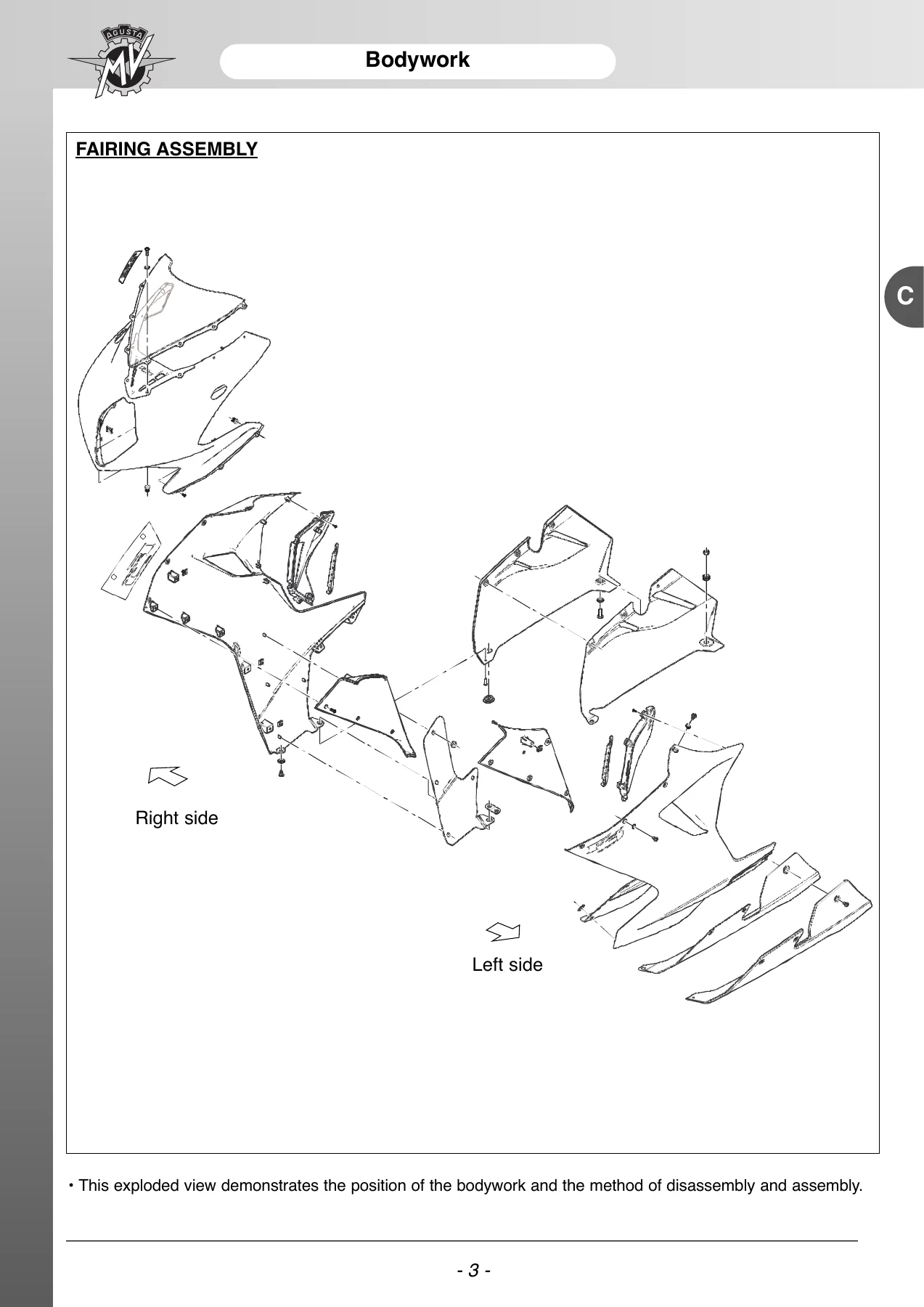
The MV Agusta F3 675 F3 800 F3 ORO F3 AGO Motorcycle Workshop Manual Edition 3 is a detailed technical service reference for the F3 family, covering F3 675, F3 ORO, F3 800 and F3 AGO. It was prepared to assist workshop personnel with motorcycle maintenance, inspection, diagnosis, component removal, repair and reassembly, with procedures supported by photographs, exploded drawings, wiring diagrams, technical data and specified tightening values.
This manual is particularly useful when work extends beyond routine servicing. Alongside oil, coolant, brake, chain and tyre maintenance, it provides procedures for removing body panels and the fuel tank, accessing the airbox and injection equipment, checking electrical components, servicing suspension and wheel assemblies, dismantling frame-related components, bleeding and repairing brake systems, testing the cooling circuit and tracing faults through the diagnostic sections.
File Details
- Manual type: Motorcycle workshop manual
- Brand: MV Agusta
- Models: F3 675, F3 ORO, F3 800, F3 AGO
- Language: English
- Pages: 446
- File format: PDF
- Part number: 8A00B7594
- Edition: Edition no. 3
- Printed: June 2014
Technical Coverage for the F3 Series
The opening technical-data pages distinguish the specifications of the four covered versions. The manual identifies the F3 675 and F3 ORO with 675 cm3 displacement and the F3 800 and F3 AGO with 798 cm3 displacement. It records dimensions, dry weights, fuel capacity, engine configuration, bore and stroke, compression ratios, ignition and injection equipment, clutch and transmission ratios, frame construction, suspension travel, brake dimensions, wheel and tyre specifications, electrical-system data and bodywork materials.
The engine is described as a three-cylinder, four-stroke, 12-valve unit. The ignition and fuel-feed system uses the integrated MVICS system, Eldor EM2.0 engine control, Mikuni full drive-by-wire throttle bodies, pencil coils with ion-sensing technology, multiple engine mappings and traction-control adjustment. These details make the MV Agusta F3 workshop manual valuable not only for mechanical disassembly but also for systematic electrical and electronic diagnosis.
Scheduled Maintenance and Service Operations
A substantial maintenance section sets out the programmed service schedule from pre-delivery through 36,000 km and describes individual operations in workshop sequence. Engine oil and filter replacement, coolant checks and replacement, electric cooling-fan checks, spark plug service, fuel filter work, air-filter service, brake-fluid inspection, brake-pad limits, steering checks, transmission-chain adjustment and lubrication, tyre inspection, wheel bearings, rear hub, swingarm bearings, rear shock absorber, side stand, front fork oil, electrical checks and fastener inspections are all addressed.
The manual supplies practical service values directly alongside the procedures. Examples include a 12 N·m spark-plug tightening torque, a 1 mm brake-pad wear limit, a 112 mm transmission-chain reference measurement, 28-32 N·m rear hub eccentric-adjuster screw tightening, and a 1.5 mm tyre-tread minimum limit. Lubricant and fluid recommendations are also included, including SAE 5W-40 engine-oil requirements and DOT 4 brake fluid.
Fuel Injection, Electronics and Diagnostic Information
The injection section explains how engine speed, intake pressure, temperature, battery voltage, acceleration and other sensor inputs affect injection control. It covers the fuel-feed system, pressure regulator, injectors, fuel-pump control, ECU operation, intake-air and throttle-position sensors, actuator checks and diagnostic routines.
Fuel pressure is specified at 3.5 kg/cm2 (350 kPa), and component checks include resistance and signal tests for injectors, air-temperature sensing, fuel-pump circuitry and throttle-position sensors. The manual also contains an extensive Eldor power-unit fault-code section for engine-management diagnosis, listing DTCs together with affected components, possible causes, operating conditions and corrective actions. TEXA diagnostic software procedures are described for reading parameters, reading and deleting faults and carrying out active diagnosis.
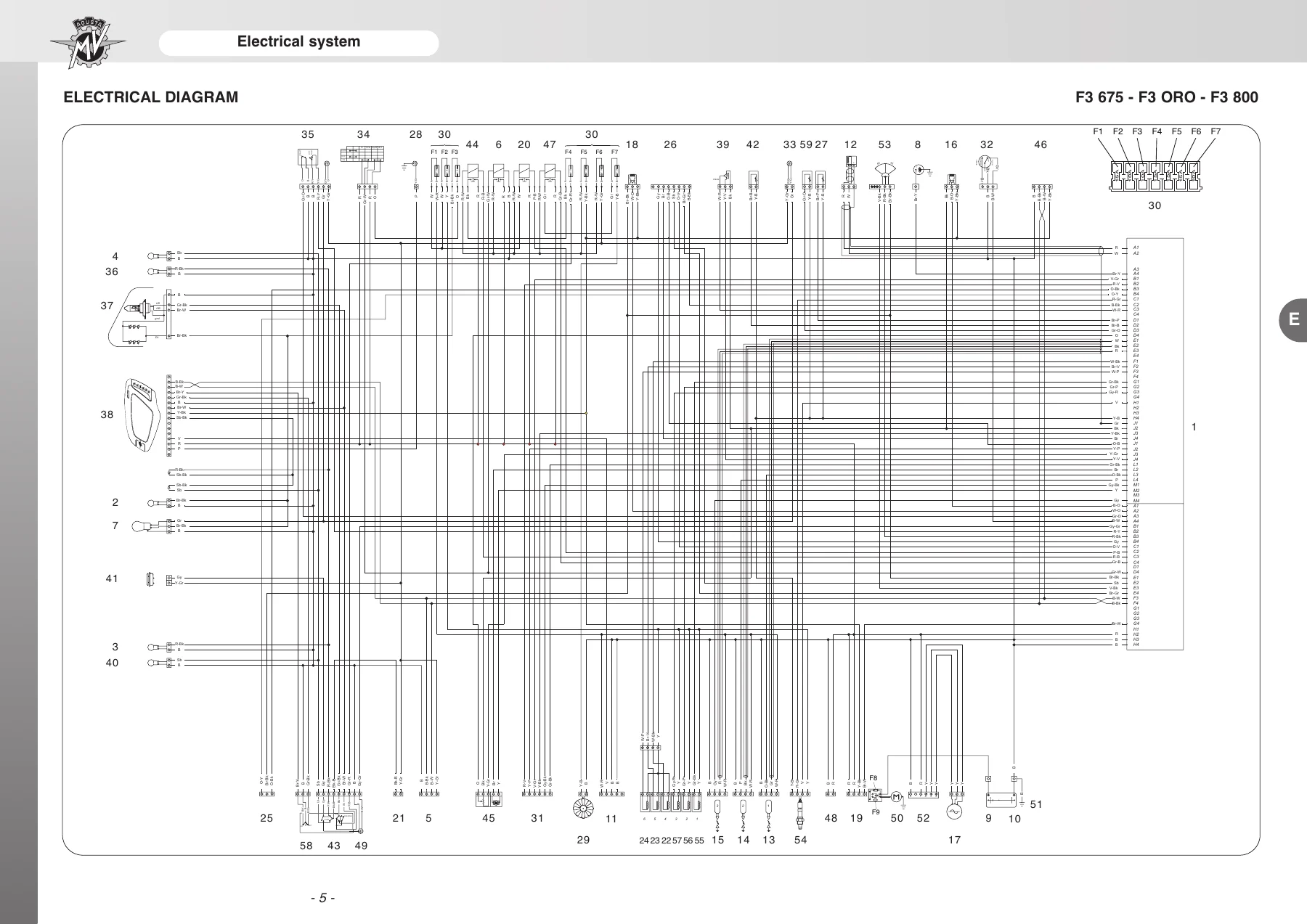
Electrical-system coverage extends to charging and starter systems, battery removal and charging, generator checks, relays, side-stand and gear-position switches, engine pick-up, electronically assisted shift, instrumentation, oil-pressure and fuel-level circuits, water-temperature sensing, speed sensors and ABS-system checks on applicable models. Separate electrical diagrams are provided for F3 675 / F3 ORO / F3 800 configurations and F3 675/800 ABS / F3 AGO configurations.
Important Engine Coverage Note
This motorcycle workshop manual provides extensive motorcycle-level maintenance and repair coverage, but some internal engine procedures are specifically referred to a separate F3 Engine Workshop Manual, Part Code 8000B6035. For example, the manual directs the technician to that separate engine publication for the detailed tappet-adjustment procedure and for timing-chain, guide and tensioner overhaul work. Buyers looking specifically for complete internal engine disassembly and rebuilding should be aware of this distinction.
Chapters Covered
- General Description
- How to consult the manual and workshop symbols
- Safety information and operative technical specifications
- Motorcycle identification
- Maintenance
- Technical data and programmed maintenance schedule
- Engine oil and oil filter, coolant and cooling fan
- Valve-mechanism access, timing components and spark plugs
- Fuel filters, fuel pump assembly and fuel lines
- Engine idle checks and air-filter service
- Brakes, control adjustments, brake pads and locks
- Steering, transmission chain, tyres and wheels
- Rear wheel hub, swingarm bearings, rear shock absorber and front fork
- Electrical system, battery, instruments, lights, fuses and headlamp adjustment
- Bodywork
- Fairing assembly
- Tail unit and heat shield
- Fuel tank and air-intake ducts
- Airbox and air-intake system
- Mudguard, central conveyor and radiator protection
- Air Intake Injection System
- Injection-system characteristics and injection compensation
- Fuel-feed system, pressure regulator, injectors and fuel pump
- ECU, sensors and actuators
- Diagnostics and Eldor power-unit fault codes
- Engine-control component locations, electrical diagram and ECU pinout
- Electrical System
- Electrical diagrams and parts lists
- Battery, charging system and generator checks
- Starter system, starter motor and starter relay
- Tilt sensor, gear-position switch and side-stand switch
- Fuses, spark plugs, main relay and engine pick-up
- E.A.S., instrumentation and sensor checks
- Speed sensors and ABS system diagnosis
- ABS unit replacement and activation
- Lighting, cooling fan, horn, ECU and switches
- Electrical-system wire-clamp positioning
- Suspension and Wheels
- Front wheel
- Front forks for F3 675, F3 800 and F3 AGO
- Steering assembly
- Rear suspension and swingarm
- Rear wheel hub
- Motorcycle set-up adjustment
- Wheel checking and balancing
- Frame
- Battery cables, side stand and foot pegs
- Exhaust silencer and exhaust tubes
- Frame-removal preparation and throttle-body removal
- Battery box, main cabling and controls
- Frame disassembly, inspection and steering-bearing housing checks
- Rear frame and frame-plate removal
- Vehicle reassembly and exhaust-valve transmission adjustment
- Brakes
- Front brake system and brake-pad replacement
- Front brake-fluid replacement and bleeding
- Front calipers, master cylinder, reservoir, switch, lever and discs
- Rear brake system and rear brake-pad replacement
- Rear brake-fluid replacement and bleeding
- Rear caliper and brake-disc service
- Cooling System
- Complete cooling-system assembly and leakage checks
- Radiator-cap testing and coolant extraction
- Water radiator removal and component service
- Recovery tank and thermostatic valve
- Oil radiator disassembly and assembly
- Cooling-system filling and function verification
- Special Tools
- Workshop stands, steering and bearing tools
- Wheel, suspension, clamp and eccentric-hub tools
- Tightening Torques
- Specified tightening values for motorcycle assemblies and fasteners
- Diagnostics
- Electrical-component troubleshooting
- Battery charging, starter, cooling and lighting faults
- E.A.S., traction control, speed limiter and instrumentation faults
- Frame, steering, suspension and brake troubleshooting
- Analytical Index
- Alphabetical reference to procedures and systems throughout the manual
Taken as a whole, the MV Agusta F3 675 F3 800 F3 ORO F3 AGO Motorcycle Workshop Manual Edition 3 gives the technician a structured path from routine inspection through component removal, electrical measurement, system diagnosis and chassis repair. The combination of model-specific service data, photographs, exploded drawings, wiring schematics, fault-code information and torque references helps reduce uncertainty when moving between related systems on the motorcycle.
Workshop Procedures Supported by This Manual
Use this MV Agusta F3 675 / F3 800 workshop manual when carrying out scheduled services, tracing an electrical or injection fault, checking an ABS-equipped model, removing bodywork to access concealed components, servicing the fuel system, replacing brake components, working on suspension or wheel assemblies, dismantling frame components or rebuilding the cooling system. The manual repeatedly links related chapters so that removal and reassembly sequences can be followed in the correct order instead of treating each component in isolation.
The photographs and drawings are particularly useful for work where connector location, fastener position, hose routing, component orientation or removal order matters. Electrical diagrams and ECU pin information support circuit tracing, while the dedicated diagnostic chapters help connect symptoms with likely components and checks. Special-tool references and tightening data provide the supporting information needed to carry out procedures to the specified values.
Get the MV Agusta F3 Workshop Manual Instantly
The MV Agusta F3 675 F3 800 F3 ORO F3 AGO Motorcycle Workshop Manual Edition 3 supports a wide range of maintenance, chassis, brake, suspension, cooling, fuel-injection, electrical and diagnostic work on the covered motorcycles. Following the documented procedures, measurements, service limits and tightening specifications is especially important when a repair involves safety-critical assemblies, electronic control systems or components that must be installed in a defined sequence.
IMAGES PREVIEW
Your manual is supplied as an instant PDF download after payment. There is no physical book and no shipping delay. Save the PDF to your computer, phone or tablet for workshop reference, and print the pages you need for a particular service or repair.
Reviews
There are no reviews yet.