★ TRUSTED BY 321,897+ PROFESSIONALS WORLDWIDE
🏢
Trusted Business
Verified & Licensed
🛡️
Virus Free Files
100% Safe Downloads
🔒
Secure Payment
SSL Protected
⚡
Instant Delivery
Available Immediately
Sale!

Ruthmann Steiger T 230.2 Operating and Maintenance Instructions PDF – 2023 Edition

Original price was: $44.95.Current price is: $27.95.

Complete operating and maintenance instructions for the Ruthmann Steiger T 230.2 mobile elevating work platform, fabrication no. 33510. Covers safety, operation, hydraulic and electrical systems, emergency lowering, troubleshooting, and full maintenance procedures with wiring and hydraulic diagrams.

⚡
Instant PDF Download
Available immediately
💾
Save to Your Device
Download & keep forever
🛡️
Antivirus Scanned
100% virus-free
🌍
Trusted Worldwide
175,000+ customers

Description

Ruthmann Steiger T 230.2 Operating and Maintenance Instructions

The Ruthmann Steiger T 230.2 Operating and Maintenance Instructions is the complete factory-issued document for the mobile elevating work platform bearing type T 230.2, fabrication no. 33510. This 2023 edition (document BA.ENG.23-33510-07-28-FTA-hem) covers every stage of the machine’s life cycle — commissioning, normal operation, emergency lowering, maintenance, and disposal — and applies specifically to the T 230.2 mounted on the Mercedes-Benz Atego chassis (MB 816 Atego 4×2 / 3620 Euro VI E).

File Details

  • Manual type: Operating and Maintenance Instructions
  • Brand: RUTHMANN
  • Model: STEIGER T 230.2
  • Fabrication no.: 33510
  • Document number: BA.ENG.23-33510-07-28-FTA-hem
  • Edition date: 28.07.2023
  • Language: English
  • Page count: 591
  • File format: PDF
  • Chassis reference: MB 816 Atego 4×2 / 3620 Euro VI E

Chapters Covered

  • 0 General information — Introduction, EU Declaration of Conformity, liability, availability of instructions, layout and content, list of terms
  • 1 Intended use and safety instructions — Correct use, foreseeable misuse, personnel requirements, basic rules, travel operation, Steiger-operation, electrical and hydraulic system safety, brakes, maintenance, live electrical parts, earthing, residential areas, halls, starting aid, signage, personal protective equipment
  • 2 Technical specifications — Technical data, dimensions and weights, Steiger superstructure details, stabilizing jacks, boom, work platform, carrying capacity, hydraulic pump drive, control, parametrisation, noise level, vibrations, chassis details, fabrication sign, CE marking, inspection tags, work area, Beaufort scale
  • 3 Description — Structure of the Ruthmann Steiger T 230.2, components and assemblies, Steiger-substructure, stabilizing jacks, boom, work platform, 230 V socket, pneumatic/water line, hydraulic system, control description, stabilizing jack basis, plausibility monitoring, Steiger movements, control device, control positions, EMERGENCY STOP switch, STOP button, engine stop, engine speed increase, electric interlocking, platform overload detection, platform bottoming detection, swivel angle dependent range limiting, automatic jacking, automatic platform compensation, soft start/stop, end position damping, driver’s cabin securing, memory, automatic start-up help, automatic home position, RUTHMANN Cockpit control panel, operator panel of EMERGENCY CONTROL, power supply, battery voltage monitoring, fuses
  • 4 Control elements and displays — Arrangement of EMERGENCY STOP switch, control elements and displays of chassis, dashboard controls, STABILIZING JACK CONTROL, PLATFORM CONTROL switch box, RUTHMANN Cockpit, graphical display, EMERGENCY CONTROL switch box, operator panel, function keys, clear text display messages, over-riding emergency system, manual pump, emergency control system in extreme cases, ball valve, solenoid arresting devices, directional valves, jacking/inclination display
  • 5 Commissioning — Transport configurations and basic setting, measures before starting operations, measures before Steiger-operation, checks, installation location, safeguarding in public road traffic, safety distances to live components, safety distances from embankments, pits and excavations, supporting underground, determining carrying capacity, opening the Rüssel interlock, earthing, preventive measures for winter operation, attachment of another standard work platform
  • 6 Operation — EMERGENCY STOP switch, travel operation, switching hydraulic pump drive on/off, switching operating and control position on/off, Steiger-operation, handling operator panel of STABILIZING JACK CONTROL, entering and leaving work platform, handling RUTHMANN Cockpit, moving stabilizing jacks, full jacking, one-sided jacking, two-sided jacking, retracting jacks, moving boom and work platform, Rüssel movements, boom lift/lower, boom swivel, telescope extend/retract, platform rotate, straightening work platform horizontally, automatic start-up help, memory, automatic home position, handling operator panel for EMERGENCY CONTROL, starting/stopping engine, moving stabilizing jacks, moving boom and work platform, information and diagnostics system (IDS), choosing language, password, setting clock, resetting operating time counter, disabling/enabling access ladder switch, changeover of simultaneous boom movements, disabling/enabling fine control, fine control
  • 7 Emergency control (emergency lowering) — Failure of main drive force, ability of operating personnel, failure of electrical/electronics systems (extreme situation), emergency lowering after interruption by conditional EMERGENCY STOP
  • 8 Elimination of malfunctions — Control-related problems during Steiger operation, impact of malfunction, limited Steiger operation, conditional EMERGENCY STOP, EMERGENCY STOP, reading out error memory, meaning of fault messages and remedial action
  • 9 Maintenance — Lubrication, lubricants, lubrication points list, lubrication points plan, tightening torques, bolted connections, connecting pieces on hydraulic cylinders/drives, valves, cutting ring bolted connections, DKO bolted connections, male plug for bolted connections, hollow bolts for swivel bolted connections, sensors, inspection and routine maintenance, inspection list/routine maintenance list, checks, daily checks, checks by qualified persons, periodic inspection, exceptional inspection, cleaning and care, remarks on carrying out inspection and maintenance work, lights, Steiger complete, bearing points/bolt locks, bearing points with plastic bushings, base frame, stabilizing jacks, boom system, Rüssel, Rüssel platform console, Rüssel-stop, work platform, ball bearing slewing ring, hydraulic system, swivelling drive, hydraulic cylinder, hydraulic pump, drive shaft of hydraulic pump, manual pump, ball valve, safety valves, stop valves in hydraulic cylinders, directional and proportional valves, line filter in valve box, hydraulic hose lines, hydraulic oil tank, electrical system, batteries, function and effectiveness of safety equipment, current supply work platform, repair, touching up painting/coating, replacing components
  • 10 Special equipment — Insulation according to DIN VDE 0682-742, use on or in vicinity of live components up to AC 1000 V and DC 1500 V, type of work platform, insulation test, maintenance of insulation, shunting movements, traversing work platform occupied by person, buzzer signal connection, programmable telescope extension limitation, fully variable stabilizing jacks, Steiger-operation without stabilizing jacks, supporting plate with milled groove, technical specifications, handling, cleaning and care
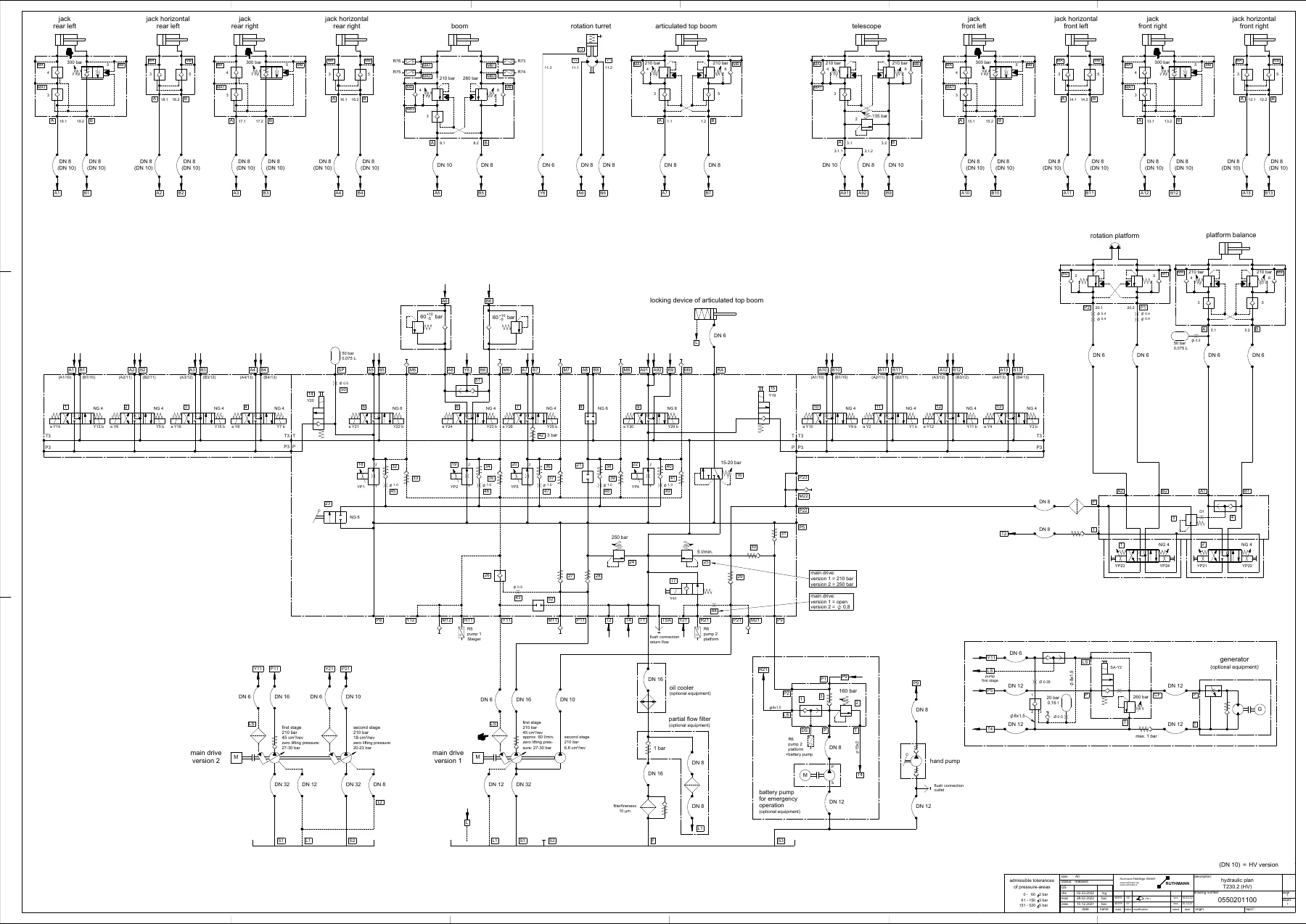
  • 11 Hydraulic diagram — Hydraulic plan Ruthmann Steiger T 230.2, document no. 0.550.201.100
  • 12 Electrical documentation — Circuit diagram Ruthmann-Steiger T 230.2 (doc. no. 0.850.405.100), vehicle interface MB Atego (doc. no. 0.850.700.140), Steiger with fully variable stabilizing jacks (doc. no. 0.850.307.100), work area without stabilizing jacks / shunting movements T 230.2 (doc. no. 0.850.408.100)
  • 13 Spare parts — Spare parts lists and drawings reference
  • 14 Annex — Work area diagrams, safety data sheets for lubricants used ex-factory

Complete PDF Bookmark Tree

Complete Bookmarks

The complete bookmarks in the “Ruthmann Steiger T 230.2 Operating and Maintenance Instructions PDF – 2023 Edition” are as follows:

0 General informationp. 25
0.1 Introductionp. 26
0.2 Declaration of Conformityp. 27
0.2.1 EU Declaration of Conformityp. 27
0.2.2 Quality management systemp. 28
0.2.3 Liability for material defectsp. 29
0.2.4 Unauthorised changes / retrofitsp. 29
0.2.4.1 Teleservice, operating data recording with remote query or GPS localisationp. 31
0.3 Availability of the Operating and Maintenance Instructionsp. 32
0.4 Layout and content of the Operating and Maintenance Instructionsp. 33
0.4.1 In principlep. 33
0.4.2 Explanation for the warning instructionsp. 34
0.4.3 Explanation for the pictogramsp. 35
0.4.4 Structure of the Operating and Maintenance Instructionsp. 36
0.5 Information for the operator / businessp. 39
0.5.1 Requirement on the provision and usep. 39
0.5.1.1 General requirementsp. 39
0.5.1.2 Regulations for technical occupational safetyp. 39
0.5.1.3 Risk assessmentp. 40
0.5.1.4 Operating instructionp. 41
0.5.2 Instruction / trainingp. 41
0.5.2.1 Example for instructing / training topicsp. 42
0.5.2.2 Specimen "Certification of training"p. 44
0.5.3 Maintenancep. 45
0.5.4 Disposalp. 46
0.6 List of termsp. 48
1 Intended use and safety instructionsp. 59
1.1 Using the Ruthmann Steiger T 230.2.p. 59
1.1.1 Correct usep. 59
1.1.2 Foreseeable misusep. 60
1.1.3 Personnel requirementsp. 61
1.1.3.1 Operating personnelp. 61
1.1.3.2 Maintenance personnelp. 61
1.2 Safety instructionsp. 62
1.2.1 Basic rulesp. 62
1.2.2 Travel operation (traversing)p. 64
1.2.3 Steiger-operationp. 65
1.2.4 Leaving the Ruthmann Steiger T 230.2p. 67
1.2.5 Electrical system of the Ruthmann Steiger T 230.2p. 67
1.2.6 Hydraulic system of the Ruthmann Steiger T 230.2p. 68
1.2.7 Brakes, wheels and tyres of the chassisp. 68
1.2.8 Maintenancep. 68
1.2.9 Use of the Ruthmann Steiger T 230.2 on or in the vicinity of live parts of electrical systemsp. 70
1.2.10 Earthing the Ruthmann Steiger T 230.2 when being used on transmitter systems, wind turbines or transformer stationsp. 71
1.2.11 Use of the Ruthmann Steiger T 230.2 in residential or sensitive areasp. 71
1.2.12 Use of the Ruthmann Steiger T 230.2 in hallsp. 71
1.2.13 Starting aidp. 72
1.3 Signagep. 73
1.3.1 Icons on safety signsp. 73
1.4 Personal Protective Equipmentp. 78
2 Technical specificationsp. 81
2.1 Technical datap. 81
2.1.1 Dimensions and weights of the entire vehiclep. 82
2.1.2 Details for the Steiger superstructurep. 83
2.1.2.1 Main characteristic datap. 83
2.1.2.2 Stabilizing jacksp. 84
2.1.2.3 Boomp. 85
2.1.2.4 Work platformp. 86
2.1.2.4.1 Carrying capacity of the Steiger and nominal load of the work platformp. 86
2.1.2.4.2 Weight of possible equipment of the work platformp. 87
2.1.2.4.3 Determining the usable load of the work platformp. 88
2.1.2.4.4 Identification of the work platformp. 89
2.1.2.4.5 Standardised Ruthmann work platformp. 90
2.1.2.5 Hydraulic pump drivep. 91
2.1.2.6 Controlp. 92
2.1.2.7 Parametrisationp. 92
2.1.2.8 Noise levelp. 93
2.1.2.9 Vibrationsp. 93
2.1.3 Details on the chassisp. 94
2.1.4 Static and dynamic inspections by the manufacturerp. 94
2.2 Fabrication sign, CE marking and inspection tagsp. 95
2.3 Work areap. 96
2.4 Beaufort scalep. 97
3 Descriptionp. 99
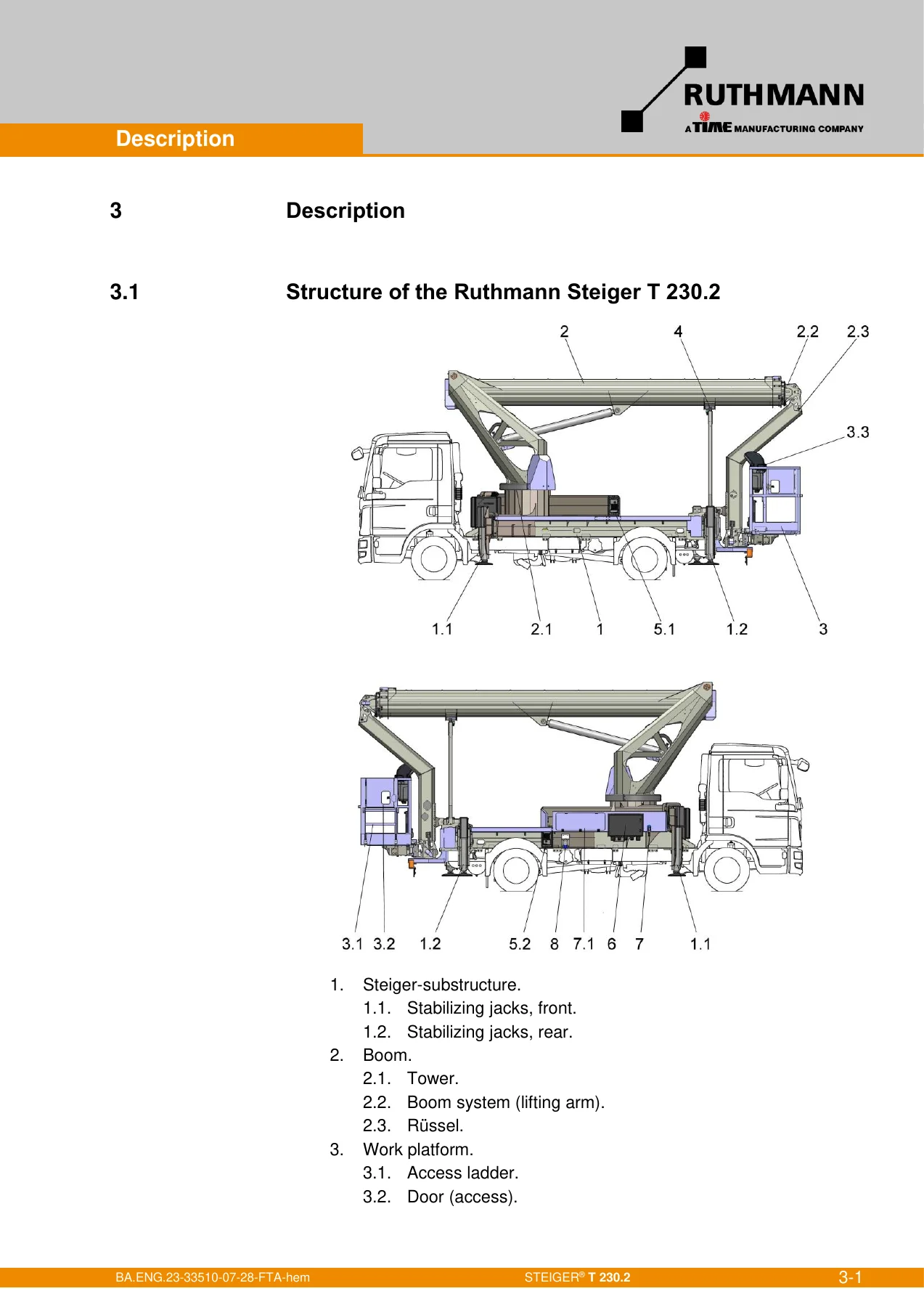
3.1 Structure of the Ruthmann Steiger T 230.2p. 99
3.1.1 Components and assembliesp. 101
3.1.1.1 Steiger-substructurep. 101
3.1.1.1.1 Stabilizing jacksp. 101
3.1.1.2 Boomp. 102
3.1.1.3 Work platformp. 102
3.1.1.3.1 230 V socketp. 104
3.1.1.3.2 Pneumatic or water line to the work platform (special equipment)p. 105
3.2 Hydraulic systemp. 106
3.3 Description of the controlp. 108
3.3.1 Stabilizing jack basisp. 108
3.3.1.1 Plausibility monitoring of the jacking situationp. 109
3.3.2 Steiger movementsp. 110
3.3.3 Control devicep. 112
3.3.4 Control positionp. 113
3.3.4.1 Control position STABILIZING JACK CONTROLp. 113
3.3.4.2 Control position PLATFORM CONTROLp. 114
3.3.4.3 Control position EMERGENCY CONTROLp. 115
3.3.5 EMERGENCY STOP switchp. 116
3.3.6 STOP buttonp. 116
3.3.7 Vehicle engine stop with "EMERGENCY STOP"p. 116
3.3.8 Increasing the vehicle engine speed in Steiger-operationp. 116
3.3.9 Electric interlockingp. 117
3.3.9.1 Platform overload detection aidp. 117
3.3.9.2 Platform bottoming detectionp. 117
3.3.9.3 Swivel angle dependent range limitingp. 118
3.3.10 Automatic jackingp. 119
3.3.11 Automatic platform compensationp. 120
3.3.12 Soft start and soft stopping of Steiger movementsp. 120
3.3.13 End position dampingp. 121
3.3.14 Securing the driver´s cabin when swivelling or lowering the boomp. 121
3.3.15 Memoryp. 122
3.3.16 Automated start up help for the middle position of the boomp. 122
3.3.17 Automatic movement to the home position of the Steigerp. 122
3.3.18 Control panel "RUTHMANNCockpit" of the work platformp. 123
3.3.18.1 Control information and switch areap. 123
3.3.18.2 Control areap. 124
3.3.19 Operator panel of the EMERGENCY CONTROLp. 125
3.3.19.1 Clear text display:p. 125
3.3.19.2 Flat keyboard:p. 125
3.3.19.3 Choosing the languagep. 125
3.4 Power supplyp. 126
3.4.1 Battery voltage monitoringp. 126
3.4.2 Fusesp. 126
3.4.2.1 Chassis fusesp. 126
3.4.2.2 Ruthmann Steiger T 230.2 fusesp. 127
4 Control elements and displaysp. 129
4.1 Arrangement of the EMERGENCY STOP switchp. 129
4.2 Control elements and displays of the chassisp. 131
4.3 Control elements and displays of the Ruthmann Steigerp. 131
4.3.1 Control elements and displays on the dashboard in the driver´s cabinp. 131
4.3.2 STABILIZING JACK CONTROL on the Steiger-substructurp. 132
4.3.2.1 Push buttons on operator panel (left side)p. 133
4.3.2.2 Push buttons on operator panel (right side)p. 135
4.3.3 Switch box PLATFORM CONTROL in the work platformp. 137
4.3.3.1 Control panel RUTHMANNCockpitp. 137
4.3.3.2 Graphical displayp. 148
4.3.3.2.1 Possible navigation symbols of function keys F1 to F10p. 148
4.3.3.2.2 Explanation for the menu screensp. 149
4.3.4 Switch box EMERGENCY CONTROL on the Steiger-substructure (right side)p. 151
4.3.4.1 Operator panel for EMERGENCY CONTROLp. 152
4.3.4.1.1 Function keys of the flat keyboardp. 153
4.3.4.1.2 Operating and informative messages of the clear text displayp. 156
4.3.5 Over-riding emergency systemp. 165
4.3.5.1 Manual pumpp. 165
4.3.6 Emergency control system in extreme casesp. 166
4.3.6.1 Ball valvep. 167
4.3.6.2 Solenoid arresting devicesp. 167
4.3.6.3 Directional valves / solenoid valvesp. 168
4.3.6.3.1 Directional valve for controlling the stabilizing jacksp. 169
4.3.6.3.2 Directional valve for controlling the boomp. 171
4.3.6.3.3 Directional valve for controlling the work platformp. 172
4.3.7 Jacking/inclination displayp. 173
5 Commissioningp. 175
5.1 Definition of the transport configurations and basic settingp. 175
5.2 Measures before starting operationsp. 177
5.3 Measures before Steiger-operationp. 178
5.3.1 Checks before Steiger-operationp. 178
5.3.2 Installation locationp. 179
5.3.2.1 Safeguarding in public road trafficp. 180
5.3.2.2 Safety distances to live components of electrical systemsp. 181
5.3.2.3 Safety distances from embankments, pits and excavationsp. 183
5.3.2.4 Supporting undergroundp. 185
5.3.2.4.1 Determining the carrying capacityp. 187
5.3.3 Opening the Rüssel interlockp. 189
5.3.4 Earthing (special equipment)p. 189
5.4 Preventive measures for winter operationp. 190
5.5 Attachment of another standard work platformp. 191
6 Operationp. 195
6.1 EMERGENCY STOP switchp. 195
6.2 Travel operationp. 196
6.3 Switching the hydraulic pump drive (Power take-off) on or offp. 197
6.4 Switching the operating and control position on or offp. 199
6.4.1 Switch the operation on or offp. 199
6.4.2 Switching the control position PLATFORM CONTROL on or offp. 200
6.4.3 Switching the control position STABILIZING JACK CONTROL on or offp. 201
6.4.4 Switching the control position EMERGENCY CONTROL on or offp. 202
6.5 Steiger-operationp. 203
6.5.1 Handling the operator panel of the STABILIZING JACK CONTROLp. 204
6.5.1.1 Operating the jack push buttonsp. 204
6.5.2 Entering and leaving the work platformp. 205
6.5.3 Handling the RUTHMANNCockpit in the work platformp. 207
6.5.3.1 Cover of the control panelp. 207
6.5.3.2 Starting or stopping the vehicle enginep. 207
6.5.3.3 Signal connection work platform ( driver´s cabin (special equipment)p. 208
6.5.3.4 Operating the joystickp. 208
6.5.3.5 Graphical displayp. 210
6.5.4 Moving the stabilizing jacksp. 211
6.5.4.1 Full jackingp. 212
6.5.4.1.1 Execution with the operator panel of the stabilizing jack controlp. 213
6.5.4.1.2 Execution with the control panel of the work platformp. 214
6.5.4.2 One-sided stabilizing jacks in the vehicle profilep. 217
6.5.4.2.1 Execution with the operator panel of the stabilizing jack controlp. 217
6.5.4.2.2 Execution with the control panel of the work platformp. 219
6.5.4.3 Two-sided jacking in the vehicle profilep. 222
6.5.4.3.1 Execution with the operator panel of the stabilizing jack controlp. 222
6.5.4.3.2 Execution with the control panel of the work platformp. 223
6.5.4.4 Retracting the stabilizing jacksp. 225
6.5.4.5 Moving the stabilizing jacks with the help of the control element ALL JACKSp. 227
6.5.5 Moving the boom and work platformp. 229
6.5.5.1 "Move the Rüssel upwards" or "Move the Rüssel downwards"p. 231
6.5.5.2 "Lift the boom" or "Lower the boom"p. 231
6.5.5.3 "Swivel the boom on the left side" or "Swivel the boom on the right side"p. 231
6.5.5.4 "Extend the telescope" or "Retract the telescope"p. 232
6.5.5.5 "Rotate the platform on the left side" or "Rotate the platform on the right side"p. 232
6.5.6 Straightening up the work platform horizontallyp. 233
6.5.7 Automatic start-up help for the boom middle positionp. 234
6.5.8 Memoryp. 235
6.5.8.1 Saving the target positionp. 235
6.5.8.2 Move to the target positionp. 235
6.5.9 Automatic movement to the home position of the Steigerp. 237
6.6 Handling the Operator Panel for EMERGENCY CONTROLp. 239
6.6.1 Starting or stopping the vehicle enginep. 240
6.6.2 Moving the stabilizing jacksp. 241
6.6.2.1 Full jackingp. 241
6.6.2.2 One-sided stabilizing jacks in the vehicle profilep. 241
6.6.2.3 Stabilizing jack in the vehicle profile, both sidesp. 242
6.6.2.4 Retracting the stabilizing jacksp. 242
6.6.2.5 Individual jack control of the horizontal jack armsp. 243
6.6.2.6 Individual jack control of the vertical jacksp. 244
6.6.3 Moving the boom and work platformp. 245
6.6.3.1 "Move the Rüssel upwards" or "Move the Rüssel downwards"p. 245
6.6.3.2 "Lift the boom" or "Lower the boom"p. 245
6.6.3.3 "Swivel the boom on the left side" or "Swivel the boom on the right side"p. 245
6.6.3.4 "Extend the telescope" or "Retract the telescope"p. 246
6.6.3.5 "Rotate the platform on the left side" or "Rotate the platform on the right side"p. 246
6.6.4 Straightening up the work platform horizontallyp. 246
6.6.5 Information and Diagnostics system (IDS)p. 247
6.6.5.1 Choosing the languagep. 247
6.6.5.2 Passwordp. 248
6.6.5.2.1 Enter a passwordp. 249
6.6.5.2.2 Change passwordp. 250
6.6.5.3 Setting the clockp. 251
6.6.5.4 Resetting operating time counterp. 252
6.6.6 Disabling or Enabling the switch "Access ladder"p. 253
6.6.7 Changeover of the simultaneous boom movements to be executedp. 254
6.6.8 Disabling or Enabling the fine control optionp. 254
6.7 Fine controlp. 255
7 Emergency control (emergency lowering)p. 257
7.1 Failure of the main drive forcep. 258
7.2 Ability of the operating personnelp. 259
7.3 Failure of the electrical / electronics systems (Extreme situation)p. 260
7.4 Emergency lowering after interruption of Steiger movements by a "conditional EMERGENCY STOP"p. 265
8 Elimination of malfunctionsp. 267
8.1 Control-related problems during Steiger operationp. 267
8.2 Impact of a malfunction on the Steiger operationp. 273
8.2.1 Limited Steiger operationp. 273
8.2.2 Conditional EMERGENCY STOPp. 273
8.2.3 EMERGENCY STOPp. 273
8.3 Reading out the error memoryp. 275
8.3.1 Meaning of the fault messages and information on remedial actionp. 276
9 Maintenancep. 285
9.1 Lubricationp. 288
9.1.1 Lubricantsp. 288
9.1.2 Lubrication points listp. 289
9.1.3 Lubrication points planp. 291
9.2 Tightening torquesp. 293
9.2.1 Bolted connectionsp. 293
9.2.2 Connecting pieces on hydraulic cylinders / drivesp. 300
9.2.3 Valvesp. 301
9.2.4 Cutting ring bolted connectionsp. 305
9.2.5 DKO – Bolted connectionsp. 306
9.2.6 Male plug for bolted connectionsp. 307
9.2.7 Hollow bolts for swivel bolted connectionsp. 308
9.3 Sensorsp. 309
9.4 Inspection and Routine Maintenancep. 313
9.4.1 Inspection List / Routine Maintenance Listp. 313
9.4.2 Checksp. 320
9.4.2.1 Daily checksp. 320
9.4.2.2 Checks by qualified personsp. 320
9.4.2.2.1 Periodic inspectionp. 321
9.4.2.2.2 Exceptional inspectionp. 321
9.4.3 Cleaning and carep. 323
9.4.4 Remarks on carrying out inspection and maintenance workp. 327
9.4.4.1 Lightsp. 327
9.4.4.2 Steiger, completep. 328
9.4.4.3 Bearing points / Bolt locksp. 329
9.4.4.4 Bearing points with plastic bushingsp. 329
9.4.4.5 Base framep. 330
9.4.4.6 Stabilizing jacksp. 330
9.4.4.7 Boom systemp. 331
9.4.4.8 Rüsselp. 335
9.4.4.9 Rüssel platform consolep. 336
9.4.4.10 Rüssel-stopp. 336
9.4.4.11 Work platformp. 337
9.4.4.12 Ball bearing slewing ringp. 338
9.4.4.13 Hydraulic systemp. 340
9.4.4.14 Swivelling drivep. 341
9.4.4.15 Hydraulic cylinderp. 343
9.4.4.16 Hydraulic pumpp. 344
9.4.4.17 Drive shaft of the hydraulic pumpp. 346
9.4.4.18 Manual pumpp. 347
9.4.4.19 Ball valvep. 347
9.4.4.20 Safety valvesp. 348
9.4.4.21 Stop valves in hydraulic cylindersp. 349
9.4.4.22 Directional and proportional valvesp. 349
9.4.4.23 Line filter in the valve box of the work platformp. 350
9.4.4.24 Hydraulic hose linesp. 351
9.4.4.25 Hydraulic oil tankp. 353
9.4.4.26 Electrical systemp. 356
9.4.4.27 Batteriesp. 358
9.4.4.28 Function and effectiveness of the safety equipmentp. 360
9.4.4.29 Current supply "Work platform"p. 363
9.5 Repairp. 364
9.5.1 Touching up the painting / coatingp. 364
9.5.2 Replacing componentsp. 365
10 Special equipmentp. 367
10.1 Insulation according to DIN VDE 0682 – 742p. 367
10.1.1 Use of the Ruthmann Steiger T 230.2 on or in the vicinity of live components of electrical systems with a potential of up to AC 1000 V and DC 1500 V.p. 368
10.1.2 Type of work platformp. 369
10.1.3 Insulation test (repeated test)p. 370
10.1.4 Maintenance of the insulationp. 371
10.2 Shunting movementsp. 374
10.2.1 Traversing a work platform occupied by a personp. 374
10.2.2 Buzzer signal connection work platform ( driver´s cabinp. 376
10.3 Programmable telescope extension limitationp. 377
10.4 Fully variable stabilizing jacksp. 378
10.5 Steiger-operation without stabilizing jacksp. 379
10.6 Supporting plate with milled groovep. 380
10.6.1 Technical specificationsp. 381
10.6.2 Handlingp. 381
10.6.3 Cleaning and carep. 381
11 Hydraulic diagramp. 383
12 Electrical documentationp. 387
13 Spare partsp. 473
14 Annexp. 475
14.1 Work areap. 475
14 Annex
14.2 Safety data sheets for lubricants used ex-factoryp. 483

This Ruthmann Steiger T 230.2 Operating and Maintenance Instructions is far more than a basic operator’s booklet. It is the complete technical documentation set for the T 230.2 elevating work platform, bringing together mechanical descriptions, hydraulic schematics, electrical wiring diagrams, maintenance schedules, torque specifications, diagnostic fault codes, and safety procedures into a single 591-page reference. The document is structured so that every phase of ownership is supported — from the initial commissioning checks and jacking procedures through to the annual technical expert inspection and long-term maintenance planning. The chapters on control elements and displays walk through the RUTHMANN Cockpit, the STABILIZING JACK CONTROL panels, and the EMERGENCY CONTROL operator panel in detail, while the operation chapter covers every permitted boom, Rüssel, telescope, and platform movement with the conditions that must be met before each is released. The maintenance chapter is particularly extensive, with a full inspection and routine maintenance list keyed to daily, 300-hour, 600-hour, and annual intervals, plus lubrication points, tightening torques for bolted connections, valve torque tables, hydraulic hose replacement intervals, and step-by-step procedures for the swivelling drive, hydraulic pump, ball bearing slewing ring, and work platform. For troubleshooting, the elimination of malfunctions chapter provides a fault-code index with possible causes and remedial actions for control-related problems, sensor faults, hydraulic issues, and electrical errors.

What This Manual Enables

With the Ruthmann Steiger T 230.2 Operating and Maintenance Instructions on hand, a technician or operator can correctly jack and level the machine for full, one-sided, or in-profile stabilizing jack configurations; set up and operate the boom, Rüssel, telescope, and work platform through the RUTHMANN Cockpit; perform emergency lowering using the manual pump or the emergency control system in extreme cases; diagnose and clear fault messages from the error memory; carry out daily, 300-hour, 600-hour, and annual inspection routines; and reference the hydraulic and electrical diagrams needed for component-level repair. The manual also covers the special equipment variants — insulation to DIN VDE 0682-742 for work near live components up to AC 1000 V and DC 1500 V, programmable telescope extension limitation, fully variable stabilizing jacks, and operation without stabilizing jacks — so owners of machines with those options have the relevant procedures documented.

Why It Matters

The T 230.2 is a group B / type 2 mobile elevating work platform with a 23 m work height, a 21 m platform height, and a maximum carrying capacity of 350 kg. Operating it outside the specified procedures — incorrect jacking, exceeding the permissible jacking inclination, bypassing the load moment limitation, or ignoring the wind speed limit of 12.5 m/s — puts the platform personnel and the machine at risk. The manual specifies the exact conditions, limits, and safety distances that must be observed, and it documents the torque values and service limits that keep the machine within its design parameters. For anyone responsible for the safe operation, inspection, or repair of a Ruthmann Steiger T 230.2, this document is the reference that the manufacturer intends to accompany the machine through its working life.

Delivery

IMAGES PREVIEW

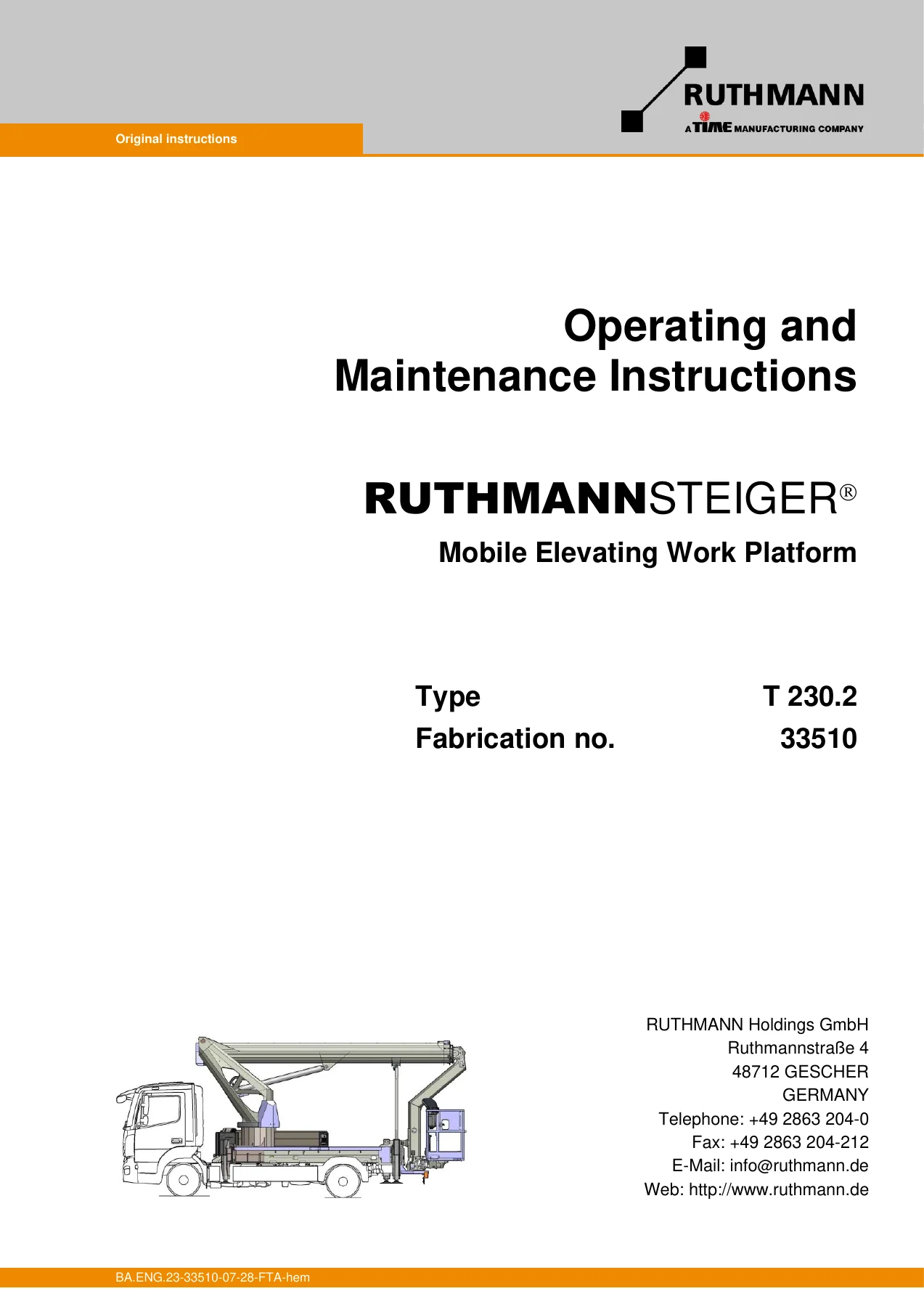
Ruthmann Steiger T 230.2 Operating and Maintenance Instructions PDF - 2023 Edition — PDF page 1 preview
Ruthmann Steiger T 230.2 Operating and Maintenance Instructions PDF - 2023 Edition — PDF page 99 preview
Ruthmann Steiger T 230.2 Operating and Maintenance Instructions PDF - 2023 Edition — PDF page 385 preview

This Ruthmann Steiger T 230.2 Operating and Maintenance Instructions is delivered as an instant PDF download after payment — no shipping, no waiting. The file can be viewed on any device, searched for specific terms, and printed for use in the workshop or driver’s cabin. Whether you are commissioning a newly acquired T 230.2, planning annual maintenance, troubleshooting a fault code, or preparing for the periodic inspection by a technical expert, having the complete manual in PDF form means you can access the relevant procedure whenever and wherever you need it.
Reviews

There are no reviews yet.

Be the first to review “Ruthmann Steiger T 230.2 Operating and Maintenance Instructions PDF – 2023 Edition”

What Our Customers Say

★★★★★ Live reviews from customers
Loading customer reviews...
0
    0
    Your Cart
    Your cart is emptyReturn to Shop
    🛒
    Recently Purchased
    🕒 verified order