
Tecnam P2006T Aircraft Flight Manual 2006/044 – EASA Approved AFM PDF
Original price was: $39.95.$24.95Current price is: $24.95.
Complete EASA-approved Aircraft Flight Manual for the Tecnam P2006T – Doc. 2006/044, 3rd Edition Rev. 1. Limitations, emergency procedures, normal checklists, performance data, weight and balance and full systems description in one PDF.
Description
Tecnam P2006T Aircraft Flight Manual – EASA Approved AFM (Doc. 2006/044)
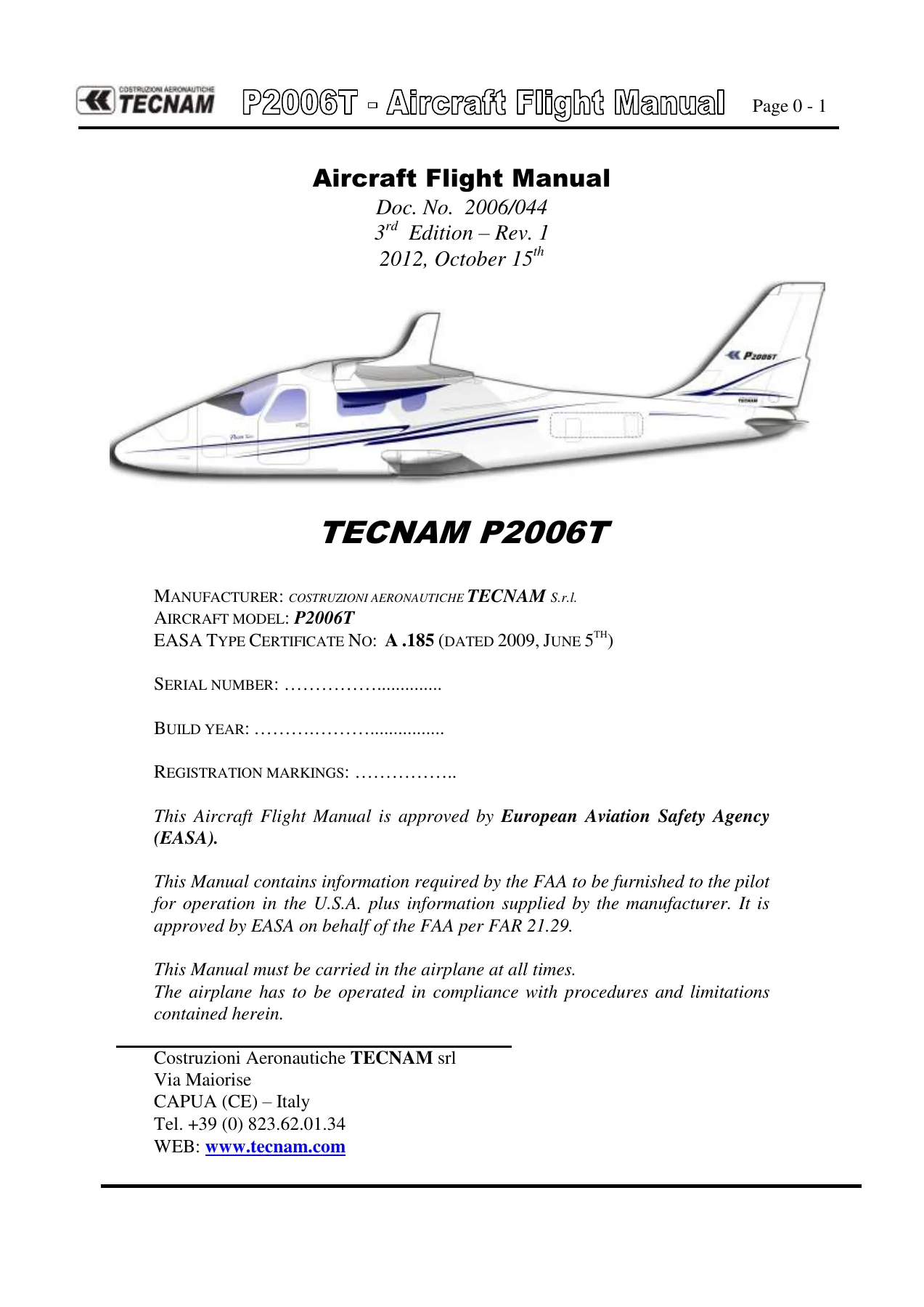
This is the complete EASA-approved Aircraft Flight Manual for the Tecnam P2006T twin-engine four-seat light aircraft, issued by Costruzioni Aeronautiche Tecnam S.r.l. under document number 2006/044. It is the 3rd Edition, Revision 1, dated 15 October 2012 – the Tecnam P2006T Aircraft Flight Manual the aircraft is certified against under EASA Type Certificate A.185, and the document the aeroplane must be operated in compliance with.
Nothing here is generic. Every limitation, airspeed, checklist step, performance chart, weight-and-balance value and centre-of-gravity boundary in this P2006T AFM is specific to the P2006T, and the two certified maximum take-off weight configurations – 1180 kg (2601 lb) standard and 1230 kg (2712 lb) when the Increased MTOW Supplement A19/G10 is embodied – are handled throughout the sections that depend on them.
File Details
- Manual type: EASA-approved Aircraft Flight Manual (AFM)
- Manufacturer: Costruzioni Aeronautiche Tecnam S.r.l., Capua (CE), Italy
- Aircraft model: Tecnam P2006T
- Document number: 2006/044
- Edition / revision: 3rd Edition, Rev. 1
- Revision date: 15 October 2012
- EASA Type Certificate: A.185, dated 5 June 2009
- Language: English
- Format: PDF
Chapters Covered
Section 1 – General
- Introduction; warning, caution and note definitions
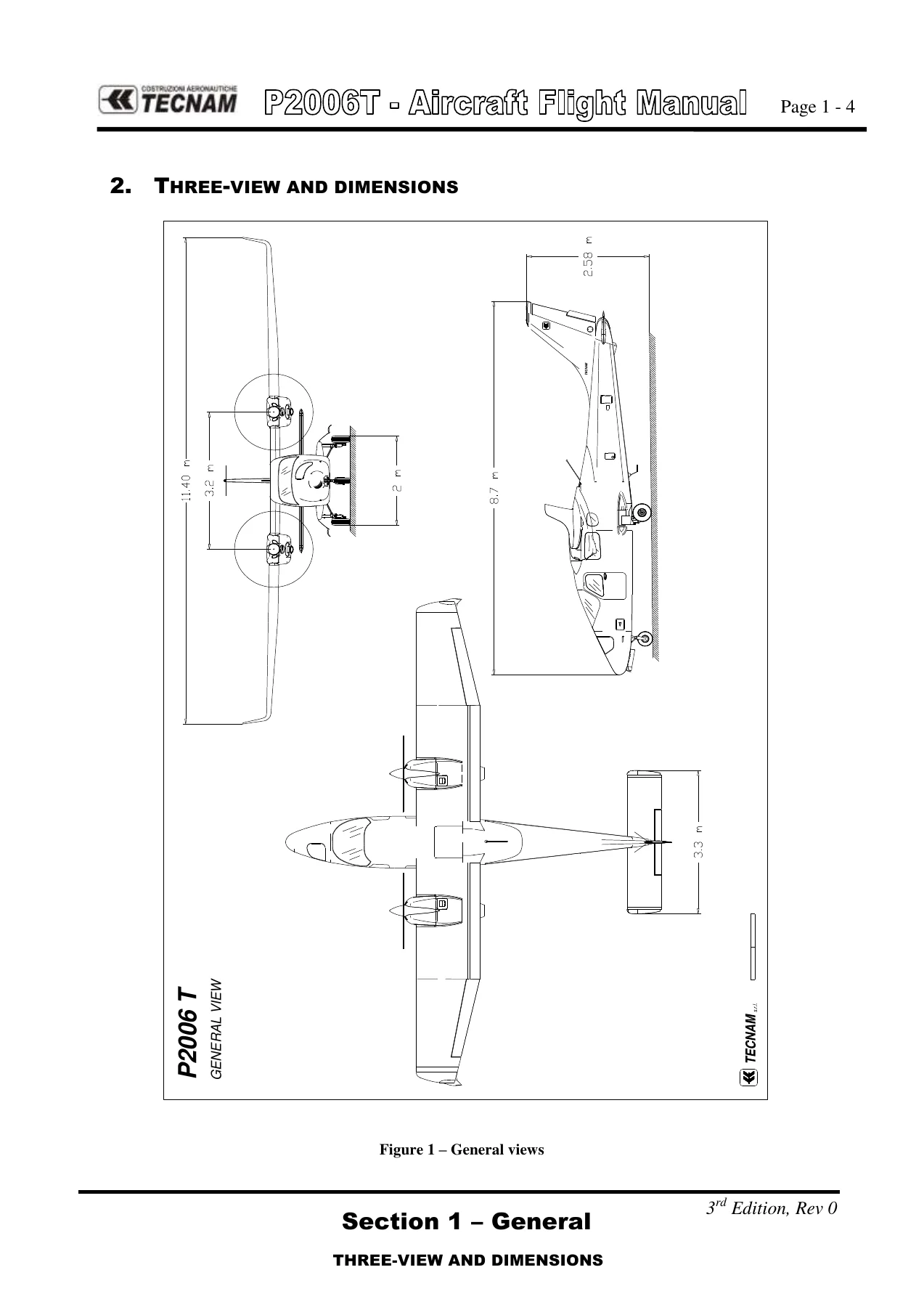
- Three-view and principal dimensions
- Control surfaces travel limits
- Engine, propeller and governor data
- Fuel, lubrication and cooling
- Maximum weights, standard weights, specific loadings
- Acronyms, terminology and unit conversion charts
Section 2 – Limitations (EASA Approved)
- Speed limitations and airspeed indicator markings
- Powerplant limitations and instrument markings
- Lubricant, coolant, propeller and governor limitations
- Maximum operating altitude and ambient temperature
- Warning, caution and advisory lights
- Weights and centre-of-gravity range
- Approved manoeuvres and manoeuvre load factor limits
- Flight crew, flight conditions and fuel
- Limitations placards and the Kinds of Operations Equipment List (KOEL)
Section 3 – Emergency Procedures
- Failures indicated on the annunciator panel – LH/RH generator failure, generator overvoltage, failed door closure, pitot heat failure, coolant low level, gear pump failure, engine fire
- Engine securing
- Powerplant emergencies – propeller overspeeding, CHT limit exceedance, oil temperature and oil pressure exceedance, low fuel pressure
- Other emergencies – electrical system total failure, static port failure, unintentional flight into icing, carburettor icing, flaps control failure
- One engine inoperative procedures, including in-flight restart and OEI landing
- Landing gear failures and emergency extension
- Smoke and fire on the ground, during takeoff run and in flight
- Unintentional spin recovery
- Landing emergencies – without engine power, with deflated nose or main gear tyre, without brakes
- Aircraft evacuation and ditching
Section 4 – Normal Procedures
- Airspeeds for normal operations
- Preflight checks – aircraft walk-around and cockpit inspections
- Checklists: engine starting, before taxiing, taxiing, prior to takeoff, line-up, takeoff and climb, cruise, descent and approach, before landing, balked landing / missed approach, after landing, parking / shut-down, postflight checks
Section 5 – Performances
- Airspeed indicator system calibration
- ICAO Standard Atmosphere and worked examples
- Stall speed and crosswind
- Take-off performances and take-off rate of climb at Vy and Vx
- Enroute rate of climb at Vy and Vx
- One-engine rate of climb at VySE and VxSE
- Cruise performances
- Landing performances
- Balked landing climb gradient and noise data
Section 6 – Weight and Balance
- Weighing procedures, preparation and levelling
- Determination of C.G. location
- Weighing records
- Weights and C.G. loading chart
- Baggage loading
- Equipment list
Section 7 – Airframe and Systems Description
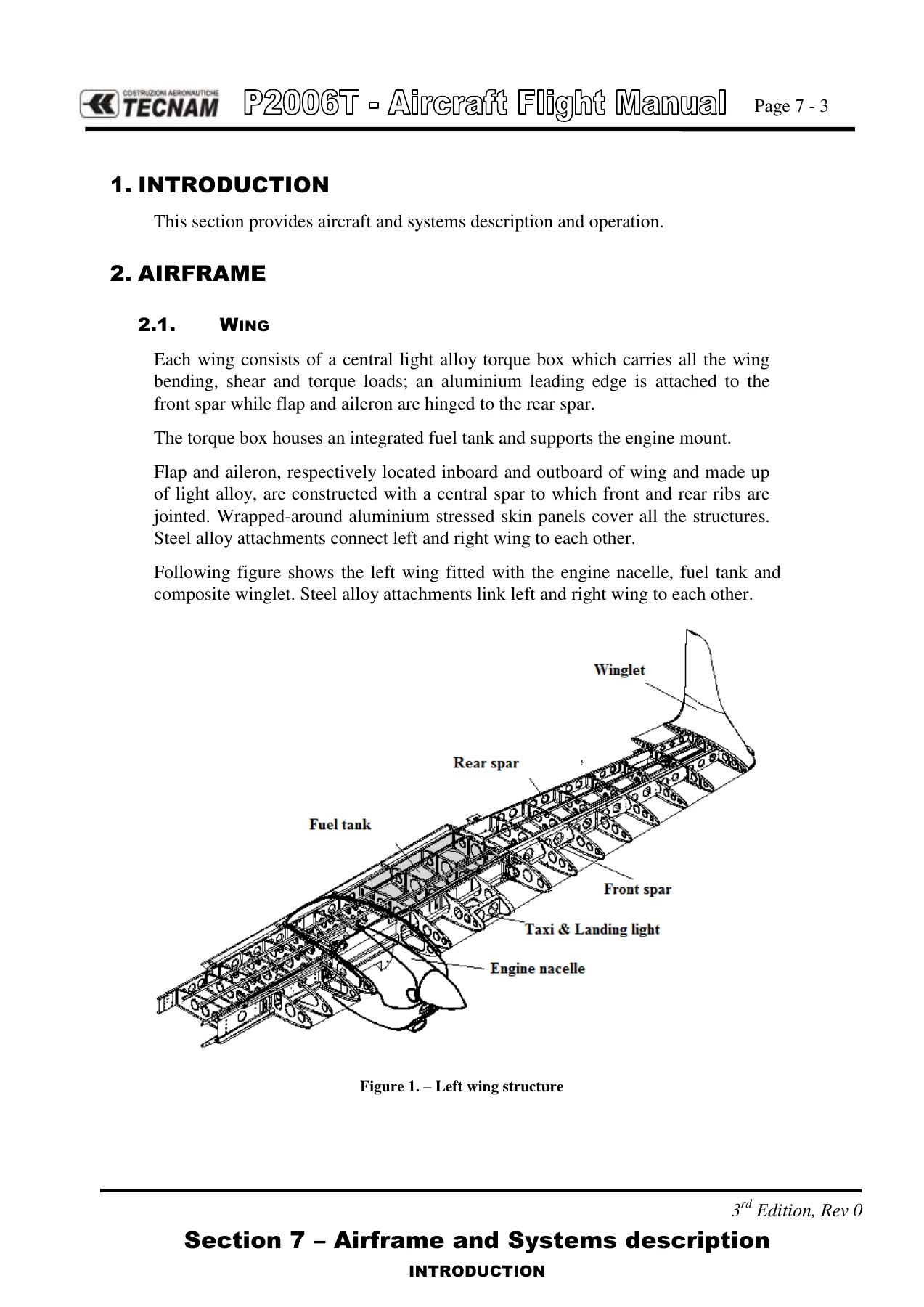
- Airframe – wing, fuselage, empennages and flight controls
- Powerplant and propeller features
- Pedestal controls and cabin over-head panel controls
- Internal lights and external lights
- Fuel system
- Landing gear system
- Brakes
- Ventilation and cabin heat
- Seats and safety belts, doors, baggage compartment
- Placards, instruments panel, electrical system
Section 8 – Aircraft Care and Maintenance
- Inspection intervals
- Aircraft changes or repairs
- Maintenance – refuelling, oil level control, landing gear tyre pressure control
- Ground towing, parking and mooring
- Cleaning and ice removal
Section 9 – Supplements
- Supplements for aeroplanes with analogue instruments (A1-A20)
- Supplements for aeroplanes with the Garmin G950 Integrated Flight Deck System (G1-G11)
Read as a whole, this Tecnam P2006T flight manual is the complete operational reference for the aircraft: the sections a pilot uses before every flight, and the reference a maintenance engineer returns to for aircraft systems, limitations, loading and performance. It runs from the walk-around and normal checklists through to the emergency procedures for engine fire, generator failure, gear malfunction and ditching, and it carries the aircraft’s certified performance tables and weight-and-balance data alongside the systems description that explains how each installation works.
What the Emergency and Limitations Chapters Give You
The two chapters a P2006T pilot reaches for most often are unusually well developed in this manual. Section 2 sets out every certified limit the P2006T operates under – VNE 167 KIAS, VNO 135 KIAS, VA/VO 118 KIAS, VLE/VLO 93 KIAS, VFE 93 KIAS with flaps full and 119 KIAS at take-off, VMCA 62 KIAS – together with the airspeed indicator colour arcs, the cylinder head temperature ceiling of 135 degC, oil temperature and oil pressure windows, fuel pressure limits, the 14000 ft maximum operating altitude and the placards that reproduce those limits in the cockpit.
Section 3 then takes each of those failure modes and gives the pilot the drill: the bold-face memory items that must be executed immediately after detection, and the longer step-by-step procedures for everything from a single generator dropping off-line to an engine fire in flight, an in-flight restart attempt, or a partial main landing gear extension. The one-engine-inoperative speed schedule, the restart altitude and speed guidance, and the landing procedures for nose-gear and main-gear tyre deflation are all in here.
Performance, Loading and Systems
Section 5 carries the performance data a P2006T operator actually flies to – take-off ground roll and 50 ft distances across pressure altitude and temperature, rates of climb for both engines and for one engine inoperative at VySE and VxSE, cruise tables at 0, 3000, 6000, 9000 and 12000 ft, landing distances and the balked-landing climb gradient. Section 6 lays out the weighing procedure, the C.G. envelope and the loading chart, and Section 7 explains the airframe, the Rotax 912 S3 installation, the hydraulic landing gear, the fuel and brake systems, the electrical distribution across the five bus bars, and the instrument and switch panels.
Delivery and Use
IMAGES PREVIEW
This Tecnam P2006T Aircraft Flight Manual is delivered as an instant PDF download – no shipping, no waiting. It opens on any device, is straightforward to print for a flight bag or maintenance bench copy, and the sections can be navigated quickly when you need one specific limitation or checklist rather than the whole book. The same document a P2006T owner, pilot or maintenance engineer would keep on the aircraft is available here, ready to download.
Reviews
There are no reviews yet.