
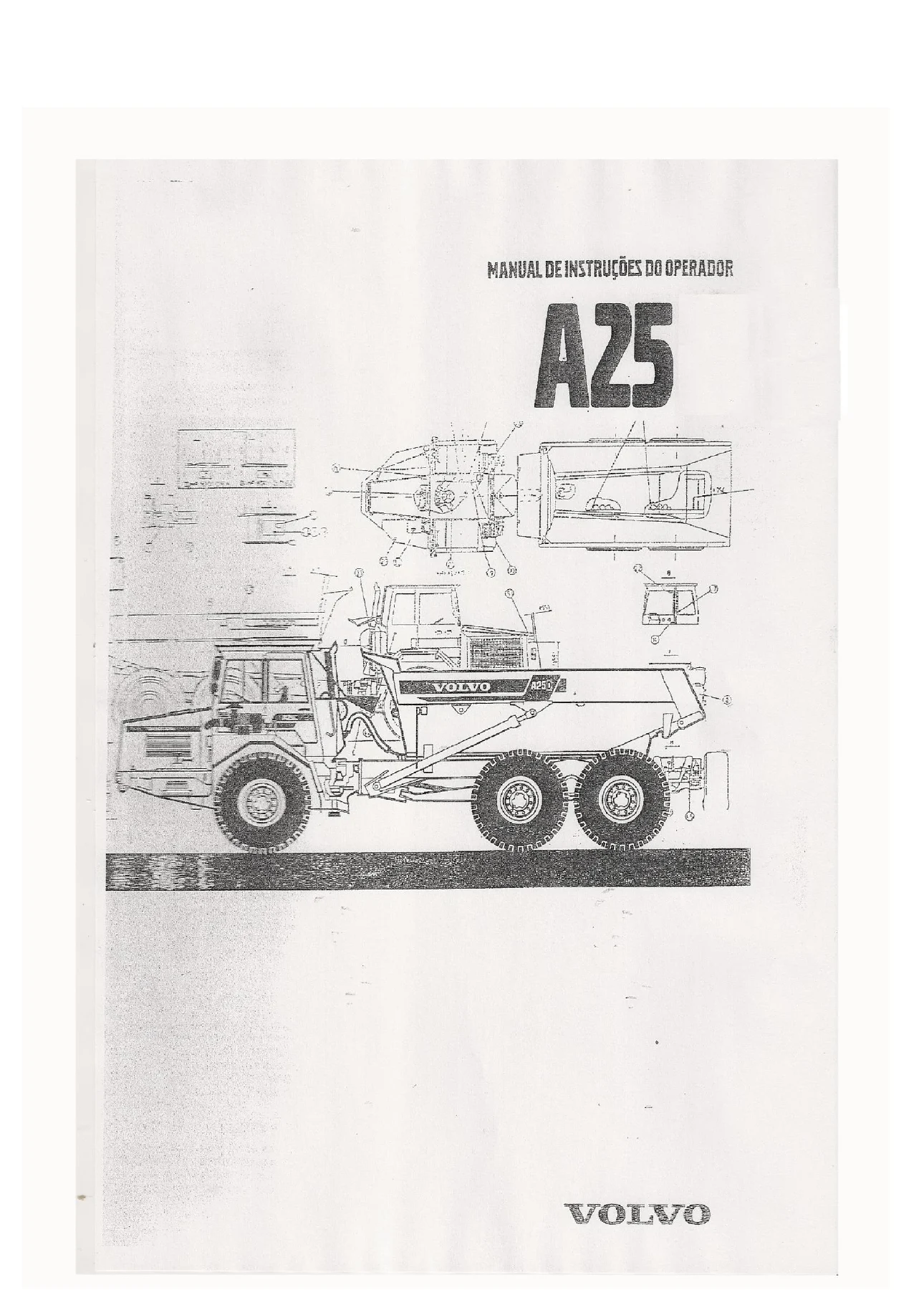
Volvo A25C 6×6 Articulated Dump Truck Operator Instruction Manual
Original price was: $26.95.$15.95Current price is: $15.95.
Operator instruction manual for the Volvo A25C 6×6 articulated dump truck covering controls, safe operation, loading and dumping, service precautions, scheduled maintenance, and machine specifications.
Description
Volvo A25C 6×6 Articulated Dump Truck Operator Instruction Manual
The Volvo A25C 6×6 Articulated Dump Truck Operator Instruction Manual is the cab-side guide for running and looking after this 3-axle articulated hauler. It explains how the machine should be used and maintained, and the preface states that the book should stay on the machine. Do not operate the truck or carry out maintenance until the contents have been read and understood. The text is written for all markets, so equipment that does not apply to a particular unit can be skipped.
File Details
- Manual type: Operator instruction manual
- Brand / model: Volvo A25C (A25C 6×6 articulated dump truck)
- Language: English
- Page count: 253
- File format: PDF
Machine Covered
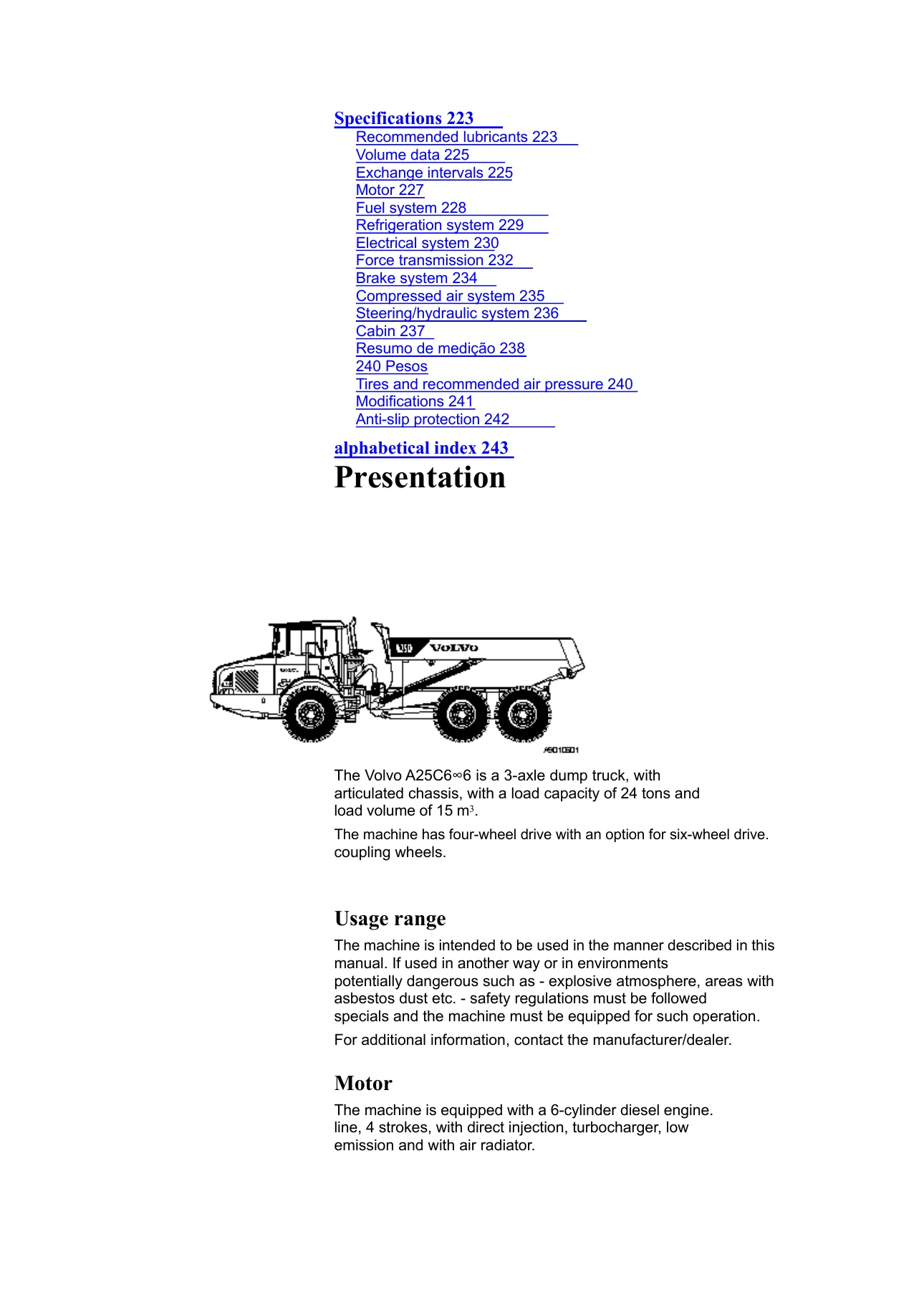
The presentation section describes the Volvo A25C 6×6 as a 3-axle dump truck with an articulated chassis, a load capacity of 24 tons, and a load volume of 15 m³. Four-wheel drive is standard, with six-wheel drive available by coupling the remaining wheels. The usage range is limited to the work described in this manual. Operation in potentially dangerous environments such as explosive atmospheres or areas with asbestos dust requires special safety rules and equipment; the text directs readers to the manufacturer or dealer for that information.
The engine is a 6-cylinder, 4-stroke diesel with direct injection, turbocharger, low-emission specification, and an air radiator. Specifications later in the book identify the Volvo designations D10BADE2 (EU) and D10BACE2 (EPA + EU). Steering-wheel power at 33 r/s (1980 rpm) is given as 228 kW (306 hp) SAE J1349 Gross and 227 kW (304 hp) SAE J1349 Liquid / DIN 6271 with the cooling fan at basic rotation. Torque at 22 r/s (1320 rpm) is 1375 Nm SAE J1349 Gross and 1365 Nm SAE J1349 Liquid / DIN 6271. The engine has 6 cylinders, 120.65 mm bore, 140 mm stroke, 9.6 liters total displacement, 18:1 compression, and firing order 1-5-3-6-2-4.
Force transmission uses a fully automatic planetary gearbox with a torque converter, freewheel stator, and automatic lockup in all gears except reverse. There are six forward gears and two reverse gears. A hydraulic retarder is built into the gearbox and is rated at a maximum 245 kW (333 hk). The specifications section names the gearbox PT1560 and the transfer box IL 1. The transfer box differential reduces tension between the driving axles; the longitudinal differential can be locked. Drive axles use differentials and planetary hub reductions, and every driving axle has a differential lock. Axle designations listed are Volvo AH56E, AH56F, and AH56G.
Service braking is two air-over-hydraulic disc-brake circuits, one for the engine unit and one for the load unit. The parking brake is a spring brake acting on the cardan shaft together with the transfer-box differential lock, released by a separate compressed-air circuit. Steering is Volvo’s self-compensating hydro-mechanical system with a secondary steering function. A ground-dependent pump on the transfer box keeps steering available even with the engine off. The cabin has heating and ventilation with window defrost, optional air conditioning, two emergency exits (the door and the right rear side window), and FOPS / ROPS approval. Unauthorized cabin changes such as lowering the roof, drilling, or welding mounts are forbidden without Volvo engineering review because they can void the protective-structure approval.
Instruments, Controls, and Information Panel
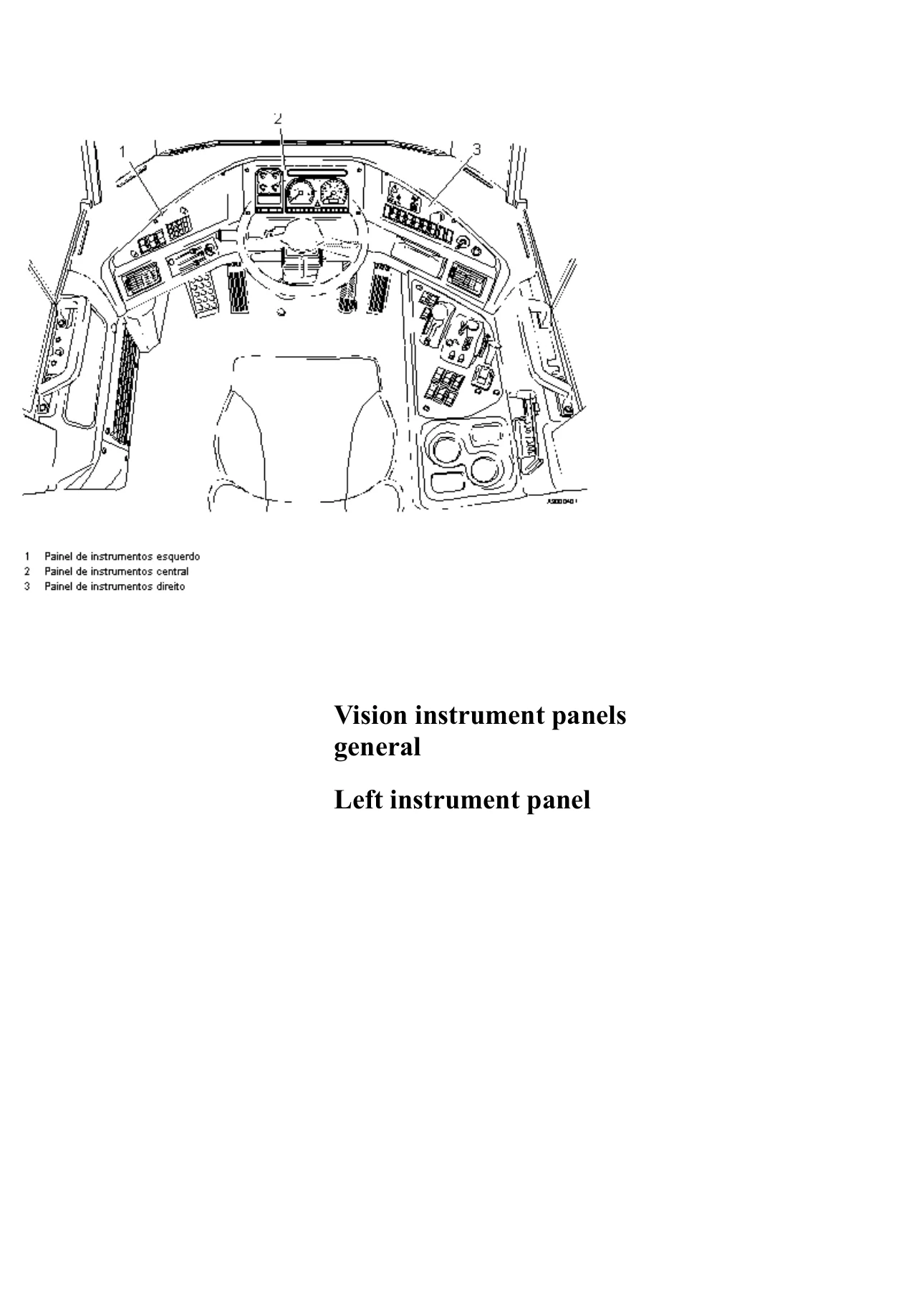
Left, central, and right instrument panels are drawn and labeled in detail. The left panel covers rheostats for switch and instrument lighting, headlights, optional front and rear work lights, and the keypad that selects screens on the information panel. The central cluster includes preheating, orange INFO and red STOP central alarms, charging, primary and secondary steering warnings, gearbox oil temperature and malfunction lamps, high beam, turn indicators for traction and load units, engine air-filter warning, coolant temperature, engine oil pressure, brake-system pressure, parking-brake and service-brake lamps, dual air-pressure gauges for the two brake circuits, a fuel gauge (the instrument text states tank capacity 480 liters), gearbox/retarder oil temperature, a tachometer scaled 0–28 (×100 rpm), and a speedometer/odometer reading 0–80 km/h (0–50 mph).
The right panel repeats the red STOP alarm and groups ignition, safety stop, optional delayed stop, hazard flashers, rotating beacon, heated mirrors, heated seat, and increased engine idle. Separate chapters walk through other controls and operator comfort: seat adjustment, heating and ventilation, optional air conditioning, and related cab equipment. The information panel is an LCD that shows machine status, warning images, fault-code images, and operating information; the left-hand keypad selects those views. Alarm-level guidance tells the operator when an orange INFO condition can wait until the next stop and when a flashing red STOP lamp means halt immediately and find the cause.
Operation and Working Technique
The operation section of the Volvo A25C 6×6 Articulated Dump Truck Operator Instruction Manual covers safety and responsibility, checks before work, ignition, starting, gear selection, driving with differential locks, steering, braking, dumping, after-work shutdown, rescue and towing, and the cargo body. Operators are required to know national and local safety rules; those rules take precedence over the book. Warning stickers on the machine must remain in place and readable. An untrained operator must not drive the truck. Never use a machine that has no operator instruction manual on board.
Gear-shift guidance includes positions D, R, and 1/2/3, shift-point behavior, a march inhibitor, automatic gear inhibitor, and over-rotation protection. A warning sticker and the text both forbid coasting in N on descents and require shifts only with the accelerator released. Differential-lock use is explained for poor traction. Braking covers the service circuits, parking brake, retarder, and additional exhaust-brake effect. Dumping instructions include body control, raised-bed hazards, and a warning not to use a bed cover if it can trap the load and tip the machine. Rescue and tow procedures include filling the compressed-air system and forced release of the parking brake. After operation, parking and shutdown steps are listed.
IMAGES PREVIEW
Operation techniques add public-road movement, ramps and slopes, irregular surfaces, loading, hauling a load, unloading, and recovery when the truck is stranded. Maximum load must not be exceeded. Movement in enclosed spaces is restricted. Transport of the machine, lifting points, tie-down anchors, and locking the steering joint and dump body before service or transport are described. Secondary steering can be tested from the cab. Communication radios and extra 12 V / 24 V equipment must be installed to the designated roof and cab connectors with a permanent external antenna so they do not disturb the machine electronics; the truck was tested to EU EMC Directive 89/336/EEC.
Service Safety and Maintenance
Service work starts from a defined service position. Read-before-service notes, fire-prevention measures, battery handling, the refrigeration unit (R134a), and tire safety come before any hands-on work. High-pressure brake oil, tensioned springs, compressed-air residual pressure, and the articulated steering joint are called out with dedicated warnings. Do not lean under a raised body unless it is supported. Do not spray water into the air intake. Do not use starting ether; an electric preheater is fitted.
Maintenance and conservation then run system by system: preparations and protection plates, engine oil and filter (about 38 liters including the filter), fuel system and tank drainage, air radiator and turbocharger leak checks, air purifier primary/secondary elements, cooling system, 24 V electrical system and batteries, power transmission (gearbox about 48 liters including filter and radiator; transfer box about 8.5 liters; front axle 32 liters; front bogie axle 36 liters; rear bogie axle 32 liters including hub reductions), brakes and compressed air, tires and wheel-bolt torque (800 Nm), optional air conditioning, hydraulic system (about 260 liters system / 180 liters at oil change for the tank), and the load body. Lubrication diagrams mark daily/10-hour and 50-hour work plus 250, 500, 1000, and 2000-hour services. Engine oil is listed at 500 hours when conditions are met, gearbox oil at 1000 hours, and coolant, transfer box, drive axles, hydraulic oil, and brake fluid at 2000 hours. General structural inspection of front and rear chassis, hitch, body, and axle housings is recommended from 6000 hours, then every 2000 hours to 12000 hours, then every 1000 hours, and immediately after any collision.
Recommended lubricants follow SAE J 300 MAR93 viscosity charts: engine oil VDS-3 or Global DHD-1 + VDS-2 or ACEA-E5 + VDS-2 or API CH-4 + VDS-2; hypoid API GL-5 in axles/hubs and the transfer box; ATF Dexron III or Dexron II in the gearbox; hydraulic oil to Swedish SS 15 54 34 or Vickers 35VQ25 / ISO 3448 / ISO 6743-4 categories; brake fluid SAE J 1703 DOT 4 or DOT 3. Fuel must meet EN 590, ASTM D 975 1-D/2-D, or JIS K 2204 class fuels with sulfur not above 0.3% by weight in the specification section (the U.S. emissions chapter also cites ASTM D 975 with cetane and 0.5% sulfur limits for certified engines). Original Volvo coolant part numbers 11990915-8 (5 liters) and 11990967-9 (20 liters) are listed. Cooling-system fill is given as 71 / 80 liters. Brake-fluid volume is 2.5 liters. Lithium EP grease NLGI 2 without MoS2 is specified for pins and bearings.
Identification, Weights, and Legal Notes
Product plates and the PIN sit on the left of the engine chassis next to the steering joint; the machine serial is stamped on the right of the engine chassis. Gearbox, transfer case, axle, engine, and cabin type/serial locations are mapped. CE marking and an EU Declaration of Conformity apply to machines sold in the EU/EEA under Machinery Directive 98/37/EC and the EMC rules. The U.S. Federal Clean Air Act section forbids removing or defeating certified emission-control parts, with a stated fine of up to 2,500 USD per infraction, and points owners to Volvo Construction Equipment for emission-warranty support. California Proposition 65 wording appears on U.S.-market stickers.
With 23.5 R25 tires and fluids plus operator, service weight is 12180 kg on the front axle and 9400 kg on the bogie (21560 kg total). Maximum permissible front-axle load is 14140 kg, bogie 31420 kg, load capacity 24000 kg, and maximum total weight 45560 kg. Unloaded overall length with 23.5 R25 tires is given as 10220 mm. Forward speed maxima by gear are 8, 12, 22, 31, 40, and 53 km/h; reverse maxima are 8 and 13 km/h. Dump cylinders are two double-acting Volvo units with 12-second raise and 9-second lower times. Electrical system voltage is 24 V from two 12 V, 170 Ah batteries in series, negative ground, 1540 W / 55 A alternator, and 6.6 kW starter.
Chapters Covered
- Preface — purpose of the operator instruction manual, storage on the machine, market notes, Volvo CE responsibility conditions
- Safety rules — national regulations, warning symbol, sticker duty
- Protection against electromagnetic interference — radio, 12 V and 24 V sockets, antennas, EMC Directive 89/336/EEC
- Presentation — A25C 6×6 layout, usage range, engine, transmission, brakes, steering, cabin, FOPS/ROPS, modifications
- CE Identification, EMC Directive — CE plate, Declaration of Conformity, Machinery Directive 98/37/EC
- Signs and stickers — product plates, PIN locations, information and warning signs, U.S. market stickers
- United States emissions law / Federal Clean Air Act — prohibited tampering, customer support, fuel and preventive maintenance notes
- Instrument panels — overview; left, central, and right panels; information panel and keypad
- Other controls — control layout; operator comfort (seat, climate)
- Operation — safety and responsibility; before operation; ignition; starting; gear shift; differential locks; direction/steering; braking; unloading; after operation; rescue/tow; cargo bucket
- Operation Techniques — public roads; ramps; irregular surfaces; loading; transport with cargo; cargo unloading; stranding/recovery
- Security in service — service position; read before service; fire prevention; batteries; refrigeration unit; tires
- Maintenance and conservation — preparations; motor; fuel system; air radiator; turbocharger; air purifier; refrigeration system; electrical system; power transmission; brake system; compressed air; tires; air conditioning; hydraulic system; load bucket; others
- Maintenance Program — general inspection of the machine; lubrication and maintenance scheme (10/50 through 2000 hours)
- Specifications — recommended lubricants; volume data; exchange intervals; motor; fuel; cooling; electrical; force transmission; brakes; compressed air; steering/hydraulic; cabin; measurement summary; weights; tires and air pressure; modifications; anti-slip protection
- Alphabetical index
Taken together, those chapters give an operator or site mechanic the control map, warning logic, driving and dumping method, recovery steps, lubrication map, fluid capacities, and the specification figures needed to keep one A25C 6×6 inside the limits printed on the plates and in the back of the book. It is an operator and conservation manual, not a workshop overhaul book: valve-clearance adjustment and some chassis-bearing work are explicitly sent to an authorized workshop.
Use This Manual On the Job
With the Volvo A25C 6×6 Articulated Dump Truck Operator Instruction Manual you can pre-start the truck, read every lamp and information-panel screen, select gears and differential locks correctly, use the retarder and dual-circuit brakes on grades, dump the body without standing under an unsupported bed, set the machine in service position, follow the 10- through 2000-hour lubrication scheme, and look up oil grades, fill quantities, tire size, and weight limits before a shift. Following the printed procedures and capacities matters because the articulated joint, spring parking brake, high-pressure brake oil, and certified engine settings will injure people or take the machine out of its certified configuration if they are improvised. After purchase the file is delivered as an instant PDF download—no shipping—so you can open it on a phone, tablet, or workshop computer and print the lubrication charts or warning-sticker pages you need in the yard.
Reviews
There are no reviews yet.