
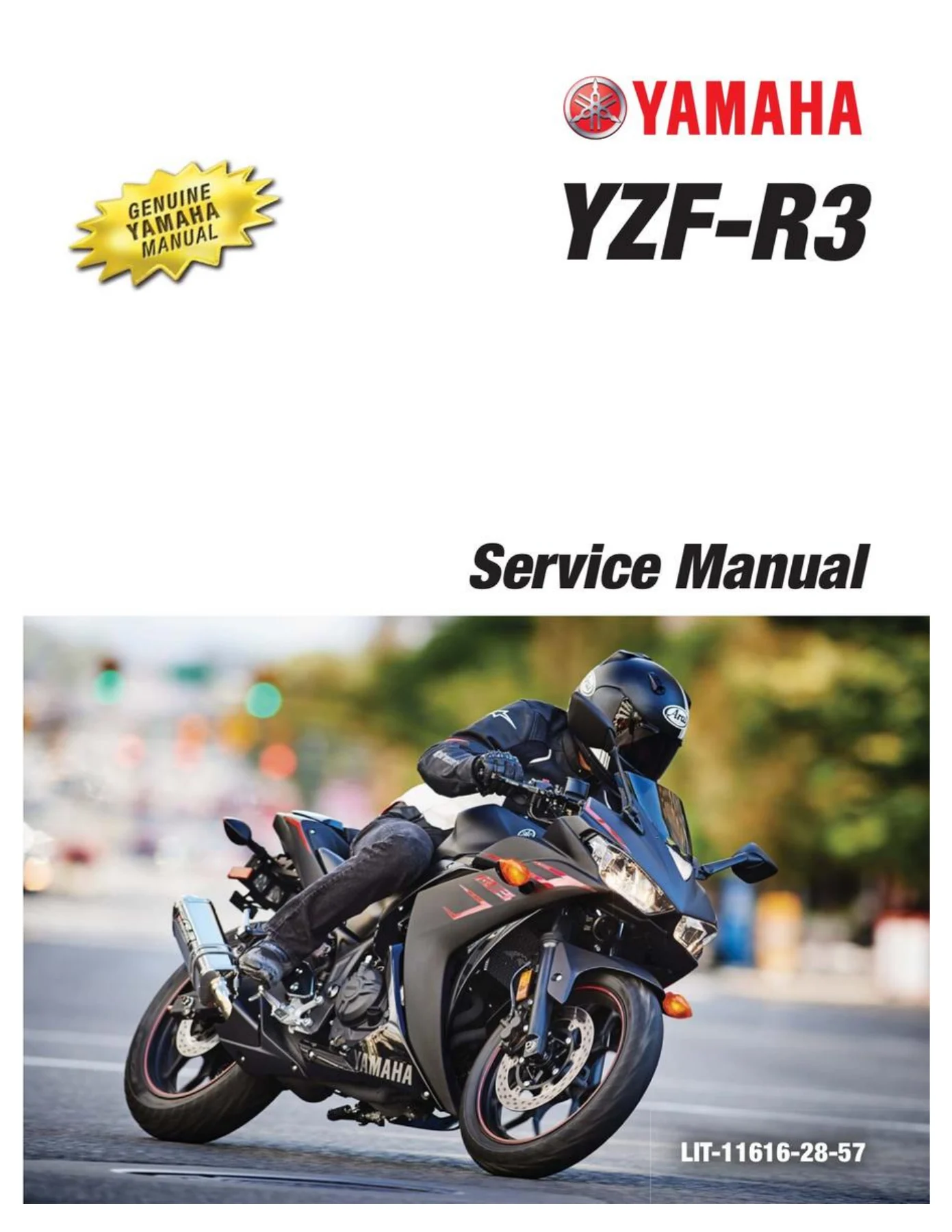
Yamaha YZF-R3 Service Manual – Full Workshop Repair Guide PDF
Original price was: $39.95.$24.95Current price is: $24.95.
The complete Yamaha YZF-R3 service manual in PDF – 488 pages of factory procedures, exploded diagrams, torque tables and service limits covering engine, fuel injection, cooling, chassis, brakes and electrical systems.
Description
The Yamaha YZF-R3 Service Manual is the complete workshop reference for the YZF-R3 sport bike, published by Yamaha under document number LIT-11616-28-57. Across 488 pages it documents every major system on the machine – engine, fuel injection, cooling, chassis, brakes, suspension, wheels and electrical – with sequential removal, disassembly, inspection, assembly and installation procedures supported by exploded diagrams, torque figures, service limits and special tool references. Whether you are setting valve clearance, rebuilding the top end, bleeding the hydraulic brakes or chasing a fault code on the self-diagnosis display, this Yamaha YZF-R3 service manual hands you the numbers and the sequence the factory used.
File Details
- Manual type: Yamaha service / workshop repair manual
- Brand: Yamaha
- Model: YZF-R3
- Document number: LIT-11616-28-57
- Language: English
- File format: PDF
- Page count: 488 pages
Chapters Covered in the Yamaha YZF-R3 Service Manual
- General Information – how to use this manual, vehicle identification number and model label location, component layout, FI system overview, instrument and multi-function meter functions
- Specifications – engine tightening torques, chassis tightening torques, lubrication points and lubricant types, general specifications
- Periodic Maintenance – air filter element and check hose, clutch lever free play, brake operation and pads, front and rear brake hoses, bleeding the hydraulic brake system, brake fluid level, wheels, tires, wheel bearings, swingarm operation and pivot lubrication, drive chain slack and lubrication, steering head, front fork, rear shock absorber, engine oil and oil filter, coolant, cables, throttle grip, switches, lights and signals, headlight bulbs and beam adjustment
- Chassis – general chassis and cowling removal, front wheel, rear wheel, front brake, rear brake, handlebars, front fork, steering head, swingarm and rear shock absorber assembly
- Engine – camshafts, cylinder head, valves and valve springs, clutch, oil pump, crankcase, transmission, generator, starter clutch and starter motor, balancer
- Cooling System – radiator, thermostat, water pump, coolant replacement
- Fuel System – fuel tank, fuel pump, throttle bodies, ISC (idle speed control) unit, air induction system, air filter case
- Electrical System – signalling system, ignition system, charging system, lighting, switches, self-diagnostic function and diagnostic code table
- Troubleshooting
Read as a whole, this Yamaha YZF-R3 repair manual is not just a parts list with pictures. Each section opens with an exploded diagram, follows it with a job instruction chart giving the order of operations, names of parts and notes, then walks through the steps that need special tools or technical data in sequence. The layout is deliberately built so that removal and disassembly are described once – installation and assembly are simply the reverse – which keeps the procedure pages tight and the diagrams large. Symbols throughout mark parts that must be lubricated or replaced, so consumables such as gaskets, oil seals, O-rings, lock washers and cotter pins are flagged before you start rather than after the engine is apart.
Engine, Fuel Injection and Cooling
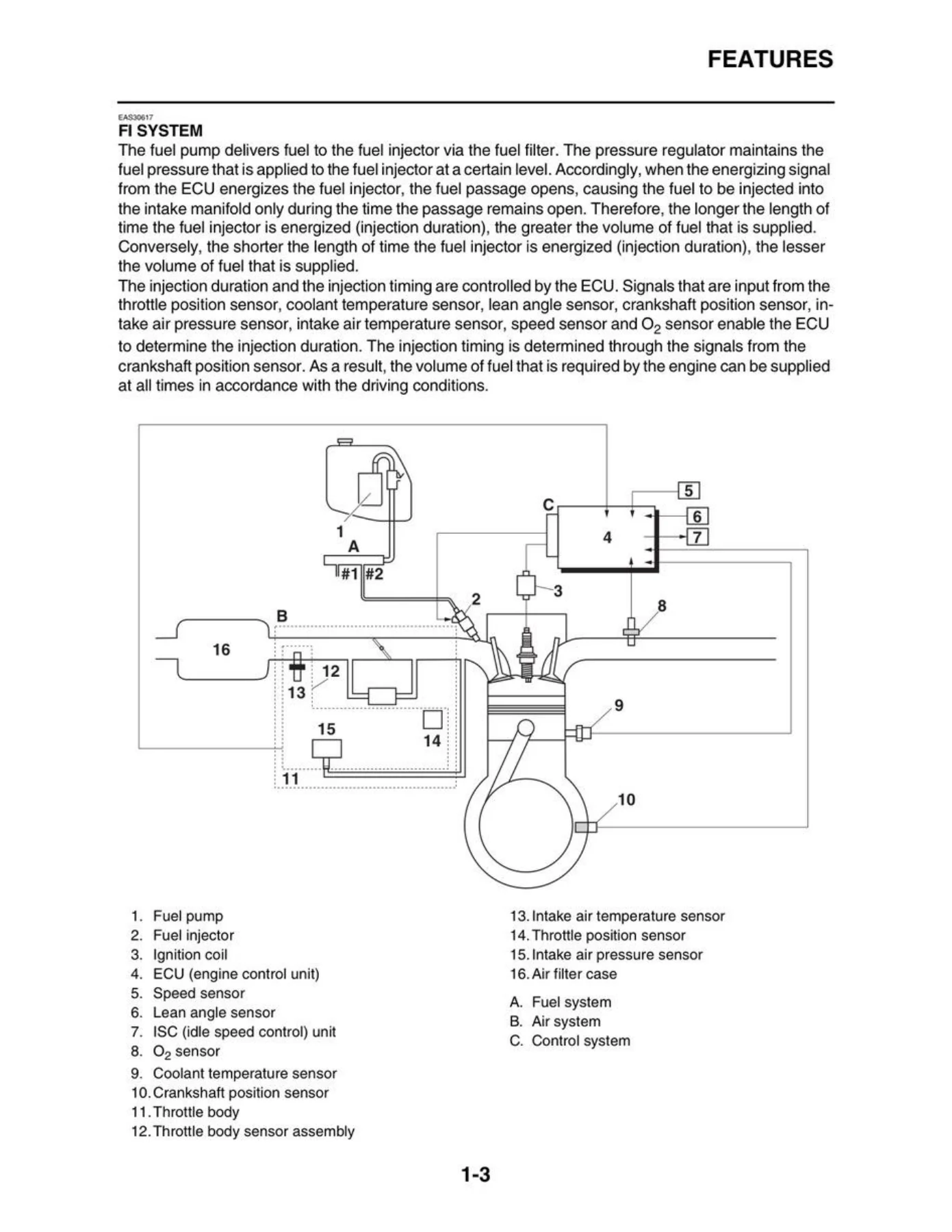
The engine chapter takes the YZF-R3 down to component level. Camshaft removal and installation, cylinder head disassembly, valve and valve spring inspection, valve clearance measurement and shim-style adjustment, clutch disassembly, oil pump service, crankcase splitting, transmission and shift mechanism work, generator and stator removal, starter clutch and starter motor overhaul and balancer service are all covered with the associated torque values. The fuel injection material explains how the pump delivers fuel through the filter to the injector, how the pressure regulator holds line pressure steady, and how the ECU varies injection duration and timing using signals from the throttle position sensor, coolant temperature sensor, lean angle sensor, crankshaft position sensor, intake air pressure sensor, intake air temperature sensor, speed sensor and O2 sensor. A full component layout diagram maps the engine trouble warning light, ignition coils, air induction system solenoid, coolant temperature sensor, fuel pump, battery, ECU, lean angle sensor, fuel injectors, ISC unit, throttle body sensor assembly, O2 sensor, sidestand switch, crankshaft position sensor, speed sensor and spark plugs so you can locate a connector before you start pulling panels. Cooling system coverage includes radiator removal, thermostat testing, water pump service and the correct fill quantities for both radiator and reservoir.
Chassis, Brakes, Suspension and Wheels
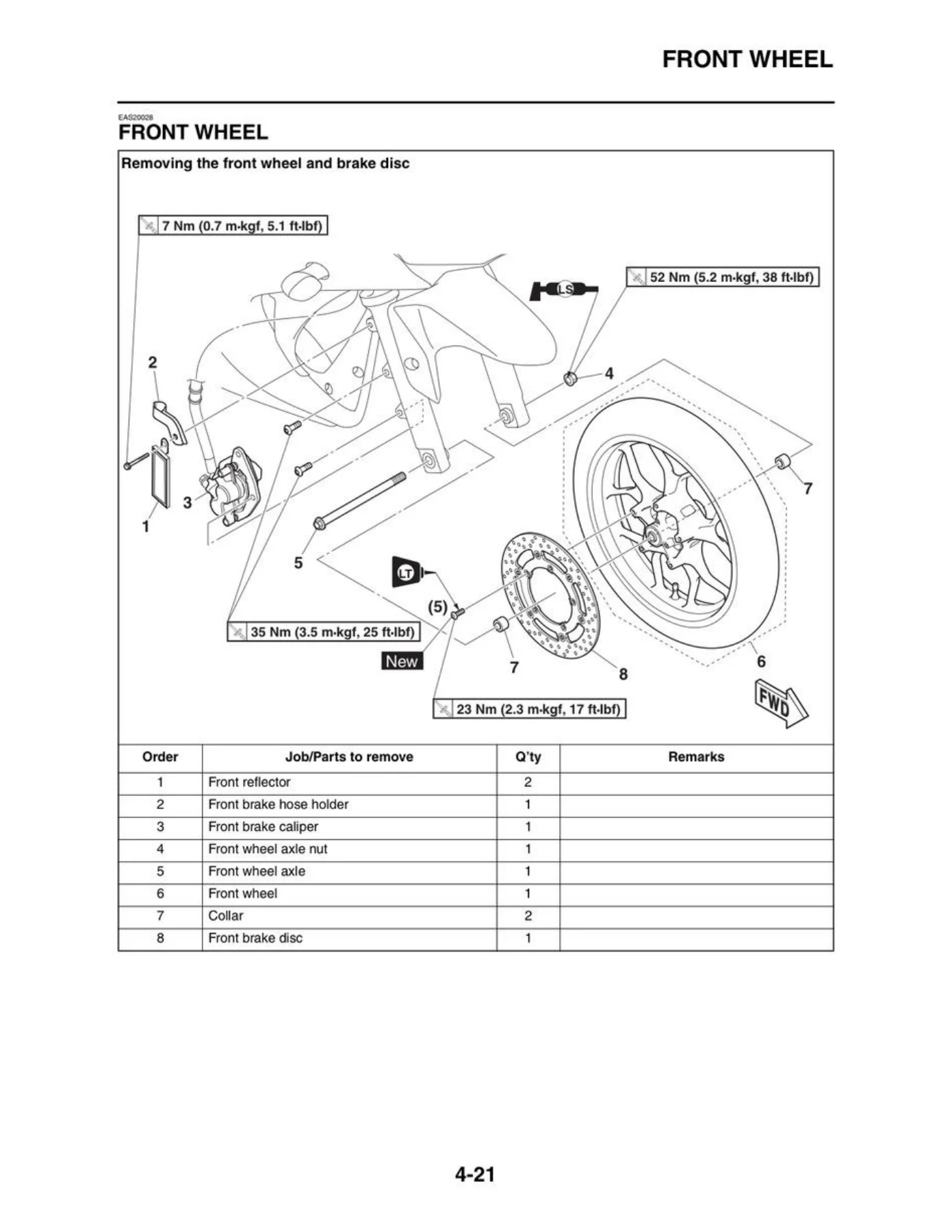
On the chassis side the manual covers front and rear wheel removal and disassembly, wheel bearing and oil seal replacement with press-fit guidance, static wheel balance, front and rear brake pad replacement, brake caliper disassembly and reassembly, brake master cylinder service, hydraulic brake bleeding, brake disc inspection with deflection and thickness limits, front fork work, steering head adjustment, swingarm and rear shock absorber assembly, and drive chain slack adjustment using the swingarm alignment marks. Every one of these sections is tied to a torque specification, from the front brake caliper bolts and front wheel axle nut through to the rear wheel sprocket nuts and the drive chain puller adjusting nut and locknut. Torque callouts appear directly on the exploded views, so you rarely have to flip back and forth between a diagram and a separate table.
Periodic Maintenance and Adjustment Values
The periodic maintenance chapter collects the routine checks and the adjustment windows that keep the bike in specification. It covers clutch lever free play, throttle grip free play, engine idling speed, valve clearance on a cold engine, spark plug gap and plug condition, brake fluid level and type, tire and wheel inspection, wheel bearing play, swingarm movement, drive chain lubrication and slack, steering head play, front fork operation, rear shock spring preload positions, engine oil level and oil change procedure including the oil filter cartridge, and coolant level and replacement. Headlight bulb replacement and headlight beam adjustment, both vertically and horizontally, are also documented with the adjusting bolt locations for the left and right headlight.
Electrical System and Self-Diagnosis
The electrical chapter handles the signalling system, ignition circuit, charging circuit and lighting, along with switch testing and bulb and bulb socket checks. The YZF-R3 is equipped with a self-diagnosis device for a range of electrical circuits: if a problem is detected the engine trouble warning light comes on and the multi-function display shows a fault code. The manual explains how to read that code and where to go next in the fuel injection system diagnostics. The multi-function meter section also documents the shift timing indicator light settings – flashing pattern, activation point, deactivation point and brightness – and the oil change tripmeter and indicator reset procedure.
Torque Tables, Special Tools and Lubrication Charts
Dedicated torque tables list engine tightening torques and chassis tightening torques item by item with thread size, quantity, Nm and ft-lbf values, including the multi-stage cylinder head bolt sequence with its molybdenum disulfide grease step and final angle specification, and the crankcase bolt sequence. A lubrication points and lubricant types chart tells you what goes where – bearings, oil seal lips, cylinder head bolt seats and threads, camshaft lobes and journals, valve stems and lifter surfaces, piston rings, crankshaft journals, balancer gear, oil pump components, clutch parts and more. A special tools list gives the tool names and part numbers needed for complete and accurate tune-up and assembly, covering items such as the pocket tester, thickness gauge and feeler gauge set, valve lapper, oil filter wrench, vacuum gauge and the Yamaha diagnostic tool.
Who This Yamaha YZF-R3 Workshop Manual Suits
This is a working document rather than a coffee-table book. It suits the home mechanic tackling scheduled maintenance in the garage, the owner who wants to understand what a shop is quoting for, and the professional technician who needs the factory sequence and torque data on hand. Because the procedures are written for one model rather than a family of machines, the diagrams match what is actually bolted to the bike and the clearances are specific to the YZF-R3 rather than a generic range.
IMAGES PREVIEW
Instant PDF Delivery – Start the Job Today
Everything described above is what this Yamaha YZF-R3 service manual lets you do: strip and rebuild the top end, set valve clearance with the correct shim calculation, service the fuel injection system, bleed the brakes properly, replace wheel bearings, adjust drive chain slack and align the rear wheel, diagnose a fault code, and hit every fastener with the correct torque instead of a guess. Correct procedures and correct specifications are the difference between a repair that lasts and one that comes back – and on a machine with hydraulic brakes and an ECU-controlled fuel system, guessing is expensive. The file is delivered instantly as a PDF after payment, with no shipping and no waiting. Read it on a laptop, tablet or phone in the workshop, or print the pages you need and take them to the bench.


Reviews
There are no reviews yet.