
1993 Jeep Grand Cherokee Grand Wagoneer ZJ Service Manual and Supplements
Original price was: $36.95.$21.95Current price is: $21.95.
Chrysler Corporation service manual and supplement set for the 1993 Jeep Grand Cherokee and Grand Wagoneer ZJ, covering 2WD and 4WD wagons with 4.0L six-cylinder and 5.2L V-8 engines, diagnosis, overhaul, wiring, and scheduled maintenance.
Description
1993 Jeep Grand Cherokee Grand Wagoneer ZJ Service Manual and Supplements
This 1993 Jeep Grand Cherokee Grand Wagoneer ZJ Service Manual and Supplements is the Chrysler Corporation service manual and supplement compilation prepared for professional technicians working on ZJ-platform Grand Cherokee and Grand Wagoneer wagons. Vehicle designation ZJ identifies the line throughout charts, captions, and procedures. Coverage includes 2WD and 4WD four-door wagons. VIN decoding in the introduction identifies Grand Cherokee 4×2 and 4×4, plus series codes for Laredo, Sport, Limited, and Grand Wagoneer. Engines called out in the identification charts and Group 9 are the 4.0 liter (242 CID) inline six with multi-point fuel injection and 8.8:1 compression, and the 5.2 liter (318 CID) overhead-valve V-8.
The publication is organized by numbered groups. Each group opens with a contents list, then general information, diagnosis, testing, adjustments, removal, installation, disassembly, and assembly. A torque chart appears at the end of each group. Groups marked with the suffix -S are supplements to the original service manual publication and are bound with the base book, including the 21-S transmission and transfer case supplement that adds 42RE automatic transmission coverage. The foreword states the book is written for daily repair work and does not teach theory of operation. Tightening torques are given as midpoint values for clean, dry OEM fasteners.
File Details
- Manual type: Service manual and supplement
- Brand / models: Jeep Grand Cherokee and Grand Wagoneer, vehicle code ZJ
- Language: English
- Page count: 1468
- File format: PDF
- Document marking: Copyright 1992 Chrysler Corporation 10M0792
- Title page: 1993 Jeep Grand Cherokee Grand Wagoneer Service Manual and Supplement
What the ZJ Book Identifies
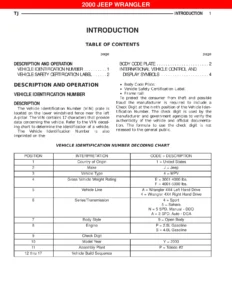
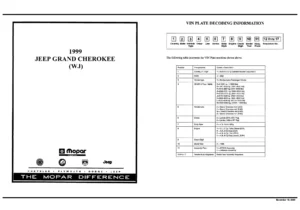
Introduction material explains how to read the vehicle. The Vehicle Safety Certification Label is on the left B-pillar and lists month and year of manufacture, GVWR, front and rear GAWR, VIN, vehicle type, rear-wheel type, bar code, and MDH of final assembly. The VIN plate sits on the top left of the instrument panel and is also stamped on the body code plate, equipment identification plate, certification label, and frame rail. A metal body code plate is riveted to the top left of the radiator reinforcement and can carry up to seven rows of sales, paint, trim, engine, and model data.
Exterior dimensions printed for the wagon are a 2691 mm (105.9 in.) wheelbase, 1473 mm (58.0 in.) front and rear track, 4488 mm (176.7 in.) overall length, 1758 mm (69.2 in.) overall width, and 1635 mm (64.4 in.) height. Interior figures include front/rear head room 991/994 mm, leg room 1044/945 mm, shoulder room 1480/1463 mm, and hip room 1445/1252 mm. Weight tables list ZJ 4WD GVWR 5300 lb and ZJ 2WD GVWR 4950 lb with P205/75R15 tires on 15 x 7 rims, 750 lb maximum passenger weight, 400 lb maximum cargo, 2500 lb front GAWR, and 2905 lb rear GAWR. Trailer towing tables for the 4.0 six with 3.55 axle and automatic transmission with auxiliary cooler give 5000 lb maximum trailer weight, 750 lb tongue weight, 9550 lb GCWR on 4WD, and 9200 lb GCWR on 2WD, with notes calling for a 500-ampere battery, maximum engine cooling, heavy-duty shocks, front stabilizer bar, heavy-duty variable-load flasher, and trailer-light harness.
Chapters Covered
- Introduction — designations, labels/plates/decals, VIN and body-code decoding, dimensions/weights, trailer towing specifications, measurement and torque specifications
- Group 0 Lubrication and Maintenance — general information, engine maintenance, drivetrain, chassis and body; scheduled maintenance for ZJ vehicles except California and California schedules; fluid capacities; jump starting; vehicle lifting and towing
- Group 2 Front Suspension and Axle — front wheel alignment, front suspension, axle noise/vibration diagnosis, Model 30 axle and tube axle (2WD), torque specifications
- Group 3 Rear Suspension and Axles — rear suspension, axle noise/vibration diagnosis, Model 35 axle, Trac-Lok differential, torque specifications
- Group 5 Brakes — antilock brake system diagnosis and operation, service brake diagnosis, adjustments/fluid/bleeding, master cylinder-HCU-combination valve-brakelines, power booster, antilock electronic components, disc and drum service, parking brake, pedal and switch service, specifications
- Group 6 Clutch — clutch diagnosis and clutch service for the hydraulic linkage used with manual transmission
- Group 7 Cooling System — diagnosis, service procedures, engine accessory drive belts, engine block heater, specifications
- Group 8 Electrical — battery/starting/charging diagnostics (8A); battery/starter/generator service (8B); overhead console (8C); ignition systems (8D); instrument panel and gauges (8E); audio systems (8F); horns (8G); vehicle speed control (8H); turn signals and hazard flasher (8J); windshield wiper and washer (8K); lamps (8L); restraint systems (8M); rear window defogger (8N); power door locks (8P); vehicle theft security system (8Q); power seats (8R); power windows (8S); power mirrors (8T); chime warning/reminder (8U); wiring diagrams (8W)
- Group 9 Engines — standard service procedures, engine diagnosis, 4.0L engine service procedures, 5.2L engine service procedures
- Group 11 Exhaust System and Intake Manifold — exhaust and intake service for both engines
- Group 13 Frame and Bumpers — bumper and frame-related service
- Group 14 Fuel System — fuel delivery, fuel tanks, accelerator pedal and throttle cable, MPI system description/operation, diagnosis, and component R&I for 4.0L and 5.2L, specifications
- Group 16 Propeller Shafts — shaft identification, vibration diagnosis, single and double Cardan joint service
- Group 19 Steering — power steering diagnosis, pump, linkage, recirculating-ball gear, steering column, automatic transmission shifter/ignition interlock, torque specifications
- Group 21 Transmissions and Transfer Cases — AX 15 manual transmission; AW-4 automatic transmission; 46RH automatic transmission; NP231, NP242, and NP249 transfer cases; specifications
- Group 21-S Transmissions and Transfer Cases supplement — 42RE automatic transmission diagnosis, in-vehicle service, removal/installation, transmission and overdrive overhaul, specifications
- Group 22 Wheels and Tires — tires, wheels, vehicle vibration, specifications
- Group 23 Body Components — exterior components, power sunroof, doors, fixed glass, underbody, interior, paint code chart, refinishing
- Group 24 Heating and Air Conditioning — system diagnostics, refrigerant service, compressor service, climate control, torque specifications
- Group 25 Emission Control Systems — evaporative and exhaust emission controls, component removal/installation, VECI label information
- Component and System Index, Index Supplement, Service Manual Comment Forms
Taken together, the groups give a working technician the identification data, inspection intervals, diagnostic trees, on-board diagnostic guidance, wiring sheets, exploded hardware views, and rebuild sequences needed to service a 1993 ZJ from scheduled oil and filter work through engine short-block procedures, axle rebuild, transmission overhaul, and body refinish codes. Electrical Group 8 is especially large: starting and charging tests sit next to ignition sensor locations, cluster lamp diagnosis, keyless-entry transmitter programming, air-bag module cautions, and a full 8W wiring-diagram section with component identification, splice maps, and system sheets.
Engines, Fuel, and Emissions
Group 9 treats the 4.0L six as an in-line, lightweight, overhead-valve engine and the 5.2L as a V-type single-cam overhead-valve engine. Shared standard procedures cover form-in-place gaskets (Mopar Silicone Rubber Adhesive Sealant versus Mopar Gasket Maker), cylinder-bore honing, Plastigage measurements, thread repair, and hydrostatic lock. Engine diagnosis charts walk no-start, stall, rough idle, and mechanical noise complaints back to oil level, ignition, fuel pressure, and internal wear. Separate service-procedure sections then cover cylinder head, valve train, front cover and oil pump, oil pan, camshaft, pistons, and in-vehicle engine R&I for each displacement, with cross-references to cooling, fuel, exhaust, and A/C groups so belts, manifolds, and refrigerant are handled in the right order.
Group 14 documents a tank-mounted electric pump, in-line filter, supply and return lines, rail, injectors, and pressure regulator, plus the pressure-relief/rollover valve and filler cap. MPI coverage is split by engine: component description and system operation, general diagnosis including on-board diagnostics and PCM connector information, then component removal and installation for sensors, relays, throttle body, idle air control, fuel rail, and injectors. Fuel-usage text requires unleaded gasoline with a minimum posted octane of 87 and discusses ethanol blends at 10 percent. Group 25 explains the VECI label in the engine compartment (engine family, evaporative family, schematic, certification application, timing and idle if adjustable, spark-plug gap) and services evaporative and exhaust devices including PCV, EGR, EVAP canister and purge solenoid, and oxygen-sensor cross-references.
Driveline, Brakes, and Chassis
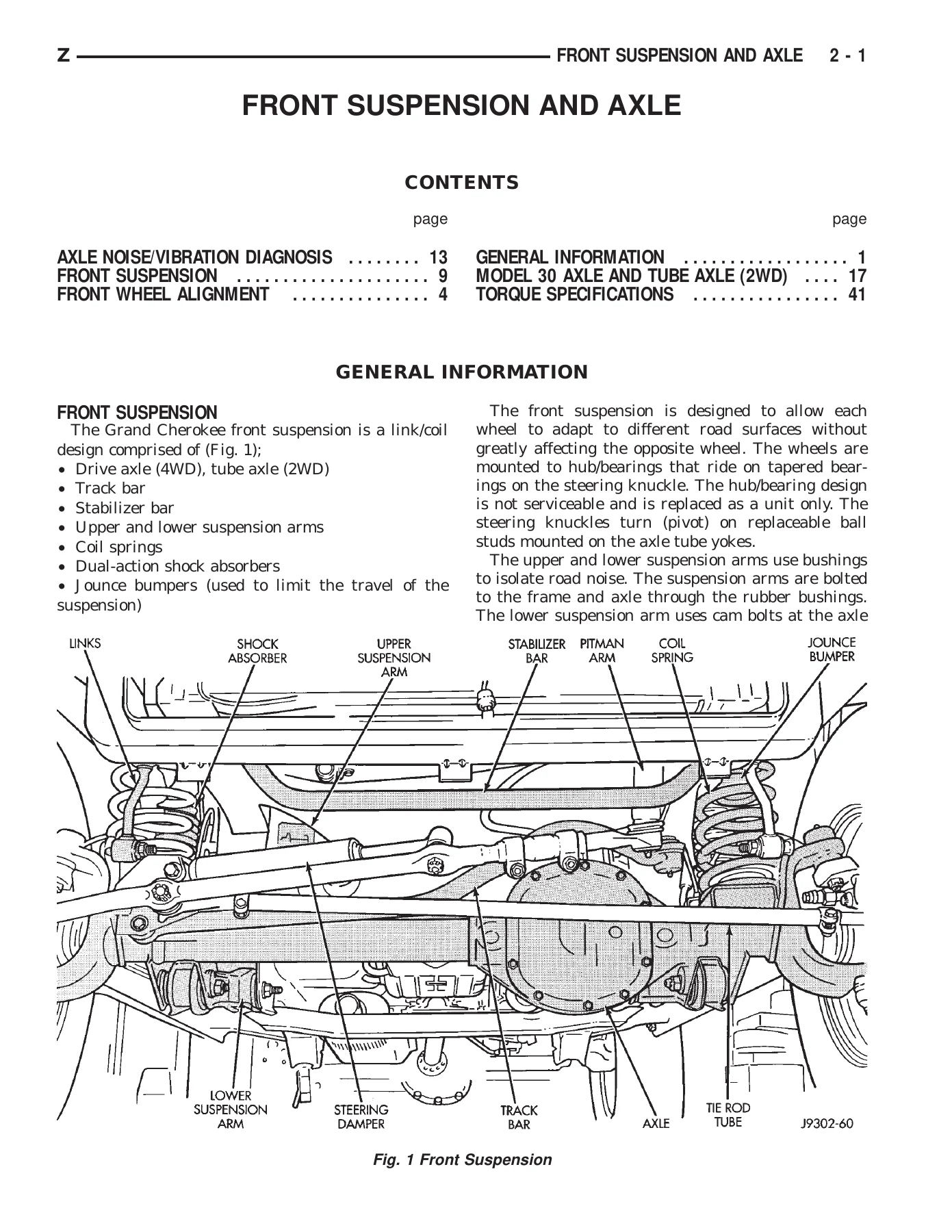
Front suspension is a link/coil layout with a Model 30 drive axle on 4WD or a tube axle on 2WD, track bar, stabilizer bar, upper and lower arms, coil springs, dual-action shocks, and jounce bumpers. Hub/bearings are non-serviceable assemblies. Alignment procedures give caster, camber, and toe guidance and note that propeller-shaft angle has priority over caster. Rear suspension uses the same link/coil idea with a Model 35 hypoid axle, optional Trac-Lok, and ABS tone rings pressed on the axle shafts. Lubricant quantities printed in the axle groups include 50±1 fl oz for the non-disconnect front axle and 40±1 fl oz of synthetic gear lubricant with friction modifier for the rear.
Brakes combine front single-piston disc calipers and ventilated rotors with 254 x 44 mm (10.0 x 1.75 in.) rear drums, a 200 mm (7.8 in.) dual-diaphragm vacuum booster, dual-reservoir master cylinder, and combination proportioning valve. ABS is standard, with an ECU, wheel-speed sensors, tone rings, and hydraulic control unit. The book covers bleeding, lining service, parking-brake cable tension, and antilock electronic diagnosis. Clutch coverage applies to manual-transmission models: dry disc, diaphragm cover, hydraulic master and slave cylinders, and DOT 3 fluid only.
Cooling procedures differ by engine. The 4.0L uses a manually adjusted accessory belt; the 5.2L uses an automatic tensioner. Water-pump, thermostat, radiator, viscous fan drive, and optional block-heater service are written separately for each engine. Capacities listed in Group 0 are 6 qt engine oil with filter on the six-cylinder, 5 qt with filter on the V-8, 9.3 qt coolant on the six, and 14.9 qt coolant on the V-8. Fuel tank capacity is given as approximately 23 gallons (87.4 liters).
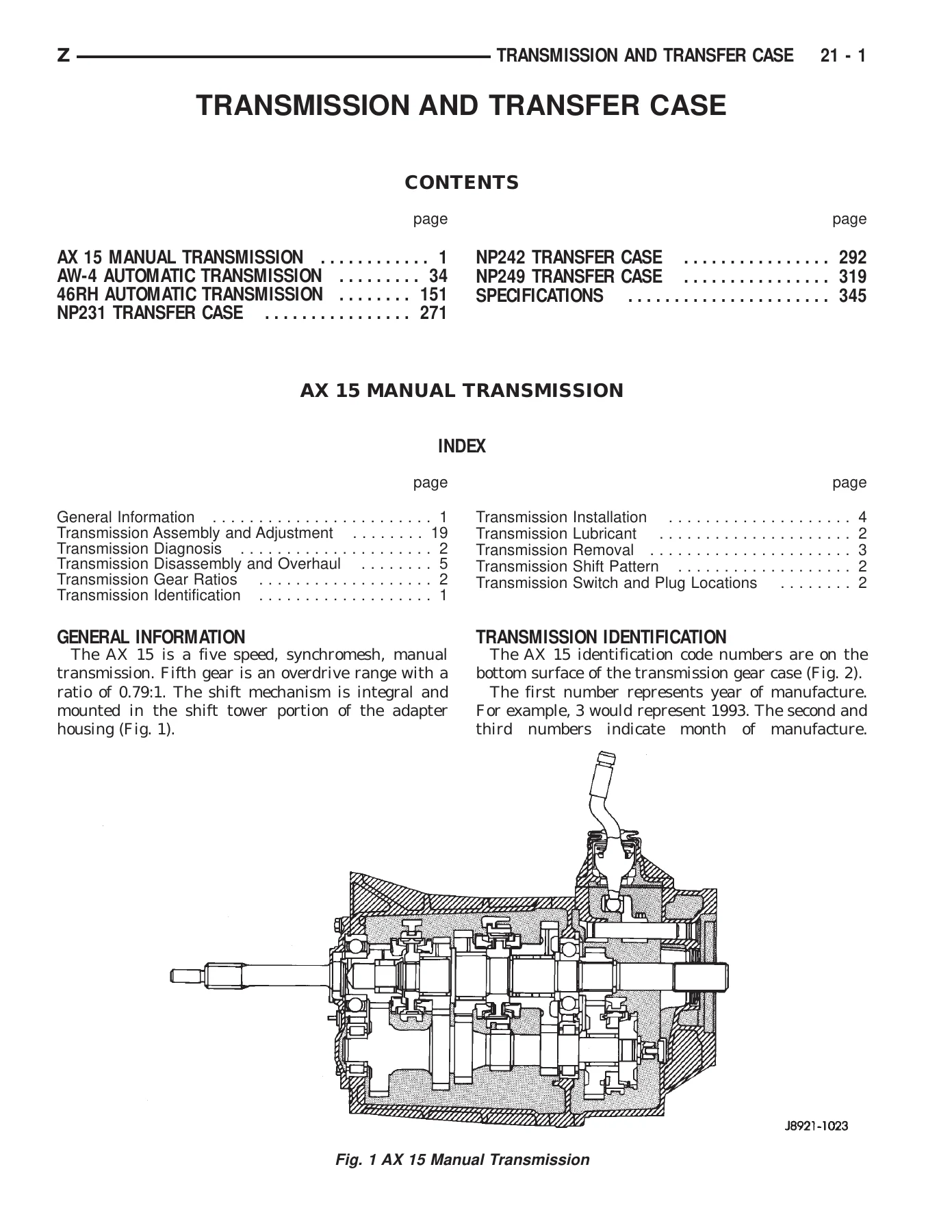
Transmission Group 21 and the 21-S supplement are a large share of the page count. The AX 15 five-speed manual lists ratios of 3.83, 2.33, 1.44, 1.00, 0.79 overdrive, and 4.22 reverse, with Mopar SAE 75W-90 GL-5 lubricant. Automatic units covered are AW-4, 46RH, and, in the supplement, 42RE with electronic governor pressure. Transfer cases are NP231 part-time, NP242, and NP249, with shift-linkage adjustment, overhaul legends, and ATF fill-to-plug-hole procedures. Steering is a recirculating-ball power gear (codes AL and MN at 12.7:1, MN with trailer-tow seals), belt-driven pump, linkage with adjustable sleeves, and column service that includes air-bag cautions and the automatic-transmission shifter/ignition interlock cable.
Electrical, Climate, and Body
Wiring diagrams occupy Group 8W with secondary-ignition layouts for both engines (4.0L firing order 1-5-3-6-2-4; 5.2L 1-8-4-3-6-5-7-2), harness-repair notes, splice locations, and indexed system sheets. Restraint Group 8M covers air-bag system checks and module handling. Climate Group 24 treats heater-only, manual A/C, and automatic temperature control from a common heater-A/C housing, with R-134a refrigerant warnings, evacuate/charge steps, compressor clutch service, and door-actuator replacement that often requires instrument-panel removal. Body Group 23 walks grille and GOR, hood, fenders, cladding, woodgrain overlay, sunroof, doors, glass, seats, consoles, trailer hitch, transfer-case skid plate, and paint-code use from the body code plate.
Maintenance Group 0 remains the everyday reference: API SG or SG/CD oil with SAE 10W-30 preferred, unleaded 87-octane fuel, California versus federal interval charts, severe-service definitions (short trips under 15 miles, dust, towing, idle, high speed, desert, cold, commercial use), and general services such as 4×4 steering-linkage lubrication every 7,500 miles or 6 months, automatic-transmission drain and refill every 30,000 miles normal or 12,000 miles severe, transfer-case drain and refill every 30,000 miles, and axle service on the same normal/severe split. Jump-starting, floor-jack lift points on the subframe rails, and towing cautions are included so the vehicle can be supported without loading an axle tube.
Use This Manual On the Vehicle
The 1993 Jeep Grand Cherokee Grand Wagoneer ZJ Service Manual and Supplements supports the jobs a ZJ owner or shop actually faces: reading VIN and body-code data, setting alignment and pinion angle, diagnosing ABS and PCM fault lamps, pressure-testing the fuel rail after a correct pressure-release procedure, replacing a Model 30 or Model 35 differential, overhauling an AX 15, AW-4, 46RH, or 42RE, rebuilding an NP231/242/249 transfer case, tracing a circuit on an 8W sheet, recovering R-134a, and following the printed torque and capacity figures instead of guessing. Correct procedures and midpoint torque values matter on this platform because the book repeatedly warns that wrong hardware, lubricated threads without the stated 10 percent reduction, or skipped pressure-release and air-bag steps can damage parts or create an unsafe assembly.
After payment the file is delivered as an instant PDF download. There is no printed-book shipping delay. Open it on a shop computer, tablet, or phone and print the group, wiring sheet, or torque chart you need for the job in front of you.
Reviews
There are no reviews yet.