
6×6 Wildland Fire Engines Project 63 – Military M35 M809 M939 Fire Engine Conversion Manual
Original price was: $39.95.$24.95Current price is: $24.95.
Roscommon Equipment Center Project 63 report and design packets for converting U.S. Military 2.5-ton and 5-ton 6×6 trucks (M35, M39, M809, M939) into wildland fire engines, with tank drawings, frame extensions, brush protection, cab fabrication and 12-volt alternator installation.
Description
6×6 Wildland Fire Engines Project 63 – Military 6×6 Fire Engine Conversion
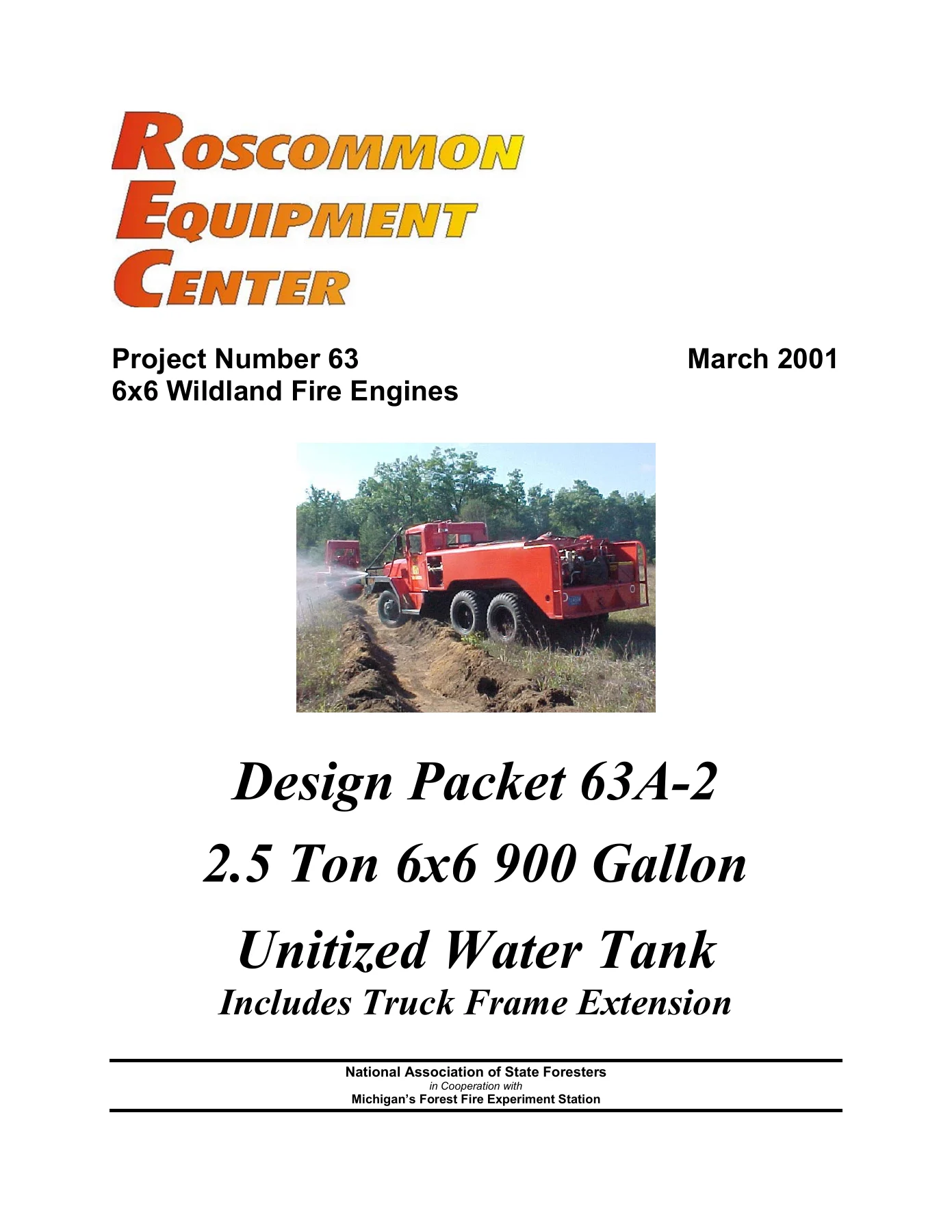
The 6×6 Wildland Fire Engines Project 63 manual is the Roscommon Equipment Center’s consolidated technical report and design packet series for turning U.S. Military 2.5-ton and 5-ton 6×6 trucks into working wildland fire engines. Produced by the Roscommon Equipment Center through the Forest Fire Experiment Station in Roscommon, Michigan, in cooperation with the National Association of State Foresters, this document replaces the earlier Project No. 22 and Project No. 39 reports and brings the 2.5-ton and 5-ton conversion information together into a single reference. It covers the truck families, the Federal Excess Property Program (FEPP) acquisition route, weight and payload limits, and the full set of REC design packets – from a 900 gallon unitized steel water tank for the 2.5-ton chassis to a 1,400 gallon tank for the 5-ton chassis, plus the shared plumbing, filler port, light mast, protective cab, brush protection and electrical system drawings that complete a conversion.
File Details
- Manual type: Technical conversion report and design packet series (fabrication drawings, specifications and installation guidance)
- Publisher: Roscommon Equipment Center, c/o Forest Fire Experiment Station, 1337 East Robinson Lake Road, P.O. Box 68, Roscommon, Michigan 48653
- Prepared with: National Association of State Foresters and the State of Michigan
- Project number: Project Number 63
- Principal report date: March 2001 (individual design packets carry dates from 2001 through 2009)
- Language: English
- File format: PDF
- Page count: 463 pages
Chapters Covered
- Introduction and the history of REC 6×6 conversion work
- The U.S. Military 6×6 truck family – M135 GMC 2.5-ton series, M35 (REO) 2.5-ton series, M35 Extended Service Program (ESP), M39 5-ton series, M809 5-ton series, M939 5-ton series
- Federal Excess Property Program (FEPP) – how the program works and where to get more information
- Comparing a FEPP 6×6 with commercial cab and chassis – disadvantages and advantages
- Safe modification of FEPP vehicles – GVWR, FAWR and RAWR ratings, weight calculation, vehicle lighting requirements
- Weight capacity of a U.S. military vehicle – military payload ratings, highway versus cross-country ratings, the M939 single-rating change
- REC design packets for 6x6s
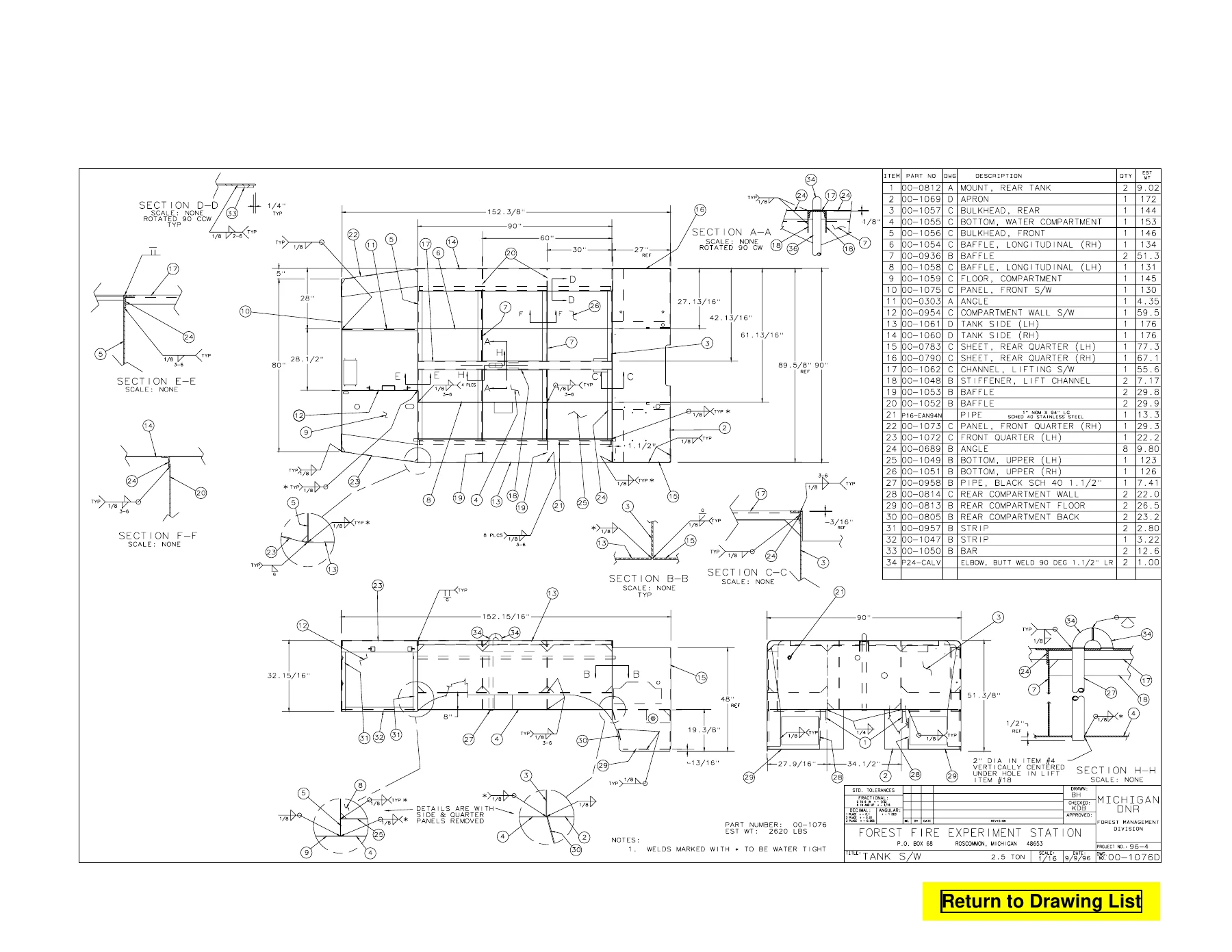
- Packet 63A-2 – 900 gallon tank drawings for 2.5-ton 6x6s, including frame extension
- Packet 63A-5 – 1,400 gallon tank drawings for 5-ton 6x6s, including frame extension
- Packet 63B – common 6×6 tank parts, including plumbing examples
- Packet 63C – filler port and strainer drawings
- Packet 63D – pneumatically controlled emergency light mast
- Packet 63E – fabricated metal cab tops for REO style 6x6s
- Packet 63F-2 – brush protection drawings for 2.5-ton 6x6s
- Packet 63F-5 – brush protection drawings for 5-ton 6x6s
- Packet 63G / 63G-1 – wiring and adding a 12-volt alternator to a Cummins engine powered (M809 series) 6×6
- Packet 63M939 – Military M939 series 6×6 truck evaluation
- Other REC publications and outside reference sources
- Appendix A – 6×6 truck families and their variants
- Appendix B – weight information for various series and types of 5-ton 6x6s
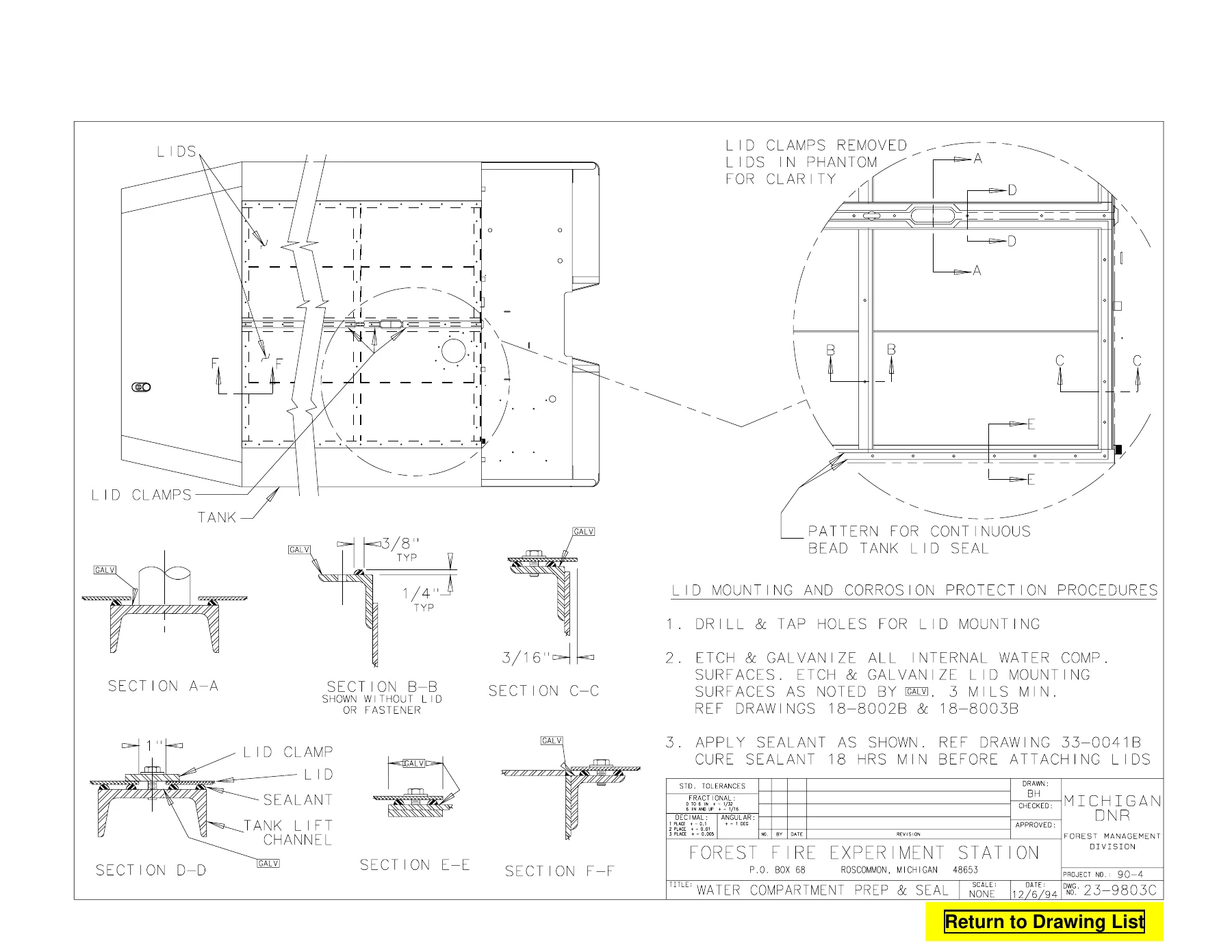
Taken as a whole, this document gives a fabricator or fire department workshop everything needed to plan and build a military 6×6 fire engine rather than simply describing one. The tank packets carry complete weldment and subassembly drawings, material specifications, estimated weights and part numbers, while the shared parts packet supplies the details that are identical whether the builder is working on a 2.5-ton or a 5-ton chassis. The frame extension drawings show how to lengthen the truck frame to carry the rear of the tank and its accessories, the mounting plates, hardwood sill strips and Grade 8 fastening method are all documented, and the brush protection packets describe the bumper, fuel tank guards, fender guards, grill guard and limb risers that protect sheet metal and radiator during off-road use. Supporting information on GVWR, axle ratings and required highway lighting means the finished truck is not just built but built within its safe operating limits.
Water Tank Design for 2.5-Ton and 5-Ton Chassis
The heart of the 6×6 Wildland Fire Engines Project 63 material is the unitized steel water tank design. The 2.5-ton tank is rated at 900 gallons nominal, weighs approximately 3,350 lbs without water or accessories, and measures 33 inches above the truck frame, 90 inches wide and 160 3/4 inches long, with 84 inches from cab to the centerline of the tandem axle. The 5-ton tank is rated at 1,400 gallons nominal, weighs approximately 3,750 lbs without water or accessories, and measures 36 inches above the truck frame, 96 inches wide and 166 3/4 inches long, again with 84 inches from cab to the centerline of the tandem axle. Both are built primarily from 7 gauge pickled and oiled carbon steel with various structural steel shapes and aluminum lids, assembled with a MIG welding system, and protected internally with a cold applied zinc galvanizing treatment. The documentation notes that with the internal galvanizing applied as depicted in the drawings, a minimum of 20 years of tank life without leakage can be expected, with 25 years normally achievable. The 900 gallon design suits the 154 inch wheelbase 2.5-ton trucks, while the 1,400 gallon design suits the 167 inch wheelbase 5-ton trucks.
M939 Series Evaluation and Payload Limits
Packet 63M939 adds an evaluation of the later M939 series 6×6, listing the model numbers in the series, the A1 and A2 design variants, and the differences from the earlier M809 units including the taller cab, full air brakes, automatic transmission, tilt forward hood, hydraulic winch and super single tires. It sets out the empty vehicle weights and published payload figures for each model, and reports the actual measured axle weights REC obtained from a stripped M931A2 truck tractor against its dash plate ratings. The conclusion is a practical one for buyers: the M939 series carries noticeably lower rated payload than the M39 and M809 series, front axle capacity is quickly used up, and any added equipment has to be placed on the rear axle set. The report states that while brush armor designed for earlier 6x6s does not appear to be an option on the M939, the tank design in Packet 63A-5 and the water handling examples in Packet 63B can be adapted with adjustments for the lower payload.
Protective Cabs, Brush Protection and Electrical Systems
Beyond the tank, the packet set covers the parts of a conversion that are easiest to get wrong. Packet 63E documents a fabricated steel protective cab top for the REO style 2.5-ton and 5-ton 6×6 cabs, built from three 11 gauge steel panels with 2 inch by 2 inch by 1/8 inch angle iron and two pieces of 1-1/4 inch by 1-1/4 inch by 1/8 inch angle iron, with two 90 degree bends of 2.5 inch radius near each end of each panel and an adjustable window jamb to absorb the loose manufacturing tolerances of the original trucks. Packet 63F-2 and Packet 63F-5 document the bumper, fuel tank guards, fender guards, grill guard and limb risers for the 2.5-ton and 5-ton trucks respectively, describing how the bumper replaces the original boxed section, how the fuel tank guards protect the tanks and air system from underside impact, and how the limb risers lift branches up and over the cab to protect mirrors, windshield and exhaust components. Packet 63D shows a telescoping light mast operated from the vehicle’s air brake system that raises the rotating beacon on the highway and lowers it beneath the cab profile in the woods, and Packet 63G-1 shows how to mount and drive a 12-volt alternator on a Cummins powered M809 series 6×6 so that radios, hose reel rewind motors and auxiliary pump engine starters can be run alongside the original 24-volt system.
What This Manual Lets You Do
The 6×6 Wildland Fire Engines Project 63 manual supports the full range of conversion work on a military 6×6: identifying which truck series and variant you have, judging whether a FEPP unit can safely carry the water load you want, building the tank and extending the frame to mount it, plumbing the tank to an auxiliary engine driven centrifugal pump, adding the filler port and strainer, fabricating a steel cab top to replace an unusable canvas canopy, and armoring the front end against brush. It also gives the weight and lighting information needed to keep the finished vehicle within its ratings on the highway, and the M939 evaluation helps an agency decide before acquisition whether a particular truck has the payload left for the job. Because the drawings are presented as fabrication specifications with part numbers, material callouts and estimated weights, they can be handed to a manufacturer, a technical school or used in your own shop for both bidding and construction.
Getting the tank capacity, mounting and payload right on a military 6×6 conversion is the difference between a fire engine that works for two decades and one that cracks a frame or overloads an axle on the first bad road. This manual supplies the original REC engineering behind the design – the axle ratings, the tank weights, the frame extension details and the fastening method – so the work is done to a proven specification instead of by guesswork.
IMAGES PREVIEW
Delivered as an instant PDF download after purchase, with no shipping and no waiting. Read it on a laptop or tablet in the shop, or print the drawing pages you need and take them to the bench.
Reviews
There are no reviews yet.