
Airbus A318 A319 A320 A321 Aircraft Recovery Manual ARM – PDF Download
Original price was: $39.95.$23.95Current price is: $23.95.
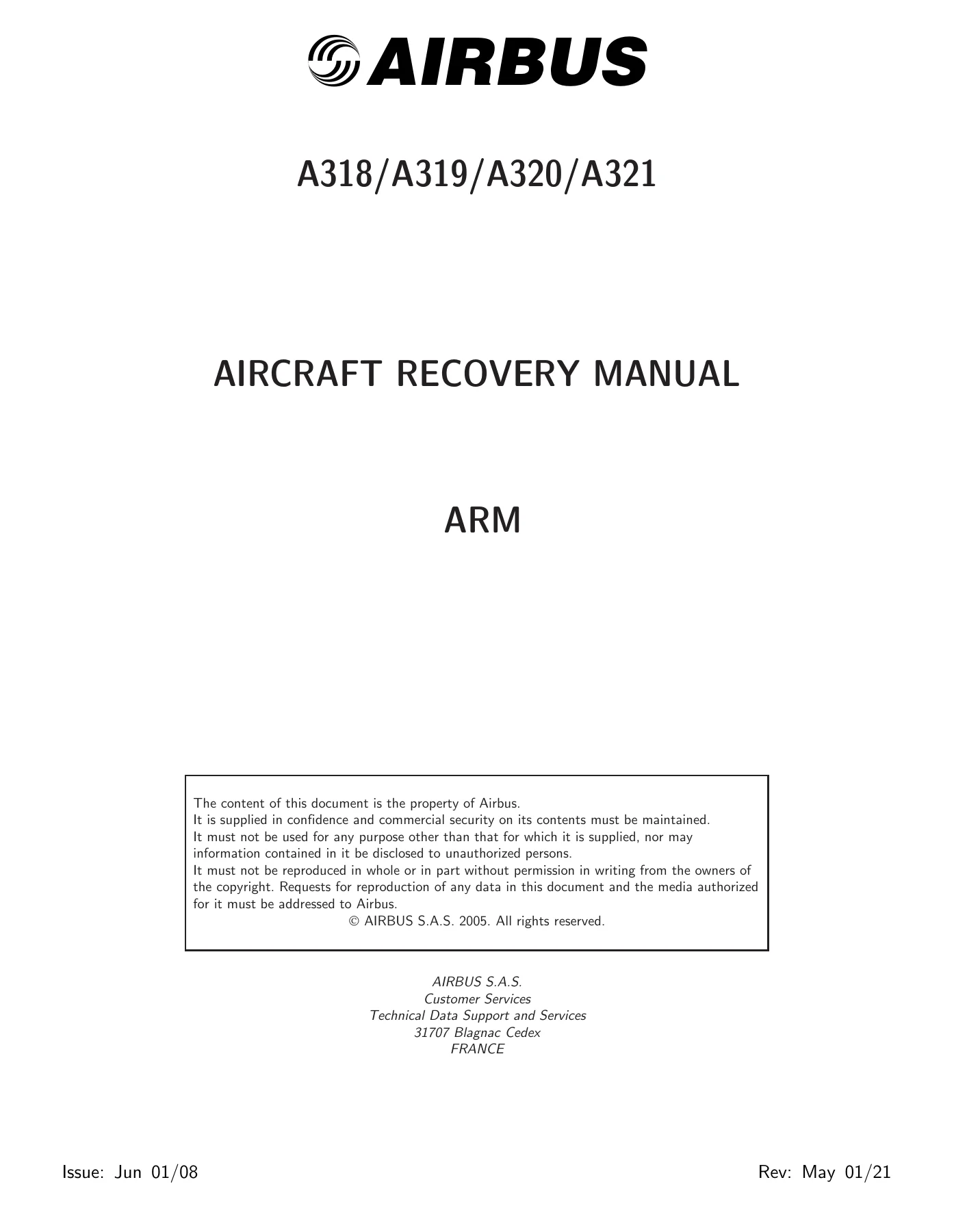
The complete Airbus A318/A319/A320/A321 Aircraft Recovery Manual (ARM) Revision 13, covering survey, weight and CG management, defueling, tethering, leveling and lifting, towing and moving damaged aircraft for the entire A320 family including neo variants.
Description
Airbus A318 A319 A320 A321 Aircraft Recovery Manual ARM
The Airbus A318 A319 A320 A321 Aircraft Recovery Manual is the official ARM document prepared by Airbus for recovery teams, maintenance engineers, and airport authorities. Revision 13 (May 01/21) covers the entire A320 family — A318-100, A319-100, A319neo, A320-200, A320neo, A321-100, A321-200, and A321neo — and gives you the complete procedure set for returning a disabled aircraft to a hard surface without causing secondary damage.
This ARM is built around the ATA iSpec 2200 format and is organized into nine chapters that move from initial survey through to post-recovery corrective actions. Every procedure, load limit, H-arm value, jacking point coordinate, and tethering configuration you need is documented in one PDF.
File Details
- Manual type: Aircraft Recovery Manual (ARM)
- Brand / Manufacturer: Airbus
- Models covered: A318-100, A319-100, A319neo, A320-200, A320neo, A321-100, A321-200, A321neo
- Engines referenced: CFM56, IAE V2500, PW 6000, PW 1100G, CFM LEAP-1A
- Language: English
- Page count: 784
- File format: PDF
- Revision: Revision No. 13 — May 01/21
- Format standard: ATA iSpec 2200
Chapters Covered
- Chapter 01 — Introduction
- General information, sequence of the document, definitions
- Related data, Airbus data references, other data sources
- General aircraft characteristics (weight variants, fuel capacity for all models)
- Chapter 02 — Survey
- Initial aircraft survey (damage inspection, fluid leaks, batteries, landing gear)
- Initial site survey (terrain, soil characteristics, access routes, weather)
- Landing gear survey and safety device installation
- Health and safety issues
- Chapter 03 — Weight and CG Management
- CG conversion principle (H-arm, Y-arm, %RC)
- Fuel load and CG control with curves for inner cell, outer cell, and center tank
- Manual fuel quantity indication using Magnetic Level Indicators (MLI)
- Managing aircraft weight and CG — cargo and baggage, traffic load, ballast, waste water, potable water, crew, catering, hydraulic fluids, large components removed or missing
- Reference for calculation — source data, OEW, DOW
- Chapter 04 — Preparation
- Stabilizing the aircraft
- Tethering the aircraft — mooring fittings, straps and cables, tether lines installation
- Ground anchors — commercial anchors, dead-man anchors, heavy vehicles
- Soil stability
- Manual operation of systems — flight controls, landing gears, cargo doors
- Chapter 05 — Weight Reduction
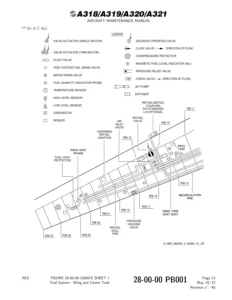
- Defueling — general preparation, fuel system description, tanks, fuel quantity indicating system
- Moving fuel for CG control
- Defuel scenarios — normal pressure defuel and drain remaining fuel
- Cargo removal
- Removal of large components
- Chapter 06 — Leveling and Lifting
- Load determination — vertical loads, side loads on jack fittings, arc movement calculation
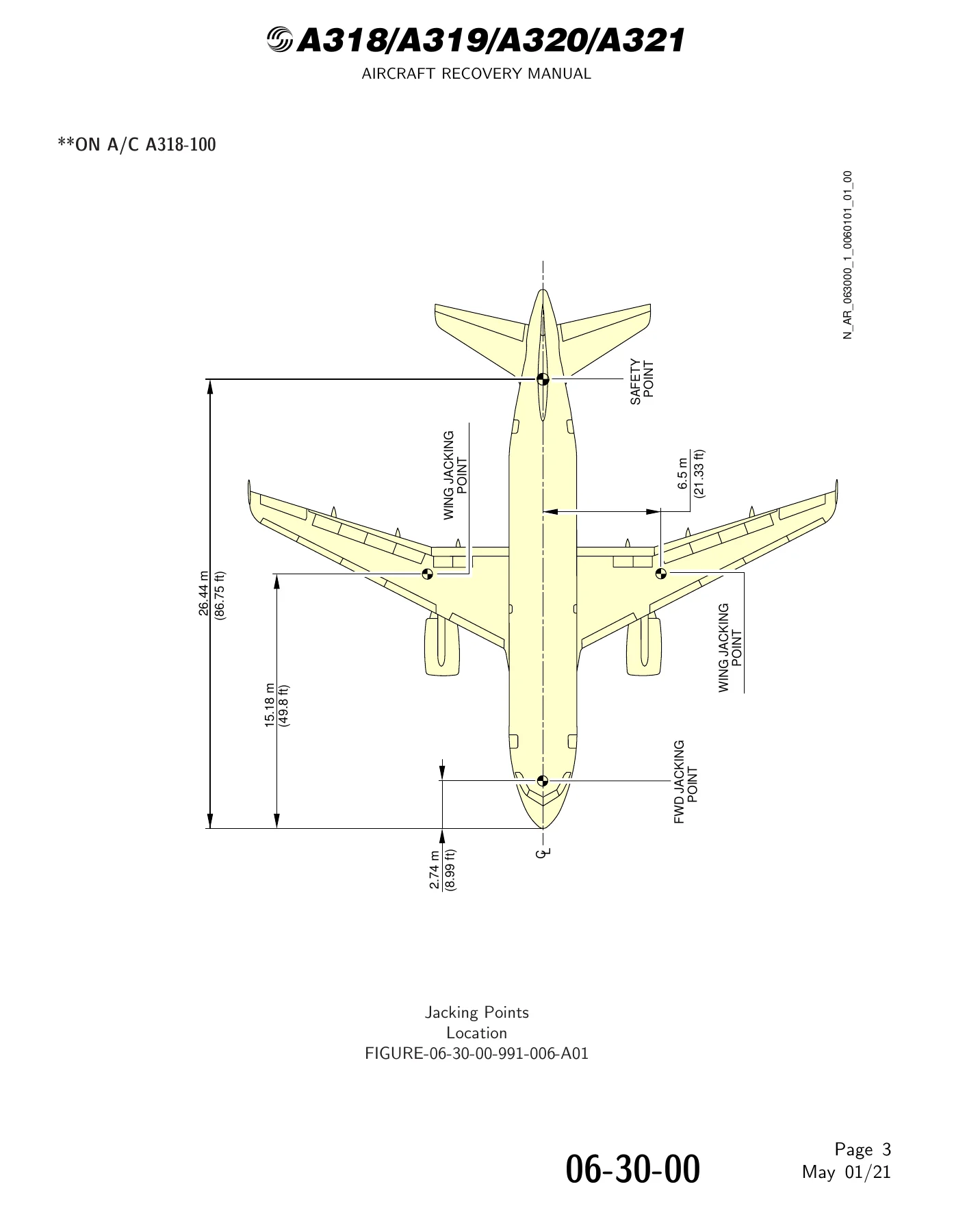
- Use of jacks — jacking points, types of jacks, allowable loads, procedures
- Use of pneumatic lifting bags — fuselage and wing bearing areas, allowable pressures
- Use of cranes — forward fuselage crane lifting with slings and fittings, wing rib attachment tool
- Leveling and lifting scenarios (Scenarios 1, 2.1, 2.2, 3, 4)
- Chapter 07 — Moving the Aircraft
- General preparation
- Preparing a roadway
- Towing and debogging — towing from NLG, towing from MLG, towing with deflated tires, towing load limits
- Moving damaged aircraft on trailers, with cranes, and with specialized equipment
- Chapter 08 — Post Recovery Corrective Actions
- Records, post-recovery inspections
- Chapter 09 — Appendix
- Units and conversions, glossary of terms, abbreviations, aircraft reference axes
- Aircraft dimensions, structural sections, composite materials, fuselage frames and H-arm table
- Wing ribs and stations, horizontal stabilizer ribs and stations
- Door sizes and locations, ground clearances, ground service connections, grounding points
- Cargo compartments, location of hazardous materials, landing gears
- Recovery preparation — quick reference data, recovery team composition
- Tooling and equipment — Airbus specific recovery tools, IATP aircraft recovery kits
- Calculation worksheets — interim worksheets and NRW & related H & Y moment worksheets
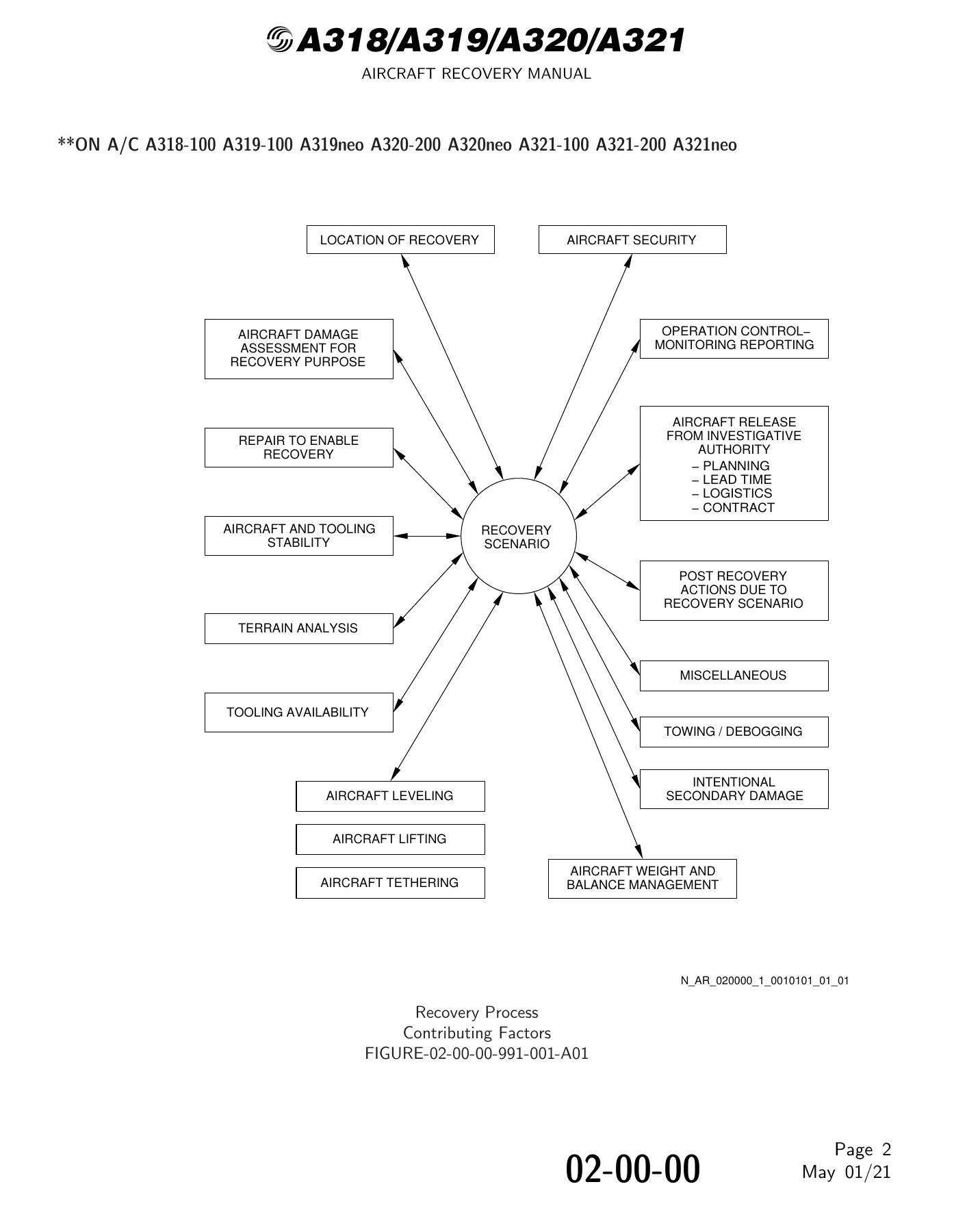
This Airbus Aircraft Recovery Manual gives a recovery team the full framework for a coordinated operation. Chapter 02 walks through the initial survey, landing gear inspection, and site assessment, so you can judge stability and ground conditions before anyone goes under the aircraft. Chapter 03 handles weight and CG — including the H-arm and Y-arm moment worksheets that feed into every lift calculation. Chapter 06 is the core of the document: it covers jacks, pneumatic lifting bags, and cranes, and then applies them across five defined recovery scenarios (NLG unserviceable, one MLG unserviceable, one MLG unserviceable with one missing, NLG and one MLG unserviceable, and both MLGs unserviceable). For each scenario the manual gives aircraft attitude data, theoretical point-of-contact coordinates, leveling and lifting clearances, and arc movement figures.
The towing and debogging chapter covers NLG towing with a towbar and with a towbarless tractor, MLG towing from the front and rear, and towing with deflated tires, with load and angle limits for each. Chapter 09 contains the reference data you will keep coming back to: fuselage frame H-arm tables, wing rib stations, door clearances, ground clearances, hazardous material locations, jacking point coordinates, allowable jack loads, and the IATP recovery kit contents.
What This Manual Enables You to Do
With the Airbus A318 A319 A320 A321 Aircraft Recovery Manual, you can calculate the Net Recoverable Weight and CG position for a disabled aircraft, determine the correct jacking points and allowable loads, select the right leveling and lifting method for the aircraft’s attitude, plan a defueling or fuel transfer operation, install tethering and mooring fittings correctly, prepare a roadway for towing, and execute the towing or debogging procedure within the aircraft’s structural limits. The manual also gives you the post-recovery inspection and recording requirements that support a return-to-service decision.
Recovery work is unforgiving — a wrong jacking load, an ignored arc movement, or a missing safety device can turn a repairable aircraft into a write-off, or worse, put the recovery team at risk. The ARM gives you the actual allowable loads, the actual tethering positions, and the actual step-by-step procedures, so every action stays within the aircraft’s structural limits.
Delivery
IMAGES PREVIEW
This Airbus Aircraft Recovery Manual is delivered as an instant PDF download. There is no shipping, no waiting for a physical copy, and no regional restriction. The file works on any device — desktop, laptop, tablet, or phone — and every page is printable for use in the field or in the hangar. Once payment is confirmed, the download link is available immediately.
Reviews
There are no reviews yet.