
Basic Aircraft Maintenance Training Handbook Module 21 – Maintenance Management PDF
Original price was: $34.95.$21.95Current price is: $21.95.
329-page training handbook covering aircraft maintenance management: maintenance philosophies, MSG-2 and MSG-3 programme development, M&E organisation, inspection, planning, materiel support, reliability, MMEL/MEL, ETOPS, test flight requirements and maintenance safety.
Description
Basic Aircraft Maintenance Training Handbook Module 21 – Maintenance Management
This Basic Aircraft Maintenance Training Handbook Module 21 covers Maintenance Management in full – the planning, organisational, reliability, inspection and safety disciplines that sit behind every airworthy departure. Issued as manual BCT-0012/A21 in the Electrical Avionics training series, Rev. 0 dated Aug 19, 2015, the handbook runs 329 pages across twelve teaching modules. It is written for trainee and working aircraft maintenance personnel studying towards Category A, B1, B2 or C licence knowledge levels, and it restates those level indicators (1, 2 and 3) at the head of every module so the reader knows exactly how deep each subject is expected to go.
Because this is a training handbook rather than a type-specific maintenance manual, the material is not tied to one airframe or engine. It teaches the maintenance management system itself – the philosophies, documents, organisations and control processes an operator applies whatever fleet it flies. Nothing in the book is model-locked, so the same explanation of a C check, a reliability alert level or an MEL repair interval category applies to a narrow-body twin or a wide-body long-haul aircraft alike.
File Details
- Manual type: Basic aircraft maintenance training handbook
- Module: 21 – Maintenance Management
- Manual number: BCT-0012/A21 (Electrical Avionics series)
- Revision: Rev. 0, Aug 19, 2015
- Language: English
- Page count: 329 pages
- File format: PDF
- Knowledge levels addressed: Category A, B1, B2 and C licence indicators (Levels 1, 2 and 3)
Chapters Covered
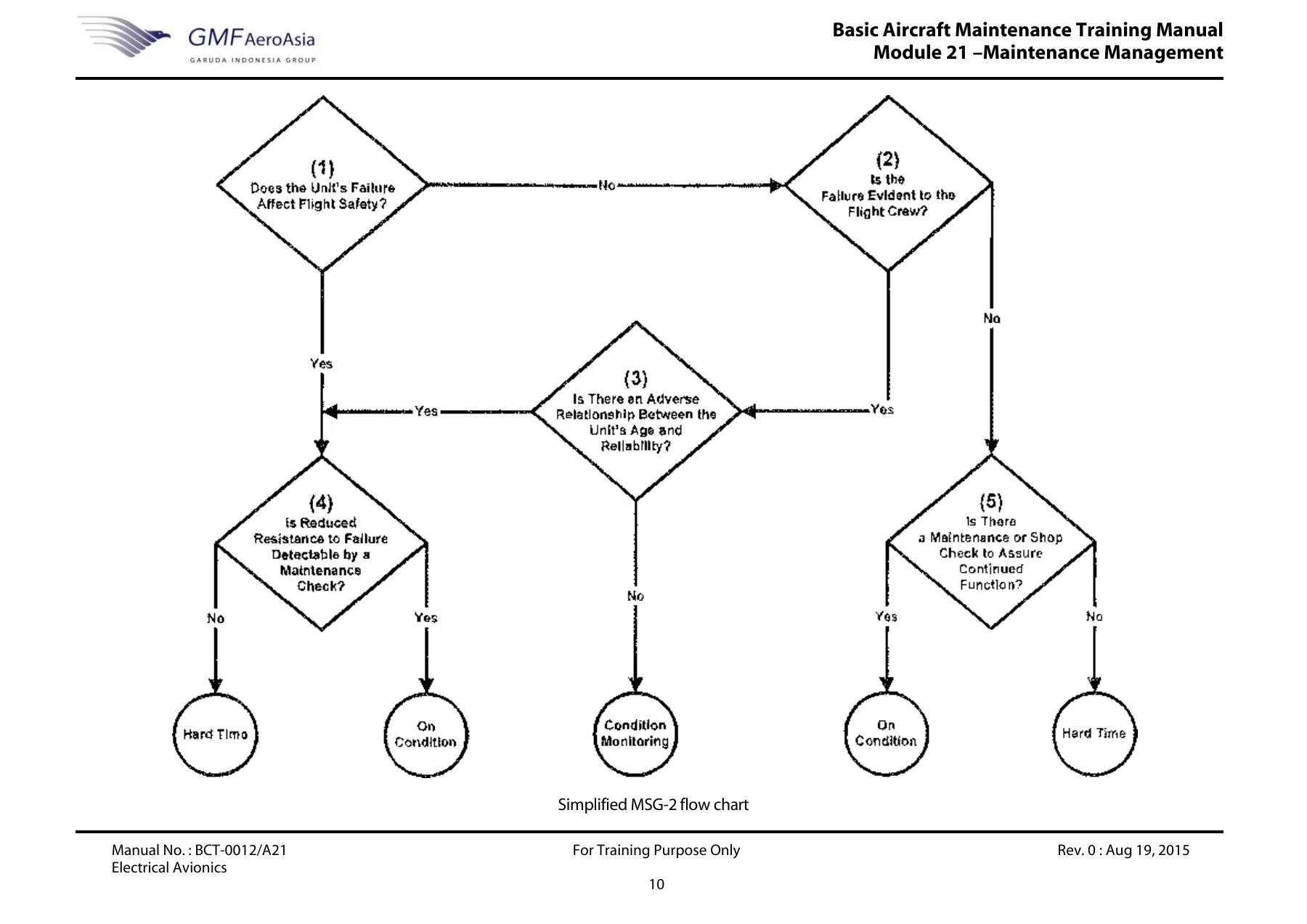
- 21.1 Maintenance Philosophies and Concepts – why maintenance is performed; line, base, minor, intermediate and heavy maintenance definitions; the process-oriented approach using hard time, on-condition and condition monitoring; the task-oriented approach; MSG, MSG-2 and EMSG development; MSG-3 and its airframe system, structural and zonal tasks; the simplified MSG-2 decision flow; MRBR and MPD/OAMP documents; daily, 48-hour, hourly and operating-cycle limit checks; letter checks; changing basic maintenance intervals; reliability and maintainability.
- 21.2 The Maintenance and Engineering Organization – organisation of maintenance and engineering; span of control; grouping of similar functions; separation of production from oversight; the M&E organisational chart; technical services, aircraft maintenance, overhaul shops, materiel and maintenance programme evaluation directorates; small and large airline variations.
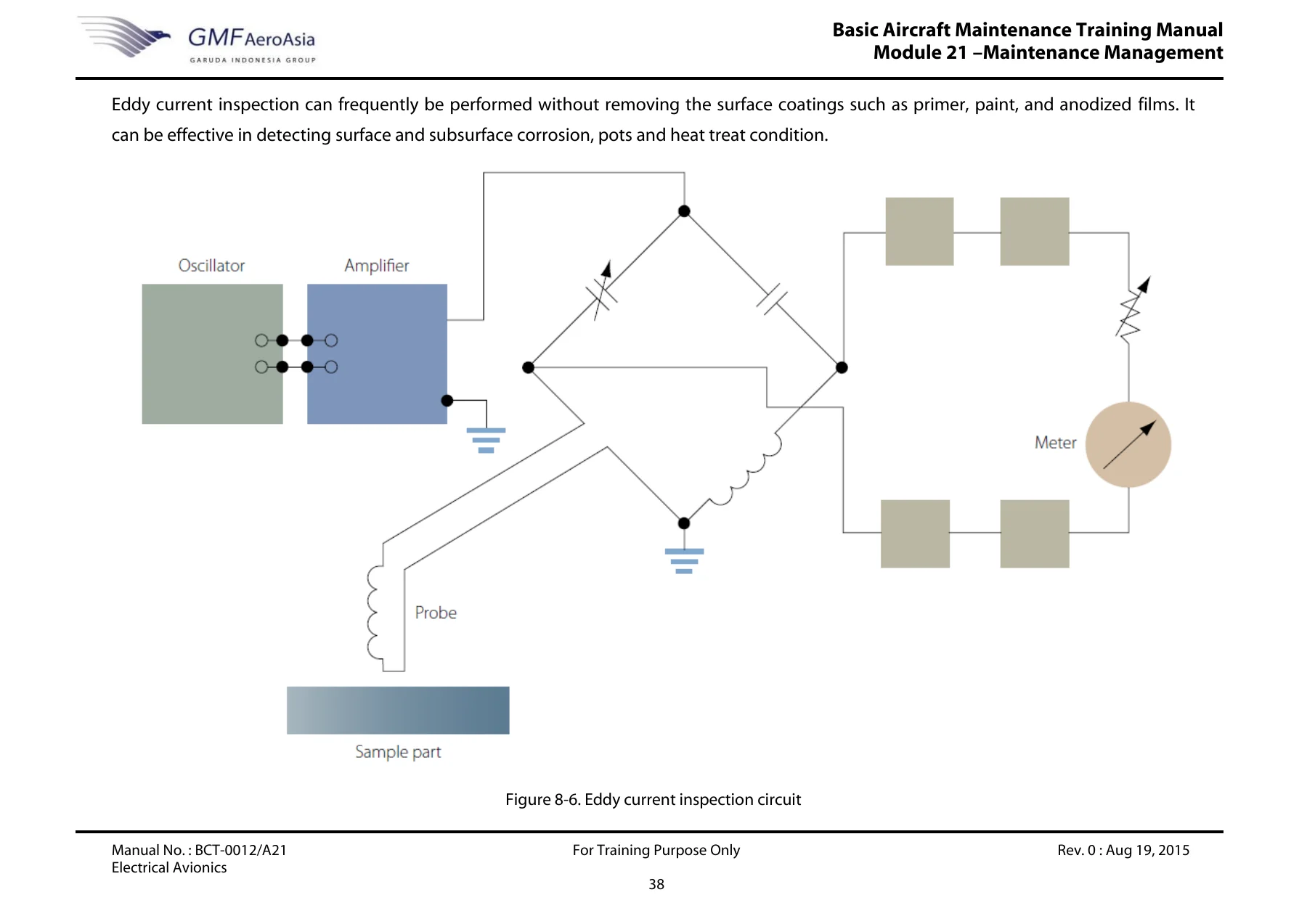
- 21.3 The Basic Inspection – inspection techniques and preparation; aircraft logs; checklists; publications including service bulletins, maintenance, overhaul and structural repair manuals, illustrated parts catalogues, CFRs, airworthiness directives and type certificate data sheets; routine and required inspections; annual and 100-hour inspections; progressive and continuous inspection programmes; altimeter and transponder checks; ATA iSpec 2200 and ATA 100 system numbering; special inspections; special flight permits; nondestructive inspection and testing; composite and weld inspection.
- 21.4 Maintenance Planning – production planning and control objectives; the planning and control philosophy; major principles in planning; production forecasting; production methods and standards; manpower, material and ground facilities planning; production scheduling and control; production performance analysis; budgeting and cost control.
- 21.5 Materiel Support – organisation and function of materiel; inventory control, stores, purchasing and shipping and receiving; parts ordering, storage, issue, control and handling; kits and flyaway kits; time-limited parts tracking; quarantine areas; exchanges, warranty and modification of parts; shelf life; stock level adjustment; obsolete and bogus parts.
- 21.6 Maintenance Schedule and Control – production forecasting; aircraft routing and its primary and secondary factors; production scheduling and control; work packaging; work card and job card concepts; work balancing; work card review.
- 21.7 Aircraft Production Management – aircraft maintenance management structure; line maintenance on-aircraft; flight turnaround and overnight services; base service manpower planning; base maintenance work flow across pre-service, in-service and post-service tasks; hangar maintenance organisation and its problem areas; support and overhaul shops; ground support equipment.
- 21.8 Reliability – statistical, historical, event-oriented and dispatch reliability; the seven elements of a reliability programme; data collection and data display; problem detection and alerting systems; setting and reading alert status; corrective action and follow-up analysis; the monthly reliability report; the Maintenance Program Review Board; FAA interaction.
- 21.9 Master Minimum Equipment List – MMEL philosophy and development; level of safety and methods of justification; source and third-country MMELs; MMEL format, page format and procedures; MEL purpose, definition, intent and limitation; MEL development, approval, amendment, audit and distribution; repair interval categories A, B, C and D; deferral of items; placarding; dispatch; training; MELs for leased aircraft.
- 21.10 Extended Range Operations (ETOPS) for Basic – background and deviation from the 60-minute rule; equipment modification and the CMP standard; flight operations requirements; the ETOPS supplemental maintenance programme; ETOPS versus conventional maintenance; ETOPS for non-ETOPS aeroplanes; polar operations.
- 21.11 Test Flight Requirements – civil and military flight test programmes; preparation, execution and analysis and reporting; test points, test cards and instrumentation; reduction of flight performance to standard conditions; performance charts for the operating data manual; the flight test team.
- 21.12 Maintenance Safety – industrial safety and OSHA standards; safety regulations and material safety data sheets; the maintenance safety programme; general responsibilities for safety; general safety rules covering smoking, fire prevention, hangar deluge systems and fall prevention; accident and injury reporting.
Read end to end, the handbook walks a technician from the reason maintenance exists at all, through how a maintenance programme is built and justified, into how an organisation is structured to deliver it, and finally into the specific control documents – task cards, work packages, reliability reports, MELs – that turn the programme into daily work. The inspection module alone runs from preflight walk-arounds to radiography, magnetic particle and ultrasonic testing, with the practical steps, indication interpretation and false-indication warnings set out for each method. The reliability and MMEL modules explain the mathematics and the legal framework behind deferring an item or extending an interval, which is the part of maintenance management most often misunderstood on the hangar floor.
Who This Handbook Suits
The twelve-module structure maps directly onto licence category knowledge requirements, so it works as a study text for candidates preparing for Category A, B1, B2 or C assessment. It is equally useful as a reference for planners, reliability analysts, stores and materiel staff, quality assurance auditors and line or hangar supervisors who need the management-side context for the work they control. Training departments and maintenance organisations that induct new staff into an existing MRO system will find the organisational, planning and materiel modules a ready-made orientation text.
What You Can Do With It
The handbook supports the work of building and defending a maintenance programme: understanding how MSG-3 analysis assigns lubrication, servicing, inspection, functional check, operational check, visual check, restoration and discard tasks; how maintenance intervals are set and changed with supporting data; how a maintenance and engineering department is divided so that production and oversight stay separate; how parts are provisioned, stored, issued and tracked through repair and warranty; and how a reliability programme collects data, sets alert levels and drives corrective action. On the inspection side it supports preparation of checklists, review of aircraft logs, interpretation of airworthiness directives and type certificate data sheets, and selection of the correct NDT method for a given defect and material. On the airworthiness side it explains how an MMEL becomes an operator MEL, what the A, B, C and D repair interval categories mean in calendar days, and when the ETOPS supplemental maintenance items such as oil consumption monitoring and engine condition monitoring apply.
Working from the correct procedures and the correct management framework is what keeps an aircraft legally dispatchable and physically safe. A deferred item signed off against the wrong repair interval category, an inspection interval changed without supporting reliability data, or a maintenance task assigned to the wrong process are the kinds of errors this handbook is built to prevent.
IMAGES PREVIEW
Instant PDF Delivery
The Basic Aircraft Maintenance Training Handbook Module 21 – Maintenance Management is supplied as a PDF for immediate download once payment is complete. There is no shipping and nothing to wait for. Read it on a laptop, tablet or phone, print the modules you need for the training room or the office wall, and keep the full 329-page reference on hand whenever a maintenance management question comes up.
Reviews
There are no reviews yet.