
Bauer K100 to K28 Compressor Blocks Workshop Manual PDF
Original price was: $29.95.$16.95Current price is: $16.95.
January 2003 BAUER Kompressoren workshop manual for K100 to K28 compressor blocks, covering valve service by stage, blow-by wear checks, piston and cylinder work, oil fill quantities, condensate drains, and pressure maintaining valves.
Description
Bauer K100 to K28 Compressor Blocks Workshop Manual PDF
This Bauer K100 to K28 Compressor Blocks Workshop Manual PDF is the January 2003 shop edition issued by BAUER Kompressoren GmbH in Munich for service and repair shops. It walks trained technicians through dismantling, inspection, adjustment, and reassembly of compressor blocks in the K100 to K28 family. Basic trade steps are omitted on purpose. For routine running and model-specific operation, the matching unit operating manual still applies. The preface also states that Varius, Purus, Utilus 10, Junior, and Oceanus scuba diving compressors are covered in a separate workshop manual, not in this block book.
File Details
- Manual type: Workshop manual for compressor blocks
- Brand / series: BAUER Kompressoren, K100 to K28 compressor blocks
- Language: English
- Page count: 114
- File format: PDF
- Edition: January 2003 basic edition (change notice 0)
- Publisher: BAUER Kompressoren GmbH, Technical Service / Technical Documentation, Munich
Who This Manual Is For
The text is written for shops that already know high-pressure compressor practice. Spare-part orders need type, serial number, and year of manufacture from the identification plate or the block number stamped in the crankcase. Safety notes require a full shutdown and depressurization, electrical isolation, no soldered or welded repairs on pressure lines, and no tightening of tube connectors under pressure. Condensate and used filter cartridges contain oil and must be disposed of under local rules.
Chapters Covered
- Preface — shop scope, liability note, excluded scuba models, January 2003 construction state
- Important notes — safety, spare-part data, environmental disposal, change notice and Munich contact numbers
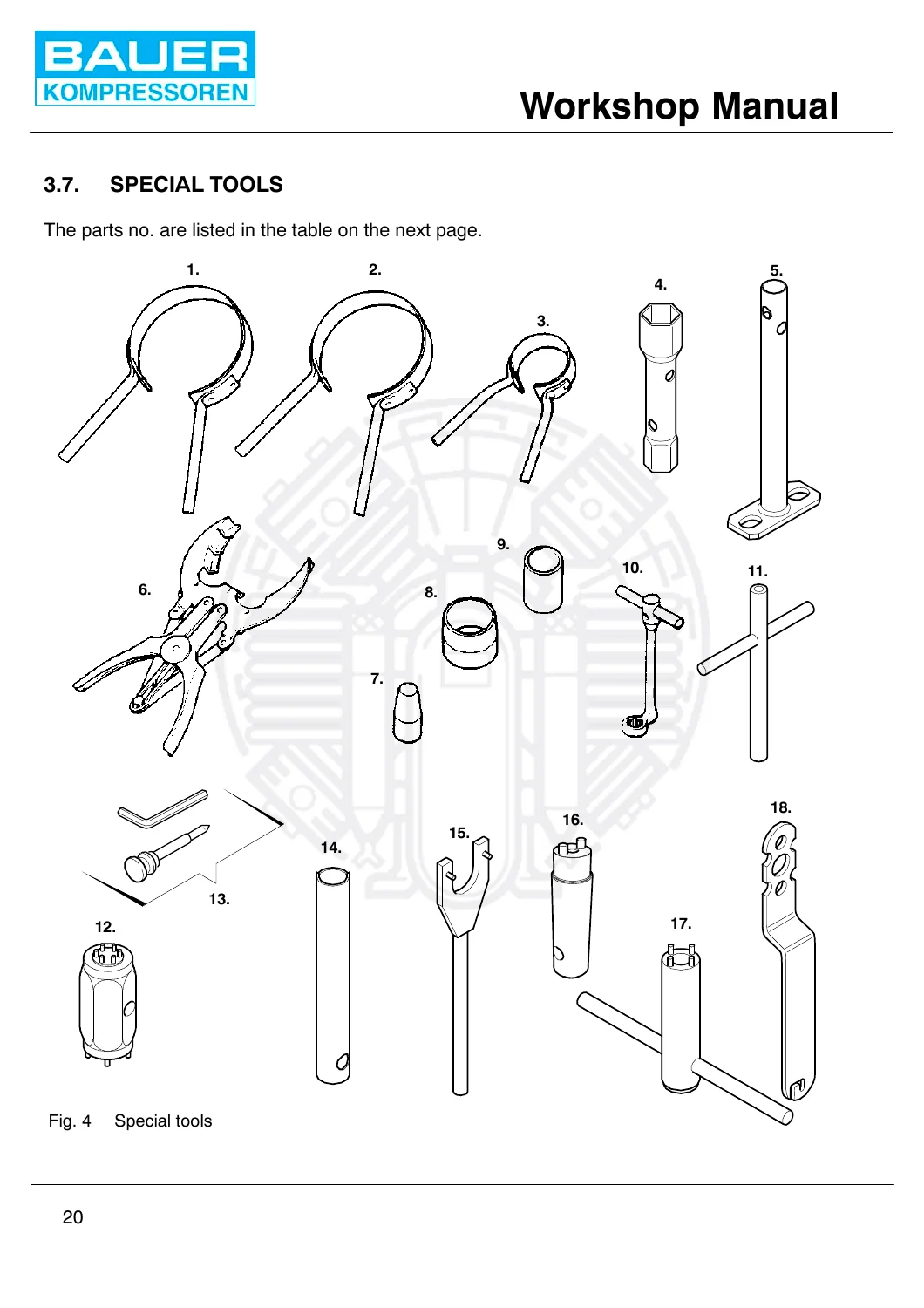
- Tables — standard and special torque values; stepped-piston antifatigue bolt torques; Taper-Lock bushing stud torques; valve-head and cylinder torque sequence; compression-fitting tube assembly; lubrication chart; adhesive and sealant chart; leak-test spray; special tools with part numbers
- Valves — wear factors, cleaning and replacement rules, 1000-hour inspection / 2000-hour replacement intervals (2000 / 4000 h on CNG plants)
- Compressor blocks IK100 II, IK120 II, BK12.2 II, U/C/M II — 1st through 3rd stage intake and pressure valve service
- Compressor block IK12.14 II — combined 1st-stage plate valve plus 2nd and 3rd stage valve work
- Compressor blocks IK150 mod. 9 and IK180 mod. 4 — stage valve heads, covers, and gaskets
- Compressor block IK18.1 — 1st and 2nd stage valves, 4th/5th stage pressure valve removal
- Compressor blocks IK150 II mod. 10, IK15.1 II mod. 11, IK15.11 II mod. 1, IK180 II mod. 5, IK18.1 II mod. 4
- Compressor blocks K22, K23, K25, K28 — multi-stage valve heads on vertical and stepped cylinders
- Compressor blocks IK22.2, IK22.5, IK23.4, IK25.4, IK28.2, IK25.5, IK28.3
- Wear assessment of piston rings, pistons and cylinders — blow-by definition, 4000-hour check (8000 h CNG), flowmeter procedure at 200 bar, model blow-by table
- Cylinders and pistons — ring orientation on stepped pistons, wear signs, ring-gap limits by cylinder diameter, mounting rules
- Oil quantities — max / min / top-up and filter volumes by compressor model
- Condensate valves — normally open and normally closed drain valves, 500-hour function check, 1000-hour inner-part kits
- Pressure maintaining valves — opening-pressure tables for medium- and high-pressure units, Types 1–4 adjustment, part-number list
- Lubricating oil list — approved synthetic and mineral oils, application codes, change intervals, change-over caution
Taken as a whole, the Bauer K100 to K28 compressor blocks workshop manual is a block-overhaul companion: it tells a technician how to pull and seat intake and discharge valves stage by stage, how to judge ring and liner wear without guessing, how much oil a given crankcase holds, and how to service the drain and pressure-maintaining hardware that protect separators and final-stage pistons.
Torque, Fasteners and Shop Tables
Unless a procedure gives a different figure, hex and Allen fasteners are torqued greasy: M6 10 Nm, M8 25 Nm (final-pressure safety-valve mounting bolts 10 Nm), M10 45 Nm, M12 75 Nm, M14 120 Nm, M16 200 Nm. Special figures cover intake valve 07790 (M14x1, 30 Nm), intake fitting 12841 and pressure fitting 14124 (M28x1.5), and studs from M8x1 through M14. Stepped-piston antifatigue bolts are listed for K12.14, K22.0, K23.0 / IK23.4, K25.0, K25.5, K28.3, K25.9 and K25.18. Taper-Lock bushing studs run from 5 Nm on 1008/1108 sizes up to 70 Nm on 3020/3030, with a drop of medium threadlocker recommended. Valve-head and cylinder fasteners are pulled evenly in the printed 4-bolt or 6-bolt star pattern, and only when the metal is cold to hand-warm.
Compression olive fittings get a right-angle cut, deburr, lubricant on thread and olive (example N19753), finger-tight start, then 1 to 1 1/4 turns to form the collar. Final make-up is finger-tight plus about half a turn; nut, olive, tube and connector stay a matched set. The lubrication chart names WEICON WP 300 WHITE or BAUER P/N 072500 for rubber, plastic and filter threads, Klüber SK 01-205 on the shaft side of shaft seals, and copper or MoS2 anti-seize on screws. Sealants include Loctite 2701 on screws and studs, Loctite 243 on conical threads, WACKER E10 on high-temperature metal joints, and Loctite FAG 2 on paper gaskets. Leakage test spray FM0089 is specified for tubing.
Valve Service Across the K100 to K28 Blocks
Chapter 4 is the core of this Bauer K100 to K28 Compressor Blocks Workshop Manual PDF. Valves are replaced as complete sets. Dirty plates are soaked in diesel or petroleum and brushed; ultrasonic cleaning is preferred. Copper gasket lands are coated with high-temperature compound N19753. Dented seats or disks mean a new valve. After any valve job the flywheel is turned by hand. Studs and cap nuts are retightened after a 30-minute cool-down from the first restart, then pressure bolts and caps again after three operating hours so gaskets can settle. Intermediate pressures are the functional check. Inspection is every 1000 operating hours (2000 h CNG); replacement every 2000 hours (4000 h CNG) to limit fatigue failure.
Procedures are split by block. On IK100 II the 1st-stage head uses a cap nut, stud, screw-in plug and plate intake valve. IK120 II combines intake and pressure in one plate valve under the head, with a marked intake and pressure side. Second-stage work on IK100 / IK120 / BK12.2 II uses special tool 4555-645 to unscrew the intake body; the aluminium head is then peened in two places to lock the thread. Third-stage pressure valves lift out of the head with O-ring seals. Later chapters cover IK12.14 II manifolds, IK150 / IK180 valve covers, IK18.1 combined heads, the II-mod. 10/11/1/5/4 family, then the larger K22, K23, K25 and K28 layouts including 4th and 5th stage pressure-valve extraction. IK22.2 through IK28.3 add horizontal first-stage cylinders and stepped 2nd/3rd stage barrels.
Blow-By, Rings, Cylinders and Oil
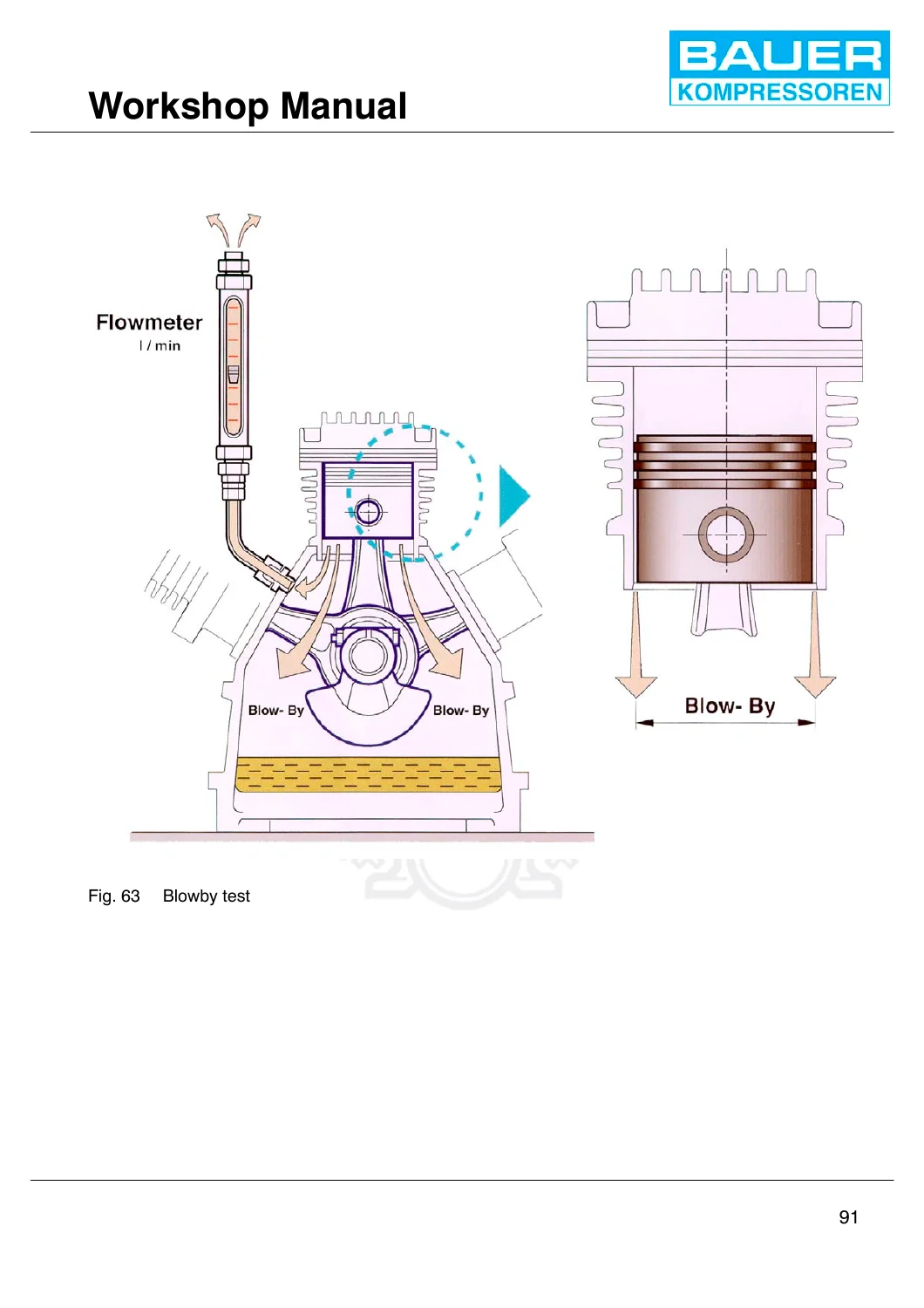
After about 4000 hours (8000 on CNG stations) pistons and cylinders are judged with a blow-by test before any teardown. Leakage from the compression chambers into the crankcase is read in l/min at the crankcase vent with 200 bar ±10% on the pressure maintaining valve after a 15-minute warm-up and a two-minute measurement. If the block reading is high, stages are isolated from the last stage forward (one-third, one-quarter or one-fifth of the table value). The blow-by table lists standard and maximum flows for K100, IK100 II, K120, IK120 II, IK12.14 II, K15 / K150 / IK150 II, K180 / IK180 II, K18.1 / IK18.1 II and several other construction states at 20 °C ambient. Above the maximum, rings on all stages are renewed and, if needed, cylinders plus the last-stage free-floating piston.
IMAGES PREVIEW
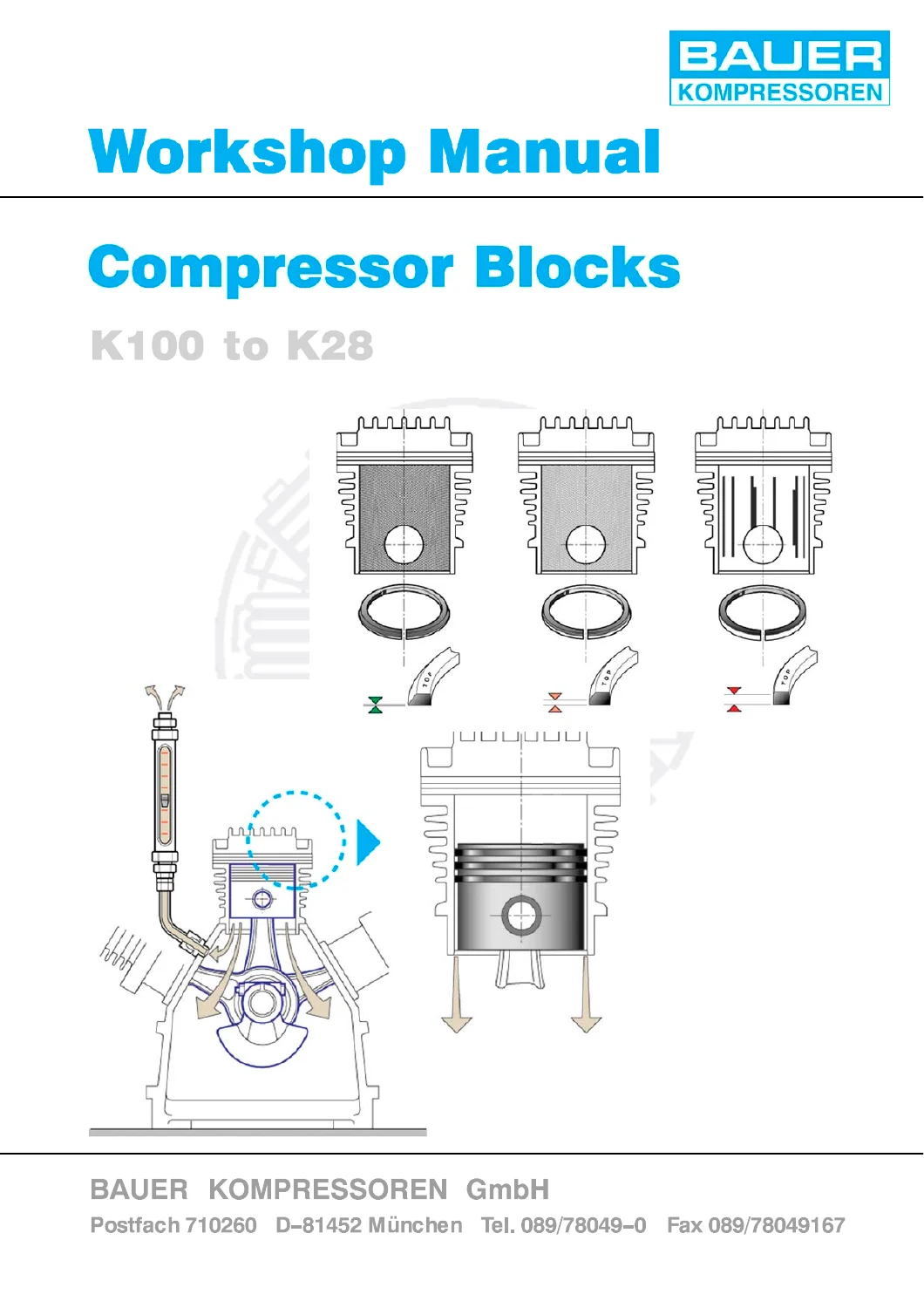
Ring TOP marks face the compression chamber; lower tapered rings on stepped pistons are the exception and sit TOP-down. Wear signs include scratches, silvery toeing on tapers, lost thickness, gummed grooves, ground ends and broken rings. Cylinders fail on grooves deeper than 0.1 mm, seizure marks, cracks, damaged threads or a vanished hone. A feeler-gauge gap check 10 mm down the bore is only a secondary test; limits run from 1.35–1.60 mm on 215 mm bores down to 0.30–0.35 mm on 16 mm bores. Rings go on as a set, gaps 180° apart, well oiled, using the listed piston-ring bands and pliers.
Oil quantity tables give max, min, top-up and filter volumes from the small IK100 / IK120 cases (2.80–2.90 l max) through IK22 / IK23 fills up to the 34.00 l max / 25.00 l min charge on IK25 and IK28 blocks. Exact level is confirmed on the dipstick or sight glass. The appended lubricating oil list authorizes BAUER special oils N28355, N22138 and N26303 plus Mobil Rarus 829 for breathing-air, nitrox, industrial, gas and CNG duty, with mineral changes at 1000 hours or annually and synthetic changes at 2000 hours or every two years.
Condensate Drains and Pressure Maintaining Valves
Automatic condensate drains are checked at least every 500 operating hours and internally serviced every 1000 hours or two years. Exploded views cover normally open and normally closed solenoid valves: coil, piston, seats and O-rings come out for ultrasonic cleaning or a maintenance kit. After assembly, Δp and drain interval / drain time are reset; final separators are guided to a Δp of at most 50% of operating pressure.
Pressure maintaining valves are inspected on the same 500 / 1000-hour cadence. Medium-pressure opening settings range from 20 bar on a 30 bar unit to 55 bar on a 90 bar unit. High-pressure settings run from 100 bar on 150 bar units to 300 bar on 500 bar units; otherwise 60% of unit operating pressure is recommended. Type 1 suits units to 350 bar and 650 l/min, Type 2 to 350 bar and 3600 l/min, Type 3 to 500 bar and 650 l/min, and Type 4 to 90 bar and 7500 l/min. Clockwise adjustment raises opening pressure. A part list ties types to operating pressure and outlet size.
Get the Manual and Start the Repair
With the Bauer K100 to K28 Compressor Blocks Workshop Manual PDF a shop can change intake and pressure valves stage by stage, lock fasteners to the printed newton-metre values, run a 200 bar blow-by test before pulling cylinders, read ring-gap limits, fill crankcases to the listed litres, and overhaul condensate and pressure-maintaining valves without guessing. Those figures and sequences are what keep high-pressure blocks from leaking, running hot, or loosening after gasket set. After payment the file is delivered instantly as a PDF — no shipping wait — ready to open on any device and print at the bench for the next K100-to-K28 block job.

Reviews
There are no reviews yet.